

Floor Insulation in Orange, CA
Energy-Saving Floor Insulation for Orange, CA Homes — Licensed & Insured
Need floor insulation in Orange, CA? Next Level Insulation of Orange offers expert installation, spray foam & crawl space solutions. Call (714) 266-2070 for a free quote.
- Licensed & Insured
- Locally Owned & Operated
- Free Inspection & Estimate
Request Your
Free EstimateFloor insulation is the process of installing thermal and acoustic barrier materials beneath your living spaces — between floor joists, under subfloors, or within crawl spaces — to prevent conditioned air from escaping and outside temperatures from infiltrating your home. For homeowners in Orange, CA, proper floor insulation is not a luxury; it is a necessity driven by the region’s Mediterranean climate, aging housing stock, and wide daily temperature swings that can reach 30°F or more between sunrise and mid-afternoon.
At Next Level Insulation of Orange, our team specializes in floor insulation solutions designed specifically for the architectural styles and climate conditions found throughout Orange County. Whether your home sits on a raised foundation with an open crawl space, a post-and-beam structure built in the 1950s, or a newer slab-on-grade construction, we assess your unique situation and deliver insulation that measurably improves comfort, reduces energy bills, and protects your home’s structural integrity. Call us today at (714) 266-2070 to schedule your free assessment.
Understanding Floor Insulation in Orange, CA
Floor insulation refers to any material or system installed to create a thermal and moisture-resistant barrier at the base of a living area. The primary function is to slow the transfer of heat between conditioned indoor spaces and unconditioned areas below — whether that area is a vented crawl space, an unheated basement, a garage, or exposed outdoor air beneath a raised foundation.
The concept of floor insulation dates to early-20th-century building science, when engineers first quantified heat loss through building assemblies and began assigning R-values — a measure of thermal resistance — to construction materials. An R-value of R-19 to R-25 is generally recommended for floor assemblies in Climate Zone 3B, the designation assigned to most of Southern California including Orange County by the U.S. Department of Energy. Higher R-values are not always better if moisture management is overlooked, a nuance that matters greatly in Orange’s climate.
Orange, CA has a housing inventory that spans nearly a century of construction. Many neighborhoods contain homes built between the 1940s and 1970s under building codes that permitted — or even encouraged — vented crawl spaces with little to no insulation beneath the floor deck. These homes are the most common candidates for floor insulation upgrades. However, even homes built in the 1980s and 1990s often used fiberglass batts that have since compressed, absorbed moisture, or fallen away from their intended position between floor joists, rendering them largely ineffective.
Beyond thermal performance, floor insulation provides meaningful acoustic benefits — reducing the transmission of impact noise, footstep sounds, and vibrations through floor assemblies. In multi-story homes common in areas like the Old Towne Orange Historic District, this acoustic benefit significantly improves livability. Additionally, properly installed floor insulation reduces the likelihood of pipe condensation and freeze events during rare cold snaps, and it discourages the moisture conditions that allow mold, mildew, and wood-destroying organisms to proliferate beneath your home.
Modern floor insulation systems often combine multiple materials: rigid foam board for a continuous thermal break, spray polyurethane foam to seal air gaps, and batt insulation to fill joist cavities. Understanding which combination suits your home requires a professional assessment — and that is precisely where Next Level Insulation of Orange begins every project. Learn more about our related service: crawl space insulation in Orange, CA.
Why Floor Insulation Is Needed in Orange, CA
Orange County’s Climate Creates Year-Round Thermal Stress
Orange sits within NOAA Climate Zone 3B, a semi-arid Mediterranean climate characterized by mild, wet winters and hot, dry summers. Average high temperatures in July and August reach 90°F to 95°F, while overnight lows in December and January can drop to 40°F to 45°F. The daily temperature swing — often 25°F to 35°F — means the air beneath an uninsulated raised foundation fluctuates dramatically throughout a 24-hour period, driving heat into your home in summer and pulling warmth out in winter.
The Santa Ana wind events that sweep through the region — most intensely between October and March — compound this problem. During a typical Santa Ana event, relative humidity can drop below 5% while temperatures spike 10°F to 20°F above seasonal norms. The October 2017 and December 2017 Santa Ana events, for example, brought sustained winds exceeding 50 mph through the Tustin Hills and Santiago Canyon areas adjacent to Orange, rapidly desiccating wood framing and creating pressure differentials that drive outside air through every gap in an uninsulated floor assembly.
Soil Conditions and Moisture Migration
Orange County’s soils are predominantly expansive clay-based formations — particularly the Altamont and Nacimiento clay series identified by the USDA Web Soil Survey — that hold and release moisture seasonally. During Southern California’s wet season (November through March), these soils absorb significant rainfall. The average annual precipitation in Orange is approximately 14 inches, with most falling in concentrated storm events. As moisture releases from clay soils throughout spring and summer, vapor migrates upward into crawl spaces and beneath floor assemblies, elevating relative humidity levels to 70% or higher directly beneath uninsulated floors.
This moisture migration is a primary driver of the wood rot, mold growth, and pest infestations observed in older homes throughout neighborhoods like Palmyra, Eichler-era tracts near Serrano Heights, and properties in the Villa Park Road corridor. A properly installed vapor barrier combined with floor or crawl space insulation is the most effective countermeasure. See our related service: crawl space encapsulation in Orange, CA.
Aging Housing Stock and Code Evolution
A significant portion of Orange’s residential inventory — particularly in Old Towne, the Cypress Street Barrio, and the neighborhoods surrounding Chapman University — was constructed before California’s Title 24 energy codes took effect in 1978. Homes built prior to 1978 frequently have no floor insulation whatsoever. Even homes built in the 1980s under early Title 24 requirements used R-11 fiberglass batts that fall well short of today’s recommended R-19 minimum for floors over unconditioned spaces in Climate Zone 3B.
Energy audits conducted in Orange County have consistently shown that floor heat loss can account for 10% to 20% of total home energy loss in homes with raised foundations — a meaningful figure when cooling and heating costs are considered. Addressing floor insulation deficiencies delivers measurable returns, typically reducing HVAC energy consumption by 8% to 15% in older Orange-area homes.
Signs You Need Floor Insulation in Orange, CA
Comfort and Temperature Indicators
- Cold floors in winter mornings, particularly in bedrooms and living areas above crawl spaces
- Noticeably warm floors during summer afternoons in rooms over garages or unconditioned spaces
- Rooms that never reach the thermostat setpoint despite prolonged HVAC operation
- Drafts or air movement felt at floor level even with windows and doors closed
Energy and Utility Bill Indicators
- Unexplained spikes in electricity or gas bills compared to prior years
- HVAC system running continuously during mild 65°F–75°F weather
- Southern California Edison bills exceeding regional averages for comparable square footage
Moisture, Odor, and Structural Indicators
- Musty or earthy odors rising from floors or registers — a sign of moisture and potential mold beneath the floor deck
- Visible sagging, discolored, or fallen insulation batts when inspecting the crawl space
- Soft spots or minor deflection in wood subfloors indicating moisture-related deterioration
- Evidence of pest activity — droppings, tunneling, or damaged wood — in the crawl space area
Urgency Indicators
If you detect standing water in your crawl space, visible mold on floor joists, or structural compromise, treat the situation as urgent. Contact Next Level Insulation of Orange at (714) 266-2070 immediately, as moisture-related damage progresses rapidly during Orange’s warm, humid post-rain periods.
Our Floor Insulation Process in Orange, CA
Free On-Site Assessment (Day 1 — 1 to 2 Hours)
Our technician visits your property to conduct a thorough inspection of all floor assemblies, crawl spaces, and accessible subfloor areas. We use moisture meters, thermal imaging cameras, and visual inspection to identify existing insulation condition, air leakage pathways, moisture levels, and structural concerns specific to your home’s construction era and type. In Orange, we pay particular attention to raised-foundation homes common in Old Towne and the West Chapman Avenue corridor.
Detailed Scope and Proposal (Day 1 to Day 3)
Within 48 hours, we provide a written proposal outlining recommended R-values, materials, square footage, vapor control strategy, and total cost. We explain why each recommendation applies to your specific home and neighborhood conditions.
Existing Insulation Removal (Day of Installation — 2 to 4 Hours)
Where degraded, fallen, or contaminated insulation exists, our crew safely removes and bags it in compliance with California waste disposal regulations before new material is installed. Learn more about our insulation removal services in Orange, CA.
Air Sealing and Moisture Preparation (Day of Installation — 1 to 2 Hours)
We seal penetrations, gaps around pipes, and rim joist cavities using low-expansion foam and appropriate tape. In crawl spaces, we install or inspect the existing ground vapor barrier. Orange’s clay soils require a minimum 6-mil polyethylene vapor barrier — we often recommend 10-mil or reinforced barriers for added durability.
Insulation Installation (Day of Installation — 2 to 6 Hours)
Depending on the approved method — spray foam, blow-in, batt, or a hybrid approach — our certified installers apply insulation to achieve the target R-value throughout the floor assembly. All materials are installed in accordance with California’s Title 24 energy code requirements.
Quality Inspection and Verification (Day of Installation)
Upon completion, a lead technician walks the installation, checks coverage uniformity, verifies vapor barrier integrity, and photographs the completed work for your project file.
Final Walkthrough and Documentation (Day of Installation)
We review the completed project with you, provide care and maintenance guidelines, and deliver all documentation you may need for insurance purposes or future home sales in the Orange real estate market.
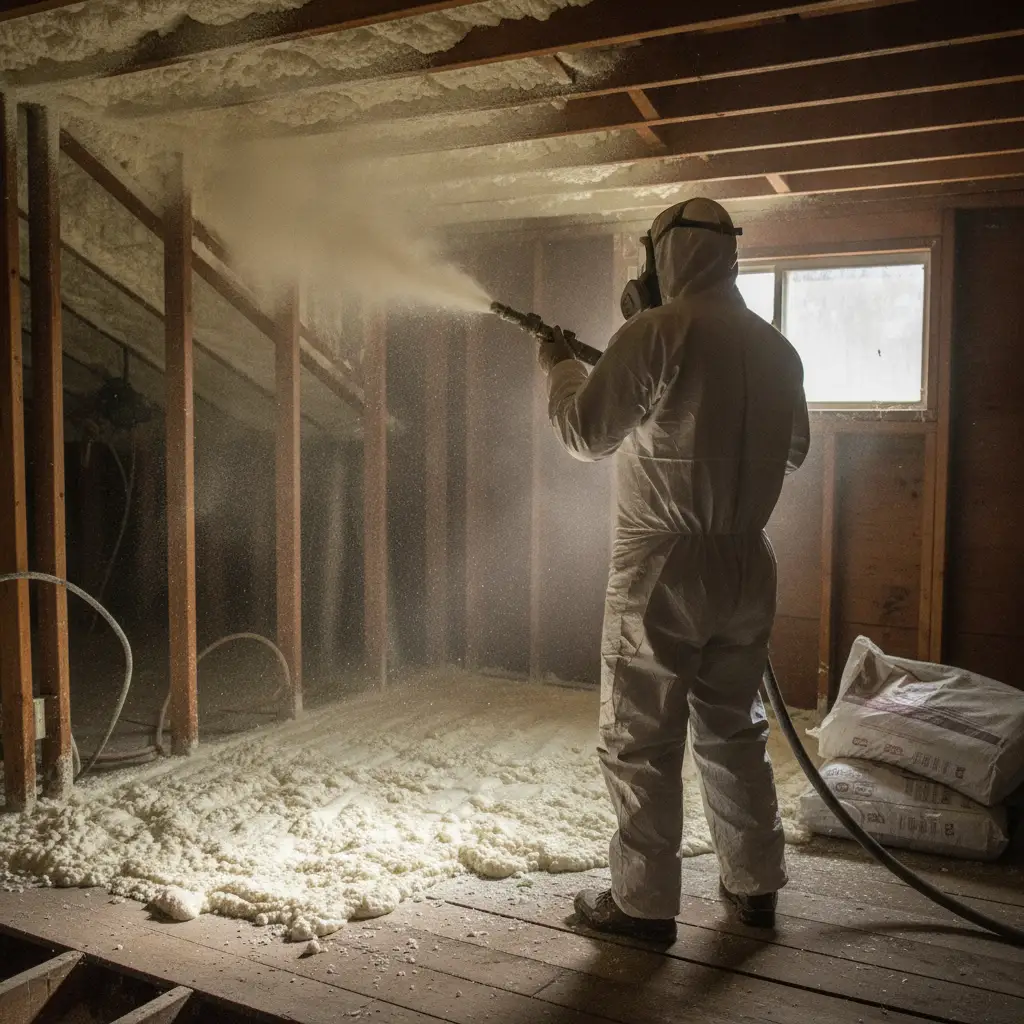
Our team in action — insulation professionals serving Orange
Floor Insulation Methods and Approaches for Orange, CA Homes
Spray Foam Insulation (Open-Cell and Closed-Cell)
Spray polyurethane foam is applied directly to the underside of the subfloor between joists. Closed-cell spray foam achieves R-6 to R-7 per inch and provides an integrated vapor retarder — an ideal choice for Orange homes in low-clearance crawl spaces where moisture management is a priority. Open-cell foam offers R-3.5 to R-3.7 per inch and superior sound attenuation. Learn more about spray foam insulation options.
Blown-In Insulation
Blown cellulose or blown fiberglass can be installed in floor cavities where access is limited or where a rapid, cost-effective upgrade is needed. Blown cellulose, with its natural moisture resistance and R-3.2 to R-3.8 per inch, performs well in Orange’s variable humidity environment. Explore blow-in insulation services.
Fiberglass Batt Insulation
Pre-cut fiberglass batts friction-fit between floor joists remain a widely used option for straightforward joist-cavity applications. R-19 or R-21 batts are the standard recommendation for floors in Orange County’s Climate Zone 3B. Proper installation with insulation supports or wire stays is essential to prevent the sagging failures common in older Orange homes.
Rigid Foam Board
Polyisocyanurate or extruded polystyrene (XPS) rigid foam panels are used to create a continuous thermal break on the underside of subfloors, particularly in homes where joist depth is insufficient for adequate batt thickness. XPS offers R-5 per inch and excellent moisture resistance — well-suited for Orange’s periodic high-humidity crawl space conditions.
Hybrid Systems
Many older Orange homes benefit from a hybrid approach: a thin layer of closed-cell spray foam for air sealing and vapor control, followed by blown cellulose or batts to reach the target R-value. This system optimizes both thermal performance and moisture management within a practical budget range.
Ready for Floor Insulation? Get Your Free Estimate Today.
Next Level Insulation of Orange serves Orange and the surrounding area — we’ll be on-site within 24 hours.
📞 Call (714) 266-2070Floor Insulation Cost in Orange, CA
Understanding the cost of floor insulation helps Orange homeowners plan budgets and evaluate proposals accurately. Pricing varies based on square footage, access difficulty, existing insulation condition, and selected material.
Typical Price Ranges for Orange, CA
- Fiberglass Batt Installation: $1.50–$2.50 per square foot installed; a 1,500 sq ft footprint typically costs $2,250–$3,750
- Blown-In Cellulose or Fiberglass: $2.00–$3.50 per square foot installed; a 1,500 sq ft home typically costs $3,000–$5,250
- Open-Cell Spray Foam: $1.00–$1.50 per board foot; a 3-inch application on 1,500 sq ft costs approximately $4,500–$6,750
- Closed-Cell Spray Foam: $1.50–$2.50 per board foot; typically $6,750–$11,250 for a 1,500 sq ft home at 3-inch depth
- Insulation Removal (if needed): $1.00–$2.00 per square foot additional
- Vapor Barrier Installation: $0.50–$1.50 per square foot for the crawl space ground area
Cost Factors Specific to Orange, CA
Older homes in Old Towne Orange and the areas surrounding Hart Park often have non-standard joist spacing (24-inch on-center rather than 16-inch), requiring custom-cut batts that add 10%–15% to material costs. Restricted crawl space clearances below 18 inches — common in mid-century homes on West Maple Avenue and nearby streets — require specialized equipment and increase labor costs by 20%–30%.
California’s prevailing wage requirements, disposal fees governed by Orange County waste regulations, and permit requirements (when applicable under Title 24 compliance upgrades) are factored into all our quotes. Contact us at (714) 266-2070 for a precise, no-obligation estimate.
Neighborhoods We Serve in Orange, CA
Old Towne Orange
One of the largest National Register Historic Districts in California, Old Towne Orange contains hundreds of Craftsman bungalows, Colonial Revival homes, and Spanish Eclectic residences built between the 1880s and 1940s. These homes almost universally feature raised foundations with uninsulated or under-insulated crawl spaces. Careful material selection is required to preserve historic fabric while meeting modern energy standards.
Serrano Heights
This master-planned community in northeast Orange, developed primarily in the 1990s and early 2000s, includes two-story homes over garages — a floor assembly commonly overlooked in the original construction. Floor insulation over garages is among the most requested upgrades in this neighborhood.
Orange Hills
Hillside properties in Orange Hills area experience amplified wind exposure, particularly during Santa Ana events, and often sit on sloped lots with variable crawl space heights requiring custom insulation approaches.
Villa Park Road Corridor
Homes in this area, many built in the 1960s and 1970s, commonly use original fiberglass batt insulation that has reached end-of-life and requires full removal and replacement before new insulation can be installed.
Cypress Street and West Chapman Neighborhoods
Dense urban neighborhoods with smaller lot sizes and older housing stock — many built pre-1960 — present access challenges and require experienced crews comfortable working in tight, low-clearance crawl spaces.
Maintenance Tips for Floor Insulation in Orange, CA
- Annual Crawl Space Inspection: Each spring after Orange’s rainy season (typically April or May), visually inspect your crawl space for fallen insulation, moisture accumulation, or pest evidence. Even a 10-minute walkthrough with a flashlight can identify issues early.
- Monitor Crawl Space Humidity: Install an inexpensive hygrometer in your crawl space. Sustained readings above 60% relative humidity indicate a moisture management issue that will degrade insulation performance.
- Maintain Crawl Space Vents: Clear debris, vegetation, and pest screens from crawl space vents quarterly. In Orange’s dry summers, clogged vents trap heat; during wet winters, they restrict airflow needed to manage moisture.
- Inspect Vapor Barrier Integrity: Check that your ground vapor barrier remains intact — tears, punctures, or displaced sections allow soil moisture to enter the crawl space unchecked.
- Keep Gutters and Grading Functional: Orange’s clay soils shed water slowly. Ensure gutters are clear and soil grades away from the foundation to prevent moisture pooling adjacent to crawl space walls, particularly after November–March storm events.
- Recheck After Plumbing Work: Any plumber or contractor accessing your crawl space should be asked to confirm insulation was not disturbed. Displaced batts are a common unintended consequence of service visits.
- Schedule a Professional Inspection Every 5–7 Years: Even well-installed insulation benefits from periodic professional review, particularly as homes age and settle. Learn about insulation replacement services.
Why Choose Next Level Insulation of Orange for Your Floor Insulation Project
Next Level Insulation of Orange is a locally based insulation contractor with deep knowledge of Orange County’s residential construction history, climate conditions, and regulatory environment. Our technicians are trained and experienced with the full range of floor insulation materials and systems — from historic Craftsman bungalows in Old Towne to contemporary two-story homes in Serrano Heights — and we approach every project with the specificity your home deserves.
We offer the complete insulation service spectrum: professional insulation installation, spray foam insulation, attic insulation, crawl space encapsulation, and insulation removal and replacement. This comprehensive capability means we can address every element of your home’s thermal envelope in a coordinated way, rather than piecemeal fixes that leave gaps.
Our assessments are free, our proposals are detailed and transparent, and our crews respect your property throughout every phase of the project. We are proud to serve Orange and the surrounding communities and stand behind every installation we complete. Call us at (714) 266-2070 to speak with a local insulation expert today.
Frequently Asked Questions About Floor Insulation in Orange, CA
How much does floor insulation cost in Orange, CA?
Floor insulation costs in Orange, CA typically range from $1.50 to $2.50 per square foot for fiberglass batt systems and $3.00 to $5.00 per square foot for spray foam systems, including labor and materials. A 1,200-square-foot home footprint averages $2,500 to $7,500 depending on the method selected, existing insulation condition, and crawl space accessibility. Restricted clearances or the need for prior insulation removal will add to the base cost. Contact us at (714) 266-2070 for a precise quote.
How long does floor insulation installation take?
For a typical Orange-area home with a 1,000- to 1,500-square-foot crawl space footprint, installation is generally completed in one day. Larger homes, complex joist configurations, or projects requiring full removal of existing insulation before reinstallation may require two days. We schedule the majority of our Orange projects Monday through Saturday and work efficiently to minimize disruption to your household.
Do I need a permit to install floor insulation in Orange, CA?
Most straightforward like-for-like insulation replacement projects in Orange do not require a building permit. However, projects that alter a building assembly, involve crawl space encapsulation that changes ventilation strategy, or are completed as part of a larger energy efficiency upgrade may trigger Title 24 compliance documentation. We navigate this process for you and advise on permit requirements during the assessment phase.
What R-value do I need for floor insulation in Orange, CA?
The California Energy Code (Title 24) places Orange County in Climate Zone 3B, which recommends a minimum of R-19 for floors over unconditioned crawl spaces or garages. Many energy professionals and our team recommend R-25 for homes with significant crawl space moisture challenges or high summer cooling loads — particularly in hillside neighborhoods exposed to direct sun and Santa Ana wind events.
How do I know if my existing floor insulation needs replacing?
Key indicators include visible sagging or fallen batts when inspecting from the crawl space, a musty odor rising through floors or HVAC registers, cold floors during Orange’s winter mornings, or energy bills that have increased without a clear explanation. Insulation older than 20–25 years in Orange’s environment — subject to seasonal moisture cycling — should be professionally assessed. Learn more about when insulation replacement is needed.
Is spray foam or fiberglass better for floor insulation in Orange’s climate?
Both materials perform well when properly installed, but each has advantages suited to different situations. Closed-cell spray foam provides superior air sealing, moisture resistance, and structural reinforcement — ideal for older Orange homes where the crawl space humidity fluctuates seasonally. Fiberglass batts or blown-in cellulose are excellent cost-effective options in newer homes or where the crawl space environment is well-controlled. Many projects in Orange benefit from a hybrid approach combining both materials.
Will floor insulation help reduce noise between floors in my home?
Yes, significantly. Floor insulation — particularly open-cell spray foam or dense-pack cellulose — absorbs and dampens impact noise, footstep transmission, and airborne sound between floors. This is one of the most-requested secondary benefits cited by homeowners in multi-story homes in Orange’s Serrano Heights and Orange Hills neighborhoods who complete floor insulation upgrades.
Do you serve areas near Orange, CA?
Next Level Insulation of Orange is based in Orange, CA and our primary service focus is the Orange community and its immediate surrounding areas. Contact us at (714) 266-2070 to confirm service availability for your specific address and to schedule your free on-site assessment.
Get Your Free Floor Insulation Assessment in Orange, CA Today
Stop losing energy and comfort through an uninsulated or under-insulated floor. Whether your home is a 1920s Craftsman in Old Towne Orange with an open crawl space, a 1970s ranch on the Villa Park Road corridor with failing original insulation, or a newer two-story with an uninsulated floor over the garage, Next Level Insulation of Orange has the expertise, materials, and local knowledge to deliver results you will feel from day one.
Our assessments are completely free and carry no obligation. We arrive on time, inspect thoroughly, and provide a clear, honest proposal — no pressure, no inflated estimates.
Call us now at (714) 266-2070 to schedule your free floor insulation assessment in Orange, CA. Comfort, efficiency, and a healthier home are one call away.