

Crawl Space Insulation in Orange, CA
Energy-Saving Crawl Space Insulation in Orange, CA for Orange, CA Homes — Licensed & Insured
Need crawl space insulation in Orange, CA? Next Level Insulation of Orange offers expert installation, free inspections & competitive pricing. Call 714-266-2070.
- Licensed & Insured
- Locally Owned & Operated
- 24/7 Emergency Service
- Financing Available
- Free Inspection & Estimate
Request Your
Free EstimateCrawl space insulation is the process of thermally and moisture-protecting the underfloor cavity beneath your home, sealing it against heat transfer, humidity infiltration, and pest intrusion. In Orange, CA, where summer temperatures regularly climb past 95°F and the Santa Ana winds drive rapid humidity swings, an uninsulated or poorly insulated crawl space directly undermines your home’s energy efficiency and indoor air quality.
At Next Level Insulation of Orange, we specialize in diagnosing and resolving crawl space performance problems for homeowners across the city. Our team understands the specific soil conditions, building vintages, and climate pressures unique to Orange — from the older ranch-style homes near Old Towne to the hillside properties along Santiago Canyon Road. We deliver lasting insulation solutions that reduce energy bills, protect structural wood members, and create a healthier living environment for your family.
Call us today at 714-266-2070 for a free crawl space assessment.
Understanding Crawl Space Insulation
A crawl space is a shallow, unfinished area beneath the first floor of a home, typically ranging from 18 inches to 4 feet in height. Unlike a full basement, crawl spaces are not designed for occupancy — they provide access to plumbing, electrical wiring, and HVAC ductwork. However, because they sit directly beneath living areas and are exposed to ground moisture and outside air, they have an outsized impact on home comfort and energy consumption.
Crawl space insulation works by placing a thermal barrier — typically rigid foam board, fiberglass batts, or spray foam — along the floor joists or the foundation walls, depending on whether the crawl space is vented or encapsulated. A properly insulated crawl space can reduce heating and cooling loads by 15% to 25%, according to the U.S. Department of Energy, a meaningful saving in Southern California where air conditioning runs for six or more months of the year.
Historically, homes built in Orange before 1980 — which represent a significant portion of the housing stock in neighborhoods like Eichler Tract, Friendly Hills, and the streets surrounding Chapman University — were constructed with vented crawl spaces and minimal or no floor insulation. Building codes at the time prioritized ventilation to manage moisture but did not adequately account for thermal performance. Over the decades, fiberglass batts installed in these homes have sagged, absorbed moisture, or been damaged by rodents, leaving large gaps in the thermal envelope.
California’s Title 24 Building Energy Efficiency Standards now require a minimum R-19 insulation value for floor assemblies over unconditioned spaces in Climate Zone 8, which covers Orange. Many existing homes fall far below this threshold, making retrofitting both a code-compliance issue and a practical comfort upgrade.
Crawl space insulation is closely related to crawl space encapsulation and is often installed alongside vapor barrier installation for a complete moisture management system. Understanding the distinction between these services helps homeowners make informed decisions about the scope of work their property actually requires.
Why Crawl Space Insulation Is Needed in Orange, CA
Orange sits within NOAA Climate Zone 8B, a semi-arid coastal transitional zone that creates a uniquely challenging environment for crawl spaces. The city experiences an average of 280 sunny days per year, with July highs averaging 95°F and occasional heat events exceeding 110°F during late-summer conditions. Ground surface temperatures in Orange can reach 140°F during peak summer, radiating significant heat upward into uninsulated crawl spaces and directly into living areas above.
Santa Ana Wind Events: Orange County experiences some of the most severe Santa Ana wind events in Southern California, with gusts recorded at over 80 mph through the Cajon and Santa Ana Canyon corridors. These events, which typically occur between October and March, cause rapid outdoor humidity to drop below 10%. The dramatic pressure differentials force dry, hot air through crawl space vents and foundation gaps, desiccating wood framing, cracking vapor barriers, and widening the thermal differential between the crawl space and conditioned living space above. The October 2017 Canyon Fire 2, which burned through portions of Anaheim Hills adjacent to Orange’s northeastern boundary, brought sustained wind events that accelerated crawl space degradation in affected neighborhoods for months afterward.
Orange’s Clay Soil Conditions: Much of Orange is underlain by expansive Botella clay loam and Myford sandy loam soils, as mapped by the USDA Web Soil Survey. These clay-dominant soils retain moisture during winter rains and swell seasonally, elevating ground moisture vapor transmission through crawl space floors. The Santiago Creek watershed, which runs through the heart of Orange near Grijalva Park, creates a higher-than-average water table in adjacent neighborhoods including Villa Park Road corridor and the tracts east of Glassell Street. Homes in these areas frequently exhibit crawl space relative humidity levels exceeding 70%, the threshold at which mold spore germination accelerates and wood rot begins.
Aging Housing Stock: Approximately 38% of Orange’s residential properties were built between 1950 and 1975, according to U.S. Census housing data. These mid-century homes — concentrated in Old Towne Orange, the Panorama Heights area, and around Peralta Park — were built with wood-frame floor systems and minimal thermal insulation. Many still contain original fiberglass batts that have compressed to R-values below R-6, far under the current Title 24 minimum of R-19.
HVAC Duct Losses: A large percentage of Orange homes route forced-air HVAC ductwork through the crawl space. The EPA estimates that duct systems running through unconditioned spaces lose 20% to 30% of conditioned air to leakage and conduction. In Orange’s summer climate, this represents hundreds of dollars in annual energy waste that proper crawl space insulation and duct sealing can directly address.
Signs You Need Crawl Space Insulation in Orange
Energy and Comfort Indicators
- Floors that feel cold in winter or noticeably warm during Orange’s summer heat events, even when HVAC is running
- Energy bills that spike above the SCE average of $180–$220 per month during summer without a corresponding increase in usage
- Uneven room temperatures, particularly on the first floor compared to upper levels
- HVAC system running continuously without achieving the set thermostat temperature
Moisture and Structural Warning Signs
- A musty or earthy odor inside the home, especially noticeable after winter rains along the Santiago Creek drainage basin
- Visible efflorescence (white mineral deposits) on foundation walls, indicating moisture wicking
- Soft, spongy, or squeaky floorboards indicating wood decay in the subfloor or joists
- Condensation on first-floor windows during Orange’s cooler December–February nights
Pest and Air Quality Indicators
- Evidence of rodent activity — droppings, nesting material, or gnawed vapor barriers — a common problem in Orange’s older neighborhoods near the Irvine Park greenbelt
- Increased allergy symptoms or respiratory irritation among household members, potentially indicating mold spore infiltration from the crawl space
- Visible insulation hanging, sagging, or missing beneath the floor joists when viewed through an access hatch
Urgency Note: If you observe standing water, active mold growth, or severely damaged structural wood members in your crawl space, contact us immediately at 714-266-2070. These conditions require urgent remediation before insulation work can proceed.
Our Crawl Space Insulation Process in Orange, CA
Free Crawl Space Inspection and Assessment (Day 1 — 1 to 2 Hours)
Our certified technician enters the crawl space through the access hatch and performs a comprehensive evaluation using a thermal hygrometer, moisture meter, and borescope camera. We document existing insulation R-values, vapor barrier condition, moisture readings, wood member integrity, and signs of pest activity. In Orange’s older neighborhoods like Old Towne, we pay particular attention to knob-and-tube wiring conflicts and asbestos-containing materials in pre-1978 homes.
Written Scope of Work and Proposal (Day 1–2)
We deliver a detailed written proposal specifying materials, R-values, square footage, and total cost. We identify whether your property qualifies for Southern California Edison or SoCalGas energy efficiency rebates, which can offset crawl space insulation costs by $150 to $400 depending on the scope.
Crawl Space Preparation and Debris Removal (Installation Day — 1 to 3 Hours)
Before new insulation is installed, our crew removes damaged or contaminated existing insulation, disposes of pest debris, and cleans the crawl space floor. We address any rodent entry points identified during inspection, coordinating with our rodent proofing service when needed.
Vapor Barrier Installation (Installation Day — 1 to 2 Hours)
We install a 6-mil to 20-mil polyethylene vapor barrier across the crawl space floor, overlapping seams by 12 inches and taping all joints with butyl tape. In high-moisture zones near Santiago Creek, we recommend a 20-mil reinforced barrier for long-term durability.
Insulation Installation (Installation Day — 2 to 5 Hours)
Depending on the agreed method, we install R-19 to R-30 insulation between or along the floor joists. All work is performed to California Title 24, Climate Zone 8 specifications.
Air Sealing and Penetration Sealing (Installation Day — 1 Hour)
We foam-seal all pipe penetrations, rim joists, and foundation sill plates to eliminate air infiltration pathways — a critical step given Orange’s Santa Ana wind pressure events.
Final Inspection and Homeowner Walk-Through (Installation Day — 30 Minutes)
We photograph the completed work and provide the homeowner with documentation suitable for building permit records and SCE rebate applications.
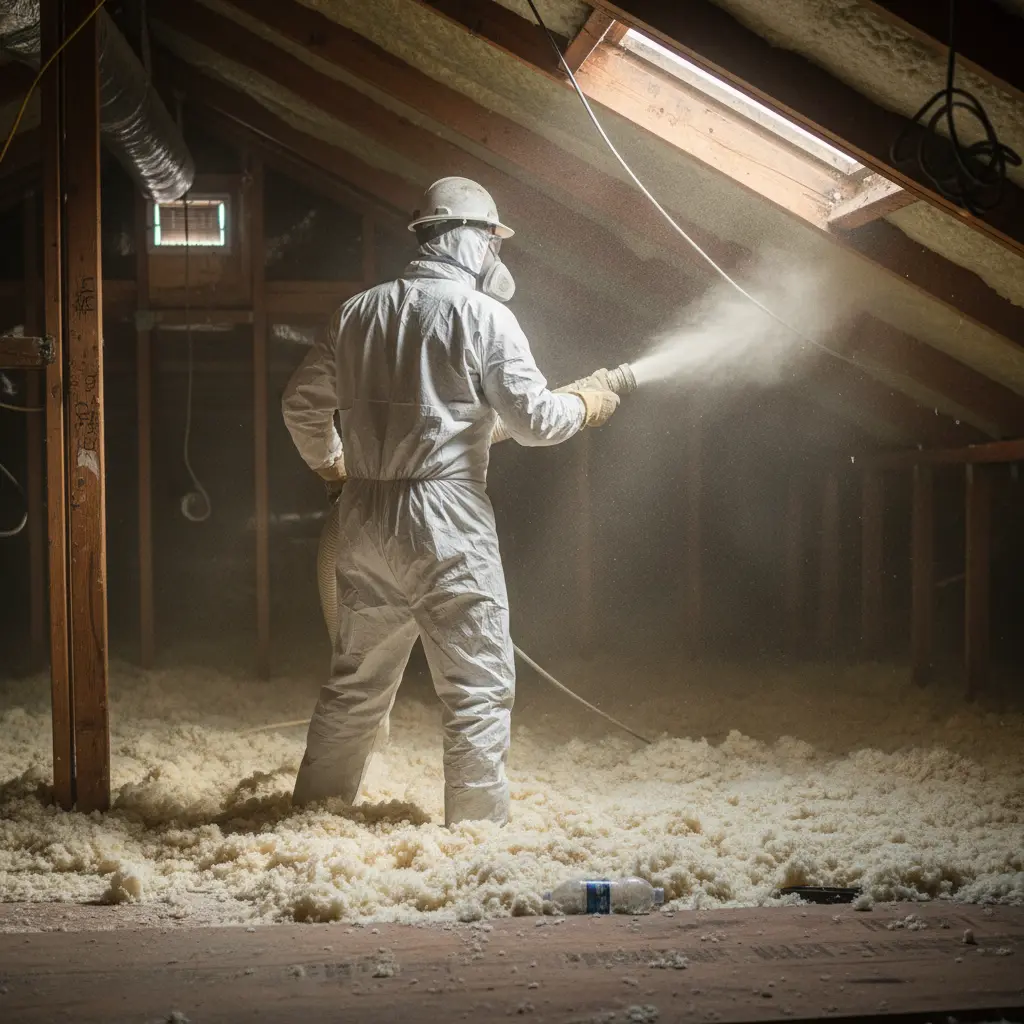
Our team in action — insulation professionals serving Orange
Crawl Space Insulation Methods We Use in Orange
Fiberglass Batt Insulation
Unfaced or kraft-faced fiberglass batts installed between floor joists at R-19 or R-30 remain the most common crawl space insulation method in Orange due to their cost-effectiveness and ease of installation in standard joist bays. Best suited for vented crawl spaces with low moisture readings and accessible, uniformly spaced joists — common in Orange’s 1960s–1970s tract homes. Learn more about our fiberglass insulation services.
Spray Foam Insulation
Closed-cell spray polyurethane foam (SPF) applied to the underside of the subfloor and rim joists delivers R-6 to R-7 per inch while simultaneously air-sealing and providing a vapor retarder. Ideal for homes in Orange’s high-moisture zones near the Santiago Creek corridor and for encapsulated (unvented) crawl space configurations. Closed-cell SPF also adds structural rigidity to aging floor systems. Explore our spray foam insulation options.
Blown-In Insulation
Loose-fill cellulose or fiberglass blown into irregular or difficult-to-access joist bays using a flexible hose. Particularly effective for Orange’s older craftsman and bungalow-style homes in Old Towne where non-standard joist spacing and pipe runs make batt installation impractical. Learn about our blown-in insulation solutions.
Rigid Foam Board Insulation
EPS or XPS rigid foam panels installed against foundation walls in encapsulated crawl space systems. Used when converting a vented crawl space to a conditioned, unvented system — a growing approach in Orange’s hillside properties where ground moisture and soil movement create persistent vapor intrusion problems.
Ready for Crawl Space Insulation? Get Your Free Estimate Today.
Next Level Insulation of Orange serves Orange and the surrounding area — we’ll be on-site within 24 hours.
📞 Call 714-266-2070Crawl Space Insulation Cost in Orange, CA
Understanding the factors that drive crawl space insulation cost helps Orange homeowners budget accurately and evaluate contractor proposals fairly.
Typical Price Ranges
- Fiberglass batt installation (R-19): $1.50 to $2.50 per square foot, or $1,500 to $3,500 for an average 1,200 sq ft Orange home crawl space
- Closed-cell spray foam: $3.00 to $5.00 per square foot, or $3,600 to $7,500 for the same footprint
- Blown-in cellulose or fiberglass: $1.75 to $3.00 per square foot
- Full encapsulation system (vapor barrier + insulation + vent sealing): $5,000 to $12,000 depending on crawl space depth, access conditions, and moisture remediation needs
- Insulation removal and disposal: $1.00 to $2.00 per square foot as a separate line item — insulation removal is typically required before new installation in pre-1980 Orange homes
Factors Affecting Cost in Orange
- Crawl space height and accessibility: Homes in Orange’s hillside neighborhoods often have variable crawl space heights of 18 to 36 inches, increasing labor time and cost
- Moisture remediation scope: Active mold treatment or structural wood repair adds $500 to $3,000 before insulation work begins
- Existing insulation removal: Required in most pre-1980 Orange homes
- SCE and SoCalGas rebates: Qualifying projects may receive $0.10 to $0.25 per square foot in utility rebates, reducing net cost
- Permit fees: City of Orange building permits for insulation work typically run $150 to $350
Contact us at 714-266-2070 for a no-obligation quote specific to your property.
Crawl Space Insulation Neighborhoods We Serve in Orange, CA
Old Towne Orange
The historic district centered on the Orange Plaza is home to craftsman bungalows, Spanish Colonial Revival homes, and ranch-style properties built predominantly between 1910 and 1960. Many feature shallow crawl spaces with original redwood framing and non-standard joist spacing, requiring blown-in or cut-and-cobble foam board approaches. Historic preservation guidelines may restrict certain exterior modifications, making crawl space access and interior methods particularly important.
Panorama Heights and Ridgeline Estates
These hillside neighborhoods east of Tustin Street feature 1970s and 1980s single-story homes with steeply sloped lots creating variable crawl space heights. Ground moisture from slope drainage is a persistent issue, making spray foam and encapsulation the preferred solutions.
Eichler Tract (North Orange)
Orange’s post-war Eichler-influenced tract homes near the 91 Freeway corridor were built in the 1950s–1960s with radiant slab floors or minimal crawl spaces. Properties that do have crawl spaces frequently have original fiberglass batts well below current R-19 requirements.
Villa Park Road Corridor
Proximity to Santiago Creek’s drainage basin creates elevated ground moisture in this area. We regularly install reinforced vapor barriers and closed-cell spray foam here to address chronic moisture infiltration.
Crawl Space Insulation Maintenance Tips for Orange Homeowners
- Inspect annually after winter rains: Orange’s rainy season (November through March) is the highest-risk period for moisture infiltration. Walk the perimeter of your home and check that crawl space vents are clear and unobstructed after each significant rain event.
- Monitor indoor humidity levels: Keep first-floor relative humidity between 40% and 60% using a digital hygrometer. Readings consistently above 65% suggest crawl space moisture is entering your living areas.
- Check vapor barriers after Santa Ana wind events: High-wind pressure can shift or puncture vapor barriers. Inspect after any Santa Ana event with gusts exceeding 50 mph.
- Keep crawl space vents clear of debris: Orange’s mature tree canopy — particularly in Old Towne — generates leaf litter that blocks foundation vents and traps moisture.
- Control exterior grading: Ensure soil slopes away from your foundation at a minimum of 6 inches over 10 horizontal feet to redirect irrigation and rainwater away from the crawl space.
- Schedule professional re-inspection every 3 to 5 years: Insulation settling, pest activity, and plumbing leaks can degrade performance over time, particularly in Orange’s older housing stock.
- Address plumbing leaks immediately: A single slow drip beneath the floor can elevate crawl space humidity by 20% within days. Coordinate prompt plumbing repair before it causes insulation damage.
Why Choose Next Level Insulation of Orange
Next Level Insulation of Orange is a locally focused insulation contractor serving homeowners throughout Orange, CA. We are not a national franchise — every project we take on is in the communities where our team lives and works. We understand the specific building vintages found in Old Towne, the moisture dynamics near Santiago Creek, and the Title 24 compliance requirements enforced by the City of Orange Building Department.
Our technicians are trained in the full spectrum of crawl space insulation methods, from basic fiberglass batt replacement to complete encapsulation systems. We carry general liability insurance and stand behind every project we complete. Our work covers attic insulation, spray foam insulation, blown-in insulation, insulation removal, attic cleaning, and rodent proofing — giving Orange homeowners a single, accountable contractor for all insulation-related needs.
We provide free, no-pressure inspections and written proposals. To schedule your assessment, call 714-266-2070 today.
Frequently Asked Questions About Crawl Space Insulation in Orange, CA
How much does crawl space insulation cost in Orange, CA?
Most Orange homeowners pay between $1,500 and $7,500 for crawl space insulation, depending on square footage, method, and whether insulation removal is required. Fiberglass batt installation at R-19 typically runs $1.50 to $2.50 per square foot, while closed-cell spray foam costs $3.00 to $5.00 per square foot. Full encapsulation systems can reach $5,000 to $12,000. Southern California Edison rebates may reduce your net cost by $150 to $400 on qualifying projects.
How long does crawl space insulation installation take?
A standard crawl space insulation project in an Orange home of 1,000 to 1,500 square feet is typically completed in one day. Larger homes, or projects requiring prior insulation removal and moisture remediation, may take two to three days total. We schedule work Monday through Saturday to accommodate homeowner availability.
Do I need a permit for crawl space insulation in Orange, CA?
The City of Orange Building Department generally requires a permit for crawl space insulation when the scope includes structural modifications, changes to the vented or unvented status of the crawl space, or spray foam application. Basic batt replacement may be exempt. We evaluate permit requirements for every project and can pull necessary permits on your behalf.
What R-value do I need for crawl space insulation in Orange?
California Title 24, Climate Zone 8 (which covers Orange) requires a minimum R-19 for floor assemblies over unconditioned vented crawl spaces. For encapsulated crawl spaces with conditioned air supply, wall insulation requirements apply instead. We recommend R-30 for maximum energy performance given Orange’s extended summer cooling season.
Should I choose a vented or encapsulated crawl space for my Orange home?
The answer depends on your specific site conditions. Vented crawl spaces work adequately in lower-moisture areas of Orange with good cross-ventilation. Encapsulated (sealed) systems are strongly recommended for homes near Santiago Creek, in the Villa Park Road corridor, or anywhere ground moisture readings consistently exceed 70% relative humidity. We assess both options during your free inspection and provide a recommendation based on measured conditions, not sales preference.
How do I know if my existing crawl space insulation needs to be replaced?
Key indicators include sagging or missing batts visible from the access hatch, a musty odor in the home, higher-than-expected energy bills, and cold floors during winter. In Orange’s pre-1980 homes, insulation that has never been replaced is very likely below current R-value requirements and may contain moisture damage or rodent contamination. Our free inspection includes a visual assessment and moisture reading to determine whether replacement is warranted.
Can crawl space insulation help with pest problems in Orange?
Insulation alone does not prevent pests, but a properly installed vapor barrier and sealed insulation system eliminates the dark, humid environments that attract rodents, termites, and other pests common in Orange’s older neighborhoods near Irvine Regional Park. We recommend combining crawl space insulation with our rodent proofing service for comprehensive protection.
Does crawl space insulation qualify for utility rebates in Orange?
Yes. Orange residents served by Southern California Edison and SoCalGas may qualify for energy efficiency rebates through the California utilities’ Energy Upgrade California program. Rebate amounts vary by project scope and current program funding. We identify qualifying rebates during the proposal process and provide the documentation required for your application.
Get Your Free Crawl Space Insulation Assessment in Orange, CA
Don’t let an uninsulated or damaged crawl space drive up your energy bills and compromise your home’s comfort through another Orange summer. Next Level Insulation of Orange provides free, no-obligation crawl space inspections for homeowners throughout Orange, CA — including Old Towne, Panorama Heights, the Villa Park Road corridor, and every neighborhood in between.
Our team will assess your current insulation R-values, moisture conditions, and pest risks, then deliver a clear written proposal with transparent pricing and available SCE rebate options.
Call us now at 714-266-2070 to schedule your free crawl space assessment. We’re available Monday through Saturday and typically schedule inspections within 48 hours of your call. Take the first step toward a more efficient, comfortable, and protected home today.