

Crawl Space Encapsulation in Orange, CA
Professional Crawl Space Encapsulation in Orange, CA in Orange, CA — Licensed, Insured & Locally Owned
Get expert crawl space encapsulation in Orange, CA. Next Level Insulation of Orange protects your home from moisture, mold & pests. Call 714-266-2070 for a free estimate.
- Licensed & Insured
- Locally Owned & Operated
- 24/7 Emergency Service
- Financing Available
- Free Inspection & Estimate
Request Your
Free EstimateCrawl space encapsulation is the process of sealing your home’s crawl space with a heavy-duty vapor barrier, insulation, and moisture control systems to create a clean, dry, and energy-efficient environment beneath your living areas. In Orange, CA — where coastal humidity from the Pacific pushes inland, seasonal Santa Ana wind events cause rapid moisture swings, and older residential neighborhoods sit atop expansive clay soils — an unprotected crawl space can quietly damage your home’s structure, air quality, and energy efficiency year after year.
At Next Level Insulation of Orange, we specialize in professional crawl space encapsulation solutions designed specifically for the unique climate, soil conditions, and housing stock found throughout Orange and the surrounding communities. From historic Old Towne bungalows to mid-century ranch homes in The Avenues, our team delivers lasting protection that keeps moisture, pests, and poor air quality out of your home for good. Call us today at 714-266-2070 to schedule your free crawl space assessment.
Understanding Crawl Space Encapsulation
A crawl space is the shallow, unfinished area beneath many homes that provides access to plumbing, electrical wiring, HVAC ductwork, and structural supports. Historically, builders in Southern California — including Orange County — designed crawl spaces with open foundation vents. The theory was that cross-ventilation would naturally keep moisture levels in check. This “ventilated crawl space” approach was standard practice for homes built from the post-World War II housing boom through the 1980s, which represents a large portion of Orange’s residential housing inventory.
Modern building science has since proven that open venting often does more harm than good in climates like Orange’s. When warm, humid air from the coast or from summer rain events flows into a cool crawl space, it condenses on cold surfaces — wood framing, floor joists, pipes, and ductwork. Over time, this cycle of condensation leads to wood rot, mold growth, increased pest activity, and degraded insulation performance.
Crawl space encapsulation solves this problem by converting the crawl space from a vented, semi-outdoor environment into a sealed, conditioned space. The process typically involves:
- Installing a thick polyethylene vapor barrier (typically 12–20 mil) across all ground surfaces and up the foundation walls
- Sealing foundation vents and any penetrations where air, moisture, or pests can enter
- Adding insulation to the crawl space walls or floor joists
- Installing drainage systems, sump pumps, or dehumidifiers where water intrusion is a concern
In Orange, where an estimated 35–40% of single-family homes were built before 1980 with ventilated crawl space designs, encapsulation has become one of the most impactful home performance upgrades available. It directly improves indoor air quality, lowers heating and cooling costs, extends the life of structural wood members, and reduces the risk of pest infestations — all critical concerns for homeowners in this region.
Encapsulation is especially relevant for homes in Orange’s lower-elevation neighborhoods near Santiago Creek and Irvine Park Road, where seasonal groundwater saturation and creek-side humidity elevate moisture exposure significantly above city averages. Learn more about our crawl space insulation services
Why Crawl Space Encapsulation Is Needed in Orange, CA
Marine Layer and Coastal Humidity Infiltration
Orange sits approximately 20 miles from the Pacific Ocean, placing it directly in the path of the Southern California marine layer. From May through September — a period locals call “June Gloom” that often stretches into August — relative humidity in Orange regularly climbs to 80–92% overnight and in the early morning hours. This moisture-laden air flows freely into unencapsulated crawl spaces through foundation vents, and as the air cools in contact with soil and concrete, it releases moisture onto every available surface. Over a single summer, this cycle can deposit gallons of condensation onto crawl space surfaces.
Santa Ana Wind Events and Rapid Moisture Cycling
Orange County’s infamous Santa Ana wind events — most intense from October through February — create dramatic swings in relative humidity. During a Santa Ana event, humidity can plummet from above 70% to below 10% within 24 hours. This rapid cycling causes wood framing in crawl spaces to expand and contract repeatedly, accelerating structural fatigue and creating micro-cracks in vapor barriers and sealants. Major Santa Ana events in 2017 and 2021 brought sustained gusts of 60–80 mph to the Orange Hills area, further stressing homes with unprotected crawl spaces.
Expansive Clay Soils
Much of Orange is underlain by Ramona and Hanford series soils — dense, clay-heavy formations that are highly expansive. These soils absorb moisture during winter rains (Orange averages 14–16 inches of rainfall annually, with most falling between November and March) and then contract and crack as they dry. This seasonal movement pushes moisture vapor upward through the soil and into crawl spaces at rates that open-vent systems cannot adequately address. In neighborhoods like Serrano Heights and areas near the Saddleback Valley boundary, expansive soil movement has been documented to cause measurable foundation shift in homes without proper crawl space moisture barriers.
Santiago Creek and Flood-Prone Low Areas
Santiago Creek runs through the heart of Orange, and areas within a half-mile of its banks — including portions of Villa Park Road and Taft Avenue — experience elevated groundwater tables during and after significant rain events. FEMA flood zone maps designate portions of east Orange as Zone AE, meaning high-risk flooding. Homes in these zones with unencapsulated crawl spaces routinely show standing water, saturated soils, and wood moisture content readings above 19% — the threshold at which mold growth becomes probable.
Aging Housing Stock
A substantial portion of Orange’s residential neighborhoods — including Old Towne Orange (the historic district centered around the Plaza), The Avenues, and segments of East Chapman Avenue — feature homes built between 1920 and 1975. These structures were constructed well before modern moisture management standards. Original vapor barriers, if present at all, are typically thin 4–6 mil plastic sheeting that has degraded, torn, or been displaced by decades of pest activity and seasonal soil movement.
Signs You Need Crawl Space Encapsulation
Moisture and Water Issues
- Musty or earthy odors rising from floors or air vents — especially common in Orange homes after the first winter rains
- Visible condensation on water pipes, HVAC ducts, or floor joists beneath the home
- Standing water or persistently damp soil visible through access panels
- Water stains or efflorescence (white mineral deposits) on foundation walls
Structural Warning Signs
- Soft, spongy, or bouncy floors — a sign of moisture-compromised floor joists
- Visible wood rot, darkening, or discoloration on structural lumber in the crawl space
- Doors and windows that stick or no longer close properly due to framing movement
- Sagging or uneven subfloor visible from below
Indoor Air Quality Indicators
- Increased allergy or asthma symptoms among household members — particularly relevant during Orange’s high pollen and mold spore seasons in spring and fall
- Visible mold or mildew on baseboards, carpet edges, or lower walls
- Persistent high indoor humidity readings above 55–60% even with air conditioning running
Pest Activity
- Evidence of rodent nesting, insect damage, or termite activity in or near the crawl space — common throughout Orange’s older residential districts
Our Crawl Space Encapsulation Process in Orange, CA
Every crawl space in Orange is different, which is why we begin every project with a thorough assessment before any work begins. Here’s what you can expect when you work with Next Level Insulation of Orange:
Free Crawl Space Inspection (1–2 Hours)
Our certified technician performs a comprehensive inspection of your crawl space, measuring dimensions, documenting moisture levels with a professional hygrometer, assessing existing insulation and vapor barriers, checking for wood rot and pest damage, and identifying water intrusion pathways. We note any Orange-specific conditions such as proximity to Santiago Creek, soil type, and foundation vent placement relative to prevailing wind directions.
Debris Removal and Crawl Space Cleaning (2–4 Hours)
Before any barrier installation, we remove old, damaged vapor barriers, deteriorated insulation, debris, and any rodent nesting materials. Learn about our professional cleaning services Surfaces are swept and treated for mold or pest residue as needed.
Foundation Vent Sealing (1–2 Hours)
We seal existing foundation vents using rigid foam vent covers and spray foam to eliminate the primary entry point for humid marine layer air. This is a critical step for Orange homes, where open vents have historically been the main driver of crawl space moisture problems.
Drainage and Sump Installation (If Needed, 4–8 Hours)
For homes in lower-elevation neighborhoods near Santiago Creek or in FEMA Zone AE, we install perimeter drainage channels and sump pump systems before vapor barrier installation to manage any active groundwater intrusion.
Vapor Barrier Installation (3–6 Hours)
We install a minimum 12-mil reinforced polyethylene vapor barrier across all ground surfaces, running it up foundation walls and securing it to the sill plate. All seams are overlapped a minimum of 12 inches and sealed with moisture-resistant tape. Penetrations for pipes and posts are individually wrapped and sealed.
Wall Insulation and Air Sealing (2–4 Hours)
We insulate the crawl space perimeter walls using closed-cell spray foam or rigid foam board, achieving the R-values required by California Title 24 energy standards. Learn more about spray foam insulation
Final Inspection and Documentation (1 Hour)
We perform a post-installation moisture reading, walk you through all completed work, and provide documentation of materials and installation for your home records.
Total Project Timeline: Most standard Orange-area crawl space encapsulations are completed in one to two days.
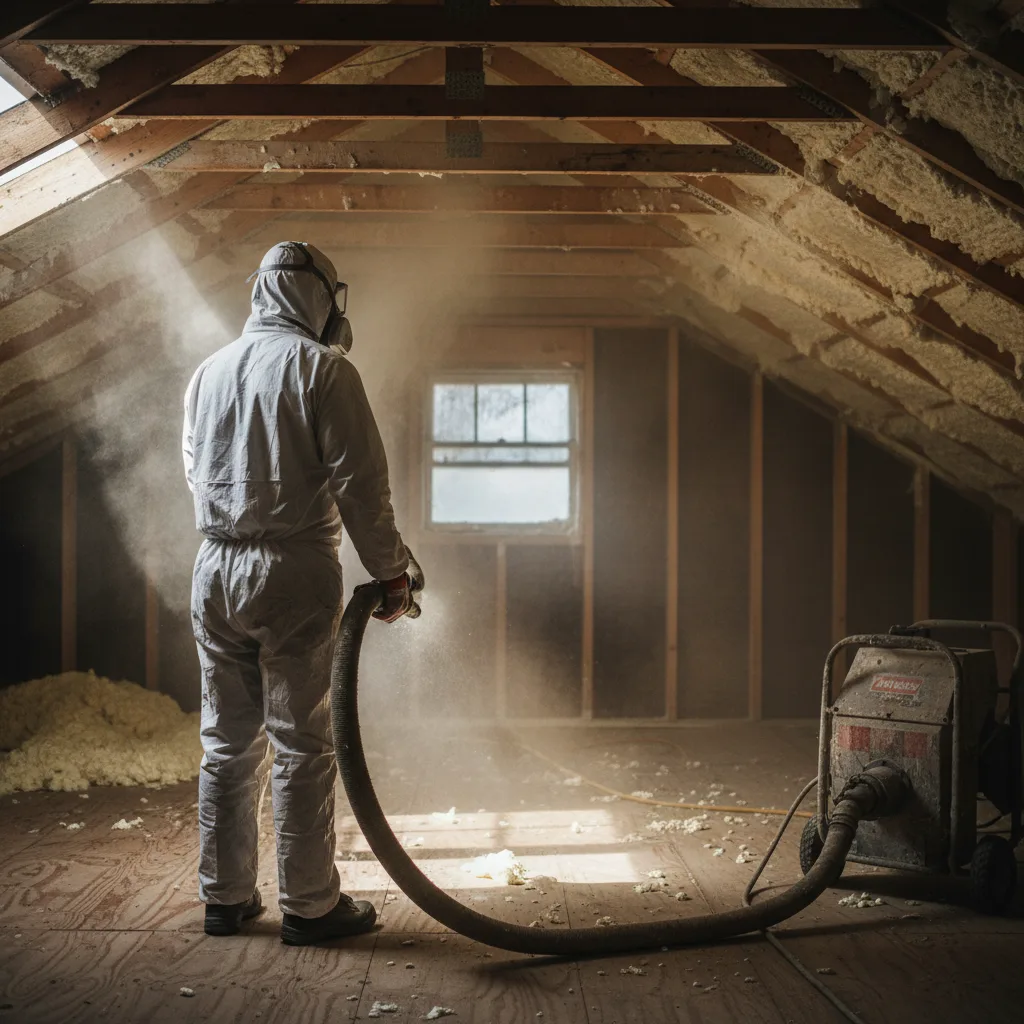
Our team in action — insulation professionals serving Orange
Crawl Space Encapsulation Methods and Approaches
Full Encapsulation with Closed-Cell Spray Foam
The most comprehensive solution, this method combines a heavy-duty ground vapor barrier with closed-cell spray foam insulation applied directly to foundation walls and rim joists. Closed-cell spray foam achieves R-6 to R-7 per inch, doubles as a vapor barrier, and adds structural rigidity to aging foundation walls. This is our recommended approach for older homes in Old Towne Orange and The Avenues where wood framing is already showing early moisture stress. Explore our spray foam insulation services
Vapor Barrier with Rigid Foam Board Insulation
A cost-effective alternative that combines a reinforced polyethylene vapor barrier with rigid foam board (EPS or XPS) panels on foundation walls. Achieves R-10 to R-20 depending on panel thickness. Well-suited for newer homes in Serrano Heights or Orange Park Acres where crawl spaces are in generally good condition.
Vapor Barrier Only (Basic Encapsulation)
For crawl spaces that are in otherwise good condition and do not require full insulation upgrades, a high-quality 20-mil vapor barrier installation alone provides significant moisture protection. Typically paired with improved ventilation control and dehumidifier installation. Recommended for budget-conscious homeowners or as a first phase of a multi-stage improvement plan.
Encapsulation with Dehumidifier System
In Orange homes where humidity levels consistently exceed 70% in the crawl space — particularly in creek-adjacent properties — we add a commercial-grade crawl space dehumidifier after encapsulation to actively maintain humidity below 55%. This is especially effective when combined with any of the above vapor barrier methods.
Crawl Space Insulation Retrofit
For homes that already have a vapor barrier but lack adequate insulation, we can retrofit blown-in or batt insulation into the crawl space floor system. Learn about blown-in insulation options
Ready for Crawl Space Encapsulation? Get Your Free Estimate Today.
Next Level Insulation of Orange serves Orange and the surrounding area — we’ll be on-site within 24 hours.
📞 Call 714-266-2070Crawl Space Encapsulation Cost in Orange, CA
Understanding what crawl space encapsulation costs in Orange helps homeowners plan and budget appropriately. Here is a breakdown of typical pricing in our service area:
General Price Ranges
- Basic vapor barrier installation (20-mil, ground only): $1,500 – $3,000 for a standard 1,000–1,500 sq ft crawl space
- Full encapsulation (vapor barrier + rigid foam wall insulation): $3,500 – $7,000 for a comparable-sized space
- Premium encapsulation (vapor barrier + closed-cell spray foam): $6,000 – $12,000 depending on crawl space size and accessibility
- Dehumidifier addition: $800 – $1,800 for equipment and installation
- Sump pump installation: $1,200 – $2,500 depending on system complexity
Key Cost Factors in Orange
- Crawl space height and accessibility: Many older homes in Orange’s historic districts have crawl spaces only 18–24 inches tall, which increases labor time and cost by 15–25%
- Existing damage remediation: Mold treatment, wood repair, or pest damage remediation prior to encapsulation adds $500–$3,000 depending on severity
- Soil and drainage conditions: Homes near Santiago Creek or in flood zones may require drainage systems that add $1,500–$4,000 to the project
- Square footage: Pricing typically scales at $3–$8 per square foot depending on method and conditions
Orange homeowners can often offset encapsulation costs through improved energy efficiency — studies show that crawl space encapsulation reduces HVAC energy use by 15–25% in similar climates. Contact us at 714-266-2070 for a free, itemized estimate specific to your home.
Crawl Space Encapsulation Service Areas in Orange, CA
Old Towne Orange
The historic district surrounding Chapman Avenue and Glassell Street features hundreds of craftsman bungalows and Spanish Colonial Revival homes built between 1910 and 1945. These homes were built long before modern moisture management standards and commonly feature original, degraded crawl spaces. Encapsulation in Old Towne often requires careful work around older plumbing, knob-and-tube wiring, and extremely low-clearance foundation heights.
The Avenues
Streets named after trees — Lemon, Orange, Olive, and Walnut — make up one of Orange’s most charming post-war neighborhoods. Homes here were predominantly built from the 1940s through the 1960s. Many retain their original, undersized vapor barriers and poorly sealed foundation vents, making them prime candidates for full encapsulation upgrades.
Orange Park Acres
This semi-rural community on Orange’s eastern edge features larger lots and custom homes from the 1970s and 1980s. Proximity to the Irvine Regional Park and Santiago Creek tributary areas elevates groundwater exposure. Many homes here benefit from encapsulation combined with active drainage or dehumidification systems.
Serrano Heights
A newer planned community with homes built from the late 1990s onward. While construction quality is higher, some homes still show early signs of crawl space moisture issues due to clay soil expansion. Encapsulation here typically involves less remediation and focuses on preventive barrier installation.
Crawl Space Maintenance Tips for Orange Homeowners
Proper maintenance after encapsulation ensures your investment lasts for decades. Here are our top recommendations for homeowners in Orange:
- Annual inspections: Schedule a visual crawl space inspection every fall before Orange’s rainy season (typically beginning in November) to identify any barrier damage, new pest entry points, or moisture accumulation.
- Check dehumidifier operation: If your encapsulation includes a dehumidifier, check the drainage system and filter monthly during the June–September marine layer season when ambient humidity is highest.
- Maintain exterior grading: Ensure soil around your foundation slopes away from the house at a minimum 6-inch drop over 10 feet to direct winter rains away from the crawl space.
- Clean gutters and downspouts: Orange’s winter rain season can deposit debris quickly. Keep gutters clear and ensure downspouts discharge at least 4 feet from the foundation.
- Monitor indoor humidity: Use a basic hygrometer to confirm indoor humidity stays below 55%. Persistent high readings may indicate a vapor barrier breach.
- Seal plumbing penetrations promptly: Any new plumbing work that penetrates the crawl space vapor barrier should be resealed immediately to maintain the integrity of the encapsulation system.
- Watch for pest activity: Check access panels seasonally for signs of rodent or insect activity, particularly after Santa Ana wind events when pests seek shelter. Learn about our rodent proofing services
Why Choose Next Level Insulation of Orange for Crawl Space Encapsulation
When it comes to protecting one of the most important — and most overlooked — parts of your home, local expertise makes all the difference. At Next Level Insulation of Orange, we bring deep knowledge of Orange County’s specific climate, soil conditions, and housing stock to every project we take on. We’re not a national chain applying generic solutions; we’re a local team that understands why homes near Santiago Creek behave differently from those on the Orange Hills, and why Old Towne bungalows require different approaches than Serrano Heights tract homes.
Our technicians are trained in the latest building science standards and use only commercial-grade materials — including reinforced vapor barriers and high-performance insulation products — on every job. We serve homeowners throughout Orange with transparent pricing, no-pressure assessments, and a commitment to doing the job right the first time.
In addition to crawl space encapsulation, we offer a full suite of home performance services including attic insulation, insulation removal, fiberglass insulation, and attic cleaning — making us your one-stop solution for whole-home comfort and protection.
Call us today at 714-266-2070 to get started.
Frequently Asked Questions: Crawl Space Encapsulation in Orange, CA
How much does crawl space encapsulation cost in Orange, CA?
In Orange, most crawl space encapsulation projects range from $1,500 for a basic vapor barrier installation to $12,000 or more for a full encapsulation with closed-cell spray foam and drainage systems. The most common full encapsulation projects we complete in Orange fall in the $4,000–$8,000 range. Specific pricing depends on crawl space size, height, existing damage, soil conditions, and the encapsulation method selected. We always provide a free, itemized estimate before any work begins.
How long does crawl space encapsulation take?
Most residential crawl space encapsulation projects in Orange are completed in one to two days. Smaller homes in The Avenues with straightforward conditions can often be finished in a single day. Larger homes or projects requiring significant remediation, drainage installation, or exceptionally limited crawl space clearance may take two to three days.
Does Orange, CA really need crawl space encapsulation, or is it just a sales pitch?
Orange’s combination of coastal humidity, expansive clay soils, proximity to Santiago Creek, and a large inventory of pre-1980 homes with outdated vapor barriers makes crawl space moisture management genuinely important — not just a upsell. Independent building science research consistently shows that homes with encapsulated crawl spaces in humid or mixed climates have lower HVAC costs, better indoor air quality, and fewer structural issues over time. That said, not every home needs the most expensive solution — we’ll honestly assess your specific situation and recommend only what’s necessary.
Will crawl space encapsulation help with my high energy bills?
Yes. An uninsulated, unencapsulated crawl space is one of the leading causes of energy loss in Orange-area homes. Heat and air conditioning escape through the floor into the crawl space, and the moisture-laden air that infiltrates through open vents increases the load on your HVAC system. Studies show that properly encapsulating and insulating a crawl space can reduce HVAC energy consumption by 15–25% in Southern California’s mixed climate zone (California Climate Zone 8, in which most of Orange falls).
Can crawl space encapsulation prevent rodents and pests?
Yes, encapsulation significantly reduces pest access by sealing foundation vents and gaps that are common entry points for mice, rats, and insects — a particular concern in Orange’s older neighborhoods where original foundation vents have deteriorated. We also offer dedicated rodent proofing services for homes with active or prior pest issues.
What is the difference between a vapor barrier and full encapsulation?
A vapor barrier is simply a plastic sheeting installed on the ground of the crawl space to reduce moisture transmission from the soil. Full encapsulation goes further — it includes sealing the foundation walls, closing vents, insulating the perimeter, and air-sealing all penetrations to create a completely controlled environment. A standalone vapor barrier is a first step; full encapsulation is a comprehensive moisture management system.
Do I need a permit for crawl space encapsulation in Orange, CA?
In most cases, basic vapor barrier installation does not require a building permit in the City of Orange. However, if the project involves significant structural repairs, sump pump installation, or changes to mechanical systems, a permit may be required. We handle all necessary permit coordination as part of our project process and are familiar with the City of Orange Building Division requirements.
How do I know if my existing vapor barrier is still working?
Signs that your existing vapor barrier has failed include visible tears, wrinkles, or displacement; standing water on or pooling beneath the barrier; musty odors coming from the crawl space; condensation on floor joists; or a crawl space moisture reading above 60% relative humidity on an inspection. If your current barrier is original to a pre-1985 home, it has almost certainly degraded beyond effectiveness and should be replaced.
Get Your Free Crawl Space Encapsulation Estimate in Orange, CA
Don’t let hidden moisture silently damage your home’s structure, air quality, or energy efficiency. Whether you’re in Old Towne, The Avenues, Orange Park Acres, or Serrano Heights, Next Level Insulation of Orange is ready to help you protect your home with professional crawl space encapsulation solutions built for Orange’s unique climate and housing conditions.
Call us today at 714-266-2070 to schedule your free, no-obligation crawl space inspection. Our local team will assess your specific conditions, walk you through every available option, and provide a transparent, itemized quote — with no pressure and no surprises. Protecting your home starts from the ground up.