

Spray Foam Insulation in Orange, CA
Energy-Saving Spray Foam Insulation in Orange, CA for Orange, CA Homes — Licensed & Insured
Get expert spray foam insulation in Orange, CA. Next Level Insulation of Orange offers open & closed-cell solutions for attics, crawl spaces & walls. Call 714-266-2070.
- Licensed & Insured
- Locally Owned & Operated
- 24/7 Emergency Service
- Financing Available
- Free Inspection & Estimate
Request Your
Free EstimateSpray foam insulation is one of the most advanced and effective insulation solutions available for homeowners and commercial property owners in Orange, California. This high-performance material expands on contact to seal gaps, cracks, and cavities — creating an air-tight thermal envelope that dramatically reduces energy loss and improves indoor comfort year-round.
Orange, CA sits in the heart of Northern Orange County, where Mediterranean climate conditions, aging mid-century housing stock, and dry Santa Ana wind events create unique insulation challenges that standard materials simply cannot address. At Next Level Insulation of Orange, our technicians are trained specifically in the demands of this region — from the high-heat summer months that push attic temperatures past 150°F to the cold, wind-driven nights of late November through February.
Whether you’re upgrading an older Craftsman bungalow near Old Towne or insulating a newer construction in the Santiago Hills area, our team delivers spray foam solutions engineered for Orange’s specific environment. Call us today at 714-266-2070 to schedule your consultation.
Understanding Spray Foam Insulation
Spray polyurethane foam (SPF) insulation is a two-component chemical system — isocyanate and polyol resin — that, when combined through a specialized spray gun, expands rapidly to fill cavities and form a rigid or semi-flexible foam barrier. There are two primary types: open-cell spray foam and closed-cell spray foam, each suited to different applications and performance goals.
Open-cell spray foam has a softer, sponge-like structure with an R-value of approximately R-3.7 per inch. It is vapor-permeable and particularly effective for interior walls, interior attic decking, and areas where moisture management is a secondary concern. It excels at sound dampening and is generally more affordable per square foot.
Closed-cell spray foam is denser and harder, achieving an impressive R-6 to R-7 per inch — among the highest of any insulation material. Because its cellular structure is sealed, it also acts as a vapor and moisture barrier, making it ideal for crawl spaces, exterior walls, garage ceilings, and below-grade applications common in properties near Orange’s lower-elevation neighborhoods.
Spray foam insulation gained widespread residential adoption in the United States through the 1980s and 1990s as energy codes tightened following the 1973 oil embargo. In California, Title 24 energy compliance requirements — updated most recently in the 2022 code cycle — have made high-R-value insulation mandatory for new construction and major renovations. Orange County contractors and building departments have been enforcing Title 24 compliance actively since the mid-2000s, making spray foam an increasingly common choice for both new builds and retrofit projects throughout the city.
Orange’s housing inventory includes a wide range of building types: post-war tract homes from the 1940s–1960s with minimal original insulation, mid-century ranch homes, 1970s–1990s split-levels, and modern stucco construction. Each building type presents unique air-sealing and insulation challenges that spray foam addresses more thoroughly than batts or blown-in alternatives. Learn more about our Attic Insulation services to understand how spray foam fits within a complete insulation strategy.
Why Spray Foam Insulation Is Needed in Orange, CA
The Santa Ana Wind Effect
Orange County experiences some of Southern California’s most intense Santa Ana wind events, with gusts regularly exceeding 50–70 mph during late fall and early winter. In October 2007, the Witch Fire and Santiago Fire — the latter burning just miles from Orange’s eastern boundary near Irvine Park — demonstrated how rapidly wind-driven conditions can escalate. Beyond fire risk, Santa Ana winds force air infiltration through even small gaps in a building envelope. A typical unsealed attic in Orange can experience air changes per hour (ACH) of 8–12 during a Santa Ana event, compared to a target of 3 ACH or less under California’s energy code. Spray foam’s expansive air-sealing properties are uniquely capable of addressing this infiltration challenge.
Summer Attic Heat Extremes
During July and August, ambient temperatures in Orange regularly reach 95°F–105°F, and uninsulated or under-insulated attics can exceed 150°F–160°F. This superheated attic air radiates heat into living spaces below, forcing HVAC systems to work far harder than designed capacity. Studies from Lawrence Berkeley National Laboratory have shown that California attics with inadequate insulation can account for 25–35% of a home’s total cooling load. In neighborhoods like Orange Park Acres, where larger ranch-style homes have expansive low-pitch roof lines, this effect is especially pronounced.
Aging Housing Stock and Air Leakage
A significant portion of Orange’s residential neighborhoods — particularly Old Towne Orange and the blocks surrounding Chapman University — feature homes built between 1920 and 1965. These structures were built before California’s first residential energy code (Title 24, adopted in 1978) and typically contain little to no wall insulation, with aging fiberglass batts in attic spaces that have settled, compressed, or become rodent-damaged over decades. Air sealing in these homes is virtually nonexistent by modern standards, making spray foam retrofit insulation a cost-effective upgrade.
Soil and Moisture Considerations
Orange sits atop expansive clay soils common to the inland Orange County plain. Seasonal ground moisture fluctuations — particularly during El Niño years such as 2022–23, which brought record rainfall to the county — can introduce moisture into crawl spaces and sub-floor areas. Closed-cell spray foam applied in crawl spaces creates a vapor barrier that protects floor structures from moisture intrusion, mold risk, and wood rot, all of which are documented concerns in properties near the Santiago Creek flood corridor.
Title 24 Compliance Pressure
The City of Orange Building Division actively enforces California Title 24 energy compliance for permitted remodels and additions. Spray foam insulation’s high R-value per inch often allows homeowners to meet or exceed required performance thresholds in wall cavities and roof assemblies where depth is limited — a common constraint in the city’s older homes. View our Insulation Removal services to learn how we prepare existing spaces for compliant spray foam upgrades.
Signs You Need Spray Foam Insulation in Orange
Energy and Comfort Indicators
- Monthly SoCal Edison bills exceeding $200–$350 during summer months despite a reasonably sized home
- Rooms that are consistently 5°F–10°F hotter or cooler than the thermostat setting
- HVAC system running continuously during afternoon heat without reaching set temperature
- Drafts noticeable near outlets, window frames, or recessed lights during Santa Ana wind events
Structural and Visual Indicators
- Visible gaps around pipe penetrations in attic floors or crawl space ceilings
- Old, yellowed, or compressed fiberglass batts with obvious voids and gaps
- Moisture staining or condensation on interior walls or floor joists in crawl spaces
- Evidence of pest activity — rodent droppings, nesting materials, or chewed insulation — particularly common in Orange Park Acres and older Old Towne properties
Urgency Indicators
- A home built before 1978 with no record of insulation upgrades
- Preparing for a permitted remodel or addition that will trigger Title 24 review
- Discovering mold or wood rot in a crawl space following a wet El Niño winter
- Recent rodent infestation that has contaminated existing insulation materials
Learn about our Rodent Proofing services if pest activity is contributing to your insulation problems.
Our Spray Foam Insulation Process in Orange, CA
Next Level Insulation of Orange follows a structured, multi-step process designed to ensure safety, code compliance, and maximum performance for every spray foam project in Orange.
Free On-Site Assessment (1–2 Hours)
A certified technician visits your property to evaluate existing insulation conditions, measure square footage, identify air leakage points, and assess building type. We review your SoCal Edison billing history and discuss Title 24 requirements if a permit is involved. For Orange’s older homes, we pay particular attention to knob-and-tube wiring concerns that must be addressed before spray foam application.
Detailed Proposal and Material Specification (1–2 Business Days)
We provide a written proposal specifying open-cell vs. closed-cell product selection, R-value targets, coverage areas, and any required preparatory work such as insulation removal or air barrier installation. We itemize costs transparently so you understand exactly where every dollar is allocated.
Permit Coordination (If Required, 3–10 Business Days)
For projects requiring City of Orange building permits — typically full attic replacements or exterior wall spray foam — we coordinate permit applications with the Orange Building Division at 300 E. Chapman Avenue. Our documentation packages are prepared to meet current 2022 Title 24 standards.
Site Preparation (2–4 Hours on Installation Day)
Our crew clears the work area, removes contaminated or deteriorated existing insulation if included in scope, seals HVAC registers and light fixtures, and applies protective sheeting to surfaces not being sprayed. Ventilation is established per OSHA requirements for spray foam application.
Spray Foam Application (4–8 Hours Depending on Scope)
Using professional-grade Graco proportioner equipment, our certified applicators spray foam in controlled passes, building thickness to specified R-value targets. In Orange’s summer heat, we schedule application during cooler morning hours to maintain optimal substrate temperatures between 60°F and 90°F as required by product specifications.
Cure Time and Quality Inspection (1–24 Hours)
Spray foam achieves initial tack-free cure within minutes but requires full 24-hour cure before the space is reoccupied. We conduct a post-application inspection to verify thickness, coverage completeness, and adhesion quality.
Final Walkthrough and Documentation (30–60 Minutes)
We walk through completed work with the homeowner, provide product data sheets and warranty documentation, and schedule any required city inspections. See our Attic Cleaning service for post-removal cleanup we often pair with spray foam projects.
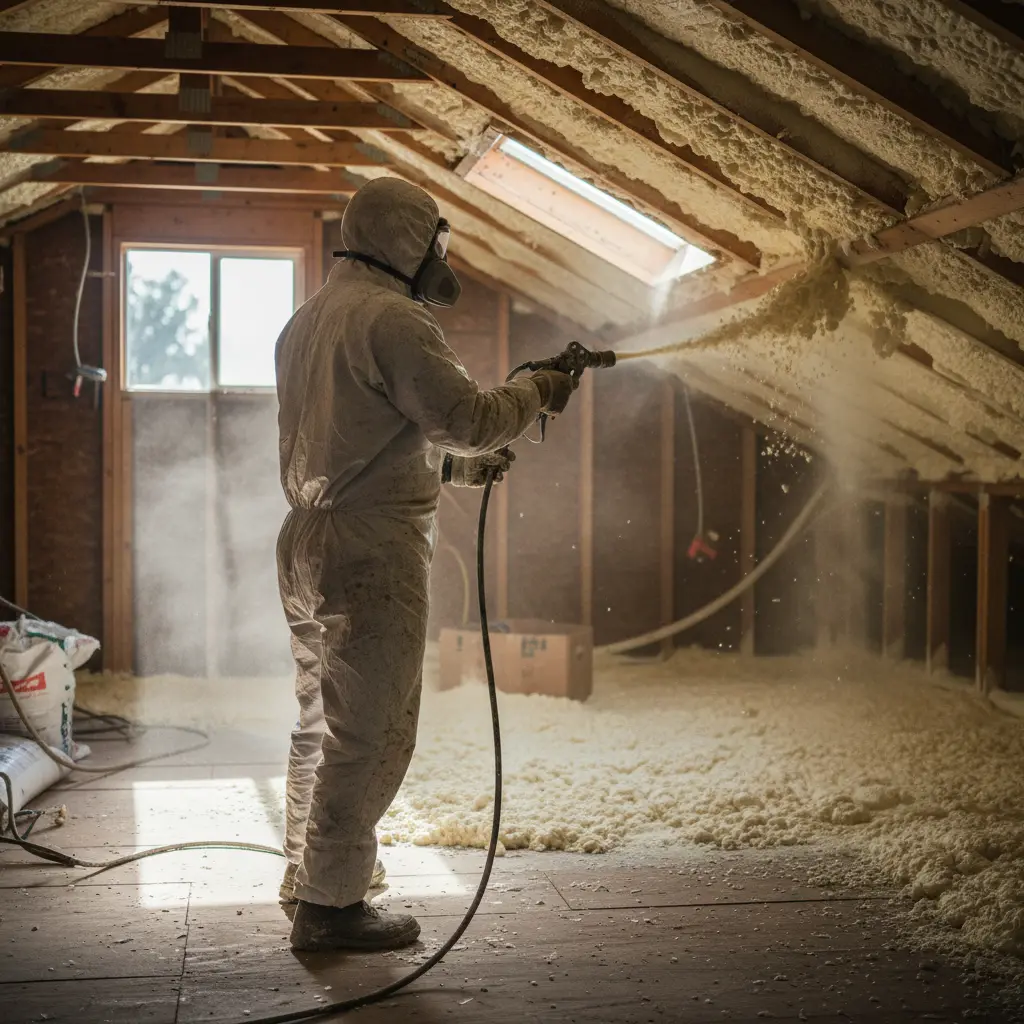
Our team in action — insulation professionals serving Orange
Spray Foam Methods and Approaches
Closed-Cell Spray Foam — High-Density Applications
At R-6 to R-7 per inch, closed-cell foam is our recommended solution for crawl spaces, below-grade walls, garage ceilings, and exterior-facing wall cavities in Orange’s older homes. Its vapor-impermeability makes it essential for any application where soil moisture — common along Santiago Creek and near lower-elevation areas of the city — could introduce water into the building assembly.
Open-Cell Spray Foam — Interior and Attic Deck Applications
Open-cell foam at R-3.7 per inch is cost-effective for unvented attic assemblies where we spray the underside of roof decking, converting the attic to conditioned space. This approach is particularly effective in Orange’s ranch-style homes where HVAC ducts run through the attic — conditioning that space reduces duct losses dramatically in summer.
Two-Pound Closed-Cell for Structural Enhancement
Two-pound closed-cell foam adds measurable racking strength to wall assemblies — a consideration for Orange properties in Seismic Design Category D. Applied to interior sheathing surfaces during renovation, it contributes to both energy performance and lateral load resistance.
Flash-and-Batt Hybrid Method
For homeowners balancing performance and budget, we apply a 1–2 inch flash coat of closed-cell spray foam to the cavity substrate for air sealing and vapor control, then fill the remainder of the cavity with fiberglass batt insulation. This hybrid approach achieves Title 24 compliance at a lower cost than full cavity spray foam.
Injection Foam for Existing Walls
For Orange’s mid-century homes where opening walls is impractical, injection foam fills existing wall cavities through small drilled holes — preserving interior finishes while dramatically improving thermal performance and air sealing.
Ready for Spray Foam Insulation? Get Your Free Estimate Today.
Next Level Insulation of Orange serves Orange and the surrounding area — we’ll be on-site within 24 hours.
📞 Call 714-266-2070Spray Foam Insulation Cost in Orange, CA
Understanding spray foam insulation pricing helps Orange homeowners budget accurately and compare quotes with confidence. Costs vary based on foam type, thickness, application area, and project complexity.
Typical Price Ranges
- Open-cell spray foam: $1.00–$1.50 per board foot (one square foot at one inch thick) installed
- Closed-cell spray foam: $1.75–$3.00 per board foot installed
- Average attic spray foam project (1,500 sq ft attic, open-cell): $2,500–$4,500
- Average crawl space closed-cell project (800 sq ft): $2,200–$4,000
- Whole-home retrofit (walls + attic + crawl space): $8,000–$18,000 depending on square footage and foam type
Factors Affecting Your Orange Project Cost
- Access difficulty: Low-pitch attics common in Orange’s 1950s–1960s tract homes require more setup time and increase labor costs by 10–20%
- Existing insulation removal: Add $1.00–$2.00 per square foot if contaminated insulation must be removed first — see our Insulation Removal service
- Permit fees: City of Orange building permits typically run $150–$400 for insulation projects
- Material pricing: Spray foam chemical costs are tied to petrochemical markets and have fluctuated 15–30% since 2021
Available Incentives
Southern California Edison’s Home Energy Improvement program offers rebates of $0.10–$0.30 per square foot for qualifying insulation upgrades. Federal tax credits under the Inflation Reduction Act (Section 25C) allow homeowners to claim 30% of insulation project costs up to $1,200 annually. Our team provides documentation to support both programs. Call 714-266-2070 for a detailed estimate.
Neighborhoods We Serve in Orange, CA
Old Towne Orange
The historic district centered around the Old Towne Plaza features some of the city’s oldest housing stock, with many homes dating to the 1910s–1940s. These Craftsman bungalows and Spanish Colonial Revival homes present original plaster walls, minimal attic insulation, and significant air infiltration challenges. Our injection foam and open-cell attic services are popular in this neighborhood.
Orange Park Acres
This semi-rural, horse-property community in eastern Orange features large ranch homes and custom builds from the 1960s–1980s. Expansive attic spaces and older HVAC systems make whole-attic spray foam upgrades especially impactful for energy savings here.
Santiago Hills
A planned community developed primarily in the 1990s–2000s, Santiago Hills homes have better baseline insulation but benefit from targeted air-sealing spray foam upgrades to meet updated Title 24 performance expectations and reduce cooling costs during hot inland summer months.
Villa Park Border Area
Properties along the western edge of this affluent neighborhood — many built in the 1970s — feature larger two-story footprints with complex roof geometries that create difficult-to-insulate spaces where spray foam’s conforming properties shine.
Cypress Street / Downtown Corridors
Denser residential streets near Chapman University include a mix of original and converted rental properties where blown-in insulation and spray foam combinations address a wide range of building vintages and conditions.
Spray Foam Insulation Maintenance Tips for Orange Homeowners
- Inspect annually after Santa Ana season (November–January): High-wind events can displace vent covers and disturb attic penetrations. Visually inspect accessible spray foam surfaces for any separation or cracking.
- Monitor crawl space moisture after winter rains: Following El Niño rain seasons, check closed-cell foam surfaces in crawl spaces for any signs of pooling water or unusual moisture accumulation near foundation walls.
- Protect exposed spray foam from UV: Open-cell and closed-cell foam degrades when exposed to ultraviolet light. Any spray foam visible in garages or mechanical rooms should be coated with an approved thermal barrier or paint within 30 days of installation.
- Seal new penetrations immediately: If plumbers, electricians, or HVAC contractors create new wall or ceiling penetrations, seal them with appropriate caulk or spray foam before the next season.
- Schedule pest inspections every 2–3 years: Even sealed spray foam can be breached by determined rodents. Regular rodent proofing inspections protect your insulation investment.
- Check attic ventilation after roofing work: Re-roofing projects sometimes disturb baffles or block ridge vents. Ensure ventilation remains balanced above any unvented spray foam assemblies.
- Keep records of installed R-values: Maintain your project documentation for future Title 24 compliance verification and potential home sale disclosures.
Why Choose Next Level Insulation of Orange
At Next Level Insulation of Orange, we are a locally focused insulation contractor serving Orange and surrounding Northern Orange County communities. Our technicians understand the specific demands of Orange’s building stock, climate conditions, and code environment in ways that out-of-area contractors simply cannot replicate.
We specialize exclusively in insulation services — including Spray Foam Insulation, Attic Insulation, Blown-In Insulation, Fiberglass Insulation, Insulation Removal, Attic Cleaning, Rodent Proofing, and Crawl Space Insulation — which means every member of our team is deeply experienced in the materials, techniques, and local conditions relevant to your project.
We provide transparent, itemized proposals with no hidden fees, and we coordinate directly with the City of Orange Building Division when permits are required. Our team arrives on time, protects your property throughout the installation process, and leaves your home cleaner than we found it.
Ready to improve your home’s comfort and energy efficiency? Call us at 714-266-2070 to schedule your free assessment today.
Frequently Asked Questions About Spray Foam Insulation in Orange, CA
How much does spray foam insulation cost in Orange, CA?
In Orange, open-cell spray foam typically costs $1.00–$1.50 per board foot installed, while closed-cell runs $1.75–$3.00 per board foot. A typical attic project for a 1,500-square-foot home ranges from $2,500 to $4,500. Whole-home retrofits including crawl space and walls can range from $8,000 to $18,000. Southern California Edison rebates and federal tax credits can offset 30–40% of project costs for qualifying homeowners.
How long does spray foam insulation installation take?
Most residential spray foam projects in Orange are completed in a single day. An attic application typically takes 4–6 hours; a crawl space takes 3–5 hours. Full-house projects spanning multiple areas may require 2 days. The foam requires 24 hours of full cure time before the space is safe for occupancy, though initial off-gassing dissipates within 1–2 hours with proper ventilation.
Is spray foam insulation safe for older homes in Old Towne Orange?
Yes, with proper preparation. Older homes in Old Towne Orange may have knob-and-tube wiring, which must be evaluated and typically replaced or isolated before spray foam is applied nearby, as spray foam can trap heat around older wiring. Our pre-installation assessment identifies these conditions and we coordinate with licensed electricians when necessary to ensure safe installation.
Does spray foam insulation help with Santa Ana wind drafts?
Absolutely. Santa Ana winds create significant pressure differentials that force air through small gaps in a building envelope. Spray foam’s expansive, air-sealing properties close these gaps comprehensively — including around recessed lights, pipe penetrations, and attic hatches that are almost impossible to seal with batt or blown-in materials. Homeowners typically report an immediate reduction in drafts and dust infiltration following spray foam installation.
Will spray foam insulation help me pass Title 24 in Orange?
In most cases, yes. Closed-cell spray foam’s high R-value per inch (R-6 to R-7) allows compliance with California’s Title 24 energy code even in shallow wall cavities typical of Orange’s older construction. We prepare the necessary documentation for City of Orange building permit applications and coordinate inspections as required.
What is the difference between open-cell and closed-cell spray foam?
Open-cell foam is softer, vapor-permeable, and achieves R-3.7 per inch — ideal for interior attic decks and walls. Closed-cell foam is dense, rigid, and vapor-impermeable at R-6 to R-7 per inch — the preferred choice for crawl spaces, exterior walls, and any moisture-prone application. Our Orange assessors recommend the appropriate type based on your specific project conditions.
How does spray foam compare to blown-in insulation for Orange homes?
Blown-in insulation is excellent for adding R-value quickly and affordably to open attic floors, but it does not air-seal. Spray foam provides both insulation and an air barrier in a single application — critical for Orange homes facing Santa Ana wind infiltration. For many projects, we recommend combining both: blown-in insulation over an attic floor for mass R-value, with spray foam sealing all penetrations and perimeter areas.
Can spray foam insulation reduce rodent intrusion in my Orange home?
Spray foam significantly reduces the entry points available to rodents by sealing gaps around pipes, wires, and structural members. However, determined rodents can chew through foam if they detect odors or pathways on the other side. We recommend combining spray foam with our Rodent Proofing service, which includes wire mesh reinforcement at key entry points for comprehensive protection.
Get Your Free Spray Foam Insulation Estimate in Orange, CA
Don’t let another scorching Orange County summer — or a drafty Santa Ana wind season — cost you hundreds of dollars in wasted energy. Next Level Insulation of Orange is ready to assess your home, explain your options clearly, and deliver a spray foam insulation solution that truly performs for your property and your budget.
Our team serves all neighborhoods across Orange, CA, from Old Towne to Orange Park Acres to Santiago Hills. We provide free, no-obligation on-site estimates with transparent pricing and no high-pressure sales tactics.
Call us now at 714-266-2070 or contact us online to schedule your assessment. Same-week appointments are typically available. Take the first step toward a more comfortable, energy-efficient home today.