

Insulation Materials & Types in Los Angeles, CA
Energy-Saving Insulation Materials & Types for Los Angeles, CA Homes — Licensed & Insured
Learn about insulation materials for Los Angeles homes — R-values, costs, and climate-specific advice from Next Level Insulation of Los Angeles. Call (323) 765-3939.
- Licensed & Insured
- Locally Owned & Operated
- Free Inspection & Estimate
Request Your
Free EstimateChoosing the right insulation material for your Los Angeles home is more than a comfort decision — it directly affects your energy bills, indoor air quality, and home resilience. Los Angeles presents a uniquely demanding environment for insulation: scorching summer temperatures that routinely exceed 95°F in the San Fernando Valley, coastal humidity and salt air near the Pacific, dramatic overnight temperature swings of 30°F or more, and increasing wildfire risk across hillside and foothill communities. Each of these factors influences how insulation performs over time.
R-value measures an insulation material’s resistance to heat flow. The higher the R-value, the better the material slows heat transfer. In Los Angeles’s hot-dry climate, selecting the correct R-value for your attic, walls, and crawl space determines how effectively your home stays cool in summer and comfortable on cold winter nights.
This guide covers every major insulation material available to Los Angeles homeowners — what each does, how it performs in local conditions, and where it works best — so you can make a fully informed decision before any installation begins.
Understanding Insulation Types for Los Angeles Homes
Los Angeles falls within California Climate Zone 9 (inland areas) and Climate Zone 6 (coastal communities), each carrying specific minimum insulation requirements under California’s Title 24 Building Energy Efficiency Standards. These codes are among the most stringent in the nation and set the baseline for what materials and R-values are permitted in new construction and major renovations.
The region’s housing stock adds another layer of complexity. Many Los Angeles homes were built between the 1920s and 1970s, when insulation standards were minimal or nonexistent. Older craftsman bungalows, stucco ranch-style homes, and mid-century construction often have narrow wall cavities, uninsulated attics, and vented crawl spaces that require material choices suited to retrofit installation rather than new builds.
Insulation materials fall into several broad categories: spray-applied foams, blown-in loose-fill products, pre-cut batts and rolls, rigid foam boards, and mineral-based products. Each category offers distinct advantages depending on whether you’re insulating an attic, exterior wall, interior wall, garage, or crawl space. Coastal homeowners near the ocean must also consider moisture resistance, while those in the Santa Ana wind corridors and wildfire interface zones should prioritize materials with fire-resistant properties. Understanding these categories — and how they interact with Los Angeles’s specific climate and building types — is the foundation of any smart insulation decision.
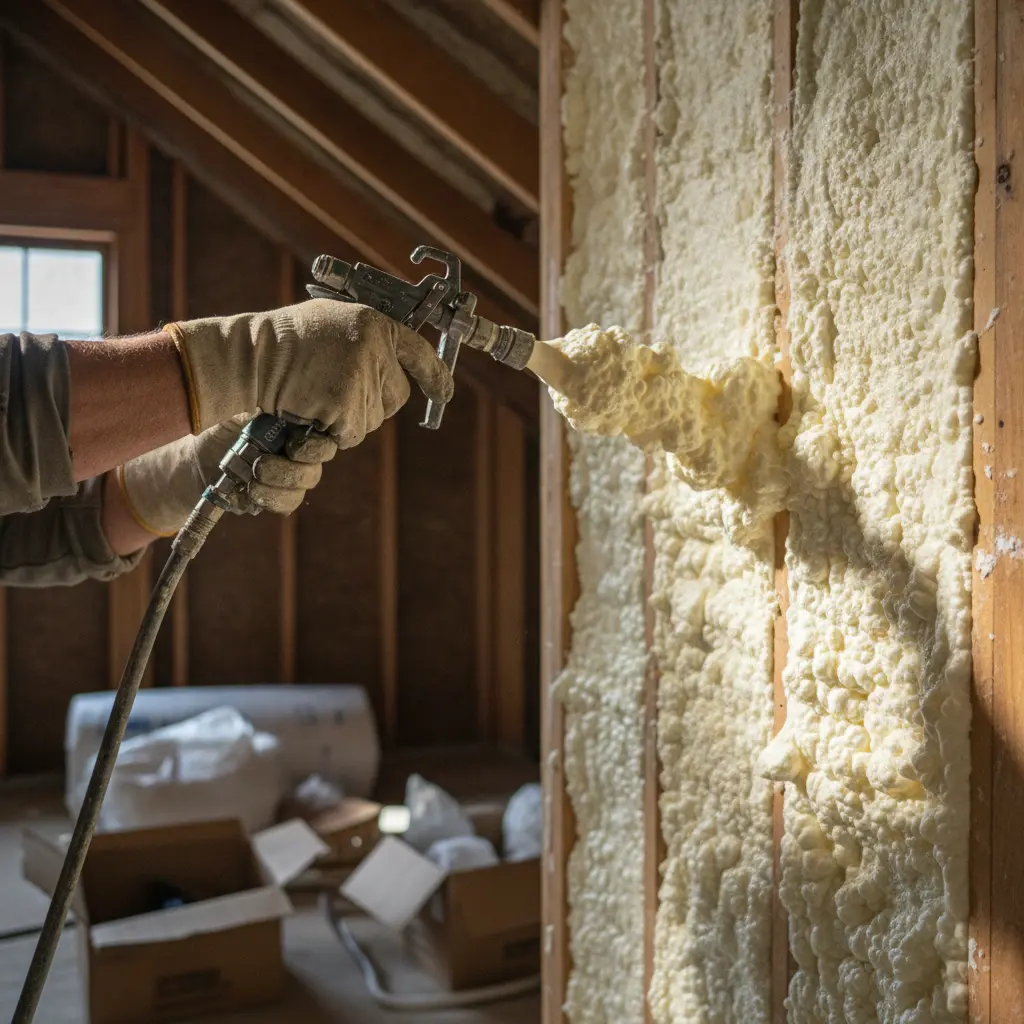
Our team in action — insulation professionals serving Los Angeles
How Los Angeles’s Climate Affects Your Insulation Material Choice
Los Angeles does not have one uniform climate — and your insulation strategy should reflect where in the region you live. Inland communities like the San Fernando Valley, San Gabriel Valley, and Inland Empire see prolonged heat waves with attic temperatures exceeding 140–160°F. In these areas, maximum R-value in the attic (R-38 to R-60) combined with an air-sealing layer — either spray foam or dense-pack cellulose — will deliver the greatest energy savings.
Coastal communities from Malibu to Long Beach experience milder summer temperatures but persistent marine layer humidity and salt-laden air. Here, moisture-resistant materials like closed-cell spray foam, mineral wool, or XPS rigid board outperform paper-faced fiberglass batts or untreated cellulose, which can degrade if moisture management is poor.
Homeowners in high wildfire risk zones — designated by CalFire as Very High Fire Hazard Severity Zones — should prioritize non-combustible or fire-resistant materials such as mineral wool batts, closed-cell spray foam, or fiberglass. California’s Title 24 and local fire codes may also impose additional requirements in these areas.
For attics in existing homes, blown-in products (cellulose or fiberglass) offer rapid, cost-effective coverage without disrupting living spaces. For walls in new construction, batts or rigid continuous insulation are standard. Crawl spaces in coastal or hillside properties benefit most from closed-cell spray foam or rigid XPS board to block ground moisture. Matching your specific location, home age, and renovation scope to the right material is the key to maximum return on investment.
Insulation Materials Available in Los Angeles, CA
Spray Foam Insulation
Spray polyurethane foam (SPF) is applied as a liquid that expands and hardens, creating a seamless air and moisture barrier. It comes in two forms: open-cell (lower density, more flexible) and closed-cell (denser, higher R-value, moisture-resistant). R-value ranges from R-3.5 per inch (open-cell) to R-6.5 per inch (closed-cell). In Los Angeles, closed-cell spray foam excels in coastal homes where humidity and salt air penetrate wall assemblies, and in wildfire-prone areas since cured foam adds structural rigidity. Open-cell foam is popular for interior attic applications. Drawbacks include higher upfront cost and the need for professional installation. Best used in attic rooflines, rim joists, crawl spaces, and hard-to-reach cavities. Installed cost typically ranges from $1.50 to $4.00 per square foot depending on thickness and foam type.
Blown-In (Loose-Fill) Insulation
Loose-fill insulation — made from fiberglass or cellulose — is machine-blown into attic floors and existing wall cavities, making it ideal for retrofitting older Los Angeles homes without major demolition. Fiberglass loose-fill offers R-2.2 to R-2.7 per inch; cellulose loose-fill achieves R-3.2 to R-3.8 per inch. In Los Angeles’s sun-baked attics, where temperatures can exceed 150°F in summer, a deep blanket of blown-in material significantly reduces heat transfer into living spaces below. The process is fast, minimally invasive, and cost-effective for large attic areas. Moisture can be a concern in coastal zip codes if vapor management isn’t addressed. Best applications include attic floors, existing closed wall cavities, and cathedral ceilings. Installed cost generally falls between $1.00 and $2.50 per square foot.
Fiberglass Batt Insulation
Fiberglass batts are pre-cut panels of spun glass fibers designed to fit standard stud and joist spacing. R-values range from R-11 to R-38 depending on thickness. Batts are one of the most widely used insulation materials in Los Angeles new construction and wall cavity upgrades because they are readily available, easy to install, and non-combustible — an important property in wildfire risk areas. However, batts must be fitted carefully to avoid gaps and compression, which dramatically reduce effective R-value in the hot climate. They offer limited air-sealing ability on their own. Fiberglass batts perform best in open wall cavities during construction or remodel, attic floors, and floors over garages. Installed cost typically ranges from $0.50 to $1.50 per square foot, making them one of the most budget-friendly options.
Mineral Wool / Rockwool Insulation
Mineral wool — also marketed as Rockwool or slag wool — is manufactured from volcanic rock or industrial slag spun into dense fibers. It achieves R-3.0 to R-4.2 per inch. For Los Angeles homeowners in wildfire interface communities such as Altadena, Sylmar, or the Santa Monica Mountains, mineral wool’s fire resistance (it withstands temperatures above 1,400°F without melting) is a compelling advantage. It is also naturally moisture-resistant, dimensionally stable, and an excellent sound absorber — valuable in dense urban neighborhoods. Mineral wool is heavier and costs more than standard fiberglass batts, but its durability and multi-hazard resistance justify the premium for many homeowners. Best applications include exterior walls, party walls, attic floors, and any fire-risk zone construction. Installed cost ranges from $1.00 to $2.50 per square foot.
Cellulose Insulation
Cellulose is made from recycled paper fiber treated with borate-based fire retardants and is one of the most environmentally sustainable insulation options available. It achieves R-3.2 to R-3.8 per inch. Blown-in cellulose fills irregular spaces thoroughly, reducing air infiltration significantly — a major benefit in aging Los Angeles homes with drafty attics and wall assemblies. Its dense-pack installation method makes it excellent for retrofitting existing walls without removing drywall. In coastal areas, cellulose requires careful moisture management because it can absorb water if not properly vapor-controlled, potentially leading to mold. Fire retardant treatment satisfies California fire code requirements. Cellulose works best in attic floors and dense-pack wall applications in older homes. Installed cost typically ranges from $0.90 to $2.00 per square foot, offering strong value per R-value unit.
Foam Board (Rigid) Insulation
Rigid foam board insulation consists of panels of expanded polystyrene (EPS), extruded polystyrene (XPS), or polyisocyanurate (polyiso). R-values range from R-3.8 per inch (EPS) to R-6.5 per inch (polyiso). Rigid foam excels in Los Angeles applications where space is limited but high R-value performance is needed — exterior wall sheathing, under-slab applications, garage doors, and crawl space walls. Polyiso performs exceptionally in hot climates like Los Angeles because its R-value holds stable at high temperatures. Foam board also provides a continuous insulation layer that eliminates thermal bridging through studs. It must be covered with a thermal barrier (drywall) per California building code if used in interior applications. Installed cost ranges from $1.25 to $3.50 per square foot depending on material type and thickness.
Ready for Insulation Materials & Types? Get Your Free Estimate Today.
Next Level Insulation of Los Angeles serves Los Angeles and the surrounding area — we’ll be on-site within 24 hours.
📞 Call (323) 765-3939Why Los Angeles Homeowners Trust Next Level Insulation of Los Angeles for Insulation
When selecting an insulation contractor in Los Angeles, experience with the full range of materials and deep knowledge of local climate conditions make the difference between an installation that performs for decades and one that falls short. Here is what sets Next Level Insulation of Los Angeles apart:
Insulation Materials FAQ for Los Angeles Homeowners
What is the best insulation type for Los Angeles’s climate?
There is no single best material — the right choice depends on your location within Los Angeles, your home’s construction, and the specific area being insulated. For hot inland communities, blown-in cellulose or fiberglass in the attic combined with air sealing delivers strong performance. For coastal homes, moisture-resistant options like closed-cell spray foam or mineral wool are preferred. For wildfire-risk areas, mineral wool and fiberglass are the top choices due to their non-combustible properties.
What R-value do I need for my Los Angeles home?
California’s Title 24 energy code sets minimum R-values based on climate zone. In most Los Angeles areas (Climate Zones 6 and 9), attic insulation should reach at least R-38, with R-49 to R-60 recommended for maximum savings in hotter inland zones. Wall insulation minimums are typically R-13 to R-21 depending on construction type. Crawl space and floor insulation commonly targets R-19 to R-30. An on-site assessment will confirm the right targets for your specific home.
How do insulation material costs compare in Los Angeles?
Fiberglass batts are generally the lowest-cost option at $0.50–$1.50 per square foot installed. Blown-in cellulose and fiberglass are moderately priced at $0.90–$2.50 per square foot. Mineral wool runs $1.00–$2.50 per square foot. Rigid foam board costs $1.25–$3.50 per square foot. Spray foam is the most expensive at $1.50–$4.00 or more per square foot, but its air-sealing capability and high R-per-inch value can offset higher upfront costs through long-term energy savings.
Is attic insulation or wall insulation more important in Los Angeles?
In Los Angeles’s climate, attic insulation typically delivers the highest return on investment because roofs absorb intense solar radiation, and an under-insulated attic allows enormous heat gain into the living space below. That said, wall insulation is critical in older Los Angeles homes built before 1980, many of which have little to no wall insulation. Ideally, both are addressed — but if budget requires prioritization, the attic should come first.
How much can I save on energy bills by upgrading insulation?
According to the U.S. Department of Energy, proper insulation and air sealing can reduce heating and cooling costs by 10–20% or more. In Los Angeles, where air conditioning runs for an extended season, homeowners with poorly insulated attics often see the most dramatic savings after upgrading — sometimes cutting cooling costs by 25% or more. Actual savings depend on current insulation levels, home size, HVAC efficiency, and the material and R-value installed.
Are there rebates or tax credits available for insulation in California?
Yes. California homeowners may qualify for several financial incentives. The federal Inflation Reduction Act (IRA) provides a 30% tax credit (up to $1,200 per year) for qualifying insulation improvements as part of the Energy Efficient Home Improvement Credit. Southern California Edison and SoCalGas both offer rebates for insulation upgrades that meet minimum R-value thresholds. The California Energy Commission’s TECH Clean California program also supports weatherization upgrades. Eligibility and amounts change periodically, so confirming current program details at the time of your installation is important.
Can insulation help with wildfire protection in Los Angeles?
While insulation alone cannot protect a home from a wildfire, choosing fire-resistant materials adds an important layer of protection. Mineral wool insulation withstands temperatures above 1,400°F and does not contribute to flame spread. Fiberglass is also non-combustible. In CalFire-designated Very High Fire Hazard Severity Zones throughout the Los Angeles hills and canyons, using fire-resistant insulation in attics, walls, and eaves is a smart risk-reduction strategy that may also support compliance with local fire codes.
How do I know if my existing insulation needs to be replaced?
Signs that your insulation may need upgrading include consistently high cooling or heating bills, uneven room temperatures, visible settling or thinning of attic insulation, water damage or mold in insulated areas, and a home built before 1980 that has never had insulation upgraded. A professional insulation assessment uses measurements and thermal evaluation to determine current R-values and identify areas where performance has degraded, helping you prioritize improvements for the best results.
Get a Free Insulation Assessment in Los Angeles
Not sure which insulation material is right for your Los Angeles home? Next Level Insulation of Los Angeles offers free, no-obligation insulation assessments for homeowners throughout the greater Los Angeles area. Our licensed and insured team will evaluate your attic, walls, and crawl space, measure existing R-values, and provide honest, material-specific recommendations that fit your budget and your home’s unique climate challenges.
Whether you’re dealing with a sweltering San Fernando Valley attic, coastal humidity in Santa Monica, or wildfire-risk concerns in the foothills, we have the expertise and product knowledge to match you with the right solution. Call us today at (323) 765-3939 to schedule your free assessment and take the first step toward a more comfortable, energy-efficient home.