

Spray Foam Insulation in Los Angeles, CA
Energy-Saving Spray Foam Insulation for Los Angeles, CA Homes — Licensed & Insured
Need spray foam insulation in Los Angeles, CA? Next Level Insulation offers expert installation for attics, crawl spaces & more. Call (323) 765-3939 for a free estimate.
- Licensed & Insured
- Locally Owned & Operated
- Free Inspection & Estimate
Request Your
Free EstimateSpray foam insulation is one of the most advanced and energy-efficient insulation solutions available today, creating an airtight thermal and moisture barrier that outperforms traditional insulation materials in nearly every measurable way. At Next Level Insulation of Los Angeles, we specialize in professional spray foam insulation services tailored to the unique demands of Los Angeles homes and commercial buildings.
Los Angeles presents a distinct set of insulation challenges — from the intense summer heat radiating off the Santa Monica Mountains to the marine layer humidity rolling in from the Pacific, and the wide daily temperature swings experienced in inland neighborhoods like the San Fernando Valley. These local conditions make choosing the right insulation not just a comfort decision, but a critical energy and structural one.
Our team understands the local building codes, climate zones, and architectural styles that define Los Angeles construction — from mid-century Modern hillside homes in Silver Lake to post-war stucco bungalows in Boyle Heights. Call us today at (323) 765-3939 to schedule your consultation.
Understanding Spray Foam Insulation
Spray foam insulation is a two-component liquid material — isocyanate and polyol resin — that, when combined through a specialized spray gun, chemically reacts and expands into a dense foam that seals gaps, fills cavities, and creates a continuous thermal envelope. It was first developed for commercial use in the 1940s and became widely adopted in residential construction beginning in the 1980s as energy codes tightened across California and the nation.
There are two primary types of spray foam used in residential and commercial applications:
- Open-Cell Spray Foam: A softer, more flexible foam with an R-value of approximately R-3.5 to R-3.8 per inch. It excels at sound dampening and is commonly used in interior walls and between floor joists. Its vapor-permeable nature makes it suitable for certain climate conditions.
- Closed-Cell Spray Foam: A rigid, dense foam with an impressive R-value of R-6 to R-7 per inch. It is vapor-impermeable, adds structural rigidity to walls, and acts as a moisture barrier — making it ideal for attics, crawl spaces, and exterior-facing assemblies in Los Angeles’s varied microclimates.
In Los Angeles, spray foam insulation is increasingly being specified in new construction under Title 24 — California’s Building Energy Efficiency Standards — which requires higher insulation performance than most other U.S. states. The California Energy Commission updates Title 24 periodically, with the most recent 2022 standards pushing R-value requirements higher than ever, making spray foam a preferred solution for builders and remodelers looking to meet or exceed compliance.
Los Angeles’s diverse building stock — spanning Craftsman bungalows from the 1910s in Highland Park, Spanish Colonial Revival homes from the 1920s in Hancock Park, modernist structures in West Hollywood, and dense multi-family housing across East Los Angeles — means that spray foam must be adapted to a wide variety of structural configurations, wall depths, and existing insulation conditions. Next Level Insulation of Los Angeles has extensive experience navigating all of these building types.
Beyond energy savings, spray foam insulation improves indoor air quality by reducing infiltration of outdoor pollutants, allergens, and wildfire smoke — a growing concern for Los Angeles residents in fire-adjacent communities such as those near the Angeles National Forest.
Why Spray Foam Insulation Is Needed in Los Angeles, CA
Los Angeles sits within California Climate Zone 9 (inland valleys) and Climate Zone 10 (portions of the San Fernando Valley), with coastal neighborhoods falling into Climate Zone 8. This diversity means that a single neighborhood can experience summer temperatures exceeding 100°F while a coastal community just 10 miles away stays below 75°F. Without proper insulation, these temperature differentials translate directly into skyrocketing utility bills and uncomfortable living conditions.
Extreme Heat Events: The September 2022 Southern California heat dome pushed temperatures in Downtown Los Angeles to 109°F — the highest recorded temperature in the city’s history. The San Fernando Valley communities of Woodland Hills and Canoga Park regularly see summer highs of 105°F to 110°F. Homes built before the 1978 California energy code changes frequently have little to no insulation in their attic assemblies, allowing radiant heat to transfer directly into living spaces and forcing air conditioning systems to work overtime.
The Marine Layer and Humidity: The marine layer — a low-lying coastal fog driven inland from the Pacific Ocean — introduces consistent moisture into neighborhoods like Culver City, West Hollywood, and portions of South Gate. This persistent humidity can penetrate poorly sealed building envelopes, leading to moisture accumulation in wall cavities and attic spaces. Over time, this moisture causes wood rot, mold growth, and degrades traditional batt insulation, reducing its effective R-value by up to 40% when wet.
Wildfire Smoke Infiltration: The 2018 Woolsey Fire burned over 96,000 acres and sent hazardous smoke throughout the greater Los Angeles basin for weeks. During fire events, homes with inadequate air sealing allow smoke particulates to infiltrate through gaps in the building envelope — around electrical outlets, recessed lighting, and unsealed attic hatches. Closed-cell spray foam creates a continuous air barrier that dramatically reduces smoke infiltration, protecting occupants with respiratory sensitivities.
Seismic Activity and Structural Considerations: Los Angeles sits on the Pacific Ring of Fire, with the Newport-Inglewood Fault, the Hollywood Fault, and the Puente Hills Fault all posing seismic risk. The 1994 Northridge Earthquake (6.7 magnitude) caused widespread structural damage across the San Fernando Valley. Closed-cell spray foam adds measurable structural racking strength to wall assemblies — studies show it can increase wall racking resistance by up to 300% — providing an additional layer of structural resilience between seismic events.
Energy Costs: Los Angeles Department of Water and Power (LADWP) residential electricity rates reached a baseline of approximately $0.22 per kilowatt-hour in 2023, among the highest in the nation. Homes with inadequate insulation can spend 30% to 50% more on annual cooling costs compared to well-insulated equivalents. For a typical 1,500-square-foot Los Angeles home, this can represent $800 to $1,500 in unnecessary annual energy expenditure — costs that spray foam insulation directly addresses.
Signs You Need Spray Foam Insulation in Los Angeles
Energy and Comfort Indicators
- Monthly LADWP electric bills consistently exceeding $250 to $300 during summer months
- Rooms that remain uncomfortably hot even with air conditioning running
- Noticeable temperature differences between rooms on the same floor — often a 5°F or greater variance
- HVAC system running continuously during Santa Ana wind events or summer heat domes
Structural and Moisture Warning Signs
- Visible moisture staining or discoloration on ceilings or interior walls, especially in coastal-adjacent neighborhoods
- Musty odors emanating from attic spaces or crawl spaces — often indicative of mold growth in degraded insulation
- Drafts felt near electrical outlets, window frames, or along baseboards during windy conditions
- Sagging, compressed, or visibly damaged batt insulation when accessing the attic
Air Quality and Indoor Environment
- Increased dust accumulation throughout the home despite regular cleaning
- Smoke odors or outdoor pollution smells penetrating the interior during fire season
- Elevated allergy or asthma symptoms among household members, potentially linked to outdoor particulate infiltration
Urgency Indicators
If your home was built before 1978, has never had insulation replaced, or has recently experienced water intrusion from roof leaks or plumbing failures, scheduling a professional inspection with Next Level Insulation of Los Angeles should be treated as a priority — not a convenience.
Our Spray Foam Insulation Process in Los Angeles
Initial Consultation and Energy Assessment (1–2 Hours)
We begin with a comprehensive site visit to assess your home’s existing insulation, air sealing condition, and building envelope performance. Our technicians use thermal imaging cameras to identify heat loss patterns and infiltration points specific to your structure and neighborhood’s microclimate.
Customized Project Proposal (24–48 Hours)
Based on our assessment, we develop a detailed written proposal specifying the spray foam type (open-cell or closed-cell), coverage areas, target R-values calibrated to your Title 24 climate zone requirements, and total project cost. We identify whether permits are required under the Los Angeles Department of Building and Safety (LADBS) — generally required for projects involving new construction or significant renovation work.
Pre-Installation Preparation (2–4 Hours)
Before spraying begins, our crew clears and protects surfaces, covers HVAC registers, seals off adjacent living areas, and verifies that attic and crawl space conditions meet moisture thresholds safe for foam application. In Los Angeles’s coastal-influenced neighborhoods, we pay particular attention to existing moisture levels before applying closed-cell foam to exterior assemblies.
Spray Foam Application (4–8 Hours Depending on Scope)
Our certified technicians apply spray foam in controlled passes to ensure proper chemical mixing ratios and consistent cell structure. Closed-cell foam is applied in layers no thicker than 2 inches per pass to manage exothermic heat. We monitor ambient temperature and humidity conditions throughout application — a critical step in Los Angeles where marine layer conditions in the morning can transition to low-humidity afternoon air.
Curing and Off-Gassing Period (24 Hours)
After application, the foam requires a minimum 24-hour curing and off-gassing period. Occupants should vacate the treated areas during this time. We provide detailed re-entry guidelines in compliance with California’s Proposition 65 requirements.
Inspection and Thermal Verification (1–2 Hours)
Post-installation, we conduct a thermal imaging scan to verify uniform coverage, identify any voids or thin spots, and confirm that the installed R-value meets the project specifications and applicable Title 24 requirements.
Cleanup and Final Walkthrough (1 Hour)
We restore the work area, remove all protective coverings, and conduct a final client walkthrough to review the completed installation and provide maintenance guidance specific to your Los Angeles home’s insulation system.
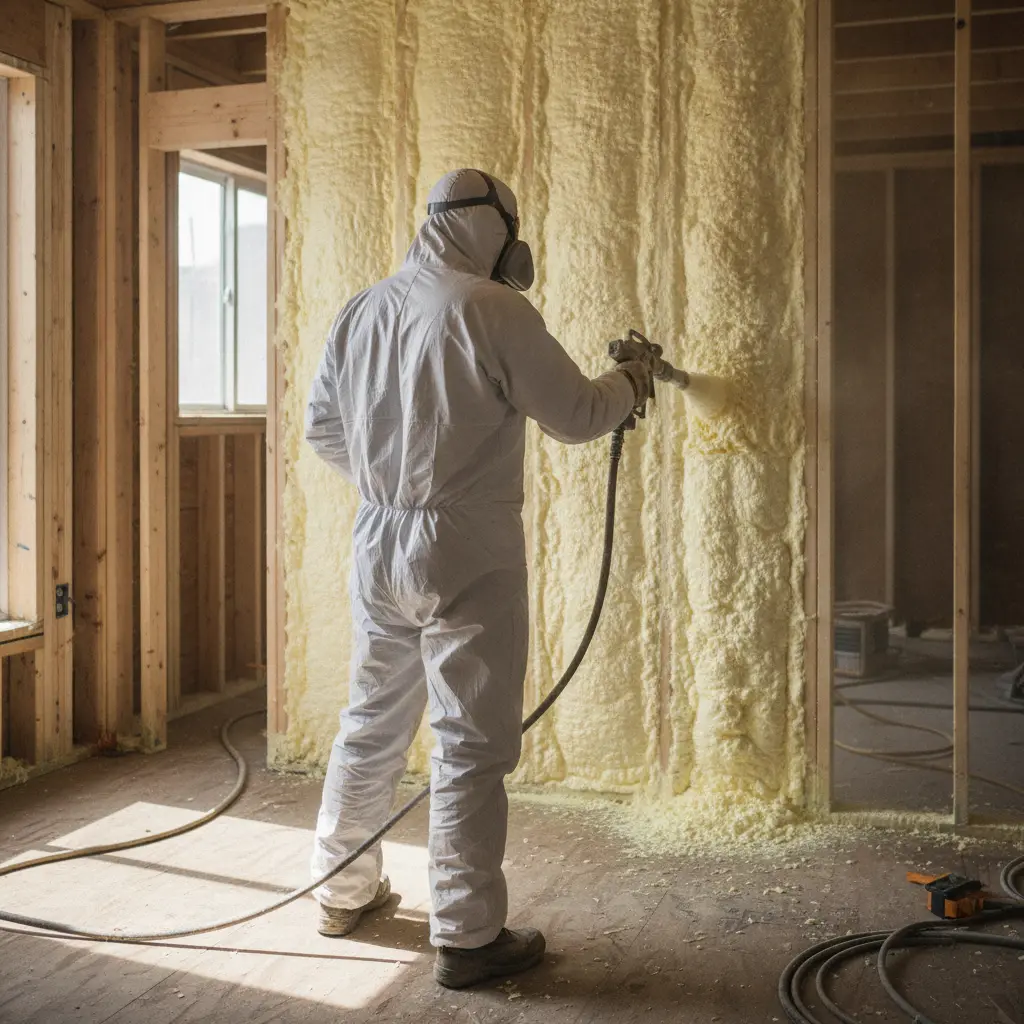
Our team in action — insulation professionals serving Los Angeles
Spray Foam Insulation Methods and Approaches
Closed-Cell Spray Foam for Attics and Roof Decks
Applying closed-cell spray foam directly to the underside of roof decking creates an unvented conditioned attic — a highly effective approach in Los Angeles’s hot inland climates. By moving the thermal boundary to the roof deck rather than the attic floor, HVAC equipment and ductwork located in the attic are now within the conditioned envelope, dramatically improving system efficiency. This method is particularly effective in Pasadena and Glendale homes where summer attic temperatures can reach 160°F or higher.
Open-Cell Spray Foam for Interior Walls and Sound Control
Open-cell foam is the preferred choice for interior wall cavities in multi-family buildings and urban Los Angeles homes where noise from neighboring units, street traffic, or proximity to freeways like the I-10 or US-101 is a quality-of-life concern. It provides an STC (Sound Transmission Class) rating improvement of 15–20 points over uninsulated walls.
Closed-Cell Foam for Crawl Spaces and Below-Grade Applications
Homes in areas with older construction — particularly in East Los Angeles, Montebello, and Maywood — often have unencapsulated crawl spaces that allow moisture and soil gases to infiltrate the living space. Closed-cell spray foam applied to crawl space walls and rim joists creates a moisture-resistant encapsulation system. Learn more about our crawl space encapsulation services
Flash-and-Batt Hybrid System
For cost-conscious projects where maximum R-value is needed within a limited budget, we employ a flash-and-batt approach — applying a 1- to 2-inch layer of closed-cell spray foam to exterior wall sheathing for air and moisture control, then filling the remaining cavity depth with blown-in or batt insulation to achieve code-required R-values.
Ready for Spray Foam Insulation? Get Your Free Estimate Today.
Next Level Insulation of Los Angeles serves Los Angeles and the surrounding area — we’ll be on-site within 24 hours.
📞 Call (323) 765-3939Spray Foam Insulation Cost in Los Angeles, CA
Understanding spray foam insulation costs in Los Angeles requires accounting for local labor rates, material costs, project complexity, and the specific foam type selected. Below are typical price ranges for our Los Angeles service area:
- Open-Cell Spray Foam: $1.00 to $1.50 per board foot (one square foot, one inch thick). For a typical 1,500-square-foot attic at 3.5 inches of coverage, expect a total cost of $5,250 to $7,875.
- Closed-Cell Spray Foam: $1.75 to $3.00 per board foot. For the same 1,500-square-foot attic at 3 inches of coverage, total costs range from $7,875 to $13,500.
- Crawl Space Encapsulation with Spray Foam: $2,500 to $6,500 depending on crawl space square footage and access complexity.
- Whole-Home Air Sealing Package: $3,500 to $9,000 for a comprehensive approach combining spray foam with supplemental air sealing at penetrations.
Los Angeles-Specific Cost Factors
- Los Angeles labor rates are 15% to 25% higher than national averages due to the local cost of living and licensing requirements under the California Contractors State License Board (CSLB)
- Permit fees through the Los Angeles Department of Building and Safety (LADBS) can add $200 to $800 to applicable projects
- Homes with existing damaged or contaminated insulation requiring removal before spray foam installation will incur additional costs of $1.00 to $2.50 per square foot for removal Learn more about our insulation removal services
- LADWP rebate programs may offset costs by $200 to $500 for qualifying insulation upgrades — our team can guide you through the application process
Call us at (323) 765-3939 for a free, no-obligation estimate specific to your Los Angeles property.
Spray Foam Insulation Service Areas in Los Angeles
Pasadena
Pasadena’s housing stock includes many homes built during the 1910s–1930s Craftsman era, which were constructed with minimal wall insulation. The city’s inland location means summer temperatures regularly exceed 100°F, making closed-cell attic insulation upgrades particularly valuable for energy savings.
Culver City and West Hollywood
These coastal-adjacent communities experience the marine layer’s persistent humidity, increasing the risk of moisture-related insulation degradation. Vapor-impermeable closed-cell spray foam is frequently the recommended solution for crawl spaces and exterior wall assemblies in these neighborhoods.
East Los Angeles and Maywood
Dense with post-war construction from the 1940s–1960s, these communities contain a high proportion of homes with original fiberglass batt insulation that has compressed, degraded, or been contaminated over decades. Insulation removal and spray foam replacement is a common project profile in these areas. Explore our insulation replacement services
Glendale and Montebello
These communities blend older residential housing with newer commercial and multi-family development. Our team is experienced with both residential attic applications and commercial spray foam projects in these growing areas.
We also serve: Cudahy, Bell Gardens, Alhambra, Bell, Commerce, Downey, South Pasadena, Huntington Park, South Gate, Walnut Park, and surrounding communities. View our full service area
Spray Foam Insulation Maintenance Tips for Los Angeles Homeowners
- Annual Attic Inspections: Inspect your attic each fall before Southern California’s rainy season begins (typically November through March) to verify that spray foam remains intact and no roof leaks have compromised the insulation surface.
- Monitor for UV Exposure: Open-cell spray foam exposed to sunlight in unconditioned attic spaces can degrade over time. Ensure exposed foam surfaces are coated with an appropriate thermal barrier or intumescent paint as required by Los Angeles building code.
- Check Crawl Space Conditions: Following heavy rainfall events — which can produce 3 to 4 inches of rain in a single storm during El Niño years — inspect your crawl space for standing water that could affect foam adhesion and performance.
- Seal New Penetrations Promptly: Any new electrical, plumbing, or HVAC penetrations through insulated assemblies should be professionally re-sealed with compatible spray foam or caulking immediately after installation.
- Fire Season Preparation: Before wildfire season (June through November), verify that all attic vents are screened with ember-resistant mesh and that your spray foam’s air barrier is intact to minimize smoke infiltration during regional fire events.
- HVAC Filter Changes: A properly insulated and air-sealed home will operate more efficiently — but consistent HVAC filter changes every 60–90 days maintain the system performance that your insulation investment enables.
- Schedule Professional Re-Inspection Every 5–7 Years: While spray foam is extremely durable, professional thermal imaging inspections every five to seven years confirm continued performance and identify any areas where foam may have separated from substrates following seismic activity.
Why Choose Next Level Insulation of Los Angeles
At Next Level Insulation of Los Angeles, we bring specialized expertise in the insulation challenges unique to Southern California’s climate zones, building types, and regulatory environment. Our team is deeply familiar with Los Angeles Department of Building and Safety requirements, Title 24 compliance standards, and the specific performance demands placed on insulation in a city where summer heat, coastal humidity, wildfire smoke, and seismic activity all intersect.
We offer the full spectrum of insulation services — from spray foam and attic insulation to blow-in insulation, crawl space insulation, and complete insulation removal and replacement — giving our clients a single, accountable partner for every phase of their insulation project.
Our service area spans the greater Los Angeles basin, from Pasadena to Culver City and from Glendale to South Gate, meaning our technicians are intimately familiar with the neighborhood-level climate and construction nuances that influence every project we undertake.
Ready to experience the Next Level difference? Call us at (323) 765-3939 to schedule your free in-home assessment.
Frequently Asked Questions About Spray Foam Insulation in Los Angeles
How much does spray foam insulation cost in Los Angeles?
Spray foam insulation in Los Angeles typically costs between $1.00 and $1.50 per board foot for open-cell foam and $1.75 to $3.00 per board foot for closed-cell foam. A complete attic insulation project for a 1,500-square-foot Los Angeles home generally ranges from $5,250 to $13,500 depending on foam type and coverage depth. Local labor rates and LADBS permit requirements can influence final pricing. Call (323) 765-3939 for a precise estimate.
How long does spray foam insulation last in the Los Angeles climate?
Properly installed spray foam insulation can last the lifetime of the building — 80 years or more — when protected from direct UV exposure and physical damage. In Los Angeles’s climate, where UV intensity is high and temperature cycling is significant, closed-cell foam in attic applications performs especially well due to its dimensional stability under thermal stress.
Does spray foam insulation help during Los Angeles wildfire season?
Yes. Closed-cell spray foam creates a continuous air barrier that significantly reduces the infiltration of smoke particulates and toxic gases during wildfire events — a critical benefit for Los Angeles residents near fire-prone areas like the Santa Monica Mountains, Angeles National Forest, and foothill communities. It is not fireproof, but it substantially reduces smoke infiltration compared to conventionally insulated homes.
Do I need a permit for spray foam insulation in Los Angeles?
Permit requirements depend on the scope of work. Insulation replacement within an existing assembly typically does not require a permit in Los Angeles. However, if the project involves structural modifications, changes to the building envelope, or new construction, a permit from the Los Angeles Department of Building and Safety (LADBS) may be required. Our team assesses permit requirements during the initial consultation.
How long does the spray foam installation process take?
Most residential spray foam projects in Los Angeles are completed within one to two days. The application itself takes four to eight hours depending on square footage and complexity. A 24-hour off-gassing and curing period is required before occupants re-enter treated spaces. Total project duration from scheduling to completion is typically five to ten business days, including the initial consultation and post-installation inspection.
Is spray foam insulation safe for my family?
Once fully cured (within 24 hours of application), spray foam insulation is inert and safe for occupants. During installation and the curing period, the space must be vacated. We follow all California Proposition 65 and EPA guidelines for safe application and re-entry. Our team provides detailed safety guidance specific to your home’s ventilation configuration.
Can spray foam insulation be installed in older Los Angeles homes?
Absolutely. Many Los Angeles homes built before 1978 — particularly Craftsman bungalows, Spanish Revival homes, and post-war stucco construction — are ideal candidates for spray foam upgrades. However, older homes may require asbestos or lead paint testing before work begins if existing insulation or surfaces will be disturbed. We can advise on pre-project testing requirements based on your home’s construction era.
What is the difference between spray foam and blown-in insulation for a Los Angeles attic?
Blown-in insulation fills the attic floor cavity and is a cost-effective way to increase R-value, but it does not air seal the building envelope. Spray foam, particularly when applied to the roof deck, provides both insulation and continuous air sealing — a significant advantage in Los Angeles where air infiltration accounts for a substantial portion of cooling energy loss. Compare blown-in insulation options here
Get a Free Spray Foam Insulation Estimate in Los Angeles Today
Don’t let another scorching Los Angeles summer or wildfire season leave your home vulnerable to extreme heat, moisture, or smoke infiltration. Next Level Insulation of Los Angeles is ready to help you achieve a more comfortable, energy-efficient, and resilient home with professional spray foam insulation services designed specifically for the Los Angeles climate and building environment.
Whether you’re in Pasadena, Culver City, Glendale, South Gate, or any of our other service communities throughout the greater Los Angeles basin, our team is ready to provide a thorough, no-obligation assessment and competitive estimate.
Call us today at (323) 765-3939 or contact us online to schedule your free consultation. Experience the Next Level difference — insulation expertise built for Los Angeles.