

Attic Insulation in Los Angeles, CA
Energy-Saving Attic Insulation for Los Angeles, CA Homes — Licensed & Insured
Need attic insulation in Los Angeles, CA? Next Level Insulation serves all of LA County. Get R-38–R-60 upgrades, free assessments & LADWP rebate help. Call (323) 765-3939.
- Licensed & Insured
- Locally Owned & Operated
- Free Inspection & Estimate
Request Your
Free EstimateAttic insulation is the thermal and air-sealing barrier installed between your living space and the roof structure above, preventing unwanted heat transfer and dramatically reducing energy consumption. In Los Angeles, where summer temperatures in the San Fernando Valley can spike past 110°F and rooftop surface temperatures on low-slope residential roofs exceed 160°F, a properly insulated attic is not a luxury — it is a structural and financial necessity.
Next Level Insulation of Los Angeles specializes in attic insulation solutions tailored to the unique building stock, climate zones, and energy codes that define the greater Los Angeles area. Whether your home sits in the coastal marine layer of Culver City, the inland heat corridor of Pasadena, or the dense urban grid of East Los Angeles, our team arrives with the product knowledge, equipment, and local experience needed to maximize comfort and lower your monthly utility bills. Call us today at (323) 765-3939 to schedule a free assessment.
Understanding Attic Insulation in Los Angeles, CA
Attic insulation works on a straightforward thermodynamic principle: slow the movement of heat through your roof assembly. During the day, solar radiation heats your roof deck, and without adequate insulation, that heat radiates downward into living spaces, forcing air conditioners to run longer and work harder. At night — particularly in coastal Los Angeles where marine layer cooling can drop temperatures 20°F to 30°F within hours — the same insulation layer retains conditioned warmth inside rather than allowing it to escape into the cooler atmosphere.
The concept of adding insulative material to attic cavities became a standard residential practice in the United States during the energy crisis of the 1970s. Before that period, the vast majority of Los Angeles homes built during the post-World War II boom — spanning roughly 1945 to 1965 — were constructed with little to no attic insulation, or with degraded fiberglass batts rated at R-11 or less. California’s Title 24 Building Energy Efficiency Standards, first adopted in 1978 and updated every three years since, now require a minimum of R-38 in most Los Angeles climate zones, with Climate Zone 9 (covering much of the Los Angeles Basin) and Climate Zone 10 (the hotter inland areas including Pasadena and Alhambra) each carrying specific insulation depth requirements for new construction and qualifying renovations.
The Los Angeles housing stock is extraordinarily diverse. You will find 1920s Spanish Colonial bungalows in Glendale with shallow hip roofs and narrow rafter cavities, post-war tract homes in Downey with open attic spaces ideal for blown-in insulation, 1960s flat-roof dingbats throughout West Hollywood that require specialty board insulation approaches, mid-century Modern homes in South Pasadena with exposed beam ceilings that demand spray foam application, and modern multi-unit construction in Monterey Park that must meet stricter Title 24 2022 compliance thresholds. Each building type demands a different insulation strategy, which is why local expertise is irreplaceable when selecting materials and methods.
Learn more about our spray foam insulation services or explore our blow-in insulation options for full details on each product line.
Why Attic Insulation Is Needed in Los Angeles, CA
Extreme Thermal Swings and Mediterranean Climate Stress
Los Angeles sits within a semi-arid Mediterranean climate characterized by hot, dry summers and mild, occasionally wet winters. The county spans multiple microclimates: coastal zones near Culver City and West Hollywood experience average summer highs around 82°F, while inland zones like Pasadena, Alhambra, and Montebello regularly record temperatures exceeding 100°F from June through September. During the September 2022 heat event — one of the most severe on record — Pasadena reached 109°F and downtown Los Angeles hit 108°F, overwhelming cooling systems in thousands of under-insulated homes. Proper attic insulation at R-38 to R-60 depth can reduce attic air temperatures by 20°F to 40°F compared to uninsulated or under-insulated assemblies, directly reducing compressor runtime and protecting HVAC equipment from premature failure.
Santa Ana Wind Events and Combustion Debris
The Santa Ana wind events that sweep through Los Angeles County from October through March — with gusts regularly exceeding 60 mph in the Glendale Narrows and the passes above Pasadena — deposit debris, ash, and particulate matter into attic ventilation systems. The 2017 Thomas Fire, the 2018 Woolsey Fire (which burned into the hillsides above West Hollywood and Culver City), and the January 2025 Eaton Fire (devastating neighborhoods near Altadena, adjacent to Pasadena) all introduced combustion byproducts into regional air circulation. This debris accelerates degradation of older fiberglass insulation, reducing its effective R-value and creating air quality concerns in living spaces below. Insulation replacement and air sealing after fire events is now a recognized need across the northeast Los Angeles corridor.
Aging Housing Stock and Title 24 Non-Compliance
Approximately 60% of single-family homes in Los Angeles County were built before 1980, many with original insulation that has compacted, settled, or been contaminated by rodent activity. In neighborhoods like East Los Angeles, Bell Gardens, and Huntington Park — where dense blocks of 1940s and 1950s construction predominate — it is common to find attics with less than 3 inches of settled, degraded blown mineral wool that delivers an effective R-value of R-7 or less. Current California code requires R-38 minimum in these climate zones, meaning many existing homes operate at less than 20% of code-required thermal performance.
Utility Costs and LADWP Rate Structures
LADWP (Los Angeles Department of Water and Power) operates a tiered rate structure that penalizes high summer electricity consumption. Households in the top billing tier pay rates exceeding $0.35 per kWh during peak summer months. A home with inadequate attic insulation may run its air conditioning 30% to 50% more hours per day during heat events. Upgrading from R-11 to R-49 attic insulation in a typical 1,500-square-foot Los Angeles bungalow can reduce cooling energy consumption by 15% to 25%, translating to $200 to $600 in annual savings depending on occupancy and thermostat settings.
Pest and Moisture Damage to Existing Insulation
The mild Los Angeles winters create ideal overwintering habitat for roof rats — a well-documented problem in neighborhoods including Boyle Heights, Maywood, and Commerce. Rat nesting and tunneling collapses blown insulation and saturates batts with urine, rendering them ineffective and biologically hazardous. Our insulation removal service safely extracts contaminated material before new installation begins.
Signs You Need Attic Insulation in Los Angeles
Energy and Comfort Indicators
- Monthly LADWP bills that spike above $250 to $350 in summer months for homes under 1,800 square feet
- Rooms on the top floor consistently 5°F to 10°F warmer than rooms on lower floors
- Air conditioning running continuously during afternoon hours without reaching the set thermostat temperature
- Noticeable warm ceiling surfaces when placing your hand against the drywall on hot days
Physical and Structural Signs
- Visible insulation depth below 10 inches when viewed through the attic access hatch (indicating less than R-30 coverage)
- Insulation that appears gray, matted, or compacted rather than fluffy and lofted
- Evidence of rodent tunneling, nesting material, or droppings within the insulation layer
- Musty or ammonia-like odors emanating from ceiling registers or the attic access panel
- Dark staining or streaking on insulation surfaces near eave vents, indicating airflow bypasses
Urgency Indicators
- Your home was built before 1980 and has never had insulation professionally assessed or upgraded
- Your property is located in Pasadena, Alhambra, or Montebello — all in Climate Zone 10 with the highest seasonal temperature variation in the county
- You have recently experienced water intrusion or roof repair, which may have compressed or wetted existing insulation
Our Attic Insulation Process in Los Angeles
Free On-Site Assessment (Day 1 — 60 to 90 Minutes)
Our technician visits your property, accesses the attic, and measures existing insulation depth using a calibrated depth probe at a minimum of six representative points across the attic floor. We document current R-value, identify air bypasses at top plates, recessed light fixtures, plumbing penetrations, and HVAC chases, and photograph conditions including any evidence of pest activity, moisture, or prior fire debris. In Los Angeles homes with low-pitch roofs, we also assess eave clearance to confirm proper ventilation baffles can be installed.
Insulation Removal (if Required — Day 2 to 3, 4 to 8 Hours)
When existing material is contaminated, compacted below R-11, or fire-event compromised, we perform full removal using HEPA-filtered vacuum extraction equipment. All debris is double-bagged and disposed of per Los Angeles County waste disposal regulations. Learn more about our removal process here.
Air Sealing (Day 2 to 3, 2 to 4 Hours)
Air leakage accounts for up to 40% of heat gain in older Los Angeles homes. We seal all top-plate gaps, recessed light boxes, and plumbing penetrations with two-component spray foam or fire-rated caulk before any insulation is installed. This step is required for Title 24 compliance in qualifying projects.
Baffle and Ventilation Preparation (Day 3, 1 to 2 Hours)
We install AccuVent or equivalent rafter baffles from eave to ridge to maintain a minimum 1-inch clear air channel, ensuring proper attic ventilation that prevents moisture accumulation — critical in coastal Los Angeles ZIP codes where morning marine layer humidity regularly reaches 90%.
Insulation Installation (Day 3 to 4, 4 to 8 Hours)
Depending on the selected method, we install blown-in cellulose, blown fiberglass, or spray polyurethane foam to achieve the target R-value — typically R-38 to R-60 for Los Angeles residential projects. Our blowing equipment is truck-mounted for consistent density and coverage.
Post-Installation Inspection and Documentation (Day 4, 30 to 60 Minutes)
We measure final insulation depth at multiple points, photograph completed coverage, and provide a written completion report including product data sheets, R-value certification, and any Title 24 compliance documentation required for permit closure.
Cleanup and Walkthrough (Day 4, 30 Minutes)
We remove all equipment and debris, restore attic access hatches with weatherstripped insulated covers (R-10 minimum recommended for Los Angeles Climate Zones 9 and 10), and walk you through completed work and ongoing maintenance recommendations.
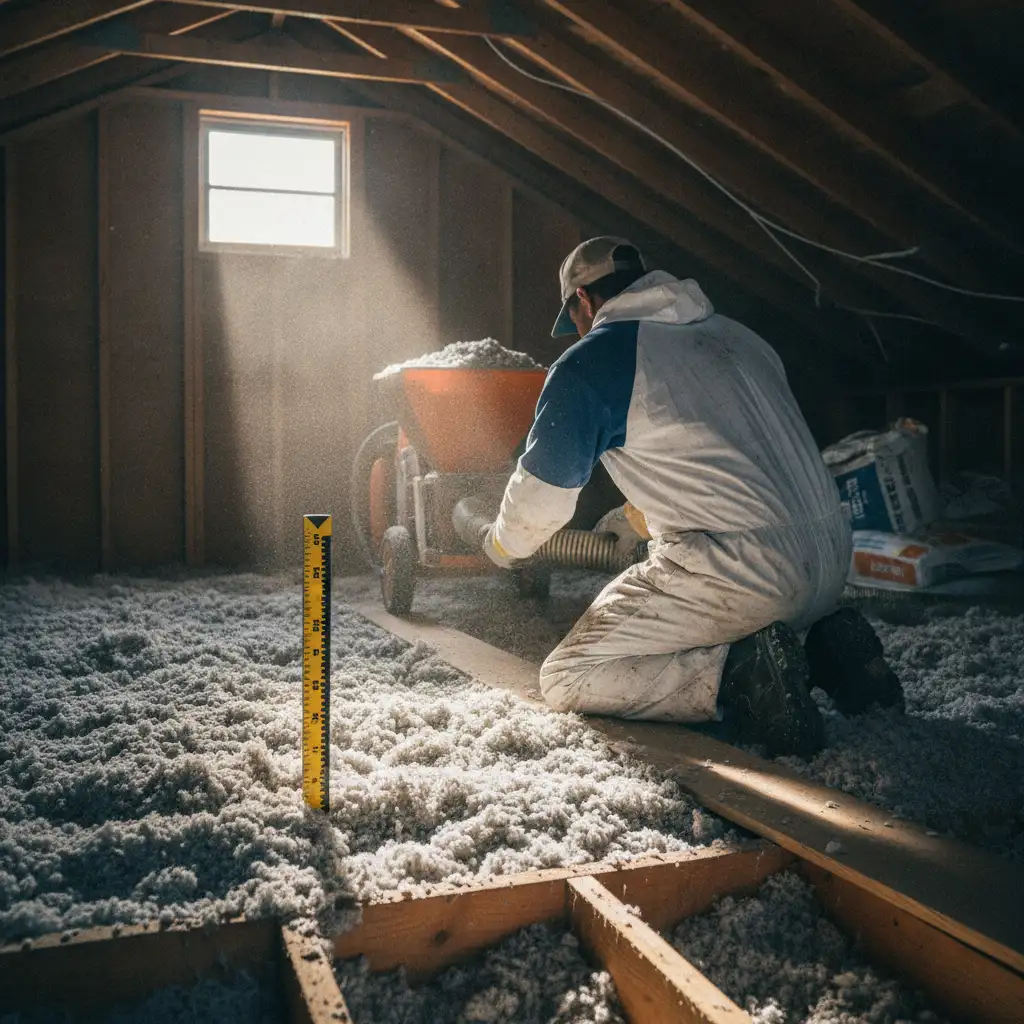
Our team in action — insulation professionals serving Los Angeles
Attic Insulation Methods and Approaches
Blown-In Cellulose Insulation
Recycled cellulose is the most common choice for open-attic floor applications in Los Angeles residential retrofits. It settles to approximately 3.7 lbs per cubic foot and achieves R-3.8 per inch — meaning a 13-inch installed depth delivers approximately R-49. Cellulose performs exceptionally well in older Los Angeles bungalows with irregular framing because it conforms to any cavity shape without gaps. Its borate treatment also provides pest-deterrent properties, relevant in neighborhoods with documented rodent pressure such as East Los Angeles and Maywood.
Blown-In Fiberglass Insulation
Loose-fill fiberglass is preferred when moisture exposure risk is elevated — for example, in homes near the coast in Culver City or properties with prior roof leak history. Fiberglass does not absorb water and will not support mold growth. It achieves approximately R-2.5 per inch, requiring greater installed depth to meet code minimums. Explore our full blown-in insulation service page for product comparisons.
Spray Foam Insulation (Open and Closed Cell)
For unvented attic assemblies — common in flat-roof dingbats throughout West Hollywood and commercial-residential mixed buildings in Commerce — closed-cell spray polyurethane foam applied directly to the underside of the roof deck creates a conditioned attic space. Closed-cell foam achieves R-6.5 per inch and provides an integrated vapor retarder. Open-cell foam at R-3.7 per inch is used in applications requiring acoustic performance. See our spray foam insulation service page for full application details.
Fiberglass Batt Insulation
Unfaced or kraft-faced fiberglass batts are used in accessible rafter bays in cathedral ceiling applications or as a supplemental layer beneath blown insulation in some retrofit projects. R-21 high-density batts are appropriate for 2×6 rafter cavities common in 1980s Pasadena construction.
Insulation Removal and Replacement
When existing insulation is beyond remediation, our replacement service provides complete extraction and re-installation as a bundled project, often qualifying for LADWP rebates when upgrading to code-minimum R-38 or above.
Ready for Attic Insulation? Get Your Free Estimate Today.
Next Level Insulation of Los Angeles serves Los Angeles and the surrounding area — we’ll be on-site within 24 hours.
📞 Call (323) 765-3939Attic Insulation Cost in Los Angeles, CA
Understanding the cost of attic insulation in Los Angeles helps homeowners budget accurately and evaluate contractor proposals. Below are representative price ranges based on current material and labor conditions in the Los Angeles market.
Typical Price Ranges
- Blown-in cellulose (to R-49): $1.50 to $2.50 per square foot installed. A typical 1,200-square-foot attic runs $1,800 to $3,000.
- Blown-in fiberglass (to R-49): $1.75 to $2.75 per square foot. Same 1,200-square-foot attic: $2,100 to $3,300.
- Closed-cell spray foam (unvented roof assembly): $5.00 to $8.00 per square foot depending on required depth. A 600-square-foot flat-roof application: $3,000 to $4,800.
- Insulation removal: $1.00 to $2.00 per square foot for full extraction and disposal. A 1,200-square-foot attic removal: $1,200 to $2,400.
- Air sealing (standalone): $500 to $1,500 depending on the number of penetrations and bypass conditions found.
Factors Affecting Your Los Angeles Quote
- Attic access difficulty: Homes with low-pitch roofs in Culver City or narrow access hatches in Glendale bungalows add labor time.
- Existing insulation condition: Contaminated or asbestos-containing legacy material (found in some pre-1980 South Gate and Bell properties) requires specialized removal protocols at higher cost.
- LADWP rebate eligibility: LADWP currently offers rebates up to $0.10 per square foot for qualifying insulation upgrades — potentially reducing your net cost by $100 to $250 on average projects.
- Title 24 documentation: If your project requires a building permit (common in additions or ADU conversions in Monterey Park and Alhambra), compliance documentation adds modest administrative cost.
Call (323) 765-3939 for a no-obligation on-site quote specific to your property’s square footage, attic configuration, and current insulation status.
Neighborhoods We Serve Across Los Angeles
Next Level Insulation of Los Angeles provides attic insulation services across a wide service area, with knowledge of the specific building eras and construction challenges found in each community.
- Pasadena: Home to a high concentration of 1910s to 1930s Craftsman bungalows with shallow attic depths and original redwood framing, Pasadena properties in Climate Zone 10 face the county’s most extreme summer heat. Blown-in cellulose to R-49 is the standard recommendation here.
- East Los Angeles and Maywood: Dense 1940s and 1950s stucco bungalows predominate. Rodent pressure from documented urban rat populations makes insulation removal and replacement — combined with pest exclusion — a frequent project scope.
- West Hollywood: A high concentration of 1960s dingbat apartment buildings with flat, low-slope roofs requires closed-cell spray foam applied to the roof deck underside rather than conventional attic floor insulation.
- Glendale: Post-war tract homes built 1945 to 1965 with accessible gable attics are ideal candidates for blown-in cellulose retrofits. Santa Ana wind debris and ash from nearby fire corridors make periodic insulation inspection and air sealing essential.
- Culver City and South Gate: Proximity to coastal marine layer creates higher relative humidity in attic spaces; blown-in fiberglass is preferred over cellulose in homes with any history of roof leakage.
We also serve Cudahy, Bell, Bell Gardens, Commerce, Downey, Huntington Park, Alhambra, Monterey Park, Montebello, South Pasadena, and Walnut Park. View our full service area map.
Attic Insulation Maintenance Tips for Los Angeles Homeowners
Proper maintenance extends the life of your attic insulation and protects your investment against Los Angeles-specific degradation factors.
- Inspect annually after Santa Ana wind season (March): Check attic vents for debris, ash, or particulate buildup that can block airflow and introduce contaminants into insulation.
- Check insulation depth every 5 years: Blown-in insulation settles over time. Cellulose typically loses 0.5 to 1 inch of depth per decade; verify coverage remains adequate with a depth probe at six or more points.
- Seal new HVAC penetrations promptly: Anytime HVAC contractors access the attic for system servicing or replacement, verify that any disturbed insulation or newly created penetrations are resealed with spray foam.
- Monitor for rodent evidence: In neighborhoods with documented roof rat activity, place snap traps or call a licensed pest control operator at the first sign of activity before rodents damage insulation.
- Maintain proper attic ventilation: Clear soffit vents each fall of any debris, and ensure ridge vents remain unobstructed. Blocked ventilation raises attic temperatures 15°F to 20°F, reducing insulation effective performance.
- Replace attic access hatch cover: An uninsulated attic hatch is equivalent to leaving a window open. Install a weatherstripped, foam-insulated cover rated R-10 or above.
- After any roof repair: Have insulation inspected for moisture saturation, especially after El Niño winter rain events, which occur in Los Angeles on a recurring 3- to 7-year cycle.
Why Choose Next Level Insulation of Los Angeles
Next Level Insulation of Los Angeles is a locally operated insulation contractor with deep familiarity with the building stock, climate conditions, and utility programs that define the greater Los Angeles market. We are not a national franchise dispatching unfamiliar crews — we are a Los Angeles team working in Los Angeles neighborhoods every day.
Our technicians are trained on California Title 24 compliance requirements, LADWP rebate documentation procedures, and the specific challenges posed by Los Angeles’s range of construction eras — from 1920s plaster-and-lath bungalows in Pasadena to 2000s stucco construction in Monterey Park. We carry general liability insurance appropriate for California contractor operations and maintain safety certifications for attic environments including respiratory protection standards for blown insulation work.
We offer a comprehensive range of services including attic insulation, spray foam insulation, blow-in insulation, crawl space insulation, crawl space encapsulation, and insulation removal and replacement — meaning you have a single trusted contractor for every insulation need your property may present.
Call us at (323) 765-3939 to schedule your free on-site assessment.
Frequently Asked Questions About Attic Insulation in Los Angeles
How much does attic insulation cost in Los Angeles?
Most Los Angeles residential attic insulation projects range from $1,800 to $4,500 for blown-in installation in a standard 1,000 to 1,500 square foot attic, depending on current insulation condition, chosen material, and attic access complexity. Spray foam applications for flat-roof properties cost more — typically $3,000 to $6,000 — due to higher material cost. LADWP rebates can offset a portion of qualifying project costs.
What R-value do I need for my Los Angeles attic?
California Title 24 establishes minimum R-38 for most Los Angeles Basin residential properties (Climate Zone 9), and minimum R-38 to R-49 for inland areas like Pasadena and Alhambra (Climate Zone 10). We recommend targeting R-49 to R-60 in inland zones where summer temperatures regularly exceed 100°F, as the additional material cost is typically recovered within 3 to 5 years through energy savings.
How long does attic insulation installation take?
A standard blown-in insulation installation in a 1,200 to 1,500 square foot attic with no removal required typically takes one full day (6 to 8 hours). When insulation removal is added, plan for a two-day project. Spray foam applications cure within 24 hours and the space can be occupied immediately after installation is complete.
Does Los Angeles require a permit for attic insulation?
Simple insulation retrofits in existing homes generally do not require a City of Los Angeles building permit. However, projects tied to ADU conversions, room additions, or HVAC replacement may trigger Title 24 compliance documentation requirements. Our team is familiar with LADBS (Los Angeles Department of Building and Safety) requirements and will advise you during the initial assessment.
Can attic insulation help during Santa Ana wind events?
Yes. While insulation primarily manages heat transfer rather than air infiltration caused by wind pressure, a properly air-sealed and insulated attic significantly reduces the amount of outdoor particulate matter that infiltrates living spaces during high-wind events. Comprehensive air sealing at top plates and penetrations — performed before insulation installation — is especially important for homes in the Glendale Narrows corridor and northeast Los Angeles hillside communities.
Is my existing insulation covered under any LADWP rebate program?
LADWP’s residential energy efficiency rebate program currently offers incentives for qualifying insulation upgrades in homes that are upgrading to at least R-38 coverage. Rebate amounts and eligibility requirements change periodically. We assist clients with rebate documentation during every qualifying project — call (323) 765-3939 to ask about current program availability.
How do I know if my attic insulation has been damaged by rats?
Key indicators include visible tunneling or compression channels through blown insulation, presence of nesting material (shredded paper, fabric, plant matter) within the insulation layer, strong ammonia odor from the attic access area, and HVAC filters that clog more frequently than expected. If you observe any of these signs, contaminated insulation should be removed and replaced rather than supplemented, as rodent waste creates biological hazard and degrades insulation performance. Our removal service handles full extraction safely.
What is the difference between attic insulation and crawl space insulation?
Attic insulation addresses heat transfer through your roof assembly — the primary driver of cooling costs in Los Angeles summers. Crawl space insulation and crawl space encapsulation address moisture, radon, and heat loss through your floor assembly — more critical for homes in hillside neighborhoods with raised foundations, including parts of South Pasadena, West Hollywood, and Glendale. Many older Los Angeles properties benefit from addressing both systems as part of a comprehensive energy improvement project.
Schedule Your Free Attic Insulation Assessment in Los Angeles Today
Do not wait for another record-breaking Los Angeles heat event to discover that your attic insulation is inadequate. Next Level Insulation of Los Angeles provides free, no-obligation on-site assessments for homeowners and property managers throughout Los Angeles, Pasadena, Glendale, Culver City, Downey, West Hollywood, and all surrounding communities.
Our team will measure your current R-value, identify air sealing opportunities, advise on LADWP rebate eligibility, and provide a transparent, itemized written quote with no hidden fees. Whether you need a simple blown-in top-up or a complete insulation removal and replacement, we have the equipment, materials, and local expertise to get the job done right.
Call us now at (323) 765-3939 to book your free assessment. Serving all of Los Angeles County — from Cudahy to Pasadena, from West Hollywood to South Gate.