

Rockwool Insulation in Los Angeles, CA
Energy-Saving Rockwool Insulation for Los Angeles, CA Homes — Licensed & Insured
Need Rockwool insulation in Los Angeles, CA? Next Level Insulation installs fire-resistant, soundproof mineral wool for LA homes. Call (323) 765-3939 for a free quote.
- Licensed & Insured
- Locally Owned & Operated
- Free Inspection & Estimate
Request Your
Free EstimateRockwool insulation — also known as mineral wool or stone wool insulation — is a premium insulation material manufactured from volcanic basalt rock and recycled slag. It delivers exceptional thermal resistance, superior fire protection, and outstanding soundproofing performance that synthetic alternatives simply cannot match. At Next Level Insulation of Los Angeles, we specialize in professional Rockwool insulation installation across the greater Los Angeles area, helping homeowners and building managers combat the region’s extreme summer heat, wildfire risk zones, and the acoustical challenges of dense urban living.
Los Angeles presents unique insulation demands unlike anywhere else in the country. From the scorching San Fernando Valley temperatures that routinely exceed 110°F to the fire-prone hillside communities of the Santa Monica Mountains, Rockwool’s inherent fireproof and thermally efficient properties make it the insulation of choice for discerning LA property owners. Our team brings deep local knowledge and hands-on expertise to every project we undertake across Los Angeles County.
Call us today at (323) 765-3939 for a free estimate.
Understanding Rockwool Insulation
Rockwool insulation is created through an industrial process that melts volcanic basalt rock and steel mill slag at temperatures exceeding 2,900°F, then spins the molten material into fine, interlocking fibers. The resulting product is a dense, wool-like batt or board that traps air within millions of tiny pockets, creating a highly effective thermal and acoustical barrier. Rockwool has been manufactured commercially since the early 20th century, with widespread adoption in Scandinavian countries before spreading across North America as builders recognized its superior performance characteristics.
Unlike traditional fiberglass insulation, Rockwool does not melt, burn, or off-gas toxic fumes when exposed to fire. It maintains structural integrity at temperatures up to 1,400°F, earning a non-combustible rating under ASTM E136 testing standards. This property alone makes it invaluable in high-fire-risk regions like Los Angeles. Rockwool also repels water naturally — its hydrophobic properties allow moisture to drain away rather than absorb, preventing the mold and mildew growth that plagues fiberglass batts in Southern California’s occasional humid conditions.
Rockwool products most commonly installed in Los Angeles properties include:
- Rockwool Safe ‘n’ Sound: Designed specifically for interior partition walls and floors between living spaces to reduce noise transmission
- Rockwool Comfortbatt: Used in exterior walls and attic applications for thermal performance, with R-values ranging from R-15 to R-30 depending on thickness
- Rockwool Comfortboard: Rigid continuous insulation boards used on exterior sheathing applications, common in Los Angeles commercial and multi-family renovations
Los Angeles’s building stock spans an enormous range of construction eras — from pre-war Craftsman bungalows in Pasadena built in the 1910s and 1920s, to postwar stucco tract homes in Downey from the 1950s and 1960s, to modern mixed-use developments rising across Culver City and West Hollywood today. Each era presents distinct insulation challenges that Rockwool’s versatile product line is uniquely equipped to address. Whether retrofitting a century-old wood-frame structure or insulating a new steel-framed commercial shell, Rockwool adapts to the application with consistent, reliable results.
Why Rockwool Insulation Is Needed in Los Angeles, CA
Extreme Heat and the Urban Heat Island Effect
Los Angeles experiences a semi-arid Mediterranean climate, but the urban heat island effect in densely built neighborhoods like East Los Angeles, Huntington Park, and Maywood pushes local temperatures significantly higher than surrounding areas. During the record-setting September 2022 heat event, downtown Los Angeles hit 108°F — the highest temperature ever recorded in the city’s history. The National Weather Service documented that communities in the Southeast Los Angeles basin, including Bell, Bell Gardens, and Commerce, sustained overnight low temperatures above 85°F during that event, preventing structures from cooling naturally. Rockwool’s high thermal mass and R-value ratings of up to R-23 per 3.5-inch batt help buffer these extreme temperature swings, keeping interiors 15–20°F cooler than structures with inadequate insulation during peak heat events.
Wildfire Risk and Fire-Resistant Construction
The Los Angeles Department of Building and Safety designates vast swaths of the city as Very High Fire Hazard Severity Zones (VHFHSZ). Communities bordering the Santa Monica Mountains — including areas of West Hollywood, and hillside portions of Glendale and Pasadena — sit directly adjacent to terrain that burned catastrophically during events like the 2017 La Tuna Fire (which scorched over 7,000 acres in the Verdugo Mountains) and the January 2025 Eaton Fire, which devastated portions of the Altadena and Pasadena foothills. California’s Title 24 energy code increasingly incentivizes fire-resistant construction materials. Rockwool’s non-combustible rating means it will not contribute to a structure fire — a consideration that no fiberglass or cellulose product can match.
Acoustical Demands of Urban and Suburban Los Angeles
Los Angeles is one of the noisiest urban environments in the United States. The city ranks among the top five for traffic noise exposure according to the U.S. Department of Transportation’s noise mapping data. Neighborhoods like South Gate, Montebello, and Walnut Park sit near the intersection of major freight corridors including the 710 Freeway and Union Pacific rail lines. Multi-family residential buildings throughout Los Angeles — from duplexes in Alhambra to apartment complexes in Culver City — face persistent complaints about noise transmission between units. Rockwool’s sound attenuation coefficient (NRC rating of 1.05) outperforms fiberglass batts at reducing both airborne and impact noise, making it the preferred choice for party walls and floor-ceiling assemblies.
Seismic Resilience and Moisture Variability
Los Angeles sits at the intersection of multiple active fault systems, including the Puente Hills Fault running beneath the Los Angeles basin and the Hollywood Fault traversing the urban core. Post-earthquake inspections following the 1994 Northridge earthquake (magnitude 6.7) revealed that damaged wall cavities exposed to the elements allowed significant moisture intrusion into structures with fiberglass insulation, causing mold growth within weeks. Rockwool’s hydrophobic fiber composition repels bulk water, maintaining its thermal and structural properties even after exposure to weather events — a meaningful advantage during the post-earthquake rehabilitation period common in LA’s older housing stock.
Signs You Need Rockwool Insulation in Los Angeles
Thermal Comfort Problems
- Rooms that reach 85°F or higher during Los Angeles summer heat waves despite air conditioning running continuously
- Noticeable hot or cold spots on interior walls, particularly on west-facing walls that absorb intense afternoon sun
- Energy bills spiking above $300–$400 per month during summer cooling season in a standard single-family home
- Attic temperatures exceeding 150°F when measured with an infrared thermometer during summer months
Noise and Acoustical Issues
- Clearly audible conversations from adjacent rooms or neighboring units in multi-family buildings
- Highway or freeway noise from nearby routes like the 10, 110, or 405 intruding into living spaces
- Impact noise (footsteps, dropped objects) transmitting through floor-ceiling assemblies in two-story homes
Moisture and Air Quality Concerns
- Visible mold or mildew on interior wall surfaces, particularly in older homes in Monterey Park or East Los Angeles with original fiberglass insulation
- Musty odors emanating from wall cavities or attic spaces
- Existing fiberglass insulation that has compressed, yellowed, or become visibly water-stained
Fire Safety Upgrades
- Property located within a designated Very High Fire Hazard Severity Zone
- Planning a renovation or addition that requires compliance with current California Title 24 fire codes
- Insurance carrier requiring upgraded fire-resistant construction materials
Our Rockwool Insulation Installation Process in Los Angeles
Free In-Home Assessment (Day 1 — 1 to 2 Hours)
Our certified insulation specialist visits your Los Angeles property to conduct a thorough evaluation. We assess existing insulation conditions using thermal imaging cameras, measure wall cavity depths and attic joist spacing, and identify air sealing deficiencies. For hillside properties in Glendale or Pasadena, we pay particular attention to attic ventilation pathways and potential ember intrusion points identified under WUI (Wildland-Urban Interface) construction guidelines.
Detailed Written Proposal (Within 24–48 Hours)
We prepare a comprehensive written scope of work including specific Rockwool product selections, R-value targets calibrated to California Title 24 energy compliance requirements for Climate Zone 10 (which covers the greater Los Angeles basin), and itemized pricing with no hidden fees.
Insulation Removal and Prep (Day 1 of Installation — 2 to 4 Hours)
Where existing degraded insulation is present, our team safely removes and disposes of old fiberglass or cellulose material. Learn more about our insulation removal services. Wall cavities and attic spaces are vacuumed clean and inspected for pest activity or moisture damage — common findings in pre-1970s construction throughout South Gate, Maywood, and Huntington Park.
Air Sealing (Day 1 — 1 to 3 Hours)
Before any Rockwool is installed, our technicians seal all penetrations, gaps, and bypasses using low-expansion spray foam and acoustical sealant. Air sealing is mandatory for Title 24 compliance and dramatically improves the performance of any insulation system. Explore our spray foam insulation services.
Rockwool Installation (Day 1 to Day 2 — 4 to 8 Hours Depending on Scope)
Rockwool batts are cut precisely to fill every stud or joist cavity without compression or voids. Our installers wear appropriate PPE and follow manufacturer specifications for fit and fastening. For open-face attic floors, batts are installed perpendicular to joists in double layers where required to achieve Title 24-compliant R-38 or R-49 ratings.
Quality Inspection and Documentation (Final Day — 1 Hour)
A senior technician performs a walk-through inspection, documenting installed R-values, coverage areas, and product batch numbers. We provide you with all necessary documentation for building permit compliance and utility rebate applications through programs offered by LADWP (Los Angeles Department of Water and Power).
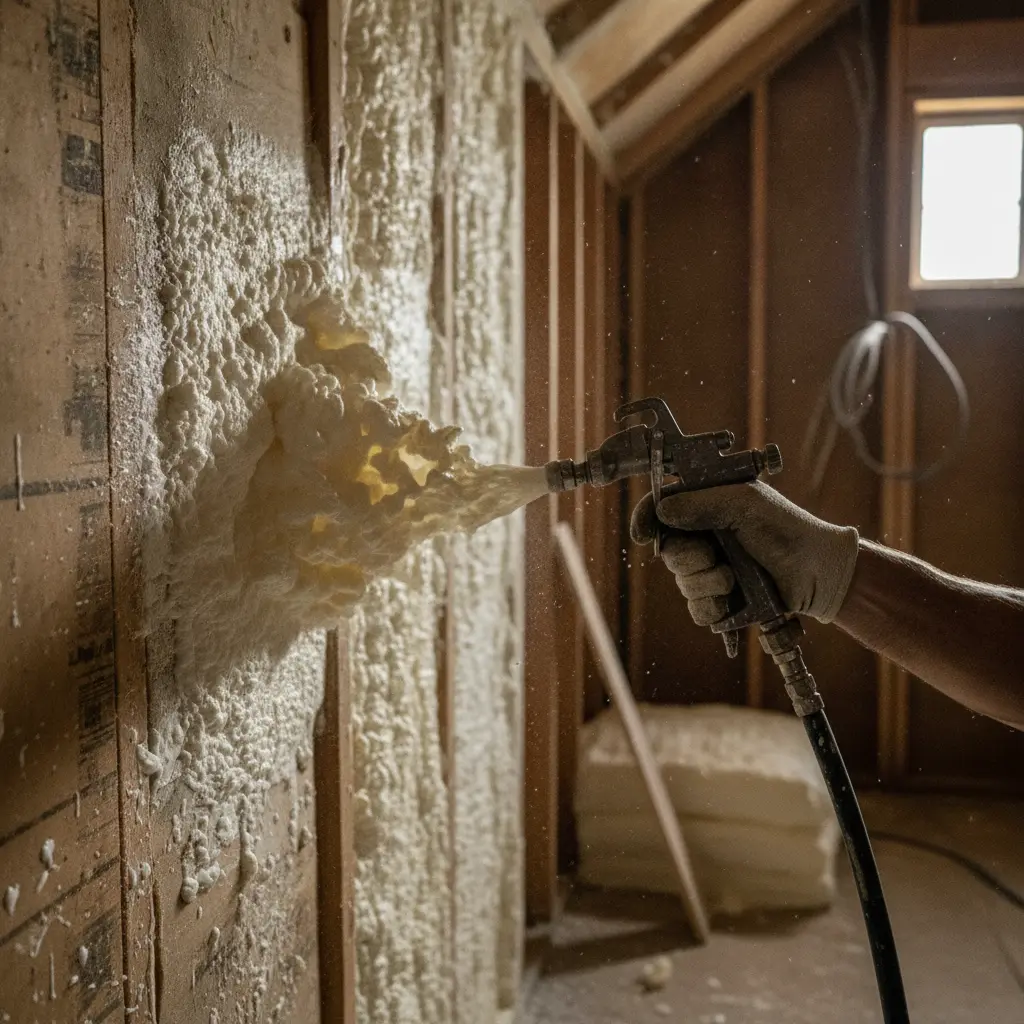
Our team in action — insulation professionals serving Los Angeles
Rockwool Insulation Methods and Approaches
Batt Installation in Wall Cavities
The most common Rockwool application in Los Angeles residential projects involves fitting pre-cut batts into exterior wall stud cavities. Rockwool Comfortbatt slides into standard 2×4 cavities (delivering R-15) or 2×6 cavities (delivering R-23) without requiring any special equipment. This method is ideal during renovation projects in older Craftsman homes in Pasadena or South Pasadena where walls are opened for electrical or plumbing updates.
Attic Floor Insulation
In the vast majority of Los Angeles single-family homes, the attic floor — rather than the roof deck — is the primary thermal barrier. Learn about our full attic insulation services. Rockwool Comfortbatt installed in double perpendicular layers across attic joists achieves R-38 or R-49 coverage required by Title 24 for Los Angeles Climate Zone 10, dramatically reducing cooling loads during summer heat events.
Interior Partition Walls for Sound Control
Rockwool Safe ‘n’ Sound is installed in interior partition walls and floor-ceiling assemblies of multi-family buildings, home theaters, and music studios throughout Los Angeles. Its high NRC rating makes it the preferred product for noise-sensitive applications in apartment-dense corridors like Koreatown, Culver City, and West Hollywood.
Continuous Exterior Insulation Boards
Rockwool Comfortboard rigid mineral wool panels are applied to exterior wall sheathing on commercial buildings and multi-family residential projects throughout the Los Angeles area. This approach eliminates thermal bridging through wall studs and is increasingly required under California’s updated energy code for new construction and significant renovations.
Crawl Space and Subfloor Applications
Explore our crawl space insulation services. Rockwool batts installed between floor joists above vented crawl spaces in older Los Angeles bungalows provide both thermal insulation and moisture resistance — a critical combination given the occasional winter rainy season that can introduce ground moisture into crawl space environments.
Ready for Rockwool Insulation? Get Your Free Estimate Today.
Next Level Insulation of Los Angeles serves Los Angeles and the surrounding area — we’ll be on-site within 24 hours.
📞 Call (323) 765-3939Rockwool Insulation Cost in Los Angeles, CA
Understanding the investment involved in a professional Rockwool insulation project helps Los Angeles homeowners and property managers plan their budgets accurately. Costs vary based on the scope of work, property type, and specific products selected.
Typical Price Ranges
- Exterior wall batt insulation (open wall): $1.50–$3.00 per square foot installed
- Attic floor insulation (full attic coverage): $1,800–$4,500 for a typical 1,200–1,800 sq ft Los Angeles single-family home attic
- Interior partition wall sound insulation: $1.25–$2.50 per square foot installed
- Exterior continuous Comfortboard installation: $3.00–$6.00 per square foot installed
- Crawl space floor insulation: $2.00–$4.50 per square foot installed
Factors Affecting Your Los Angeles Rockwool Insulation Cost
- Insulation removal: Removing existing degraded insulation adds $1.00–$2.00 per square foot to total project cost
- Accessibility: Low-pitch attics common in postwar Downey and South Gate tract homes require additional labor time
- R-value required: Achieving Title 24-compliant R-49 in attics requires greater material volume than minimum R-30 installations
- Project size: Larger projects (2,500+ sq ft) typically reduce per-square-foot pricing
Available Rebates and Incentives
LADWP offers residential insulation rebates of up to $0.15 per square foot for qualifying attic insulation upgrades. Southern California Gas Company (SoCalGas) provides additional rebates for whole-home weatherization projects. Our team will identify all applicable rebate programs and assist with documentation as part of every project. Call us at (323) 765-3939 for a customized quote.
Los Angeles Neighborhoods We Serve
Pasadena and South Pasadena
These communities are home to a high concentration of pre-1940s Craftsman bungalows, Spanish Colonial Revival homes, and mid-century ranch houses. Older structures in these neighborhoods frequently have no wall insulation whatsoever and deteriorated knob-and-tube wiring that must be addressed before any insulation can be installed. Rockwool’s fire-resistant properties are particularly valued here given proximity to the San Gabriel Mountains fire corridors. Rockwool insulation in Pasadena.
Glendale and the Verdugo Hills
Glendale’s mix of hillside single-family homes and dense multi-family corridors along Brand Boulevard creates diverse insulation needs. Post-earthquake retrofitted structures and newer condominium construction both benefit from Rockwool’s combined thermal and acoustical performance. The 2017 La Tuna Fire underscored the importance of fire-resistant building materials throughout the Verdugo foothills.
Culver City and West Hollywood
These rapidly developing communities feature significant multi-family residential and mixed-use construction where acoustical performance between units is a primary driver. Rockwool Safe ‘n’ Sound in party walls and floor assemblies addresses the noise transmission complaints common in these urban neighborhoods. Rockwool insulation in Culver City.
Southeast Los Angeles: Bell, Bell Gardens, Huntington Park, Maywood, and South Gate
The dense, working-class communities of Southeast LA feature primarily postwar wood-frame stucco homes from the 1940s–1960s with original compressed fiberglass insulation approaching the end of its useful life. Replacement with Rockwool delivers dramatic energy savings for families managing high summer cooling costs in one of the county’s most heat-exposed urban corridors.
Rockwool Insulation Maintenance Tips for Los Angeles Homeowners
- Inspect attic insulation annually: Check each fall before the rainy season for any signs of moisture intrusion, rodent nesting, or displacement from attic foot traffic.
- Maintain attic ventilation: Ensure soffit and ridge vents remain unobstructed. In Los Angeles attics, blocked ventilation causes heat buildup exceeding 160°F that degrades insulation systems over time.
- Seal new penetrations immediately: Any new electrical, plumbing, or HVAC penetrations through insulated assemblies should be air-sealed promptly to maintain thermal and fire performance.
- Monitor for pest activity: Roof rats — a persistent problem in older neighborhoods across East Los Angeles and Alhambra — can burrow through attic insulation. Address infestations and replace damaged insulation promptly.
- Check crawl space moisture barriers: Inspect ground vapor barriers in crawl spaces each spring after Los Angeles’s rainy season to ensure no pooling or barrier tears have occurred. Learn about crawl space encapsulation.
- Keep attic access hatches insulated and weatherstripped: Uninsulated attic hatches are one of the most significant thermal bypasses in Los Angeles homes — ensure hatches remain properly sealed.
- Avoid compressing batts during storage access: When accessing attic storage areas, avoid walking directly on Rockwool batts, as compression reduces R-value performance.
Why Choose Next Level Insulation of Los Angeles
Next Level Insulation of Los Angeles is a dedicated insulation contractor with deep roots in the Los Angeles market. We understand the specific demands that LA’s climate zones, fire hazard designations, seismic construction requirements, and Title 24 energy code impose on every insulation project — knowledge that out-of-area contractors simply cannot replicate.
Our comprehensive service menu — including insulation installation, spray foam insulation, attic insulation, blow-in insulation, crawl space encapsulation, crawl space insulation, insulation removal, and insulation replacement — means we handle every phase of your project in-house with no subcontracting surprises.
We serve homeowners and property managers across the full Los Angeles basin, from Pasadena and Glendale in the northeast to Culver City and West Hollywood in the west, and throughout the Southeast LA communities of Bell, Maywood, South Gate, Huntington Park, and beyond. Our team is committed to transparent pricing, clean workmanship, and insulation systems that perform for decades. Call (323) 765-3939 today to speak with a local expert.
Frequently Asked Questions About Rockwool Insulation in Los Angeles
How much does Rockwool insulation cost in Los Angeles?
Rockwool insulation installation in Los Angeles typically ranges from $1.50 to $3.00 per square foot for wall applications and $1,800 to $4,500 for a complete attic insulation project in a standard single-family home. Factors including existing insulation removal, property accessibility, and the R-value required by California Title 24 all affect final pricing. LADWP and SoCalGas rebates can offset a portion of the cost for qualifying projects.
Is Rockwool better than fiberglass insulation for Los Angeles homes?
For most Los Angeles applications, yes. Rockwool outperforms fiberglass in three critical areas for LA properties: fire resistance (non-combustible vs. fiberglass which melts at 1,112°F), moisture resistance (hydrophobic fibers vs. fiberglass which absorbs moisture and loses R-value), and acoustical performance (NRC 1.05 vs. approximately 0.95 for fiberglass). In fire-prone communities near the Santa Monica Mountains or Verdugo Hills, the non-combustible rating alone often justifies the modest premium over fiberglass.
How long does Rockwool insulation installation take in a typical LA home?
Most single-family home projects in Los Angeles — including attic insulation or wall cavity insulation for a 1,500–2,000 sq ft home — are completed within one to two days. Larger multi-family projects or whole-home renovations requiring insulation removal and full replacement may take three to five days. We work efficiently to minimize disruption to your household.
Is Rockwool insulation required by California building code?
California’s Title 24 energy code does not mandate Rockwool specifically, but it does establish minimum R-value requirements that Rockwool products meet or exceed. In Wildland-Urban Interface (WUI) designated zones — which cover significant portions of Glendale, Pasadena, and Los Angeles hillside areas — California’s Building Code Chapter 7A requires non-combustible or fire-resistant construction assemblies for new construction and substantial renovations, making Rockwool a natural code-compliant choice.
Can Rockwool insulation help reduce my LADWP electricity bill?
Significantly, yes. Homeowners in Los Angeles who upgrade from no insulation or degraded original insulation to Title 24-compliant Rockwool installations typically report summer cooling bill reductions of 20–35%. During the extreme heat events that Los Angeles increasingly experiences — such as the September 2022 heat wave — proper insulation can be the difference between a home that maintains a livable temperature and one that requires continuous air conditioning operation at maximum capacity.
Does Rockwool insulation help with noise from the freeway?
Yes. Rockwool’s dense fiber matrix provides substantially better noise attenuation than fiberglass at the same thickness. For homes near major Los Angeles freeway corridors — the 10, 110, 405, or 710 — Rockwool installed in exterior walls combined with upgraded window glazing can reduce interior noise levels by 40–50% compared to uninsulated walls. Rockwool Safe ‘n’ Sound is specifically engineered for maximum sound control applications.
Do you serve all of Los Angeles County?
We serve communities throughout the Los Angeles area including Cudahy, Los Angeles, Monterey Park, Glendale, Pasadena, Bell Gardens, Alhambra, Bell, Commerce, Culver City, Downey, East Los Angeles, South Pasadena, Huntington Park, Maywood, Montebello, South Gate, Walnut Park, and West Hollywood. Call us at (323) 765-3939 to confirm service availability for your specific address.
How does Rockwool perform during and after earthquakes?
Rockwool’s rigid batt structure maintains its position in wall cavities and attic assemblies better than loose fiberglass or cellulose during seismic events. Following significant earthquakes like the 1994 Northridge event, inspectors documented that Rockwool-insulated cavities retained their thermal performance even where minor structural movement had occurred, while fiberglass batts in adjacent structures had shifted and fallen from wall cavities — leaving exposed framing and creating moisture vulnerability during the subsequent repair period.
Get a Free Rockwool Insulation Quote in Los Angeles Today
If you’re ready to upgrade your Los Angeles property with professional Rockwool insulation — whether you’re dealing with sky-high summer energy bills, unacceptable freeway noise, fire hazard concerns in a hillside community, or simply deteriorated original insulation in an older home — the team at Next Level Insulation of Los Angeles is ready to help.
We serve homeowners and property managers across the entire Los Angeles basin, delivering honest assessments, transparent pricing, and insulation installations built to California code and engineered for LA’s specific climate and fire risk demands.
Call us today at (323) 765-3939 to schedule your free in-home assessment. Our Los Angeles insulation specialists are standing by to answer your questions and get your project started.