

Cellulose Insulation in Los Angeles, CA
Energy-Saving Cellulose Insulation for Los Angeles, CA Homes — Licensed & Insured
Need cellulose insulation in Los Angeles, CA? Next Level Insulation offers expert blow-in cellulose for attics & walls. Title 24 compliant. Call (323) 765-3939.
- Licensed & Insured
- Locally Owned & Operated
- Free Inspection & Estimate
Request Your
Free EstimateCellulose insulation is a plant-based, recycled-content thermal and acoustic barrier made primarily from post-consumer newspaper and cardboard treated with fire-retardant chemicals. It is installed in attics, walls, and floors to reduce heat transfer, lower energy bills, and improve indoor comfort. In Los Angeles, where summer temperatures in the San Fernando Valley regularly exceed 100°F and nighttime marine layer conditions create moisture fluctuations, choosing the right insulation material is critical to a home’s long-term performance.
At Next Level Insulation of Los Angeles, we specialize in cellulose insulation solutions tailored to the unique building stock, climate zones, and energy code requirements found across Los Angeles County. From the craftsman bungalows of Pasadena to the mid-century stucco apartment buildings of Culver City, our team delivers precise, code-compliant installations that keep your property comfortable year-round. Call us today at (323) 765-3939 to schedule your free assessment.
Understanding Cellulose Insulation
Cellulose insulation has been used in North American construction since the late 1800s, but it gained widespread commercial adoption during the 1970s energy crisis when the federal government incentivized homeowners to improve building efficiency. Today, cellulose accounts for a significant portion of all blown-in insulation installed in the United States, and its popularity continues to grow as sustainability requirements tighten under California’s Title 24 Building Energy Efficiency Standards.
The material consists of approximately 75–85% recycled paper fiber, primarily sourced from newspapers, cardboard, and similar cellulosic products. Manufacturers treat it with borate-based compounds — most commonly sodium tetraborate — to achieve Class I or Class A fire-resistance ratings and to resist mold, pests, and settled compaction over time. The result is a dense, fibrous product that packs tightly around pipes, wiring, and structural framing, virtually eliminating the air gaps that fiberglass batts notoriously leave behind.
In Los Angeles specifically, cellulose is well-suited to the region’s dominant building types. The city’s housing stock includes a disproportionately high number of structures built between 1920 and 1970 — a period before modern insulation standards existed. The Los Angeles Department of Building and Safety estimates that roughly 60% of single-family homes in the city were constructed before 1980, meaning millions of properties operate with inadequate or deteriorated insulation. Cellulose is ideal for retrofitting these older homes because it can be blown into closed wall cavities through small drill holes, minimizing demolition costs.
Dense-pack cellulose achieves an R-value of approximately R-3.2 to R-3.8 per inch, while loose-fill cellulose in attic applications typically settles to between R-3.1 and R-3.7 per inch after installation. California’s Title 24 standards require a minimum of R-38 for attic assemblies in Los Angeles’s Climate Zone 9 — meaning a properly installed cellulose attic layer must be at least 10–12 inches deep to comply. Our team calculates precise coverage depths for every project to ensure full compliance and maximum energy performance.
Why Cellulose Insulation Is Needed in Los Angeles, CA
Los Angeles sits across multiple distinct climate microzones, and this geographic complexity creates insulation demands unlike almost any other major American city. The Los Angeles Basin is flanked by the Santa Monica Mountains to the north and west, the San Gabriel Mountains to the northeast, and the Pacific Ocean to the southwest. These features drive the famous Southern California marine layer — a low-lying coastal fog that pushes inland each morning during May, June, and July (a phenomenon locals call “June Gloom”) before burning off by midday. This daily moisture cycling, combined with scorching afternoon heat, creates repeated thermal and humidity stress on building envelopes that inadequately insulated homes cannot manage efficiently.
During the summer of 2021, a historic heat dome event pushed temperatures in downtown Los Angeles to 95°F and sent neighborhoods like Woodland Hills and Canoga Park in the San Fernando Valley to a record 121°F on September 6 — the hottest temperature ever recorded in Los Angeles County. Homes without adequate attic insulation saw interior temperatures climb well above thermostat set points as heat radiated through unprotected roof assemblies. Cellulose insulation with a proper R-38 or higher rating acts as a thermal buffer, slowing the rate at which exterior heat penetrates living spaces and reducing peak cooling loads by 20–30%.
Seismic activity is another Los Angeles-specific factor that affects insulation performance. The 1994 Northridge earthquake (magnitude 6.7) caused widespread structural cracking in homes across the San Fernando Valley, Reseda, Granada Hills, and Northridge itself. Cracked wall assemblies and displaced attic hatch frames allow conditioned air to escape and unconditioned air to infiltrate. Many affected homes had their original fiberglass batt insulation dislodged or compressed during the shaking. Cellulose dense-pack installation fills these irregular cavities more completely than batts can, making it the preferred remediation choice in post-earthquake retrofits.
Wildfire smoke infiltration is a growing concern in Los Angeles neighborhoods near the urban-wildland interface. Homes in Altadena, La Cañada Flintridge, and the hills above Pasadena frequently experience heavy smoke events during the Santa Ana wind season (October through March). A properly sealed and insulated building envelope — including properly installed cellulose in attic spaces with sealed penetrations — significantly reduces the volume of smoke particles that enter living areas during red-flag fire conditions. The January 2025 Eaton Fire, which burned aggressively through the Altadena and Pasadena foothills, made this reality painfully clear for thousands of San Gabriel Valley residents.
Los Angeles also enforces strict energy benchmarking requirements under the Los Angeles Building Energy and Water Efficiency Ordinance (BEWEO), which applies to commercial and multifamily buildings of 20,000 square feet or more. For residential property owners, California’s Title 24, Part 6, mandates that any permitted addition or alteration include insulation upgrades to current standards. Cellulose insulation is one of the most cost-effective ways to achieve compliance, making it a practical choice for the thousands of Los Angeles homeowners who undertake renovation projects each year.
Signs You Need Cellulose Insulation in Los Angeles
Energy and Comfort Indicators
- Monthly electric bills exceeding $200–$300 during summer months even with a functioning HVAC system
- Rooms that cannot reach thermostat temperature within 30 minutes of running air conditioning
- Noticeable temperature differences of 5°F or more between rooms on the same floor
- HVAC system cycling on and off more than four times per hour during peak afternoon heat
Physical and Structural Symptoms
- Visible gaps or voids in attic insulation when viewed through the attic hatch
- Old fiberglass batts that appear yellowed, matted, or falling away from joists
- Cold interior walls during winter evenings despite heating being active
- Drafts perceptible near electrical outlets on exterior walls
Urgency Indicators
- Home was built before 1980 and has never had an insulation upgrade
- Home experienced structural movement or cracking after the 1994 Northridge earthquake or subsequent seismic events
- Pest inspector discovered rodent activity in attic — rodents nest in and destroy fiberglass batts
- Water intrusion from roof leaks or plumbing has saturated existing insulation, rendering it ineffective and potentially moldy
Our Cellulose Insulation Installation Process
Initial Assessment and Energy Audit (1–2 Hours)
Our technician visits your property to inspect existing insulation levels, measure cavity depths, identify air-sealing deficiencies, and document current R-values. We use thermal imaging cameras to detect heat loss patterns invisible to the naked eye. For Los Angeles homes with clay tile roofs common in the San Gabriel Valley, we pay particular attention to ridge vent configurations that affect attic airflow.
Permitting and Code Review (1–5 Business Days)
We determine whether your project requires a permit from the Los Angeles Department of Building and Safety or the relevant municipal authority in cities like Pasadena, Glendale, or Culver City. Insulation-only projects typically do not require permits, but projects tied to additions or HVAC replacements may. We handle all documentation.
Old Insulation Removal if Needed (4–8 Hours)
When existing insulation is contaminated, compressed below 50% of original depth, or pest-damaged, we remove it using HEPA-filtered vacuum equipment. We follow California Department of Public Health protocols for asbestos-containing materials, which are present in some Los Angeles homes built before 1978. Learn more about our insulation removal services
Air Sealing (2–4 Hours)
Before installing cellulose, we seal all attic penetrations — recessed lights, top plates, plumbing chases, and electrical junction boxes — with fire-rated spray foam or caulk. This step is critical in Los Angeles’s Climate Zone 9, where air infiltration accounts for up to 30% of total cooling load.
Cellulose Installation (3–6 Hours)
We calibrate our blowing machines to achieve the target density — typically 1.5–2.0 lb/ft³ for open-blow attic applications and 3.0–3.5 lb/ft³ for dense-pack wall cavities. Depth rulers are installed every 100 square feet to verify coverage meets or exceeds R-38 per Title 24 requirements.
Quality Verification and Documentation (1 Hour)
After installation, we photograph depth rulers, compile material documentation including bag count and manufacturer certification, and provide a Certificate of Installation for your records — useful for insurance documentation and resale disclosures required under California Civil Code.
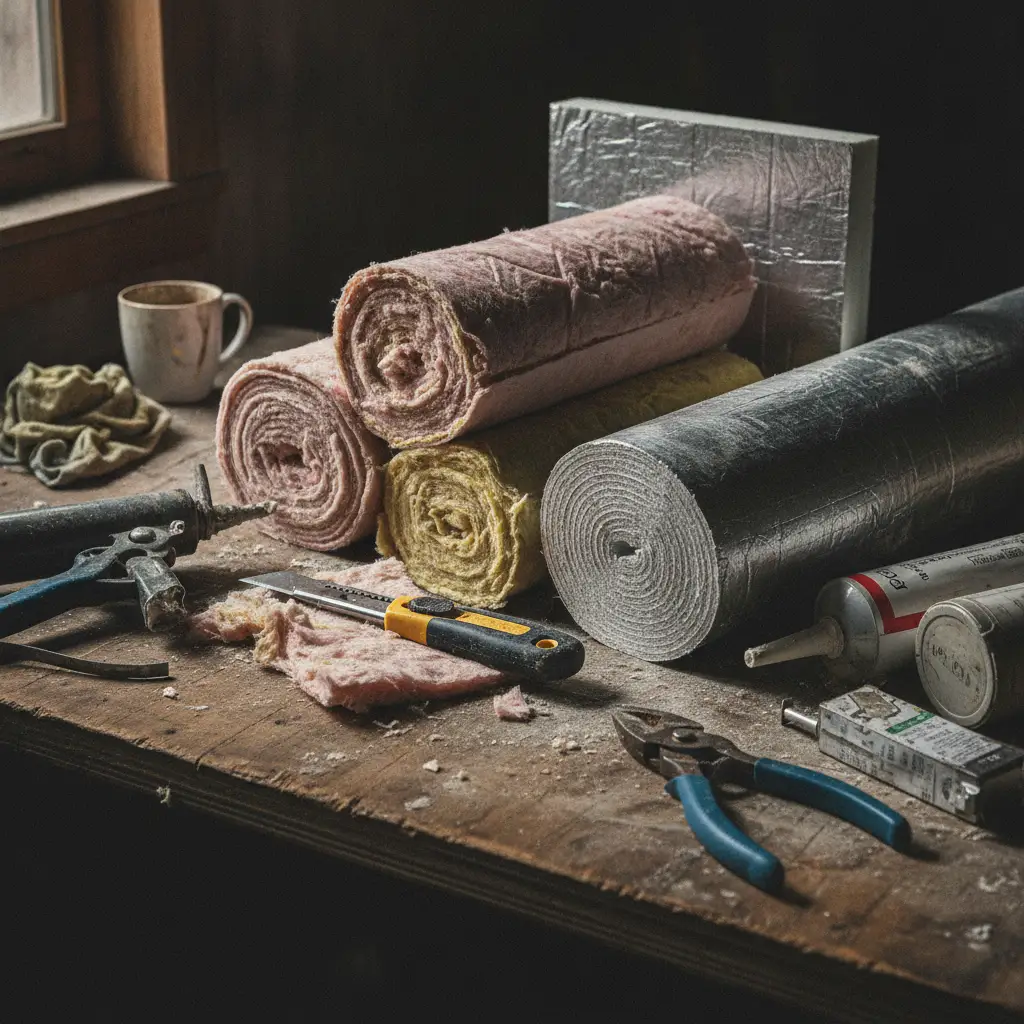
Our team in action — insulation professionals serving Los Angeles
Cellulose Insulation Methods and Approaches
Loose-Fill Blown-In Cellulose (Attic Application)
This is the most common method used in Los Angeles attics. Cellulose is blown through a flexible hose to a depth of 10–15 inches, achieving R-38 to R-60. It is ideal for unfinished attic floors with open joist bays and is highly effective in the tile-roof homes prevalent in Pasadena, Alhambra, and Montebello where radiant heat gain through the roof deck is extreme during summer afternoons. Explore our full attic insulation services
Dense-Pack Cellulose (Closed Wall Cavities)
For retrofitting walls in Los Angeles’s large inventory of pre-1980 homes, we drill 2-inch access holes between studs, insert a fill tube, and inject cellulose at high density until the cavity is fully packed. This eliminates the convective loops that occur in under-insulated walls and is the preferred method for the craftsman bungalows of East Los Angeles and South Pasadena.
Stabilized Wet-Spray Cellulose (Open Cavities)
During new construction or major renovation when wall sheathing is exposed, cellulose mixed with a small amount of water is spray-applied directly into open stud bays. The moisture activates natural starches in the paper fiber, causing it to adhere to framing and dry in place. This method is increasingly specified in new construction projects in West Hollywood and Culver City where green building standards are stringent.
Blow-In Blanket System (Cathedral Ceilings and Rafters)
For Los Angeles homes with vaulted or cathedral ceilings — common in mid-century modern properties in areas like Silver Lake and Echo Park — we install a fabric netting across rafter bays and blow cellulose behind it to achieve continuous coverage without compressing ventilation channels. See our full blow-in insulation options
Ready for Cellulose Insulation? Get Your Free Estimate Today.
Next Level Insulation of Los Angeles serves Los Angeles and the surrounding area — we’ll be on-site within 24 hours.
📞 Call (323) 765-3939Cellulose Insulation Cost in Los Angeles, CA
Cellulose insulation costs in Los Angeles typically range from $1.00 to $2.50 per square foot for loose-fill attic applications, translating to a total project cost of $800 to $3,500 for an average single-family home attic of 1,200–1,500 square feet. Dense-pack wall insulation runs $2.50 to $5.00 per square foot of wall area due to the additional labor involved in drilling and patching access holes.
Key Cost Factors
- Existing insulation removal: Add $1.00–$2.00 per square foot if old material must be extracted before new cellulose is installed
- Air sealing scope: Comprehensive air sealing adds $300–$800 to most projects but delivers significant energy savings that offset the cost within 2–4 years
- Attic accessibility: Homes in the Hollywood Hills and other hillside neighborhoods often have low-clearance or irregular attic configurations that increase labor time
- Target R-value: Upgrading from R-19 to R-38 costs less than starting from zero; many Los Angeles homes have some existing insulation that can be supplemented rather than replaced
- Los Angeles labor market: Contractor labor costs in Los Angeles County are approximately 15–20% higher than the California state average, reflecting the region’s elevated cost of living
California homeowners may be eligible for rebates through the TECH Clean California program or through their utility provider — Southern California Edison and SoCal Gas both offer insulation rebates that can offset $200–$500 of project cost. We can help identify rebate opportunities during your assessment. Call (323) 765-3939 for a detailed quote specific to your property.
Neighborhoods We Serve in Los Angeles and Surrounding Areas
Pasadena
Pasadena’s housing stock is dominated by craftsman bungalows and Spanish Colonial Revival homes built between 1905 and 1940. These structures have balloon-frame wall construction with minimal or no original insulation. Our dense-pack cellulose installations are particularly valuable here, and homes near the foothills face elevated wildfire smoke risk, making tight building envelopes a priority. Insulation services in Pasadena
Glendale
Glendale features a mix of 1950s ranch-style homes and newer multi-family construction. Many ranch homes have accessible attic spaces suited to loose-fill cellulose upgrades that can dramatically reduce summer cooling costs given Glendale’s inland heat exposure away from the coastal marine layer. Insulation services in Glendale
Culver City
Culver City’s post-war residential neighborhoods contain many 1,000–1,500 square foot homes with original slab-on-grade construction and minimal attic depth. We adapt our installation approach for these shallow attic assemblies while still achieving Title 24-compliant R-values. Insulation services in Culver City
East Los Angeles and Montebello
These communities feature dense working-class neighborhoods with aging stucco homes from the 1940s–1960s, many housing multiple generations. Energy cost savings from cellulose insulation upgrades deliver outsized household budget benefits here, and our team provides bilingual service throughout these communities.
Cellulose Insulation Maintenance Tips for Los Angeles Homeowners
- Inspect attic depth annually: Check depth rulers or use a ruler to verify cellulose has not settled below your target R-value — slight settling of 10–15% in the first year is normal, while greater settling may indicate moisture intrusion
- Seal attic penetrations after any HVAC work: HVAC technicians frequently disturb attic insulation and create new air gaps — inspect and re-seal after any mechanical service call
- Monitor for roof leaks before and after rainy season: Los Angeles’s atmospheric river events (January–March) can saturate cellulose rapidly; wet cellulose must be dried or replaced promptly to prevent mold
- Control attic ventilation: Ensure ridge vents and soffit vents remain unblocked — proper ventilation prevents the moisture accumulation that degrades cellulose over time
- Address rodent entry points: Roof rats are prevalent throughout Los Angeles County and will burrow into cellulose to nest; seal fascia board gaps and roof penetrations to prevent infestation
- Re-inspect after seismic events: Following any earthquake of magnitude 4.0 or greater, visually check that attic insulation has not shifted and that air-sealed penetrations remain intact
- Clean gutters seasonally: Overflowing gutters can drive moisture into soffit and wall assemblies, compromising cellulose in those locations — clean gutters before every rainy season
Why Choose Next Level Insulation of Los Angeles
At Next Level Insulation of Los Angeles, we have built our reputation on deep knowledge of Los Angeles’s unique building conditions — the seismic retrofits, the marine layer moisture dynamics, the Title 24 compliance requirements, and the wildly diverse architectural styles found across more than 80 distinct neighborhoods in Los Angeles County. We do not apply one-size-fits-all solutions. Every project begins with a thorough assessment, and every installation is calibrated to the specific climate zone, building type, and performance goals of your property.
Our technicians are trained specifically on the challenges posed by Southern California’s building stock, including pre-war balloon-frame construction, mid-century flat-roof assemblies, and hillside homes with non-standard attic configurations. We use professional-grade blowing equipment calibrated for consistent density, and we document every installation with bag counts and depth photographs.
We serve homeowners, landlords, property managers, and contractors throughout Los Angeles, Glendale, Pasadena, Culver City, West Hollywood, Downey, South Gate, Huntington Park, and surrounding communities. Contact us at (323) 765-3939 to speak directly with a Los Angeles insulation specialist.
Frequently Asked Questions About Cellulose Insulation in Los Angeles
How much does cellulose insulation cost for a typical Los Angeles home?
For an average 1,200–1,500 square foot attic in Los Angeles, loose-fill cellulose installation typically costs between $800 and $3,500 depending on current insulation levels, accessibility, and the scope of any included air sealing. Dense-pack wall insulation adds $2.50–$5.00 per square foot of wall area. Los Angeles labor costs run approximately 15–20% above the California state average, which is reflected in these ranges.
How long does a cellulose insulation installation take?
A standard attic insulation project in a single-family Los Angeles home typically takes one full day — roughly 6–8 hours including setup, air sealing, installation, and cleanup. Dense-pack wall projects vary by the number of cavities being filled and whether patching is required; most wall projects are completed in one to two days.
Is cellulose insulation safe for older Los Angeles homes that may contain asbestos?
Cellulose itself is completely safe, but homes built before 1978 in Los Angeles may have asbestos-containing materials in existing insulation, duct wrap, or building components. Before any insulation removal or disturbance, we recommend a professional asbestos survey. Next Level Insulation of Los Angeles follows California Department of Public Health protocols and coordinates with certified abatement contractors when asbestos is identified.
Will cellulose insulation help with wildfire smoke infiltration during Santa Ana wind events?
Cellulose insulation alone does not create an airtight barrier, but when combined with comprehensive air sealing of attic penetrations, wall outlets, and duct systems, it significantly reduces the total volume of outdoor air — and smoke particles — that infiltrate your home. This is especially relevant for Los Angeles homes in hillside neighborhoods near the urban-wildland interface.
Does Los Angeles require a permit for cellulose insulation installation?
In most cases, an insulation-only installation in an existing single-family home in Los Angeles does not require a permit from the Los Angeles Department of Building and Safety. However, insulation work tied to a larger permitted project (such as an addition or HVAC replacement) may require documentation of compliance with Title 24 standards. We verify permit requirements for every project before beginning work.
How does cellulose compare to spray foam for Los Angeles attics?
Both are excellent options, and the best choice depends on your attic configuration and goals. Cellulose is significantly less expensive ($1.00–$2.50/sq ft vs. $3.00–$7.00/sq ft for open-cell spray foam) and is made from recycled materials, making it the more sustainable choice. Spray foam provides a superior air seal and is preferred for certain applications like unvented roof assemblies. Many Los Angeles projects benefit from a hybrid approach — air sealing with spray foam followed by cellulose for the bulk thermal layer. Learn about our spray foam insulation services
Can cellulose insulation be installed in my Los Angeles crawl space?
Cellulose is generally not recommended for crawl space floor applications in Los Angeles due to the region’s periodic moisture events during atmospheric river rainstorms. For crawl spaces, we typically recommend closed-cell spray foam or rigid foam board paired with crawl space encapsulation. See our crawl space insulation services Learn about crawl space encapsulation
Are there rebates available for cellulose insulation in Los Angeles?
Yes. Southern California Edison offers insulation rebates for qualifying residential customers, and the TECH Clean California program provides additional incentives for whole-home efficiency upgrades. Rebate amounts vary by project size and current insulation levels but typically range from $150 to $500. We help customers identify and apply for available rebates during the assessment process.
Get a Free Cellulose Insulation Estimate in Los Angeles Today
Whether your Los Angeles home is a 1920s craftsman in Pasadena, a mid-century ranch in Glendale, or a 1960s stucco duplex in Huntington Park, Next Level Insulation of Los Angeles has the expertise and equipment to deliver a cellulose insulation solution that lowers your energy bills, improves indoor comfort, and meets California Title 24 compliance standards.
Don’t wait until another summer heat dome or Santa Ana wind event exposes the limits of your current insulation. Call us now at (323) 765-3939 to speak with a Los Angeles insulation specialist and schedule your no-obligation property assessment. We serve homeowners and property managers throughout Los Angeles, Glendale, Pasadena, Culver City, West Hollywood, Downey, South Gate, Alhambra, and all surrounding communities. Your next level of comfort starts today.