

Rim Joist Insulation in Orange, CA
Energy-Saving Rim Joist Insulation for Orange, CA Homes — Licensed & Insured
Expert rim joist insulation in Orange, CA. Reduce energy loss, stop drafts & moisture. Spray foam & rigid board options. Free estimate — call (714) 266-2070.
- Licensed & Insured
- Locally Owned & Operated
- Free Inspection & Estimate
Request Your
Free EstimateRim joist insulation is the process of sealing and insulating the band of framing lumber that sits atop your home’s foundation walls, closing off one of the most overlooked pathways for heat loss, cold air infiltration, and moisture intrusion. In Orange, CA — where Mediterranean climate swings between cool, damp winters and scorching summers regularly exceeding 95°F — an uninsulated rim joist can silently account for up to 15–25% of your home’s total energy loss.
At Next Level Insulation of Orange, we specialize in diagnosing and correcting rim joist deficiencies across the Orange area. Whether your home is a post-war ranch in the Villa Park corridor or a newer construction in Orange Park Acres, our team brings precision installation techniques and locally informed expertise to every project. We use high-performance spray foam and rigid board systems designed to handle Orange County’s unique humidity and temperature profiles. Call us today at (714) 266-2070 to schedule your free assessment.
Understanding Rim Joist Insulation
The rim joist — also called a band joist or header joist — is the perimeter framing member that caps your foundation and supports the first-floor subfloor system. In most homes built before 1980, this area was left completely exposed to unconditioned air in crawl spaces or basements, creating a continuous thermal bridge between the outside environment and your living space. Even homes built after modern energy codes became standard often have rim joists that were under-insulated or improperly air-sealed.
Historically, rim joist insulation was not a priority in residential construction. Builders in the mid-20th century focused insulation dollars on attics and exterior walls, leaving the foundation perimeter as an afterthought. It wasn’t until the energy crises of the 1970s and the subsequent evolution of building science in the 1980s and 1990s that building professionals began quantifying how much energy was escaping through these seemingly minor gaps. Research from the Department of Energy confirmed that a home with an uninsulated rim joist can lose heat equivalent to leaving a window open several inches — year-round.
In Orange, California, the issue is particularly nuanced. The city sits at an elevation averaging 154 feet above sea level, positioned in the Santa Ana Valley where it experiences strong seasonal Santa Ana wind events that can drop relative humidity below 10% while pushing temperatures into triple digits. Conversely, the wet season — typically November through March — brings Pacific moisture from marine layer systems that regularly penetrate inland to Orange, creating conditions where condensation on cold rim joist framing becomes a real risk. This oscillation between extreme dry heat and seasonal humidity is fundamentally different from coastal or mountain climates and demands a rim joist insulation strategy tailored to these specific conditions.
Orange’s housing stock is predominantly composed of single-family homes built between 1945 and 1985, many featuring raised foundation systems with vented crawl spaces — exactly the configuration where rim joist performance matters most. Condominiums and multi-family buildings constructed in the 1970s and 1980s along Chapman Avenue and Katella Avenue corridors also frequently present rim joist vulnerabilities at shared floor/ceiling assemblies.
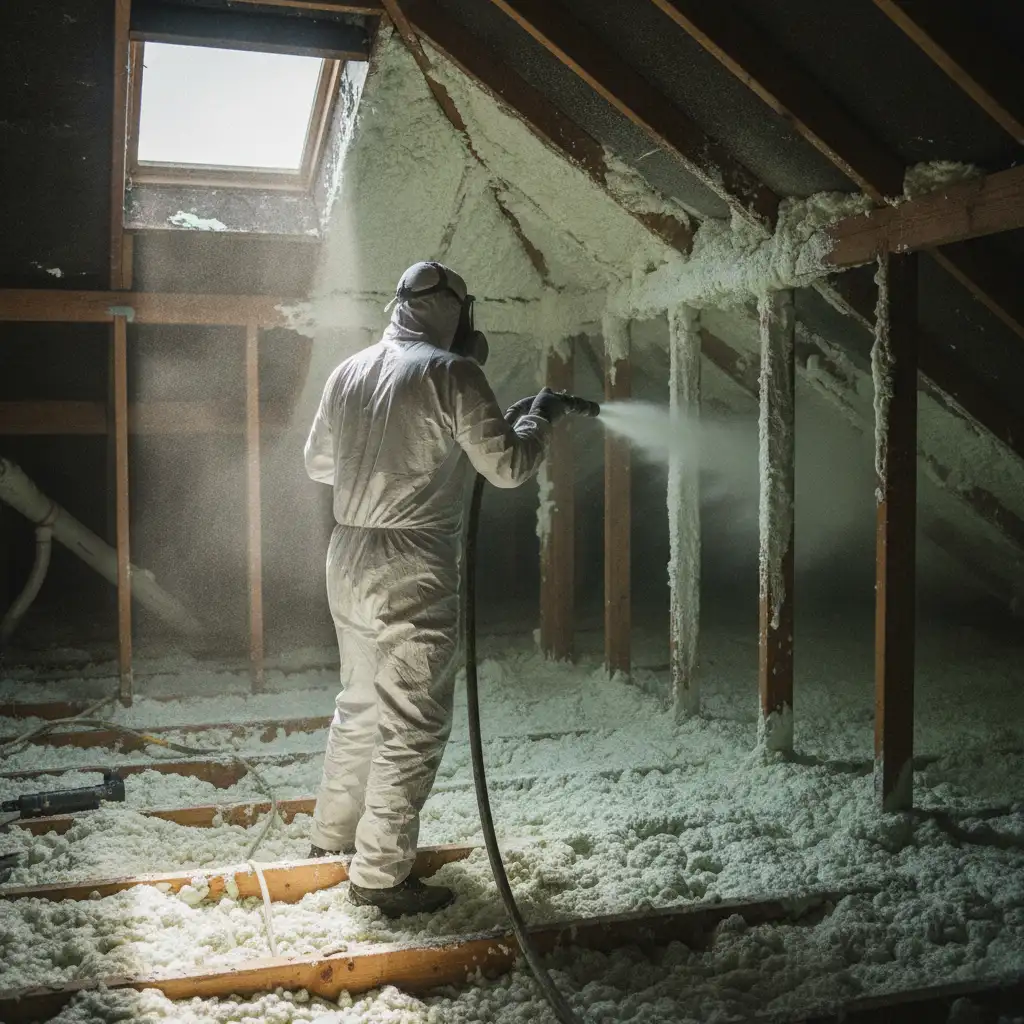
Our team in action — insulation professionals serving Orange
Why Rim Joist Insulation Is Needed in Orange, CA
Orange County’s Climate and Your Foundation
Orange, California experiences a semi-arid Mediterranean climate (Köppen classification BSk/Csa) with average high temperatures reaching 95–100°F in July and August, and overnight lows dropping to the upper 30s°F in December and January. This temperature differential — sometimes spanning 50°F or more within a single 24-hour period — places significant stress on uninsulated rim joists. As framing lumber expands and contracts with thermal cycling, existing gaps widen over time, accelerating air infiltration rates that degrade both comfort and energy efficiency.
The Santa Ana Wind Effect
Orange County’s famous Santa Ana wind events — historically most intense between October and February — bring powerful offshore winds from the northeast, sometimes gusting above 60 mph through the Brea Canyon and Carbon Canyon corridors just north of the city. These events create strong negative pressure on the windward sides of homes, actively pulling unconditioned air through any gap in the building envelope. Rim joists, often separated from the exterior by only a thin layer of siding or stucco with no air barrier, become primary infiltration points during these events. Homeowners in Orange’s northwest neighborhoods near the 57 Freeway and Lincoln Avenue report drafty floors and dramatically higher heating costs during November and December Santa Ana wind periods specifically because of this mechanism.
Coastal Moisture Infiltration
Orange sits approximately 12 miles inland from the Pacific Ocean, close enough that the marine layer regularly pushes overnight relative humidity above 80–90% during summer months — a counterintuitive fact for a city that averages only 14.5 inches of annual rainfall. This moisture-laden air infiltrates crawl spaces and contacts the cooler rim joist framing, where it can condense, promoting wood rot and mold growth. Neighborhoods in the southeastern portion of Orange near El Modena and Serrano Avenue — which feature older homes with original, unmodified crawl space ventilation systems — are particularly vulnerable to this moisture cycling.
Aging Housing Stock
Over 60% of Orange’s single-family housing stock was constructed before 1980, predating California’s Title 24 energy efficiency standards. Homes in the Old Towne Orange Historic District, which encompasses hundreds of Craftsman and Colonial Revival homes built between 1905 and 1940, feature original wood-framed crawl spaces where rim joists are completely uninsulated. A 1,500 square foot home in this neighborhood with a fully exposed perimeter rim joist can lose an estimated 8,000–12,000 BTUs per hour through that framing alone on a cold winter night — equivalent to running two space heaters continuously just to offset the loss at the foundation.
Soil Conditions and Ground Moisture
Much of Orange sits on expansive clay soils associated with the Santiago Formation, which retain moisture during wet seasons and can transmit ground moisture upward through concrete foundation walls. When this moisture contacts an uninsulated rim joist, it creates a chronically damp environment that degrades wood over decades. This is a documented concern in the Cambridge Street and Walnut Street neighborhoods of Old Towne, where foundation inspectors routinely identify moisture-stained and softened rim joist framing in homes that have never had crawl space encapsulation or insulation work performed.
Signs You Need Rim Joist Insulation in Orange, CA
Comfort and Temperature Indicators
- Cold floors on the first level during December through February, even when the thermostat is set above 68°F
- Drafts felt at floor level near exterior walls, particularly noticeable during Santa Ana wind events
- Uneven room temperatures between centrally located rooms and rooms near exterior walls
- Rooms above the garage or crawl space that are consistently 5–8°F cooler than the rest of the home
Energy and Utility Bill Indicators
- Heating and cooling bills that are disproportionately high compared to neighbors with similar square footage
- HVAC system running continuously during mild weather without achieving set temperature
- Noticeable spike in gas or electric bills during October–February compared to baseline months
Visual and Structural Warning Signs
- Visible daylight or light gaps when inspecting the crawl space rim joist area
- Discoloration, staining, or soft spots on rim joist framing lumber
- Presence of mold, mildew odor, or efflorescence on foundation walls adjacent to the rim joist
- Existing fiberglass batt insulation that is sagging, wet, or fallen out of position
- Evidence of pest entry — particularly Argentine ants and subterranean termites common in Orange County — through rim joist gaps
Urgency Note: If you observe soft or discolored wood framing, mold growth, or active pest entry through the rim joist area, these conditions warrant immediate professional evaluation before insulation installation can proceed.
Rim Joist Insulation Methods and Approaches
Closed-Cell Spray Foam Insulation
Closed-cell spray polyurethane foam (ccSPF) is the gold standard for rim joist insulation in Orange, CA. Applied at 2–3 inches thick, it achieves R-12 to R-21 while simultaneously acting as a Class II vapor retarder and air barrier — three functions in a single product. Its rigidity adds minor structural value to the rim joist assembly, and its impermeable nature makes it ideal for the moisture cycling conditions common in Orange’s marine-influenced climate. This is our most recommended method for homes in El Modena, Old Towne, and other neighborhoods with documented moisture history. Learn more about our spray foam insulation services
Rigid Foam Board with Spray Foam Perimeter Seal
Cut-and-cobble rigid foam board — typically polyisocyanurate or extruded polystyrene (XPS) — cut to fit each rim joist bay and sealed at the perimeter with one-component spray foam is a cost-effective alternative. This method achieves R-10 to R-15 and is well-suited for newer homes with dimensionally consistent framing. It is a practical choice when budget is a primary concern without sacrificing meaningful air sealing performance.
Open-Cell Spray Foam
Open-cell spray foam applied at 3.5–5.5 inches achieves R-13 to R-20 and provides excellent air sealing. It is vapor-permeable, making it appropriate in specific assemblies where the design allows drying to the interior. Our technicians assess whether this is appropriate given your specific crawl space ventilation strategy and moisture load.
Hybrid Rigid Board and Closed-Cell Foam System
For maximum performance in particularly exposed or historically problematic rim joist assemblies — especially in Old Towne Orange homes built before 1940 — we offer a hybrid system combining a rigid board layer for thermal mass with a closed-cell foam seal coat for air and vapor control. This approach consistently achieves R-20 or above. Explore our complete crawl space insulation solutions
Ready for Rim Joist Insulation? Get Your Free Estimate Today.
Next Level Insulation of Orange serves Orange and the surrounding area — we’ll be on-site within 24 hours.
📞 Call (714) 266-2070Rim Joist Insulation Cost in Orange, CA
Understanding the cost of rim joist insulation in Orange, CA helps homeowners budget appropriately and evaluate proposals. Pricing varies based on the linear footage of rim joist perimeter, the insulation method selected, existing conditions, and access difficulty.
Typical Cost Ranges
- Rigid foam board with spray foam seal: $3.50–$6.00 per linear foot of rim joist
- Open-cell spray foam (3.5″ application): $5.00–$8.00 per linear foot
- Closed-cell spray foam (2–3″ application): $7.00–$12.00 per linear foot
- Hybrid rigid + closed-cell system: $10.00–$15.00 per linear foot
Typical Project Totals
A standard 1,500 square foot single-story Orange home with a 160 linear foot perimeter rim joist typically costs $800–$1,900 for a rigid foam system and $1,500–$3,500 for a closed-cell spray foam installation. Larger homes in the 2,500–3,500 square foot range common in Orange Park Acres and Chapman Hills may run $2,500–$5,500 depending on access and complexity.
Orange-Specific Cost Factors
- Limited crawl space access (under 18 inches clearance) adds 15–25% to labor costs
- Pre-existing moisture damage remediation is billed separately and ranges $500–$3,000 depending on severity
- California prevailing wage and disposal regulations add modest overhead compared to less regulated markets
- Homes in Old Towne’s historic overlay zone may require coordination with city building officials for permit compliance
Call (714) 266-2070 for a no-obligation on-site estimate. Learn about our insulation removal services before replacement
Neighborhoods We Serve in Orange, CA
Old Towne Orange
The historic heart of Orange, with homes predominantly built between 1905 and 1945, presents the greatest rim joist insulation need in the city. Original wood-framed crawl spaces with zero insulation are standard here. Historic preservation requirements mean we use non-invasive installation techniques that do not alter exterior foundation appearances. We are experienced navigating the Old Towne Preservation Association guidelines.
Orange Park Acres
This equestrian-zoned community features larger lot homes built primarily between 1960 and 1985, many with expansive crawl spaces and multiple foundation segments. Rim joist perimeters of 250–400 linear feet are common here, and the semi-rural setting means rodent intrusion through uninsulated rim joists is a frequent concern our sealing process directly addresses.
El Modena
Homes in El Modena, concentrated along Cannon Street and Hewes Avenue, were built largely in the 1950s–1970s and frequently exhibit the crawl space moisture issues described earlier due to the area’s slightly lower elevation and proximity to Santiago Creek drainage. Closed-cell spray foam is our most recommended solution here.
Chapman Hills
Newer construction from the 1980s and 1990s with higher original insulation standards, but rim joists were often insulated with fiberglass batts that have since degraded or become moisture-compromised. Upgrade to spray foam is a cost-effective retrofit for these homes. Pair your rim joist upgrade with attic insulation for maximum savings
Rim Joist Insulation Maintenance Tips for Orange Homeowners
- Inspect annually each October before Santa Ana wind season begins — check for any gaps, pest intrusion signs, or insulation displacement in accessible rim joist areas.
- Monitor crawl space humidity — Orange’s summer marine layer can push crawl space relative humidity above 70%. Install a hygrometer in your crawl space and investigate if readings consistently exceed 60%.
- Check vents and access doors — Ensure crawl space vents are functioning as designed (or sealed if you’ve transitioned to a conditioned crawl space) and that access hatches close tightly.
- Clear foundation plantings — Dense vegetation against the foundation traps moisture and provides pest pathways. Maintain a 12-inch clearance zone around your foundation perimeter.
- After significant rain events — Orange typically receives most of its 14.5 annual inches between November and March. Inspect for water intrusion or condensation in the crawl space after any storm delivering more than 0.5 inches.
- Spray foam needs no maintenance but inspect for any mechanical damage if plumbing or electrical work was performed in the crawl space.
- Schedule a professional reassessment every 10 years to confirm insulation performance is meeting current energy code standards as California Title 24 requirements continue to evolve.
Why Choose Next Level Insulation of Orange
Next Level Insulation of Orange is a locally operated insulation contractor serving the Orange community with deep familiarity of the building types, climate patterns, and neighborhood-specific challenges that define this city. We are not a franchise operation dispatching crews unfamiliar with Southern California’s unique energy performance demands — we are your neighbors, working in these crawl spaces and attics every day.
Our technicians are trained in the full spectrum of insulation services including spray foam insulation, attic insulation, blow-in insulation, crawl space encapsulation, crawl space insulation, insulation removal, and insulation replacement — giving us the comprehensive perspective to recommend the right solution for your specific situation rather than defaulting to a one-size-fits-all approach.
We provide transparent, itemized written estimates before any work begins, and we stand behind our installations. We use only professional-grade materials from established manufacturers. Our goal is a long-term relationship with every homeowner in Orange — call us at (714) 266-2070 and experience the difference that genuine local expertise makes.
Frequently Asked Questions About Rim Joist Insulation in Orange, CA
How much does rim joist insulation cost in Orange, CA?
Rim joist insulation in Orange, CA typically costs between $800 and $3,500 for most single-family homes, depending on the linear footage of rim joist perimeter, the insulation method selected, and the existing condition of the crawl space. Closed-cell spray foam — the highest-performance option — runs $7.00–$12.00 per linear foot, while rigid foam board systems start around $3.50–$6.00 per linear foot. Contact us at (714) 266-2070 for a precise estimate specific to your home.
How long does rim joist insulation installation take?
Most standard rim joist insulation projects in Orange are completed in a single day. A typical 1,500 square foot home with accessible crawl space takes 4–7 hours from setup to cleanup. Larger homes in Orange Park Acres or Chapman Hills with 250+ linear feet of rim joist may require a full day and a half. Projects requiring pre-installation moisture remediation add 1–3 days.
Is a permit required for rim joist insulation in Orange, CA?
In most cases, rim joist insulation installation does not require a building permit in the City of Orange for straightforward retrofit projects. However, homes within Old Towne Orange’s designated Historic Preservation overlay area may require design review for any work affecting the foundation area visible from the street. We review permit requirements as part of our initial assessment and handle any necessary filings on your behalf.
Will rim joist insulation really make a noticeable difference in my Orange home?
Yes — consistently one of the most impactful upgrades available to pre-1980 Orange homes. Homeowners report immediate improvements in first-floor temperature consistency, reduced drafts during Santa Ana wind events, and heating bill reductions of 10–25% in the November–March period. Homes in El Modena and Old Towne with uninsulated crawl space rim joists often see the most dramatic before-and-after performance differences.
What is the difference between rim joist insulation and crawl space insulation?
Rim joist insulation specifically targets the band of framing lumber at the top of your foundation walls — the junction between foundation and floor system. Crawl space insulation more broadly refers to insulating the floor joists above the crawl space or the crawl space walls themselves. Both are valuable, and we frequently recommend addressing the rim joist first as it typically offers the best return on investment. Learn more about our full crawl space insulation services
Can I insulate my rim joist myself?
DIY rigid foam board installation is technically possible for homeowners with accessible crawl spaces, but achieving adequate air sealing — the most critical performance element — is difficult without professional spray foam equipment. Gaps as small as 1/16 of an inch around a board cut can negate significant insulation value. Given Orange’s humidity cycling and Santa Ana wind pressures, we strongly recommend professional installation with thermal verification to confirm complete coverage.
How does rim joist insulation interact with my crawl space ventilation?
This is an important systems-level question. Homes with traditional vented crawl spaces require that rim joist insulation leave vents unobstructed. Homes transitioning to a sealed, conditioned crawl space require a coordinated approach where vents are sealed and a complete moisture management strategy is implemented. Our technicians assess your existing ventilation configuration and recommend the appropriate approach. Explore crawl space encapsulation as a complementary upgrade
Does rim joist insulation help with pest control?
Absolutely. Closed-cell spray foam effectively seals the gaps through which Argentine ants — one of the most pervasive pest species in Orange County — and other insects enter the home. It also eliminates the gaps used by subterranean termites traveling along foundation walls. While not a replacement for professional pest management, properly installed rim joist insulation is a meaningful component of a comprehensive pest exclusion strategy for Orange-area homes.
Get Your Free Rim Joist Insulation Estimate in Orange, CA
Don’t let your home’s rim joist continue to drain your energy budget and comfort through Orange’s demanding seasons. Whether you’re dealing with cold floors during a December cold snap, spiking utility bills during Santa Ana season, or visible moisture in your crawl space, Next Level Insulation of Orange has the expertise and the right solution for your home.
Call us today at (714) 266-2070 to schedule your free, no-obligation on-site assessment. Our team serves all neighborhoods across Orange, CA and is ready to deliver the energy performance upgrade your home deserves. Ask about our complete range of services including attic insulation, spray foam insulation, and crawl space encapsulation to maximize your home’s efficiency from top to bottom.