

Duct Insulation in Orange, CA
Energy-Saving Duct Insulation for Orange, CA Homes — Licensed & Insured
Expert duct insulation in Orange, CA. R-8 attic duct upgrades, Title 24 compliance & SCE rebates. Free estimates — call (714) 266-2070 today.
- Licensed & Insured
- Locally Owned & Operated
- Free Inspection & Estimate
Request Your
Free EstimateDuct insulation is the process of wrapping or lining your HVAC ductwork with thermal and vapor-resistant materials to prevent energy loss, condensation buildup, and air quality degradation as conditioned air travels through your home or commercial building. In Orange, CA — where summer temperatures routinely climb above 95°F and attic spaces can reach 150°F — uninsulated or poorly insulated ducts can lose 20% to 30% of the conditioned air your system produces before it ever reaches a living space.
At Next Level Insulation of Orange, we specialize in comprehensive duct insulation solutions tailored to the specific climate demands, building stock, and utility pressures unique to Orange, California. Whether you own a mid-century ranch home in Eichler Highlands or a newer construction property near The Village at Orange, our team delivers expert installation using the most effective materials available. Call us today at (714) 266-2070 to schedule your free assessment and start saving on your energy bills immediately.
Understanding Duct Insulation
Duct insulation involves applying insulating material — typically fiberglass duct wrap, rigid foam board, or spray foam — around the exterior of HVAC supply and return ducts to reduce thermal transfer between the conditioned air inside the duct and the unconditioned environment outside it. The goal is to ensure that the air your system cools or heats remains at the intended temperature from the air handler to the register in every room.
Historically, duct insulation became a recognized building standard in the United States following the energy crisis of the 1970s, when federal guidelines began mandating minimum thermal resistance (R-value) requirements for ductwork in unconditioned spaces. California, through Title 24 of the California Energy Code, has since become one of the strictest states in the nation for duct insulation standards, requiring a minimum R-6 insulation value for ducts located in unconditioned attic spaces and R-4.2 for all other unconditioned locations.
In Orange, CA, the building stock presents a wide range of duct insulation challenges. The city contains a significant proportion of homes built between 1950 and 1980 — decades when duct installation practices were inconsistent and insulation materials degraded far faster than modern alternatives. Fiberglass duct wrap from this era commonly degrades to near-zero effective R-value within 15 to 20 years, meaning thousands of Orange homeowners are operating with functionally uninsulated ductwork today without knowing it.
Beyond residential homes, Orange’s commercial corridors along Chapman Avenue, Katella Avenue, and the area surrounding Old Towne Orange contain a mix of low-rise office buildings, retail strip centers, and mixed-use structures — many of which rely on rooftop package units with extensive exposed ductwork subject to extreme solar heat gain. Proper duct insulation in these environments is not only an energy issue but a comfort and indoor air quality issue for employees and customers alike.
Modern duct insulation products have advanced significantly, with options including flexible fiberglass wrap rated at R-6 or R-8, closed-cell spray polyurethane foam, and radiant barrier duct systems designed specifically for high-solar-gain climates like Southern California. Understanding which material and which R-value is appropriate for your specific building type, duct location, and utility goals is the foundation of effective duct insulation work.
Why Duct Insulation Is Needed in Orange, CA
Orange, California sits in the inland portion of Orange County, situated at approximately 33.8° north latitude in the Santa Ana Valley. This geographic position means the city experiences a semi-arid Mediterranean climate with a critical distinction from coastal communities like Newport Beach or Huntington Beach: Orange receives significantly less marine cooling influence. The Santa Ana Mountains to the east funnel hot inland air through the region, and the city regularly records summer high temperatures 10°F to 15°F warmer than coastal communities just 10 miles away.
The Santa Ana wind events — known locally as “Devil Winds” — dramatically affect duct insulation performance. During major Santa Ana events, such as the prolonged October 2017 wind event that drove regional temperatures above 100°F with relative humidity below 10%, attic spaces in Orange homes experienced extreme thermal swings within hours. Uninsulated or degraded duct systems exposed to these conditions not only lose conditioned air to the attic but also pull in dusty, dry, and sometimes smoke-laden air through duct leaks, degrading indoor air quality during the very period when residents are keeping windows closed.
Orange’s predominant soil type — classified largely as Hanford sandy loam and Ramona sandy loam by the USDA Web Soil Survey — creates specific crawl space conditions relevant to duct insulation. These well-draining soils limit groundwater wicking, but the city’s dry summers followed by concentrated winter rainfall (averaging 14.7 inches annually, mostly falling between November and March) create seasonal moisture cycles in crawl spaces that accelerate condensation on cold duct surfaces. Duct sweating in crawl spaces without adequate insulation leads to mold growth on duct exteriors, wood framing degradation, and compromised indoor air quality.
The neighborhoods of Orange Hills and the estates surrounding Santiago Oaks Regional Park represent elevated terrain where temperature inversions in summer trap heat locally, pushing attic temperatures in hillside homes even higher than those at lower elevations. Residents in these areas frequently report that second-story rooms remain uncomfortably warm despite running HVAC systems — a classic symptom of attic duct energy loss.
Additionally, Southern California Edison’s tiered rate structure and the shift toward Time-of-Use (TOU) pricing means that energy consumed during peak afternoon hours — precisely when solar attic heat and duct energy losses are greatest — costs significantly more per kilowatt-hour. SCE’s standard TOU-D-PRIME rate charges peak pricing between 4 PM and 9 PM, overlapping directly with the hottest portion of an Orange summer day when duct losses are highest. Properly insulated ducts directly reduce peak-hour energy consumption, translating to measurable monthly savings on SCE bills.
Finally, Orange’s housing density in neighborhoods like Panorama Heights and the residential streets surrounding Chapman University means many homes share similar HVAC vintage years, similar tract-built duct configurations, and similar degradation timelines. Homes built in large tracts during the 1960s and 1970s — common throughout these areas — used duct materials with a functional lifespan now well exceeded, making systematic duct insulation replacement a community-wide need in these Orange neighborhoods.
Signs You Need Duct Insulation in Orange
Energy and Utility Indicators
- SCE bills that spike above regional averages during June through September despite consistent thermostat settings
- HVAC system running continuously for 30 minutes or longer to reach set temperatures on days above 90°F
- Noticeable 5°F or greater temperature differences between rooms on the same HVAC zone
Physical and Visual Symptoms
- Visible condensation or water staining on duct exteriors in attic or crawl space
- Fiberglass duct wrap that appears collapsed, torn, wet, or missing sections
- Ductwork in unconditioned attic space with no insulation wrapping at all — common in pre-1975 Orange homes
- Flex duct that has sagged, kinked, or separated at joints, creating both thermal and airflow losses
Indoor Comfort and Air Quality Signs
- Musty or dusty odors from supply registers, particularly during Santa Ana wind events
- Excessive indoor dust accumulation suggesting duct leakage pulling attic particulates into living spaces
- Allergy or respiratory symptoms that worsen when the HVAC system is running
Urgency Indicators
If you notice active water dripping from ducts, mold growth visible on duct surfaces, or pest evidence (including rodent nesting material within duct insulation — a known issue in older Orange neighborhoods), these conditions require immediate professional evaluation as they present both structural and health risks.
Our Duct Insulation Process
Free On-Site Inspection and Assessment (1–2 Hours)
Every project begins with a no-cost inspection of your complete duct system, including attic spaces, crawl spaces, and any ducts running through garages or wall cavities. We document existing insulation R-values, identify duct leakage points, note any damaged or missing sections, and assess conditions specific to your home’s location in Orange — including attic ventilation adequacy, pest evidence, and moisture indicators.
Duct Leakage Testing (30–60 Minutes)
Before insulating, we perform a blower door-assisted duct leakage assessment to identify and quantify air leaks. Sealing leaks prior to insulation ensures that the new insulation layer performs as rated. This step is especially important in Orange homes built before 1985, where duct connections were often secured with deteriorated cloth tape rather than mastic sealant.
Old Insulation Removal (2–4 Hours Depending on System Size)
Degraded, wet, or pest-contaminated duct insulation is removed and properly disposed of before new material is installed. Our team uses appropriate PPE and containment procedures to prevent cross-contamination into living spaces — a critical step in older Orange homes where vintage fiberglass may contain binders no longer permitted in modern insulation products.
Duct Sealing and Joint Repair (1–3 Hours)
All duct connections, joints, and penetrations are sealed with UL 181-compliant mastic sealant or approved metal tape. Any damaged flex duct sections are repaired or replaced. This step alone can reduce duct leakage by 20% to 40% in typical Orange-area homes.
Insulation Installation (2–5 Hours Depending on System Scope)
New duct insulation is installed to meet or exceed California Title 24 requirements — minimum R-6 for attic ducts and R-4.2 for other unconditioned locations, though we typically recommend R-8 for attic ducts in Orange’s climate. Material selection is adapted to each location: fiberglass duct wrap for accessible attic runs, spray foam for complex geometries, and rigid board for commercial applications.
Final Verification and Documentation (30–60 Minutes)
After installation, we conduct a final thermal and visual inspection, confirm all duct connections remain secure, and provide you with documentation of installed R-values and materials — records you may need for SCE rebate applications or future home sale disclosures in California.
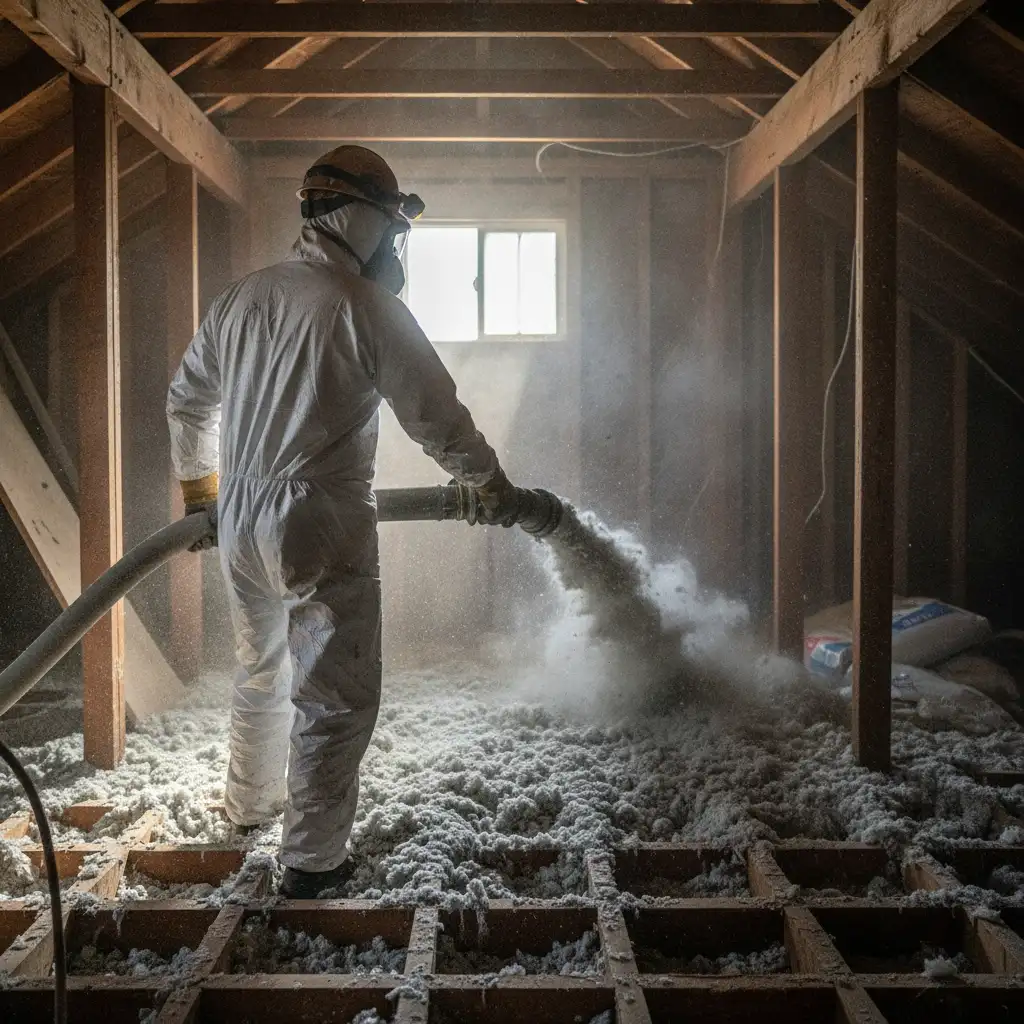
Our team in action — insulation professionals serving Orange
Duct Insulation Methods and Approaches
Flexible Fiberglass Duct Wrap (R-6 and R-8)
The most widely used approach for residential duct systems, fiberglass duct wrap is applied around rigid metal or flexible duct and secured with FSK (foil-scrim-kraft) facing outward. R-8 duct wrap is our standard recommendation for Orange attic applications given peak summer attic temperatures. This method is ideal for accessible attic spaces and straightforward duct geometries common in Orange’s tract home stock.
Spray Polyurethane Foam (Closed-Cell)
Closed-cell spray foam provides superior thermal resistance per inch (approximately R-6.5 per inch) and also seals duct leakage simultaneously. This method is best suited for irregularly shaped duct plenums, difficult-to-wrap transitions, or commercial rooftop unit connections where conventional wrap installation is impractical. We use this approach frequently in Orange’s older commercial buildings along The City Drive and Tustin Street corridors.
Rigid Foam Board Encapsulation
For large rectangular metal ducts, particularly in commercial and light industrial settings, rigid polyisocyanurate or extruded polystyrene board is cut and adhered directly to duct surfaces. This method provides excellent compressive strength and moisture resistance — advantages in Orange’s seasonal crawl space environments.
Duct Replacement with Pre-Insulated Flex Duct
When existing ductwork is beyond repair — severely degraded, pest-infested, or improperly sized — full duct replacement using factory-insulated R-8 flexible duct is the most cost-effective long-term solution. This is increasingly common in Orange’s 1960s and 1970s tract home neighborhoods where original duct systems are approaching or exceeding 50 years of service life.
Ready for Duct Insulation? Get Your Free Estimate Today.
Next Level Insulation of Orange serves Orange and the surrounding area — we’ll be on-site within 24 hours.
📞 Call (714) 266-2070Duct Insulation Cost in Orange, CA
Understanding duct insulation costs helps Orange homeowners and property managers plan and budget effectively. Pricing varies based on system size, access difficulty, existing conditions, and materials selected.
Typical Price Ranges for Orange, CA
- Basic duct wrap replacement (1,200–1,800 sq ft home): $800 – $1,800
- Full duct insulation with sealing (2,000–2,500 sq ft home): $1,500 – $3,200
- Spray foam duct insulation (per linear foot): $3.50 – $7.00
- Complete duct replacement with R-8 pre-insulated flex duct: $3,500 – $8,000 depending on system complexity
- Commercial duct insulation (per square foot of duct surface): $2.00 – $5.50
Factors That Affect Your Cost
- Attic access difficulty — Orange hillside homes in Orange Hills often have low-clearance attic spaces requiring additional labor time
- Existing insulation removal — adds $200 to $600 depending on volume and contamination level
- Degree of duct leakage repair needed before insulation can be installed
- R-value selected — R-8 materials cost approximately 25% more than R-6 but deliver significantly better performance in Orange’s climate
Available Rebates and Incentives
Southern California Edison offers rebates through the Energy Upgrade California program for qualifying duct sealing and insulation projects. Orange homeowners may also be eligible for federal tax credits under the Inflation Reduction Act for energy efficiency improvements. We help customers identify and apply for all applicable incentives to reduce net project costs. Learn more about our full insulation services and how they may qualify.
Neighborhoods We Serve in Orange, CA
Old Towne Orange
Orange’s historic downtown district, centered on the landmark traffic circle at Chapman and Glassell, contains hundreds of homes built between 1900 and 1950. These craftsman bungalows and Victorian-era structures present unique duct insulation challenges: many have been retrofitted with central HVAC systems routed through original crawl spaces with extremely limited clearance, and original building envelopes make attic access difficult. We have extensive experience with the specific constraints of Old Towne’s historic housing stock.
Panorama Heights
This established neighborhood features predominantly 1960s and 1970s ranch-style homes with attic-mounted duct systems that are now 40 to 55 years old. Fiberglass duct wrap from this era has almost universally degraded to negligible R-value, making this neighborhood a high-priority area for duct insulation replacement.
Orange Hills
Hillside properties in the eastern portion of Orange experience amplified thermal conditions due to elevation and reduced coastal airflow. Larger homes with complex HVAC systems and long duct runs benefit significantly from R-8 duct insulation upgrades, and we adapt our installation approach to the steeper roof pitches and varied attic configurations typical of this area.
The Village at Orange Area
Newer construction near The Village at Orange shopping center includes both residential and commercial properties built under more recent Title 24 standards, but duct insulation in these buildings still benefits from upgrade to R-8 given the local climate intensity. We serve HOA communities and commercial tenants throughout this corridor. See also attic insulation services for complementary upgrades.
Duct Insulation Maintenance Tips for Orange Homeowners
- Inspect duct insulation annually in spring before Orange’s summer cooling season begins — look for sagging, compression, or moisture damage in accessible attic areas.
- Check for condensation on duct surfaces in crawl spaces after Orange’s winter rainy season (November through March) when moisture levels peak.
- Replace HVAC air filters every 60–90 days — clogged filters increase static pressure, stressing duct connections and increasing leakage that degrades surrounding insulation over time.
- Monitor energy bills monthly — a sudden increase in summer SCE bills without a rate change often signals new duct insulation damage or leakage.
- Seal attic access hatches properly after any attic entry to prevent displacement of duct insulation near access points — a common issue after DIY attic inspections in Orange homes.
- Keep attic ventilation clear — Orange’s summer heat is best managed when attic ventilation operates correctly, reducing the thermal load on duct insulation and extending its effective life.
- Schedule a professional duct inspection every 5 years for homes built before 1990, as degradation in vintage Orange-area duct systems can occur faster than homeowners expect.
Why Choose Next Level Insulation of Orange
Next Level Insulation of Orange is a locally focused insulation contractor serving Orange, CA and the surrounding Orange County communities. We understand the specific climate demands, building characteristics, and utility rate structures that affect Orange homeowners and property managers — knowledge that generic national contractors simply cannot replicate.
Our team is trained in California Title 24 compliance, current SCE rebate program requirements, and the full range of duct insulation materials appropriate for Southern California’s climate conditions. We bring expertise across all insulation disciplines, including spray foam insulation, attic insulation, blow-in insulation, crawl space insulation, crawl space encapsulation, insulation removal, and insulation replacement — meaning we can address your entire building envelope in a single relationship rather than coordinating multiple contractors.
We are committed to transparent pricing, detailed written proposals, and honest assessments that prioritize your long-term energy savings over upselling unnecessary services. Call us at (714) 266-2070 to speak with a knowledgeable Orange-area insulation specialist today.
Frequently Asked Questions: Duct Insulation in Orange, CA
How much does duct insulation cost in Orange, CA?
For a typical single-family home in Orange ranging from 1,500 to 2,500 square feet, duct insulation projects generally cost between $1,200 and $3,500 depending on system size, existing conditions, access difficulty, and material selection. Homes in Orange Hills with complex attic configurations or those requiring old insulation removal before new installation will fall toward the higher end of this range. We provide free, no-obligation estimates for every project.
How long does duct insulation installation take in Orange?
Most residential duct insulation projects in Orange are completed in one day — typically 4 to 8 hours depending on system complexity. Larger homes, commercial properties, or projects requiring significant duct repair or old insulation removal may extend to two days. We schedule work at your convenience and minimize disruption to your household.
What R-value do I need for duct insulation in Orange, CA?
California Title 24 requires a minimum of R-6 for ducts in unconditioned attic spaces. However, given Orange’s climate — with attic temperatures routinely reaching 140°F to 150°F in summer — we strongly recommend R-8 for all attic duct installations. The incremental cost difference between R-6 and R-8 materials is typically recouped within one to two cooling seasons through reduced SCE energy costs.
Will duct insulation help with uneven temperatures in my Orange home?
Yes — uneven temperatures between rooms are one of the most common symptoms of duct energy loss in Orange homes. When supply air loses 15°F to 25°F of cooling capacity traveling through an uninsulated attic duct run in summer, distant rooms receive air that is too warm to cool the space effectively. Proper R-8 duct insulation can reduce this thermal loss to less than 2°F–3°F over equivalent duct lengths, dramatically improving room-to-room comfort balance.
Can duct insulation help during Santa Ana wind events in Orange?
Insulated ducts significantly reduce the system’s workload during Santa Ana events by minimizing thermal loss during peak heat periods. Additionally, pairing duct insulation with duct sealing reduces the infiltration of dry, dusty outside air through duct leaks — a particular concern during Santa Ana conditions when outdoor air quality in Orange can deteriorate rapidly due to dry vegetation and wind-driven particulates.
Is duct insulation eligible for rebates from Southern California Edison?
Yes — qualifying duct insulation and duct sealing projects may be eligible for rebates through SCE’s Energy Upgrade California programs. Eligibility depends on pre- and post-project performance metrics. We help Orange customers document their projects to maximize rebate eligibility. Federal tax credits under the Inflation Reduction Act may also apply, providing additional financial incentives for qualifying energy efficiency improvements.
How do I know if my existing duct insulation is still effective?
If your home was built before 1990 and duct insulation has never been replaced, it is almost certainly functioning below California Title 24 standards today. Visible signs of degradation include flattened, compressed, or torn fiberglass wrap; wet or water-stained insulation; and missing sections around joints or transitions. A professional inspection with thermal imaging can confirm actual performance levels without relying on visual assessment alone — something Next Level Insulation of Orange provides as part of our free site assessment.
Do you also handle insulation in crawl spaces and attics in Orange?
Yes — we offer comprehensive insulation services for the complete building envelope, including attic insulation, crawl space insulation, crawl space encapsulation, blow-in insulation, spray foam insulation, and insulation removal and replacement. Addressing duct insulation as part of a comprehensive insulation upgrade produces the greatest energy savings and is often the most cost-effective approach for Orange homeowners.
Get Expert Duct Insulation in Orange, CA — Contact Us Today
Don’t let another Orange summer pass with degraded duct insulation costing you hundreds of dollars in wasted energy and leaving your family uncomfortable in rooms far from your HVAC unit. Next Level Insulation of Orange is ready to assess your duct system, provide a transparent written estimate, and complete your project efficiently — helping you meet California Title 24 standards and maximize your Southern California Edison energy savings.
Call us now at (714) 266-2070 to schedule your free, no-obligation duct insulation assessment in Orange, CA. Our knowledgeable team is standing by to answer your questions and get your project started. You can also reach us through our website contact form for a prompt callback from an Orange-area insulation specialist. Act today — and start saving tomorrow.