

Basement Insulation in Orange, CA
Energy-Saving Basement Insulation for Orange, CA Homes — Licensed & Insured
Need basement insulation in Orange, CA? Next Level Insulation of Orange offers spray foam, blow-in & encapsulation. Call (714) 266-2070 for a free estimate.
- Licensed & Insured
- Locally Owned & Operated
- Free Inspection & Estimate
Request Your
Free EstimateBasement insulation is the process of installing thermal and moisture barriers along basement walls, floors, and ceilings to regulate temperature, prevent moisture intrusion, and improve overall energy efficiency. In Orange, CA, where summer temperatures regularly climb above 95°F and the marine layer from the Pacific creates unexpected humidity swings, a properly insulated basement is essential for comfort and structural integrity.
At Next Level Insulation of Orange, we specialize in comprehensive basement insulation solutions tailored to the unique climate, soil conditions, and building stock found throughout Orange County. Whether you own a mid-century ranch home in Old Towne or a newer construction in The Village, our team brings the local expertise needed to solve your basement insulation challenges correctly the first time. From spray foam to blow-in insulation and full crawl space encapsulation, we deliver solutions that perform year-round in Southern California’s demanding environment.
Call us today at (714) 266-2070 to schedule your free basement insulation assessment.
Understanding Basement Insulation in Orange, CA
Basement insulation encompasses a family of building science practices designed to create a controlled thermal envelope below your home’s living space. Unlike attic insulation, which primarily guards against radiant heat from a sun-baked roof, basement insulation must simultaneously address conductive heat loss through concrete or masonry walls, moisture vapor migration from the soil, and air infiltration through foundation cracks and utility penetrations.
The concept dates to post-World War II construction booms when builders across Southern California, including Orange, began mass-producing tract homes on concrete slab foundations. Many of these homes had minimal or no sub-floor insulation, relying on the moderate coastal climate to keep interior temperatures manageable. As energy costs rose through the 1970s oil crisis, homeowners began retrofitting insulation into crawl spaces and partial basements—often with substandard materials by today’s standards.
In Orange specifically, the city’s housing stock reflects several distinct eras. The Victorian and Craftsman homes concentrated around Old Towne Orange (many built between 1890 and 1930) frequently feature partial basements or deep crawl spaces with original wood framing that is now over a century old. Post-war tract homes built in the 1950s through 1970s in neighborhoods like Serrano Heights and Panorama Heights were constructed with minimal insulation specifications that are now far below California’s Title 24 energy code requirements. Modern developments built after 2010 near the Village at Orange shopping corridor are more likely to meet current standards, though even these can benefit from targeted upgrades.
Today, basement insulation in Orange must meet California Energy Commission Title 24 standards, which require a minimum R-13 for walls and R-19 for floors over unconditioned spaces in Climate Zone 8, which covers the Orange area. Understanding which climate zone your home falls under, and how Orange’s specific microclimatic variations affect moisture and thermal performance, is central to designing an effective insulation system. Our team at Next Level Insulation of Orange understands these local code requirements and applies them to every project we undertake.
Why Basement Insulation Is Needed in Orange, CA
Orange County’s Mediterranean Climate Creates Year-Round Pressure
Orange, CA sits within NOAA Climate Zone 8, a Mediterranean climate zone characterized by warm, dry summers and mild, wet winters. Average high temperatures in July reach 93°F, while winter lows occasionally dip to 42°F in January. This 50-degree seasonal swing places constant thermal stress on uninsulated basement walls and floors. Without proper insulation, heat flows freely through concrete foundation walls—walls that can absorb and re-radiate warmth for hours after outdoor temperatures drop.
The city also experiences the “marine layer effect,” where cool, moist Pacific air rolls inland through the Santa Ana Canyon corridor and the Santiago Creek drainage every evening between May and September. This nightly humidity spike, often raising relative humidity from 30% to 65% or higher within a few hours, creates ideal conditions for condensation on cold concrete basement walls and floors. Over time, this repeated moisture cycling promotes mold growth, wood rot in rim joists and floor framing, and deterioration of older fiberglass batts that were never designed for high-moisture environments.
Santa Ana Winds and Soil Conditions Compound the Problem
The infamous Santa Ana wind events, which historically occur between October and March, drive hot, dry air from the Mojave Desert through the San Gorgonio Pass and across Orange County at speeds exceeding 60 mph. During these events, recorded at the John Wayne Airport weather station, indoor relative humidity can plummet to below 10%, causing wood framing and insulation materials to contract rapidly. This expansion-and-contraction cycle creates gaps and voids in improperly installed insulation systems.
Below grade, Orange sits on soils classified by the USGS as predominantly Sorrento sandy loam and Ramona gravelly loam—both moderately permeable soils that allow water from winter rainfall to migrate toward foundation walls. Orange County averages approximately 13.5 inches of rainfall annually, much of it concentrated in atmospheric river events like the January 2023 storms that dropped over 4 inches of rain in 48 hours across the region. These intense rain events drive groundwater toward foundations in neighborhoods like Eichler Homes of Orange Park Acres and older sections of Chapman Hills, where drainage infrastructure was designed for lighter, more distributed rainfall.
Local Building Ages Increase Vulnerability
Nearly 38% of Orange’s housing stock was built before 1980, according to U.S. Census data. Homes in historic districts near Cambridge Street and Glassell Avenue were constructed well before modern vapor barrier requirements existed. Crawl spaces and partial basements in these structures frequently contain original insulation that has compressed, absorbed moisture, or become colonized by pests—reducing effective R-value by 40% to 60% from original specifications. California’s Title 24 building code, updated most recently in 2022, mandates R-19 floor insulation in these retrofit applications, meaning most pre-1980 Orange homes are significantly under-insulated by current standards.
Signs You Need Basement Insulation in Orange, CA
Energy and Comfort Red Flags
- Monthly energy bills exceeding $180 during summer months when your HVAC system runs continuously
- Cold floors throughout the home during Orange’s winter months, even with the heater running
- Uneven room temperatures between the ground floor and upper levels, with a differential of more than 5°F
- HVAC system short-cycling or running more than 20 minutes per hour during mild weather
Moisture and Structural Warning Signs
- Visible condensation or water stains on basement walls or the underside of floor joists
- Musty or earthy odors rising into the living space from below, especially after rainfall
- Sagging, discolored, or falling fiberglass insulation batts visible from the crawl space
- Visible mold or mildew on wood framing, concrete block, or existing insulation
- Evidence of rodent nesting or insect activity within insulation materials
Urgent Indicators Requiring Immediate Attention
- Standing water or mud visible in the crawl space following winter rains
- Soft or spongy flooring above the basement or crawl space indicating wood rot
- Visible daylight or significant air movement through foundation vents or penetrations
If you recognize two or more of these signs, contact Next Level Insulation of Orange at (714) 266-2070 immediately for an inspection.
Our Basement Insulation Process in Orange, CA
We follow a structured, seven-step process designed specifically for the conditions and building types found in Orange, CA. Every project begins and ends with documentation, ensuring you have a clear record for Title 24 compliance and future resale.
Free On-Site Assessment (60–90 minutes)
Our technician performs a full below-grade inspection using a digital thermal imaging camera and moisture meter. We measure current R-values, identify air bypass locations, and test for moisture levels in wood framing. We document soil moisture at the perimeter and note any evidence of past water intrusion from rainfall events.
Moisture Remediation Planning (1–3 days for quotes)
If moisture issues are identified—common in Orange homes near Santiago Creek or in lower-lying areas of Old Towne—we develop a remediation plan before any insulation is installed. Installing insulation over existing moisture problems traps water vapor and accelerates structural damage.
Old Insulation Removal (Half-day to 1 full day)
Degraded, contaminated, or pest-damaged insulation is removed using commercial vacuum equipment. All materials are bagged and disposed of in accordance with Orange County waste management regulations. Learn more about our insulation removal services
Air Sealing (2–4 hours)
Every penetration, rim joist gap, and foundation crack is sealed with two-component spray foam or caulk before new insulation is applied. This step alone can reduce air infiltration by 30–40% and is critical given Orange’s Santa Ana wind pressure cycles.
Vapor Barrier Installation (2–4 hours)
A 10-mil or 20-mil reinforced polyethylene vapor barrier is installed across all soil surfaces. Seams are overlapped a minimum of 12 inches and taped with moisture-resistant tape, complying with California Residential Code Section R408.
Insulation Installation (Half-day to 1 full day)
The selected insulation product—spray foam, blow-in, or rigid board—is installed to meet or exceed Title 24 Climate Zone 8 requirements. Learn about our spray foam insulation options
Final Inspection and Documentation (30–60 minutes)
We perform a post-installation thermal scan, provide you with a written report showing achieved R-values, and supply documentation suitable for Orange Building Department records or HOA requirements.
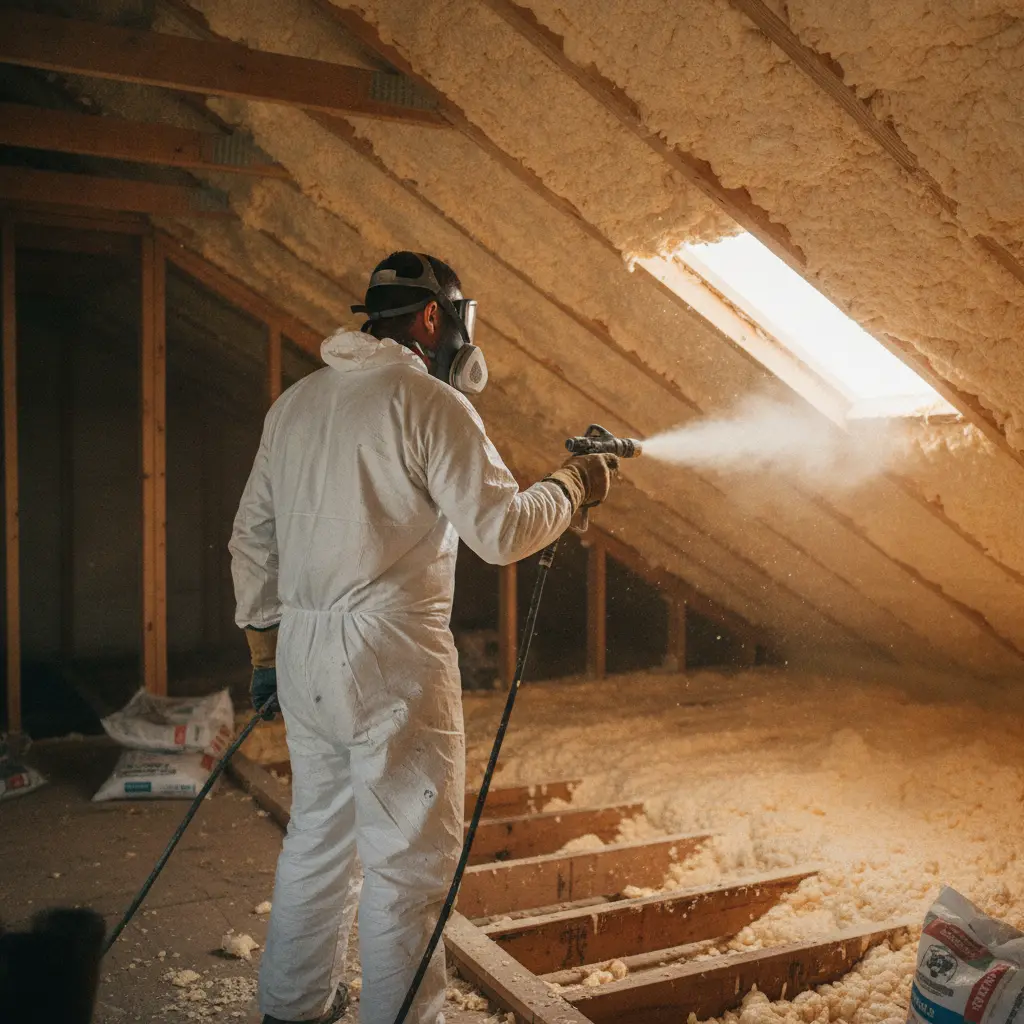
Our team in action — insulation professionals serving Orange
Basement Insulation Methods We Use in Orange, CA
Closed-Cell Spray Foam Insulation
Closed-cell spray foam delivers R-6.5 per inch and acts as both a thermal barrier and a Class II vapor retarder. It is our preferred solution for Orange homes near the Santiago Creek floodplain or in Old Towne where foundation walls show evidence of past moisture intrusion. Its rigid structure also adds structural reinforcement to aging concrete block walls common in pre-1960 construction. Explore spray foam insulation details
Open-Cell Spray Foam Insulation
At R-3.7 per inch, open-cell spray foam is a cost-effective choice for rim joists and interior wall cavities in drier areas of Orange, such as elevated neighborhoods in Orange Park Acres. It excels at air sealing irregular surfaces and is particularly effective for muffling the mechanical noise from HVAC equipment housed in basement utility areas.
Blown-In Insulation
Blow-in cellulose or fiberglass is well-suited for insulating floor cavities above unconditioned crawl spaces, especially in older Craftsman and bungalow homes near Chapman University where joist bays are irregular in size. Cellulose achieves R-3.7 per inch and is treated with borate for fire and pest resistance—an important consideration given Orange County’s history of drywood termite activity. Discover blow-in insulation solutions
Rigid Foam Board Insulation
Rigid extruded polystyrene (XPS) board, rated R-5 per inch, is installed against interior concrete basement walls to create a continuous thermal break. This method is commonly used in newer finished basements in Chapman Hills and Serrano Heights developments where a clean, paintable interior surface is desired.
Crawl Space Encapsulation
For homes with vented crawl spaces—prevalent throughout Orange’s older residential districts—full encapsulation converts the space to a conditioned environment, dramatically reducing moisture, pest pressure, and energy loss. Learn more about crawl space encapsulation
Ready for Basement Insulation? Get Your Free Estimate Today.
Next Level Insulation of Orange serves Orange and the surrounding area — we’ll be on-site within 24 hours.
📞 Call (714) 266-2070Basement Insulation Cost in Orange, CA
Understanding the cost of basement insulation in Orange, CA helps you plan your investment and evaluate proposals accurately. Prices vary based on square footage, method selected, existing conditions, and material costs in the Southern California market.
Typical Price Ranges
- Blown-in insulation (floor cavities): $1.50–$2.50 per square foot, or approximately $900–$2,500 for a typical 1,000 sq. ft. Orange crawl space
- Open-cell spray foam: $1.25–$2.00 per board foot installed, with most Orange crawl space projects ranging from $1,800–$4,500
- Closed-cell spray foam: $2.50–$4.00 per board foot installed, ranging from $3,500–$8,000 for most Orange basement wall applications
- Rigid foam board (interior walls): $2.00–$4.50 per square foot installed, typically $2,000–$5,500 for a 500–1,000 sq. ft. basement wall area
- Full crawl space encapsulation: $3,500–$9,000 depending on size, vapor barrier mil thickness, and whether a dehumidifier is added
- Old insulation removal: $1.00–$2.00 per square foot, added to installation costs when replacement is necessary
Orange, CA–Specific Cost Factors
Material costs in Orange County run approximately 8–12% above national averages due to California supply chain logistics and state regulatory compliance costs. Homes in flood-adjacent neighborhoods near Grijalva Park or along the Santa Ana River corridor may require additional vapor mitigation work, adding $500–$2,000 to base project costs. California’s prevailing wage requirements for certain permit-required work and Orange’s building permit fees (typically $150–$450 for insulation permits) should be factored into your total budget.
Call (714) 266-2070 for a detailed, no-obligation estimate specific to your home’s size and condition.
Orange, CA Neighborhoods We Serve
Old Towne Orange
The historic core of Orange, centered on the Plaza Square, contains some of the city’s oldest residential structures—many dating to 1905–1935. These Victorian, Craftsman, and Colonial Revival homes frequently have partial basements or deep crawl spaces with original wood framing, deteriorated knob-and-tube wiring near insulation zones, and brick foundation walls that require careful product selection to avoid vapor trapping. We are experienced in working within the constraints of Historic Preservation Overlay Zone requirements.
Orange Park Acres
This semi-rural community on Orange’s eastern hillside features larger lot sizes and homes built primarily in the 1960s–1990s. Elevated terrain reduces groundwater pressure, but expansive soil movement during dry Santa Ana seasons creates foundation movement that can compromise vapor barriers and rigid insulation boards.
Serrano Heights
Newer tract homes in this northeast Orange community, built largely between 1995 and 2015, often feature slab foundations with limited crawl space access. We provide targeted rim joist sealing and under-slab insulation assessment for these properties.
Chapman Hills
Upscale hillside homes in this community, built from the 1970s through 2000s, often feature walk-out or daylight basements that are partially below grade. These configurations require combination wall-and-floor insulation strategies and are well-suited to rigid foam board with spray foam detailing at transitions.
Basement Insulation Maintenance Tips for Orange, CA Homeowners
- Inspect annually after winter rains: Following Orange County’s wet season (December–March), visually check your crawl space or basement for signs of water intrusion, especially after atmospheric river events like those recorded in January 2023.
- Monitor interior humidity: Install an inexpensive hygrometer in your basement. Relative humidity above 60% in Orange’s marine-layer months indicates vapor barrier gaps or ventilation issues that need professional attention.
- Clear foundation vents seasonally: Remove leaf litter and debris from perimeter foundation vents before the Santa Ana wind season (October–March) to prevent ember intrusion and maintain airflow in vented crawl space designs.
- Check vapor barrier integrity: Every two to three years, visually inspect the crawl space vapor barrier for tears, displaced sections, or pooling water on the membrane surface.
- Inspect rim joist sealing: Look for daylight, animal entry points, or deteriorated caulk around utility penetrations at least once per year.
- Watch for pest activity: Orange County’s drywood and subterranean termite populations can tunnel through foam insulation. Annual pest inspections protect your insulation investment.
- Verify HVAC drain lines are clear: Condensate overflow from air handling units in basement utility areas is a leading cause of localized moisture damage to insulation in Orange homes.
- Document and photograph: Keep photos dated after each inspection to track any changes and support warranty or insurance claims if needed.
Why Choose Next Level Insulation of Orange
Next Level Insulation of Orange is a locally focused insulation contractor serving Orange, CA and the surrounding communities. Our technicians are specifically trained to address the building science challenges unique to Orange County’s Mediterranean climate, diverse housing stock, and California’s demanding Title 24 energy code.
We bring specialized expertise in every major insulation category—spray foam, blow-in, rigid board, crawl space encapsulation, and complete insulation removal and replacement—so we can recommend the right solution for your home’s specific conditions rather than defaulting to a single product. Our process always begins with a thorough assessment because we know that installing insulation over unaddressed moisture problems only makes things worse, particularly in Orange’s humidity-volatile marine layer environment.
We work transparently, providing written documentation of achieved R-values and installation photos suitable for building department records, real estate disclosures, or HOA submissions. Every project is treated as if it were our own home.
Ready to get started? Call us at (714) 266-2070 or request a free estimate online. Schedule your free basement insulation assessment today
Frequently Asked Questions About Basement Insulation in Orange, CA
How much does basement insulation cost in Orange, CA?
Costs range widely depending on the method and scope. Blown-in insulation for a typical Orange crawl space runs $900–$2,500. Closed-cell spray foam for basement walls ranges from $3,500–$8,000. Full crawl space encapsulation typically costs $3,500–$9,000. These figures reflect Southern California material pricing, which runs 8–12% above national averages. Contact us at (714) 266-2070 for a free itemized quote.
Is a building permit required for basement insulation in Orange, CA?
In most cases, yes. The City of Orange Building Division requires a permit for insulation work that involves changes to the thermal envelope. Permit fees typically range from $150–$450. We handle permit documentation and can provide Title 24 compliance reports to satisfy the Orange Building Department’s inspection requirements.
How long does basement insulation installation take?
Most residential basement or crawl space insulation projects in Orange are completed in one to two days. This assumes moisture remediation is not required. If old insulation removal, vapor barrier installation, and new insulation are all needed, allow two to three days for the complete project. We will give you a precise timeline during your free assessment.
Why does my crawl space have so much moisture even though Orange doesn’t get much rain?
This is very common in Orange. The marine layer that rolls in from the Pacific each evening drives humidity levels to 65% or higher on many summer nights. This moisture penetrates vented crawl spaces and condenses on cool soil and concrete surfaces. Soil vapor from Orange’s sandy loam subsoils also continuously off-gases water vapor upward through the crawl space. Crawl space encapsulation with a heavy-mil vapor barrier resolves this problem definitively.
What R-value do I need for basement insulation in Orange, CA?
Orange falls within California Energy Commission Climate Zone 8. Title 24 requires a minimum R-13 for basement walls and R-19 for floors over unconditioned spaces in new construction. For existing home retrofits, we recommend meeting or exceeding these values. Closed-cell spray foam at 2 inches achieves R-13 on walls, while blown-in cellulose at 5.25 inches achieves R-19 in floor cavities.
Can I insulate my basement myself?
While DIY insulation installation is physically possible, basement insulation in Orange requires careful moisture assessment, vapor barrier design, and Title 24 code compliance that most homeowners are not equipped to ensure. Mistakes—such as trapping moisture behind insulation in a high-humidity crawl space—can cause mold and structural damage that costs far more to remediate than a professional installation would have. We strongly recommend professional assessment before any DIY work below grade.
How does basement insulation affect home resale value in Orange?
Properly documented, code-compliant basement insulation is a positive disclosure item that supports home value in Orange’s competitive real estate market. Energy-efficient homes command a premium in California, and having written Title 24 compliance documentation reduces buyer concern and can streamline transactions. Return on investment for insulation upgrades in Orange County typically ranges from 60% to 80% at resale.
Do you offer insulation removal and replacement, or only new installation?
We offer the full spectrum: inspection, removal of old or contaminated insulation, vapor remediation, and new insulation installation. Learn more about our insulation removal and replacement services. Many Orange homes with pre-1980 construction require complete removal of original fiberglass batts before new materials can be safely installed.
Get Expert Basement Insulation in Orange, CA Today
Don’t let Orange’s marine-layer humidity, Santa Ana wind cycles, and aging housing stock compromise your home’s comfort and energy efficiency. Next Level Insulation of Orange is ready to assess your basement or crawl space, recommend the right solution for your specific conditions, and deliver a professionally installed insulation system that meets California Title 24 standards.
Our team serves homeowners throughout Orange, CA, from historic Old Towne properties to hillside homes in Chapman Hills. We provide free, no-pressure on-site assessments with written documentation of findings and recommendations.
Call us now at (714) 266-2070 to schedule your free basement insulation inspection. You can also submit a request online and we will contact you within one business day. Take the next step toward a more comfortable, energy-efficient home today.