

Roof Insulation in Orange, CA
Expert Roof Insulation in Orange, CA — Storm-Tested, Warranty-Backed
Need roof insulation in Orange, CA? Next Level Insulation of Orange offers expert attic, spray foam & blow-in insulation. Call (714) 266-2070 for a free estimate.
- Licensed & Insured
- Locally Owned & Operated
- Free Inspection & Estimate
Request Your
Free EstimateRoof insulation is a thermal and moisture barrier installed between your living space and the exterior roofline, designed to prevent heat transfer, reduce energy loss, and protect your home’s structural integrity. In Orange, California, where summer temperatures routinely climb above 95°F and the Santa Ana winds create rapid seasonal temperature swings, a properly insulated roof is not a luxury — it is a necessity.
At Next Level Insulation of Orange, we specialize in delivering professional-grade roof insulation solutions tailored specifically to the climate demands and architectural styles found throughout Orange County. Whether you own a mid-century ranch home in Old Towne Orange or a modern two-story in The Village, our technicians bring deep local knowledge, premium materials, and meticulous installation practices to every project. We handle everything from initial assessment through final air-sealing, ensuring your roof performs at its highest potential year-round. Call us today at (714) 266-2070 to schedule your free evaluation.
Understanding Roof Insulation
Roof insulation refers to any material or system installed within or directly beneath the roof assembly to resist conductive, convective, and radiant heat transfer. The goal is to maintain a consistent indoor temperature without over-relying on mechanical heating and cooling systems. Insulation is measured in R-values — a numerical rating of thermal resistance. The higher the R-value, the better the material resists heat flow.
Historically, early California residential construction from the 1940s through the 1960s used minimal insulation or none at all. Homes were designed with ventilated attic spaces and single-pane windows, relying on natural cross-ventilation to stay cool. As Orange grew rapidly during the postwar suburban boom — particularly in the 1950s and 1960s when tracts like Chapman Hills and Serrano Heights were first developed — builders prioritized speed over energy efficiency. The result is a housing stock where a significant percentage of older homes still have inadequate or degraded insulation.
Modern building science has dramatically advanced our understanding of roof insulation. Today, the California Energy Commission’s Title 24 Building Energy Efficiency Standards mandate minimum R-values for roofs and attics depending on climate zone. Orange, CA falls within Climate Zone 8, which requires a minimum attic insulation R-value of R-38. Many older Orange homes fall well short of this benchmark, sometimes containing only R-11 or R-19 batts installed decades ago — materials that have since compressed, settled, and lost a significant portion of their original thermal resistance.
Roof insulation applies to multiple building types common in Orange: single-family detached homes, attached townhomes in communities like Riverbend, older apartment complexes along Katella Avenue, and commercial structures near the City Drive retail corridor. Each building type presents unique insulation challenges based on its roof geometry, ventilation configuration, and existing material conditions. Understanding these distinctions is the foundation of every project we undertake. Learn more about our attic insulation services
Why Roof Insulation Is Needed in Orange, CA
Extreme Radiant Heat from Southern California Sunshine
Orange receives an average of 278 sunny days per year. During peak summer months — typically June through September — rooftop surface temperatures on dark asphalt shingles can exceed 160°F. Without adequate insulation, this radiant heat transfers directly into attic spaces, pushing attic air temperatures above 140°F. That superheated air then radiates downward into living spaces, forcing air conditioning systems to work 20–30% harder to maintain comfortable interior temperatures. Properly installed R-38 or higher insulation can reduce attic heat transfer by up to 85%, creating measurable savings on monthly utility bills.
Santa Ana Wind Events and Rapid Temperature Swings
The Santa Ana winds — occurring most frequently between October and March — bring dry, hot air from the inland desert into Orange County at speeds sometimes exceeding 60 mph. During these events, outdoor temperatures can spike by 15–25°F within a few hours, then drop sharply overnight. Homes without adequate roof insulation experience dramatic interior temperature fluctuations during these events, stressing HVAC systems and creating uncomfortable living conditions. The October 2017 Canyon Fire 2, which burned within miles of Orange’s eastern boundary near Anaheim Hills, highlighted how wind-driven heat events can overwhelm older, under-insulated homes in just hours.
Southern California’s Marine Layer and Moisture Intrusion
Despite Orange’s reputation for sunshine, the marine layer — a coastal fog bank driven inland from the Pacific Ocean — brings regular overnight and early-morning humidity, especially between May and July in what locals call “June Gloom.” This cyclical moisture exposure causes condensation within poorly insulated roof assemblies, promoting mold growth, wood rot, and deterioration of existing insulation materials. Homes in lower-elevation neighborhoods near the Santa Ana River corridor, including areas of the Serrano and Yorba Park neighborhoods, are particularly susceptible to this moisture cycling.
Aging Housing Stock Throughout Orange Neighborhoods
A substantial portion of Orange’s residential housing was built between 1945 and 1975. Tract developments in Old Towne Orange (a National Register Historic District), Villa Park Road corridors, and the Eichler-influenced neighborhoods near Chapman University frequently contain original blown-in rock wool or early fiberglass batts. After 40–60 years, these materials compress and settle significantly. A 6-inch batt originally rated at R-19 may now perform at R-10 or lower due to compression and moisture absorption. Replacing or supplementing this degraded insulation is one of the highest-return investments available to Orange homeowners.
Title 24 Compliance Requirements
California’s Title 24 Energy Code requires that any permitted roofing replacement or significant HVAC upgrade triggers an evaluation of attic insulation levels. With Orange’s active real estate market and regular re-roofing activity driven by aging materials, many homeowners find themselves required to upgrade their insulation at permit-pull time. Working with an experienced local contractor ensures your installation meets or exceeds Climate Zone 8 minimums. Learn about our insulation removal and replacement services
Signs You Need Roof Insulation in Orange, CA
Temperature and Comfort Indicators
- Rooms directly beneath the roofline are noticeably hotter than the rest of the home during summer months
- Interior temperatures fluctuate dramatically during Santa Ana wind events even with HVAC running
- Your air conditioning runs continuously during summer afternoons without achieving the set thermostat temperature
- Upstairs bedrooms feel 5–10°F warmer than downstairs rooms throughout the day
Energy Bill Red Flags
- Monthly utility bills consistently exceed neighbors’ in similar-sized homes
- Year-over-year energy costs are rising without a corresponding increase in usage
- Dramatic spikes in cooling costs between May and September compared to the national average
Physical and Visual Warning Signs
- Visible gaps, compression, or deterioration in existing attic insulation
- Evidence of moisture staining or mold on attic sheathing or rafters
- Ice dams or condensation on interior ceiling surfaces (rare in Orange but possible during cold snaps)
- Pest damage — rodents and insects nesting within degraded insulation batts
Urgency Indicators
If you notice active mold growth in your attic space, significant moisture damage to roof decking, or insulation that crumbles when touched, treat these as urgent conditions requiring immediate professional evaluation. Contact us about emergency insulation replacement
Our Roof Insulation Process in Orange, CA
Comprehensive Home Assessment (1–2 Hours)
Every project begins with a thorough on-site evaluation. Our technicians inspect your existing roof insulation, measure current R-values using calibrated depth gauges, assess air sealing conditions, identify moisture damage or pest intrusion, and evaluate attic ventilation adequacy. We take note of your home’s construction era and roof geometry — critical factors in homes throughout Orange’s varied neighborhoods.
Custom Project Proposal (Same Day or Within 24 Hours)
Based on our assessment, we provide a detailed written proposal outlining recommended insulation type, target R-value, air sealing scope, estimated timeline, and itemized costs. We explain all California Title 24 Climate Zone 8 compliance requirements relevant to your project.
Preparation and Protection (1–3 Hours on Installation Day)
Before any material is installed, our crew protects your home’s interior access points, seals HVAC equipment in the attic to prevent contamination, and installs attic baffles where necessary to maintain proper soffit-to-ridge ventilation — a critical detail in Orange’s warm climate that prevents moisture buildup.
Air Sealing (1–4 Hours Depending on Home Size)
Air leakage accounts for up to 40% of a home’s energy loss. We seal all penetrations — recessed light fixtures, top plates, plumbing chases, and HVAC boots — using appropriate spray foam or caulk prior to installing bulk insulation. This step is frequently skipped by less thorough contractors but is essential for peak performance.
Insulation Installation (2–6 Hours)
Material is installed to the specified depth and coverage, verified with ruler depth checks at multiple points throughout the attic. For blow-in applications, we install a minimum of one depth marker per 300 square feet. For spray foam applications on roof declines or encapsulated attics, we confirm minimum thickness with calibrated probes.
Quality Verification and Cleanup
A senior technician conducts a post-installation walkthrough, measuring final R-value depths, inspecting air sealing completeness, and photographing finished work for your records. All debris and protective coverings are removed. Your home is left cleaner than we found it.
Documentation and Follow-Up
You receive a completed Certificate of Insulation documenting material type, R-value achieved, and square footage installed — documentation required for Title 24 compliance and useful for real estate disclosure purposes.
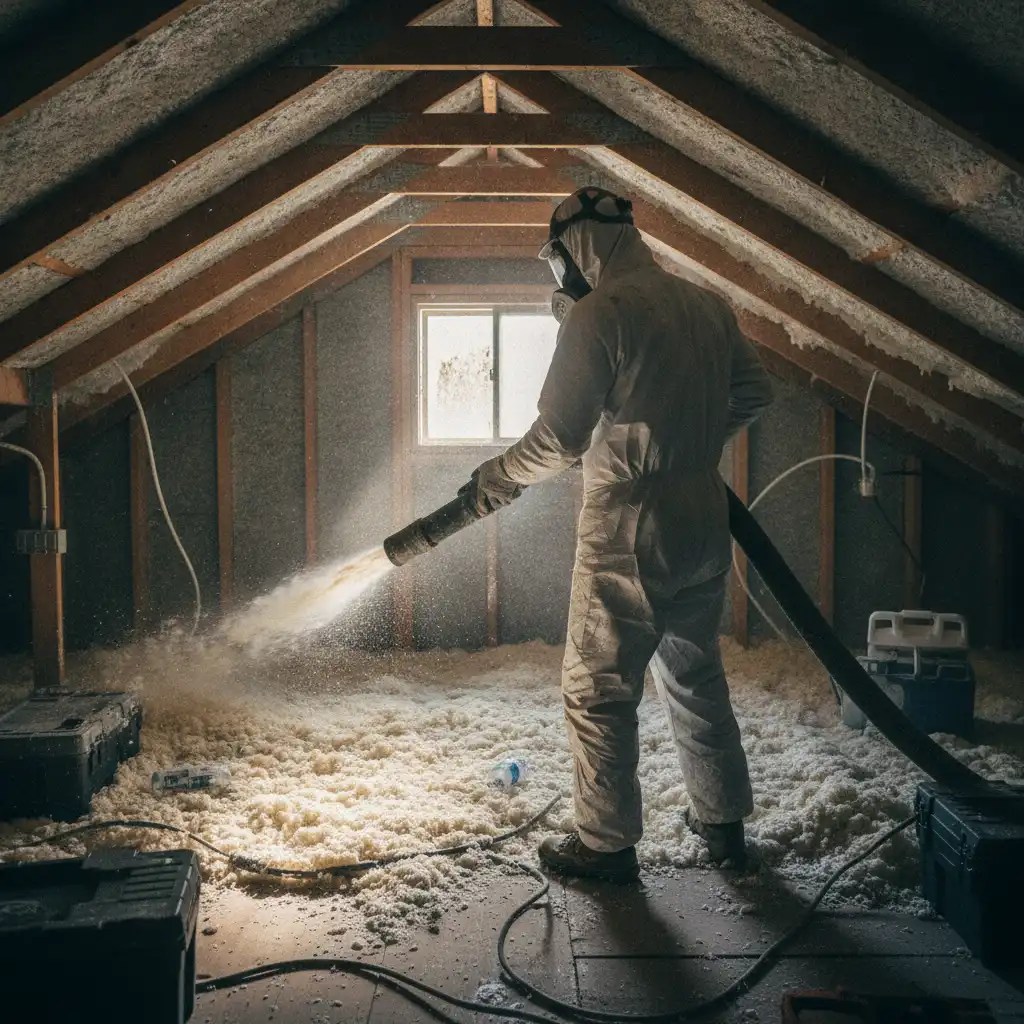
Our team in action — insulation professionals serving Orange
Roof Insulation Methods and Approaches
Blown-In Fiberglass or Cellulose (Open Attic Applications)
The most common method for Orange’s standard attic-access homes, blown-in insulation uses a mechanical blower to fill cavities uniformly. Cellulose — made from recycled paper — offers excellent fire resistance and performs well in Orange’s humidity cycling conditions. Fiberglass blow-in is moisture-resistant and settles less over time. Both are ideal for achieving R-38 to R-60 in accessible flat-ceiling attic assemblies common in ranch-style and tract homes. Learn more about blow-in insulation
Spray Foam Insulation (Unvented Roof Assemblies)
Closed-cell spray polyurethane foam (SPF) is the premium solution for encapsulating attic spaces, insulating cathedral ceilings, or addressing the vaulted roof assemblies common in Orange’s mid-century modern and Eichler-style homes. With an R-value of approximately R-6.5 per inch, closed-cell foam achieves high thermal resistance in thin profiles and creates a complete air and vapor barrier — critical for coastal-influenced climates. Explore our spray foam insulation services
Batts and Blankets (New Construction or Major Renovations)
Fiberglass or mineral wool batt insulation is appropriate for open-rafter applications during roof replacement or gut renovation projects. Batts install quickly between standard 16″ or 24″ on-center framing, making them cost-effective for new construction in active Orange development zones near El Modena and East Orange.
Rigid Foam Board (Low-Slope Commercial Roofs)
Polyisocyanurate (polyiso) or expanded polystyrene (EPS) rigid boards are used on commercial low-slope roofs and some residential flat-roof additions common in older Orange neighborhoods. These boards offer high R-values per inch and exceptional compressive strength under roofing membranes.
Ready for Roof Insulation? Get Your Free Estimate Today.
Next Level Insulation of Orange serves Orange and the surrounding area — we’ll be on-site within 24 hours.
📞 Call (714) 266-2070Roof Insulation Cost in Orange, CA
Understanding the investment required for roof insulation helps homeowners make informed decisions. Below are typical cost ranges for the Orange, CA market as of 2024–2025. All estimates include materials and labor.
Blown-In Attic Insulation
- Average cost: $1.50–$3.50 per square foot installed
- Typical 1,500 sq ft attic: $2,250–$5,250
- Upgrading from R-11 to R-38 in a 2,000 sq ft attic: $3,000–$7,000
Spray Foam Roof Insulation
- Closed-cell spray foam: $5.00–$9.00 per square foot
- Full attic encapsulation (1,500 sq ft): $7,500–$13,500
- Cathedral ceiling or vaulted rafter application: $6.00–$10.00 per sq ft
Batt Insulation (With Roof Access)
- Fiberglass batts installed: $1.00–$2.50 per square foot
Factors Affecting Your Roof Insulation Cost in Orange
- Current insulation removal required (adds $1.00–$2.00 per sq ft) insulation removal pricing
- Attic accessibility and ceiling height
- Extent of air sealing work needed
- Presence of moisture damage or mold remediation requirements
- Local permit fees if required by Orange’s Building Division
Orange County utility programs through Southern California Edison and SoCalGas occasionally offer rebates for insulation upgrades meeting specified R-value thresholds. Ask our team about currently available incentives when you call (714) 266-2070.
Neighborhoods We Serve in Orange, CA
Old Towne Orange
Centered on the historic Plaza District, Old Towne Orange contains homes built predominantly between 1905 and 1940. These Craftsman bungalows and Colonial Revivals often have shallow attic access, original knob-and-tube wiring (requiring special handling near insulation), and zero existing attic insulation. Our team is experienced navigating these older structures with the care their historic character demands.
El Modena and East Orange
This area features a mix of 1960s–1980s tract homes and newer infill construction. Many homes contain original blown-in rock wool that has settled significantly. This neighborhood’s slightly higher elevation creates stronger wind exposure during Santa Ana events, making proper insulation and air sealing especially impactful.
Serrano Heights and Canyon Hills
These planned communities from the 1980s and 1990s contain larger two-story homes with complex roof geometries including vaulted ceilings, dormers, and bonus rooms. Multi-level roof assemblies require careful assessment to ensure continuous thermal coverage without creating trapped moisture zones.
Villa Park Road Corridor and Panorama Heights
This established area features mid-century modern architecture from the 1950s and 1960s, including several Eichler-influenced designs with post-and-beam construction and flat or low-slope roofs. These homes require specialized rigid foam or spray foam solutions rather than conventional blown-in approaches.
Roof Insulation Maintenance Tips for Orange, CA Homeowners
- Inspect your attic annually — ideally in October before Santa Ana season — for signs of settling, moisture staining, or pest intrusion in your insulation.
- Check soffit and ridge vents every spring to ensure they remain unobstructed. Blocked ventilation in Orange’s warm climate leads to moisture accumulation and insulation degradation.
- After any re-roofing project, confirm with your roofing contractor that attic baffles and insulation depth were preserved during the work.
- Monitor for pest activity — roof rats are common in Orange County and readily nest in damaged insulation batts, compressing and contaminating the material.
- Keep attic access hatches weatherstripped and insulated. An unsealed pull-down attic stair is equivalent to a 10-square-foot hole in your ceiling’s thermal envelope.
- Check for air leaks around recessed lighting, ceiling fans, and HVAC penetrations annually. These gaps compound rapidly in Southern California’s cycling temperature environment.
- After major weather events — particularly heavy rain years like the atmospheric river events of January–March 2023 — inspect for any moisture that may have entered the attic and compromised insulation performance.
Why Choose Next Level Insulation of Orange
Next Level Insulation of Orange is a locally operated insulation contractor serving homeowners and businesses throughout Orange, CA and the surrounding communities. We are not a national franchise or out-of-area company dispatching unfamiliar crews — we are your neighbors, and we understand the specific building stock, climate conditions, and code requirements that define this city.
Our technicians are trained in California’s Title 24 Climate Zone 8 requirements, ensuring every installation meets or exceeds current energy code minimums. We work with the full range of insulation systems — spray foam, blown-in fiberglass, blown-in cellulose, mineral wool batts, and rigid foam — matching the right material to your specific roof assembly, budget, and performance goals.
We offer free, no-pressure on-site assessments. Our proposals are transparent, itemized, and delivered the same day or within 24 hours of your inspection. We back our work with quality craftsmanship and stand behind every installation we complete. When you call Next Level Insulation of Orange, you speak directly with knowledgeable local professionals ready to answer every question — call us at (714) 266-2070. Explore our crawl space insulation services
Frequently Asked Questions: Roof Insulation in Orange, CA
What R-value do I need for my attic in Orange, CA?
Orange, CA falls within California Energy Code Climate Zone 8. The current Title 24 minimum for attic insulation in this zone is R-38. However, many energy efficiency experts recommend upgrading to R-49 or R-60 for maximum performance, particularly for homes with high cooling loads or those that have been under-insulated for decades. Our assessment will measure your existing R-value and recommend the optimal target for your specific home.
How much does roof insulation cost in Orange, CA?
Costs vary based on insulation type, attic size, and project complexity. As a general guideline: blown-in insulation runs $1.50–$3.50 per square foot, while spray foam encapsulation ranges from $5.00–$9.00 per square foot. A typical 1,500 sq ft attic blow-in project in Orange runs $2,250–$5,250 all-inclusive. Contact us at (714) 266-2070 for a precise quote.
How long does roof insulation installation take?
Most residential attic insulation projects in Orange are completed in a single day — typically 4–8 hours from crew arrival to cleanup. Larger homes, homes requiring significant insulation removal first, or complex spray foam encapsulation projects may require 2 days. We provide a specific timeline estimate in every project proposal.
Do I need to remove my old insulation before adding new material?
Not always. If your existing insulation is dry, free of mold, and structurally intact, new blown-in material can often be added on top to bring you to the target R-value. However, if there is moisture damage, pest contamination, mold, or the presence of vermiculite (which may contain asbestos, occasionally found in pre-1980 Orange homes), removal is necessary before new insulation is installed. Learn more about our insulation removal process
Will new roof insulation actually lower my energy bills in Orange?
Yes — measurably. Homes in Southern California’s Climate Zone 8 that upgrade from minimal insulation (R-11 to R-19) to code-compliant R-38 or higher typically see cooling cost reductions of 15–30%. With Orange’s high summer cooling loads and Southern California Edison’s tiered electricity rates, these savings can amount to hundreds of dollars per year.
Is a permit required for attic insulation in Orange, CA?
In most cases, adding insulation to an existing accessible attic does not require a permit from the City of Orange Building Division. However, spray foam encapsulation that changes the attic’s ventilation configuration, or insulation work performed in conjunction with a permitted re-roofing or HVAC project, may trigger permit requirements. We advise on permit applicability as part of our proposal process.
What is the difference between vented and unvented attic insulation systems?
A vented attic uses soffit and ridge vents to passively move air through the attic space, keeping insulation at the attic floor (ceiling plane). An unvented or “encapsulated” attic uses spray foam applied directly to the roof decking, conditioning the attic space and eliminating ventilation requirements. Unvented systems are particularly effective for Orange’s vaulted and cathedral ceiling homes where soffit ventilation is impractical.
Can roof insulation help with noise reduction?
Yes. Dense-packed cellulose and closed-cell spray foam both provide meaningful sound attenuation. For homes near the 22 Freeway corridor, SR-57, or under flight paths near John Wayne Airport, enhanced insulation can noticeably reduce exterior noise intrusion through the roof assembly, improving interior acoustic comfort alongside thermal performance.
Get Your Free Roof Insulation Assessment in Orange, CA Today
Don’t let another Southern California summer drain your energy budget through an under-insulated roof. Next Level Insulation of Orange is ready to assess your home, explain your options clearly, and deliver a professional installation that performs for decades. Whether you’re in Old Towne Orange, Serrano Heights, El Modena, or anywhere in between, we bring local expertise and premium materials directly to your door.
Call us now at (714) 266-2070 to schedule your free, no-obligation roof insulation evaluation. Our team is available Monday through Saturday and can often schedule same-week assessments. Schedule your free insulation assessment online
Next Level Insulation of Orange — Roof Insulation Done Right, Right Here in Orange, CA.