

Rockwool Insulation in Orange, CA
Energy-Saving Rockwool Insulation for Orange, CA Homes — Licensed & Insured
Need Rockwool insulation in Orange, CA? Next Level Insulation of Orange offers expert installation, removal & replacement. Call (714) 266-2070 for a free estimate.
- Licensed & Insured
- Locally Owned & Operated
- Free Inspection & Estimate
Request Your
Free EstimateRockwool insulation — also known as mineral wool or stone wool insulation — is a high-performance building material made from volcanic basalt rock and recycled slag that is spun into dense, fire-resistant fiber batts and boards. For homeowners and business owners in Orange, CA, Rockwool offers a uniquely powerful combination of thermal regulation, acoustic dampening, and fire resistance that standard fiberglass simply cannot match.
Orange’s distinct Mediterranean climate — with summer highs routinely exceeding 95°F and cool, damp winters — demands insulation that can handle thermal swings, moisture exposure, and the ever-present risk of wildfire. Next Level Insulation of Orange specializes in professional Rockwool insulation installation tailored specifically to Orange’s older housing stock, new construction developments, and everything in between. Our team understands the local building codes, climate demands, and neighborhood-specific challenges that make Rockwool the premium insulation choice for this community.
Call us today at (714) 266-2070 to schedule your free assessment.
Understanding Rockwool Insulation in Orange, CA
Rockwool insulation traces its origins to the 1840s when natural mineral wool was first discovered forming around Hawaiian volcanic vents — nature’s own version of spun stone fiber. Modern Rockwool products replicate this process industrially by melting basalt rock and steel-mill slag at temperatures exceeding 2,900°F, then spinning the molten material into fine, interlocking fibers that are formed into batts, boards, or loose-fill products. The result is an insulation material that is inherently non-combustible, dimensionally stable, and highly resistant to moisture absorption.
In Orange, CA — a city that grew rapidly during Southern California’s post-WWII suburban boom and has continued expanding through the 1980s, 1990s, and into the 2000s — the building stock is remarkably diverse. Craftsman bungalows in Old Towne Orange (many built between 1910 and 1940) sit alongside ranch-style homes from the 1960s, two-story tract developments from the 1980s, and modern mixed-use buildings near Chapman University’s campus. Each era of construction came with its own insulation standards — or lack thereof — meaning the need for Rockwool upgrades and replacements is widespread across virtually every corner of the city.
Rockwool’s R-value ranges from R-15 to R-23 for standard 3.5-inch wall batts, and up to R-30 or higher in thicker attic and floor applications. Critically, Rockwool achieves these values while maintaining a fire rating of up to 2,400°F — a specification that carries enormous relevance in Orange County, where the risk of brush fires and the proximity to fire-prone wildland-urban interface zones is a documented reality.
Beyond fire resistance, Rockwool’s density — roughly 5 to 8 pounds per cubic foot — gives it exceptional sound attenuation properties, making it especially valuable in Orange’s denser residential neighborhoods where homes sit close together, traffic noise from the SR-22 (Garden Grove Freeway) corridor is persistent, and multi-family buildings require effective noise isolation between units.
Unlike fiberglass, Rockwool does not sag or settle over time. Its rigid fiber structure means that an installation completed today maintains its full R-value performance for the life of the building — a critical advantage in Orange’s older housing stock where decades-old fiberglass insulation has often compacted to a fraction of its original effectiveness.
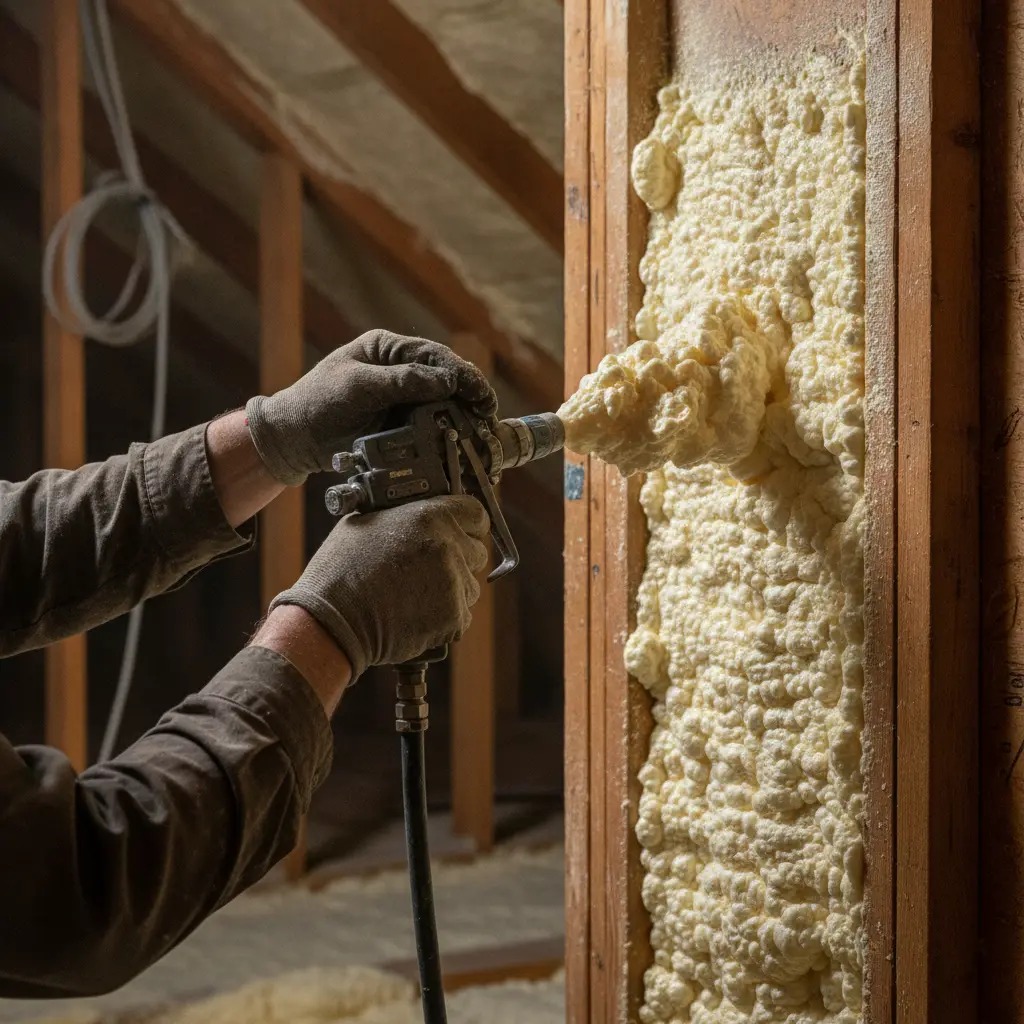
Our team in action — insulation professionals serving Orange
Why Rockwool Insulation Is Needed in Orange, CA
Orange’s Climate Creates Extreme Insulation Demands
Orange, CA sits in the inland edge of the Los Angeles Basin where the moderating influence of the Pacific Ocean weakens significantly compared to coastal cities like Huntington Beach or Newport Beach. NOAA weather data confirms that Orange regularly experiences summer temperatures 8°F to 12°F higher than coastal Orange County communities. The city’s average July high reaches 93°F, with heat events frequently pushing past 100°F — the September 2020 heat dome brought temperatures of 107°F to parts of Orange — while winter nights can dip to the low 40s°F, creating a temperature differential across the building envelope that taxes poorly insulated walls and attics relentlessly.
This thermal stress directly drives energy costs. The Southern California Edison service territory, which covers Orange, has seen residential electricity rates climb past 28 cents per kilowatt-hour as of recent billing cycles. Homes without adequate insulation — particularly those relying on original 1950s or 1960s fiberglass that has settled to an effective R-6 or lower in attics — can see cooling and heating bills that are 30% to 50% higher than properly insulated comparable homes.
The Santa Ana Wind Fire Risk Factor
Orange is directly in the path of Santa Ana wind events — dry, hot, easterly winds that funnel through Southern California’s mountain passes each fall and winter, sometimes exceeding 60 mph. The October 2007 Santiago Fire burned over 28,000 acres in the hills immediately east of Orange, and the November 2008 Freeway Complex Fire threatened communities along Orange’s eastern perimeter. These events underscore why fire-resistant building materials, including Rockwool insulation, are not merely a premium upgrade but a genuine safety priority for Orange homeowners.
Rockwool’s Class A fire rating and non-combustible composition mean it will not contribute to flame spread within wall cavities or attic spaces — a documented fire pathway in homes insulated with combustible foam or standard fiberglass facing materials.
Aging Housing Stock and Moisture Concerns
Old Towne Orange — one of the largest historic districts in California — contains hundreds of homes built before modern insulation codes existed. Many of these Craftsman-era and Spanish Colonial Revival homes have never had their original insulation replaced or upgraded. In neighborhoods like Cypress Street Historic District and along N. Shaffer Street, original blown cellulose or early fiberglass products have degraded to near-zero effectiveness.
Additionally, Orange’s position in a low-lying basin means that winter ground moisture and morning marine layer humidity — particularly between November and March — creates conditions where moisture-absorbing insulation materials like cellulose or fiberglass can become damp, compressed, and susceptible to mold growth. Rockwool’s hydrophobic composition repels moisture rather than absorbing it, making it uniquely suited to Orange’s seasonal humidity patterns and the crawl space challenges common in the city’s older slab-on-grade and raised-foundation homes.
Noise Pollution Along Key Corridors
Residents near the SR-22 Freeway corridor, Chapman Avenue, and Katella Avenue experience significant traffic noise that standard insulation does little to mitigate. Rockwool’s dense fiber matrix provides a Sound Transmission Class (STC) rating of 45 to 52 in wall applications — substantially higher than fiberglass alternatives — making it the preferred solution for noise-sensitive installations throughout Orange.
Signs You Need Rockwool Insulation in Orange, CA
Energy and Comfort Indicators
- Monthly SCE electricity bills exceeding $250–$350 during Orange’s July–September peak cooling season in a home under 2,000 square feet
- Rooms that feel 5°F or more warmer than the thermostat setting, particularly south- and west-facing rooms during afternoon hours
- HVAC system running continuously for more than 45 minutes per cycle during moderate weather
- Noticeable hot or cold spots on interior walls when touched during temperature extremes
Visual and Physical Warning Signs
- Visible gaps, compression, or yellowing of existing fiberglass batts in attic spaces
- Insulation that crumbles or produces dust when touched — a sign of severely degraded fiberglass or cellulose
- Dark streaks or staining on insulation surfaces indicating moisture infiltration
- Visible daylight through wall plates or around electrical outlets when viewed from inside the attic
Urgency Indicators
- Home was built before 1978 and has never had insulation replaced — original materials may contain hazardous components
- Musty odors emanating from wall cavities or attic — a strong indicator of mold growth in compromised insulation
- Recent rodent or pest activity in attic or crawl space that has contaminated existing insulation
- Post-fire inspection revealing char or smoke damage to attic insulation after a nearby brush fire event
Rockwool Insulation Methods and Approaches
Rockwool Batt Installation
The most common application for Orange residential projects, Rockwool batts are precision-cut to fit standard 2×4 (R-15) and 2×6 (R-23) wall cavities as well as attic joist bays. This method is ideal for new construction, renovation projects with open wall cavities, and attic upgrades in Orange’s 1960s–1990s ranch and two-story homes. Batts can be installed in a single day for most standard residential projects.
Rockwool Board Insulation
Rigid Rockwool boards (ComfortBoard IS) are used for continuous exterior insulation applications — particularly valuable for thermal bridging elimination in Orange’s newer construction and commercial projects near the city’s downtown core and Chapman University district. Board insulation is also applied in crawl space walls and rim joist areas.
Rockwool Safe’n’Sound for Interior Partitions
This specialized Rockwool product is designed specifically for interior wall applications where noise reduction — rather than thermal performance — is the primary goal. It is the preferred solution for homes near Orange’s SR-22 corridor, multi-family units, and home offices where acoustic separation is critical. STC improvements of 15–20 points over uninsulated walls are typical.
Combined Rockwool and Air Sealing Systems
For Orange’s oldest pre-1950 homes in the Old Towne district, we combine Rockwool batts with spray foam air sealing at penetrations and rim joists. Explore our spray foam insulation services This hybrid approach addresses both insulation deficiency and the significant air infiltration common in older wood-framed construction, delivering maximum energy performance without full wall-cavity demolition.
Rockwool Blow-In (Loose Fill)
For enclosed wall cavities in existing homes where opening walls is impractical, Rockwool mineral wool loose fill can be blown in through small access holes. Learn about our blow-in insulation options This method is frequently used in Orange’s 1940s–1960s tract homes where wall cavities were never insulated during original construction.
Ready for Rockwool Insulation? Get Your Free Estimate Today.
Next Level Insulation of Orange serves Orange and the surrounding area — we’ll be on-site within 24 hours.
📞 Call (714) 266-2070Rockwool Insulation Cost in Orange, CA
Understanding the investment in Rockwool insulation helps Orange homeowners budget accurately and evaluate the long-term return on their energy efficiency improvements.
Typical Price Ranges
- Attic Rockwool Batt Installation: $1.80–$2.80 per square foot installed, with a typical 1,500 sq ft Orange home attic running $2,700–$4,200 total
- Wall Cavity Rockwool Batts (Open Cavity): $1.50–$2.50 per square foot, with a full home re-insulation project in a 1,800 sq ft home ranging $3,500–$6,500
- Rockwool Board (Exterior or Crawl Space): $2.50–$4.00 per square foot installed
- Rockwool Safe’n’Sound (Interior Walls): $1.20–$2.00 per square foot for acoustic partition applications
- Combined Insulation Removal and Replacement: Add $0.75–$1.50 per square foot for old insulation removal prior to new installation
Factors That Affect Your Orange Project Cost
- Age and construction type of your Orange home — pre-1960 homes often require additional labor for irregular framing
- Attic accessibility — low-pitch rooflines common in 1950s–1970s Orange ranch homes increase installation time
- Presence of contaminated or hazardous old insulation requiring special disposal
- Scope of air sealing work needed alongside insulation
- Current material costs — Rockwool products carry a 20–30% material premium over fiberglass batts, offset by longer performance life and no replacement cycle
Available Incentives
Orange homeowners may qualify for Southern California Edison’s home energy efficiency rebates and the federal Inflation Reduction Act 25C tax credit, which provides up to 30% of insulation project costs (up to $1,200 annually) for qualifying upgrades. Our team provides documentation to support your rebate and tax credit applications. Call (714) 266-2070 for a precise quote.
Neighborhoods We Serve in Orange, CA
Old Towne Orange
One of California’s most intact historic districts, Old Towne Orange features hundreds of Craftsman bungalows, Spanish Colonial Revival homes, and early California ranch-style properties built between 1905 and 1945. These homes typically have no wall insulation, original single-pane windows, and attics with collapsed or absent insulation. Rockwool installation here requires careful navigation of irregular framing, plaster wall systems, and historic preservation considerations.
Villa Park Border and East Orange
Larger 1960s–1980s single-story and two-story homes in this area often have original fiberglass batts that have settled to R-8 or lower in attics. The proximity to the Santiago Hills increases wildfire awareness, making Rockwool’s fire-resistant properties especially relevant to homeowners in this zone.
Chapman University District
A mix of older residential properties converted to multi-family use, student housing, and newer construction surrounds Chapman University. Rockwool Safe’n’Sound installations are in high demand here for between-unit noise isolation and compliance with California soundproofing requirements for multi-family residential.
The Village at Orange and Serrano Heights
Newer planned communities in Orange’s northern and eastern areas feature 1990s–2000s construction with code-minimum insulation that underperforms during Orange’s intense summer heat events. Attic insulation upgrades and continuous exterior Rockwool board installations are the most common projects in these neighborhoods.
Rockwool Insulation Maintenance Tips for Orange, CA Homeowners
- Annual Attic Inspection: Inspect your attic each fall before Orange’s wet season (November–March) to check for signs of roof leaks that could saturate insulation — even moisture-resistant Rockwool performs better when kept dry
- Pest Exclusion: Seal all exterior penetrations annually to prevent rodent entry, as nesting activity compresses and displaces even rigid Rockwool batts over time
- HVAC Maintenance: Change air filters every 60–90 days during Orange’s high-use cooling season to keep your insulated home’s HVAC system operating efficiently
- Monitor Attic Ventilation: Ensure soffit and ridge vents remain unobstructed — proper attic ventilation in Orange’s hot summers works in tandem with your insulation to prevent heat buildup above 150°F in attic spaces
- Check Crawl Space Vapor Barriers: Inspect crawl space moisture barriers annually, particularly after Orange’s wet winters, to confirm they remain intact and secured Learn about our crawl space encapsulation services
- Inspect After Santa Ana Wind Events: Strong Santa Ana winds can dislodge insulation at open eave areas — inspect visible attic perimeters after major wind events
- Re-assess After Renovations: Any remodeling that opens walls is an opportunity to upgrade to Rockwool — take advantage rather than reinstalling old or inferior materials
Why Choose Next Level Insulation of Orange
Next Level Insulation of Orange is a locally focused insulation contractor serving the Orange community with expert knowledge of the city’s unique climate conditions, diverse housing stock, and specific energy code requirements. Our team has direct, hands-on experience working in Orange’s oldest historic neighborhoods, its mid-century ranch homes, and its newer planned communities — understanding that no two projects in this city are the same.
We specialize in the full range of insulation services Orange homeowners need: attic insulation, crawl space insulation, insulation removal and replacement, and complete spray foam insulation applications — all with Rockwool as a premium offering for clients who want the highest-performing, longest-lasting solution available.
We provide transparent, itemized quotes with no surprise fees. We source only premium Rockwool products meeting California’s rigorous Title 24 standards. And we back our workmanship with our commitment to your complete satisfaction — not finished until you are.
Call us at (714) 266-2070 to schedule your free Orange property assessment today.
Frequently Asked Questions About Rockwool Insulation in Orange, CA
How much does Rockwool insulation cost in Orange, CA?
Rockwool insulation in Orange typically runs $1.50–$2.80 per square foot installed for batt applications, depending on project scope, location in the home, and whether old insulation removal is required. A complete attic re-insulation in a typical 1,500 sq ft Orange home ranges from $2,700 to $4,200. These costs are offset by SCE energy rebates and the federal 25C tax credit of up to 30% of project costs.
Is Rockwool better than fiberglass for Orange’s climate?
Yes — for most Orange applications, Rockwool outperforms fiberglass in three critical areas: it does not sag or settle over time (maintaining its rated R-value for decades), it is hydrophobic and resists the seasonal moisture Orange experiences from November through March, and its Class A fire rating is a meaningful safety advantage given Orange County’s documented wildfire history.
How long does Rockwool insulation installation take in Orange?
Most residential Orange projects — attic or wall insulation in a standard single-family home — are completed in one to two days. Larger projects involving insulation removal, crawl space work, or whole-home re-insulation may take two to three days. Commercial or multi-family projects are scheduled on a project-specific basis.
Does Rockwool insulation qualify for rebates in Orange, CA?
Yes. Orange homeowners served by Southern California Edison may qualify for home energy efficiency rebates when upgrading to qualifying insulation products meeting California Title 24 requirements. Additionally, the federal Inflation Reduction Act 25C tax credit provides up to 30% of insulation project costs (capped at $1,200 per year) for qualifying improvements. We provide the documentation you need to apply.
Can Rockwool be installed in Orange’s older historic homes without opening walls?
In many cases, yes. For closed wall cavities in Old Towne Orange’s Craftsman and Spanish Colonial Revival homes, we can use mineral wool loose fill blown through small access holes drilled from the exterior or interior — minimizing disruption to plaster walls and historic finishes. Open wall renovation projects allow full batt installation.
Is Rockwool insulation safe for my family?
Yes. Modern Rockwool products (SAFE’n’Sound, Comfortbatt, ComfortBoard) are classified as non-carcinogenic by the International Agency for Research on Cancer. Rockwool does not off-gas VOCs, does not support mold growth, and does not attract pests. It is non-combustible and contains no formaldehyde binders in current product formulations.
Do I need a permit for insulation installation in Orange, CA?
Most residential insulation installations in Orange do not require a permit when they are like-for-like replacements. However, projects involving significant structural changes, new construction, or commercial buildings may require permits from the City of Orange Building Division. Our team advises you on permit requirements during your initial assessment.
How soon will I notice energy savings after Rockwool installation in my Orange home?
Most Orange homeowners report a noticeable improvement in indoor comfort within the first week — particularly reduced temperature variation between rooms and faster HVAC cycle completion. Measurable utility bill reductions typically appear within the first full billing cycle following installation, with the most significant savings during Orange’s June–September peak cooling season and December–February heating period.
Get Your Free Rockwool Insulation Estimate in Orange, CA
Whether your Orange home is a century-old Craftsman in Old Towne, a 1970s ranch in East Orange, or a newer build in Serrano Heights, Next Level Insulation of Orange has the local expertise and premium Rockwool products to deliver a measurable improvement in your home’s comfort, energy efficiency, and fire safety.
Stop overpaying on SCE bills and stop tolerating uncomfortable rooms during Orange’s intense summer heat events. Our team is ready to assess your property, explain your options clearly, and provide a transparent written estimate — at no cost to you.
Call us now at (714) 266-2070 to schedule your free on-site assessment. We serve all neighborhoods throughout Orange, CA and are ready to get to work for you.