

Wall Insulation in Orange, CA
Energy-Saving Wall Insulation for Orange, CA Homes — Licensed & Insured
Need wall insulation in Orange, CA? Next Level Insulation of Orange delivers expert installation, competitive pricing & free quotes. Call (714) 266-2070 today.
- Licensed & Insured
- Locally Owned & Operated
- Free Inspection & Estimate
Request Your
Free EstimateWall insulation is the process of installing thermal and acoustic barrier materials within the interior and exterior walls of a home or commercial building to regulate temperature, reduce energy consumption, and improve indoor comfort. In Orange, California, where summer temperatures regularly climb above 95°F in the inland corridor and cool coastal breezes create thermal fluctuations throughout the year, having properly insulated walls is not a luxury — it is a necessity.
Orange’s unique blend of mid-century ranch homes, Spanish Colonial Revival architecture, and modern new construction presents a wide range of insulation challenges that demand local expertise. At Next Level Insulation of Orange, our team specializes in diagnosing and solving wall insulation problems specific to the Orange housing stock and climate. Whether you own a 1950s stucco home near Old Towne Orange or a newer build in the Chapman Hills area, we deliver wall insulation solutions engineered for this city’s distinct conditions.
Call us today at (714) 266-2070 to schedule your free assessment.
Understanding Wall Insulation
Wall insulation refers to any material installed inside wall cavities — or applied to wall surfaces — to slow the transfer of heat between the interior of a building and the outside environment. The concept dates back centuries, with early builders using mud, straw, and animal hair to seal gaps in walls. Modern wall insulation evolved significantly after the energy crisis of the 1970s, when the U.S. Department of Energy began mandating minimum R-value requirements for new residential construction. R-value is the measure of thermal resistance: the higher the R-value, the better the material resists heat flow.
In California, Title 24 energy standards — enforced by the California Energy Commission — set prescriptive R-value requirements for wall assemblies that are among the strictest in the nation. For climate zone 8, which covers much of Orange County including the City of Orange, current Title 24 standards typically require a minimum of R-13 in 2×4 framed walls, though higher values are often recommended for optimal efficiency.
Orange, CA was incorporated in 1888 and experienced its most rapid residential growth between 1945 and 1975, a period during which insulation standards were minimal or nonexistent in California building codes. This means a large portion of the city’s housing stock — particularly the craftsman bungalows around Old Towne, the ranch-style homes in the Eichler neighborhoods, and the post-war tract homes throughout East Orange — were built with little to no wall insulation. Many of these homes still rely on original construction, leaving homeowners with dramatically higher utility bills and uncomfortable interior temperatures.
Beyond temperature control, wall insulation serves several additional functions critical to Orange residents. It reduces sound transmission between rooms and from outdoor noise sources — particularly relevant near the SR-55 (Costa Mesa Freeway) and SR-22 (Garden Grove Freeway) corridors. It also controls moisture infiltration, which is especially important given Orange County’s periodic high-humidity Santa Ana wind events and winter rain cycles that can introduce moisture into wall cavities.
Common wall insulation materials used in Orange homes include fiberglass batts, blown-in cellulose, mineral wool, and closed-cell or open-cell spray foam, each with distinct performance profiles suited to different building types and goals. Learn more about spray foam insulation options
Why Wall Insulation Is Needed in Orange, CA
Inland Heat Exposure
Unlike coastal communities such as Newport Beach or Seal Beach, the City of Orange sits approximately 8 to 12 miles inland from the Pacific Ocean. This distance significantly reduces the moderating effect of marine air, exposing Orange neighborhoods to some of the highest temperatures in Orange County. The National Weather Service recorded a high of 113°F at the Orange County area weather station during the historic September 2022 heat wave — one of the most extreme on record for Southern California. During events like these, under-insulated walls allow radiant heat to pour into living spaces, pushing air conditioning systems to their limits and dramatically increasing electricity costs on SCE (Southern California Edison) bills.
Santa Ana Wind Events
Santa Ana wind events, which typically strike between October and March, bring hot, dry, offshore winds that can exceed 60 mph in canyon and hillside areas of Orange. Neighborhoods in the eastern portions of the city — including areas near Santiago Creek and the foothills bordering Irvine Park — are particularly exposed to these wind-driven thermal spikes. These events force warm, dry air through any wall gaps or poorly sealed insulation, rapidly degrading indoor temperature control and dramatically increasing infiltration rates. In wall assemblies without continuous air barriers or properly installed insulation, Santa Ana conditions can reduce effective R-value performance by 30–40% compared to still-air conditions.
Aging Housing Stock and Missing Insulation
Old Towne Orange — a 1-square-mile National Register Historic District centered on the traffic circle at Chapman and Glassell — contains hundreds of homes built between 1905 and 1940 with no wall insulation whatsoever. The surrounding neighborhoods, including Cypress Street, Palm Avenue, and Palmyra Avenue areas, are filled with craftsman bungalows and Spanish Colonial Revival homes with solid-plaster walls and zero insulation in the stud cavities. Similarly, the post-war tracts developed in the 1950s and 1960s near Collins Avenue and Katella Avenue often used only fiberglass faced batts installed without proper air sealing, leaving significant thermal bridging through wall studs.
Energy Cost Pressures
Southern California Edison serves the vast majority of Orange residential customers. SCE’s tiered rate structure means energy costs accelerate sharply once households exceed baseline usage thresholds — a threshold easily exceeded during hot summers in under-insulated homes. Studies from the California Energy Commission estimate that upgrading wall insulation in pre-1978 California homes can reduce heating and cooling energy use by 20–35%, which translates to meaningful annual savings on SCE bills, particularly given rate increases implemented in 2022 and 2023 that pushed residential electricity costs above $0.30 per kWh in higher tiers.
Wildfire Smoke Infiltration
Orange County’s proximity to wildland-urban interface zones — including the hills above Orange, Villa Park, and the Cleveland National Forest — means that wildfire smoke events have become a recurring concern. During the 2020 California wildfire season and the 2017 Canyon Fire 2 event that burned near Anaheim Hills, air quality in Orange registered in the hazardous (AQI 300+) range for multiple consecutive days. Properly sealed wall insulation, combined with air barrier membranes, significantly reduces the infiltration of smoke particulates into living spaces, offering both comfort and health benefits.
Signs You Need Wall Insulation in Orange, CA
Temperature and Comfort Indicators
- Rooms on south- or west-facing walls feel significantly hotter than interior rooms during afternoon hours (common in Orange summer months, May through October)
- Cold walls to the touch during winter mornings, even with heating running
- Persistent hot or cold spots in rooms that don’t respond to thermostat adjustments
- HVAC system cycling excessively or running nearly continuously during peak summer heat
Energy Bill Warning Signs
- Monthly SCE bills exceeding $250–$350 for a standard 1,500–2,000 sq. ft. Orange home during summer months
- Year-over-year electricity cost increases that outpace published SCE rate hikes
- Heating costs in January and February that seem disproportionately high for a Southern California location
Physical and Visual Symptoms
- Visible gaps or missing insulation during any renovation or electrical work that opens wall cavities
- Moisture staining or efflorescence on interior wall surfaces near exterior walls
- Condensation forming on interior wall surfaces during Santa Ana wind events
- Audible road or freeway noise from SR-55 or SR-22 traveling easily through exterior walls
Urgency Indicators
If your home was built before 1978 and has never had insulation work performed, or if an infrared inspection reveals consistent thermal bridging across 30% or more of wall surface area, these are high-priority situations warranting immediate professional evaluation. Learn about insulation removal and replacement options
Our Wall Insulation Process in Orange, CA
Initial Consultation and Assessment (Day 1 — 1–2 Hours)
We begin with a thorough on-site assessment of your Orange property. Our technicians review the home’s construction era, wall assembly type (wood frame, stucco over lath, block, or drywall), existing insulation presence or absence, and air sealing conditions. For older homes in Old Towne or East Orange’s post-war tracts, we pay particular attention to balloon-frame construction, which requires specialized insulation techniques to avoid creating fire-spread pathways.
Thermal Imaging Inspection (Day 1 — 30–60 Minutes)
Using FLIR thermal imaging cameras, we scan exterior and interior wall surfaces to identify thermal anomalies, missing insulation pockets, and air infiltration pathways. This non-invasive step is critical for Orange’s older housing stock, where insulation may be present in some wall cavities but entirely absent in others due to partial prior work or irregular original construction.
Proposal and Material Selection (Day 1–3)
Based on assessment findings, we present a detailed proposal outlining recommended R-values, materials, installation methods, and projected energy savings. We ensure all recommendations comply with California Title 24 standards and Orange’s local building code requirements. We discuss the best insulation type for your specific wall assembly and goals.
Permitting and Scheduling (3–7 Business Days)
For projects requiring permits through the City of Orange Building Division (located at 300 E. Chapman Ave.), we handle the permitting process. Many blown-in and spray foam insulation projects in existing walls do not require permits, but we always verify requirements in advance to ensure full compliance.
Installation (1–3 Days Depending on Scope)
Installation methods vary based on wall type and access. For closed wall cavities, we drill small 2-inch holes between studs and inject blown-in cellulose or spray foam. For open-wall renovations, we install batt insulation with proper air sealing. All penetrations are patched and finished to match existing wall texture — an important consideration for stucco-clad homes common throughout Orange.
Air Sealing and Quality Verification
After insulation installation, we perform air sealing at all identified penetration points and complete a post-installation quality verification, including a second thermal imaging pass where applicable, to confirm uniform coverage and identify any voids requiring remediation.
Final Walkthrough and Documentation
We provide you with a complete documentation package including installed R-values, materials used, coverage maps, and any permit inspection records. This documentation is valuable for resale disclosures and California utility rebate applications. Explore our attic insulation services for a complete home efficiency upgrade
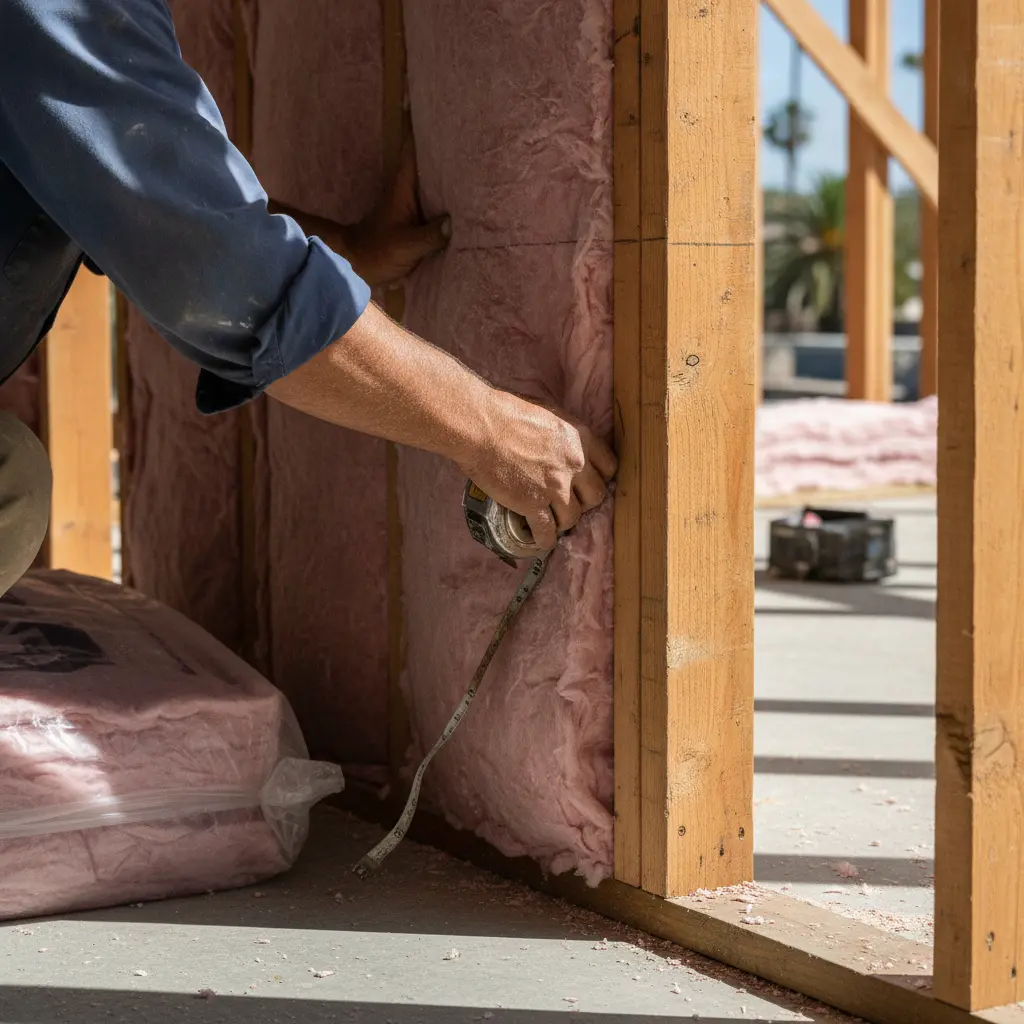
Our team in action — insulation professionals serving Orange
Wall Insulation Methods and Approaches
Blown-In Cellulose (Drill-and-Fill)
The most commonly recommended method for Orange’s older closed-wall homes. Dense-pack cellulose is blown into wall cavities through small access holes, achieving R-13 to R-15 in standard 2×4 walls with excellent air-sealing properties. Ideal for craftsman and Spanish Colonial homes in Old Towne Orange and the North Orange historic neighborhoods. Cellulose is also a fire-retardant material, which is a meaningful benefit in a city adjacent to wildland-urban interface zones.
Spray Foam Insulation
Closed-cell spray foam offers the highest R-value per inch (approximately R-6.5 per inch) and creates an integrated air and vapor barrier. It is particularly effective for Orange homes near Santiago Creek or low-lying areas where moisture management is a concern. Open-cell spray foam provides excellent sound attenuation and is well-suited for walls adjacent to the SR-55 freeway corridor. Learn more about our spray foam insulation services
Fiberglass Batt Insulation
The standard choice for open-wall renovation projects and new construction. R-13 and R-15 batts fit standard 2×4 framing and meet Title 24 minimum requirements for Orange County climate zone 8. Most cost-effective when walls are already open during kitchen, bathroom, or addition projects.
Mineral Wool (Rockwool) Batts
Mineral wool provides superior fire resistance (non-combustible to over 1,800°F), excellent sound dampening, and inherent moisture resistance. Strongly recommended for Orange hillside homes, homes in fire-adjacent neighborhoods near the Irvine Park area, and walls adjacent to garages or mechanical rooms.
Injection Foam
A low-pressure, water-blown foam injected into closed cavities. Particularly useful for block or masonry walls — more common in commercial and older civic buildings in downtown Orange — and for walls where drill-and-fill cellulose is not appropriate due to interior wall finish considerations.
Ready for Wall Insulation? Get Your Free Estimate Today.
Next Level Insulation of Orange serves Orange and the surrounding area — we’ll be on-site within 24 hours.
📞 Call (714) 266-2070Wall Insulation Cost in Orange, CA
Understanding the cost of wall insulation in Orange helps homeowners plan and budget appropriately. Prices vary based on wall area, existing conditions, access method, and material selection.
Typical Price Ranges
- Blown-in cellulose (drill-and-fill, closed walls): $1.50–$3.00 per square foot of wall area. A typical 1,500 sq. ft. Orange ranch home with approximately 800 sq. ft. of exterior wall cavity area would expect a project cost of $1,200–$2,400.
- Open-cell spray foam (open walls): $1.00–$2.00 per board foot. Full exterior wall treatment in an open-wall renovation context typically runs $2,000–$5,000 depending on home size.
- Closed-cell spray foam: $2.50–$4.00 per board foot, reflecting higher material costs and premium performance.
- Fiberglass batt installation (open walls): $0.50–$1.50 per square foot, making it the most economical option during renovation projects.
- Mineral wool batts (open walls): $1.00–$2.50 per square foot installed.
Cost Factors Specific to Orange, CA
Homes in Old Towne Orange’s historic district may incur additional costs for matching stucco patch textures after drill-and-fill work, typically $200–$600 depending on patch area. Two-story homes with tall exterior walls or homes with stucco over metal lath may require additional labor. California contractor labor rates in Orange County are among the highest in the state, reflecting the area’s cost of living.
Rebates and Incentives
Southern California Edison offers rebates through its Energy Efficiency programs for qualifying wall insulation upgrades. Federal tax credits under the Inflation Reduction Act (IRA) also provide 30% of project cost (up to $1,200) for insulation improvements in existing homes. Ask us about current rebate eligibility during your consultation.
For a precise Wall Insulation in Orange, CA cost estimate, call us at (714) 266-2070 or request a free on-site quote.
Neighborhoods We Serve in Orange, CA
Old Towne Orange
Orange’s nationally recognized historic district features homes built between 1905 and 1940, the majority of which were constructed with zero wall insulation. Plaster-over-lath walls and balloon-frame construction require specialized drill-and-fill techniques and careful air sealing to bring these irreplaceable homes up to modern comfort and efficiency standards without compromising historic integrity.
East Orange / Orange Hills
The hillside communities of East Orange, near Irvine Regional Park and the Santiago Hills, feature homes built primarily in the 1970s through 1990s. These properties face elevated wildfire risk exposure and benefit significantly from mineral wool or closed-cell spray foam in exterior walls for fire resistance and superior thermal performance given their elevated, wind-exposed positions.
North Orange / Serrano Heights
This predominantly 1960s–1980s residential area features tract homes with fiberglass batt insulation that has settled and degraded over decades. Many homes in this corridor also suffer from inadequate air sealing at electrical outlets and plumbing penetrations, compounding thermal performance issues. Learn about blow-in insulation for upgrading older homes
West Orange / Near SR-55 Corridor
Homes adjacent to the SR-55 freeway deal with persistent traffic noise in addition to thermal challenges. Mineral wool batts or open-cell spray foam in exterior walls — particularly on west- and north-facing walls closest to freeway alignment — provide meaningful noise reduction alongside thermal performance improvements.
Wall Insulation Maintenance Tips for Orange Homeowners
- Inspect exterior caulking annually: Orange’s Santa Ana wind events and periodic heavy rains from atmospheric river events (as seen in January 2023) can degrade exterior caulking around windows and doors, creating pathways for air and moisture infiltration into wall cavities. Re-caulk any cracked or separated seams each fall.
- Check for moisture after rain events: After significant rainfall — especially following extended dry periods when soil has contracted — inspect interior wall surfaces for water staining that could indicate moisture infiltrating wall cavities and compressing insulation.
- Monitor attic-to-wall junctions: In older Orange homes, the connection between attic and wall cavities is often unsealed. Have this junction inspected and air-sealed to prevent hot attic air from migrating into wall spaces during summer. Explore attic insulation services
- Avoid drilling through exterior walls unnecessarily: Mounting exterior fixtures, cameras, or holiday lighting by drilling through stucco can breach insulation and air barriers. Use surface-mounted options where possible or seal penetrations with foam backer rod and exterior caulk.
- Schedule a thermal imaging re-check every 10 years: Blown-in cellulose can settle slightly over time, and spray foam can develop small voids at adhesion points. A periodic thermal scan identifies any performance degradation before it significantly impacts energy costs.
- Maintain HVAC filters: Dirty air filters force your system to work harder, masking what may actually be a wall insulation deficiency. Clean filters quarterly and have your system inspected annually.
- Address any pest activity immediately: Rodents nesting in wall cavities — a known issue in Orange hillside neighborhoods adjacent to open space — can rapidly destroy blown-in or batt insulation. Seal all entry points and remediate immediately. Learn about insulation removal after pest damage
Why Choose Next Level Insulation of Orange
Next Level Insulation of Orange is a locally focused insulation contractor dedicated exclusively to serving homeowners and property managers in Orange and the surrounding Orange County communities. Our team brings deep familiarity with the City of Orange’s specific building eras, neighborhood-by-neighborhood construction characteristics, and the distinct climate pressures that affect wall insulation performance in this part of the inland Orange County corridor.
We understand that Old Towne Orange homeowners face entirely different challenges than those in the Chapman Hills or Serrano Heights communities. Our project approach is always tailored to the specific home, not delivered from a one-size-fits-all playbook. We use only proven, high-performance insulation materials appropriate for Southern California’s climate demands and California’s stringent Title 24 energy code requirements.
Our commitment to thorough pre- and post-installation thermal verification means you receive documented confirmation that your investment is performing as promised. We assist clients with SCE rebate applications and IRA federal tax credit documentation to help offset project costs. From the first phone call to the final walkthrough, our goal is to deliver a measurable improvement in your home’s comfort, energy efficiency, and indoor air quality.
Contact us at (714) 266-2070 to schedule your free Orange, CA wall insulation assessment today.
Frequently Asked Questions About Wall Insulation in Orange, CA
How much does wall insulation cost in Orange, CA?
Wall insulation costs in Orange typically range from $1,200 to $5,000 or more depending on home size, wall type, and insulation method. Drill-and-fill cellulose projects for a standard 1,500 sq. ft. Orange ranch home generally run $1,200–$2,400. Spray foam applications, particularly closed-cell, cost more per square foot but deliver higher R-values and integrated air sealing. We provide detailed, itemized quotes at no charge after an on-site assessment.
Do I need a permit for wall insulation in Orange, CA?
In most cases, adding insulation to existing closed walls via drill-and-fill methods does not require a permit from the City of Orange Building Division. However, open-wall insulation work that is part of a larger remodel or that modifies the wall assembly may require permits. We always verify permit requirements for each specific project and handle the permitting process when required.
How long does wall insulation installation take?
Most residential wall insulation projects in Orange are completed in one to three days. A standard single-story ranch home using drill-and-fill cellulose can typically be completed in one full day. Larger two-story homes, projects requiring significant stucco patching, or spray foam applications in open-wall renovation contexts may take two to three days.
Can wall insulation really lower my SCE bill in Orange?
Yes — significantly. Homes built before 1978 with no wall insulation can see heating and cooling energy reductions of 20–35% after professional wall insulation installation, according to California Energy Commission data. Given SCE’s current tiered residential rates exceeding $0.30 per kWh at higher usage tiers, these savings can amount to $400–$1,200 annually depending on home size and usage patterns.
What is the best type of wall insulation for older homes in Old Towne Orange?
For closed-wall homes in Old Towne Orange’s historic district, dense-pack cellulose blow-in is generally the optimal choice. It achieves excellent coverage in irregular cavities common in early 20th-century construction, provides inherent fire retardancy, and allows for minimal, patchable access holes that preserve historic wall finishes. We match stucco texture patches carefully to minimize any visual impact on these architecturally significant homes.
Will wall insulation help with freeway noise near the SR-55 in Orange?
Yes. Both open-cell spray foam and mineral wool batts provide measurable sound transmission reduction when installed in exterior walls. Homes near the SR-55 Costa Mesa Freeway in West Orange commonly report noticeable reductions in traffic noise following wall insulation upgrades, particularly when combined with window and door air sealing. Explore spray foam options for sound control
Is wall insulation effective in Orange’s mild winter climate?
Absolutely. While Orange’s winters are mild compared to most of the U.S., lows in December and January regularly drop to the mid-40s°F, and poorly insulated walls contribute to cold drafts and elevated natural gas heating costs during these months. Wall insulation provides year-round benefit — keeping heat out in summer and keeping conditioned warmth inside during winter months.
How do I know if my walls already have insulation?
The most accurate method is thermal imaging with an infrared camera, which reveals temperature differentials indicating insulated versus uninsulated wall cavities without any destructive investigation. We include thermal imaging as part of our free assessment process. Alternatively, removing an electrical outlet cover on an exterior wall and using a flashlight and probe tool can reveal whether insulation material is present in the cavity behind the receptacle box — though this provides only a single-point data sample.
Get Your Free Wall Insulation Quote in Orange, CA
Your Orange home deserves wall insulation that is engineered for this city’s specific climate, construction history, and energy cost environment — not a generic solution designed for anywhere else. Whether you live in a historic craftsman in Old Towne, a hillside home in East Orange, or a post-war ranch in North Orange, Next Level Insulation of Orange has the local expertise and the proven methods to deliver real, measurable improvement.
Take the first step toward a more comfortable, energy-efficient home. Call us now at (714) 266-2070 to speak with a wall insulation specialist and schedule your free on-site assessment. Our team is ready to evaluate your home, explain your options, assist with SCE rebate paperwork, and deliver a transparent, detailed quote with no obligation.
Next Level Insulation of Orange — Wall Insulation in Orange, CA done right, for Orange homes.