

Insulation Installation in Los Angeles, CA
Expert Insulation Installation for Los Angeles, CA Homes & Businesses
Need insulation installation in Los Angeles, CA? Next Level Insulation serves all of LA with attic, spray foam & crawl space services. Call (323) 765-3939.
- Licensed & Insured
- Locally Owned & Operated
- Free Inspection & Estimate
Request Your
Free EstimateInsulation installation is the process of placing thermal and acoustic barrier materials within walls, attics, crawl spaces, and floors to regulate indoor temperatures, reduce energy consumption, and improve comfort. In Los Angeles, where outdoor temperatures can swing from the mid-40s°F on winter nights in the San Gabriel foothills to well above 100°F during late-summer heat events in the San Fernando Valley, properly installed insulation is not a luxury — it is a necessity.
Los Angeles homes face a uniquely demanding climate: dry desert heat, marine layer humidity along the coast, and seismic activity that can shift framing and compromise existing insulation integrity. Whether you own a 1920s Craftsman bungalow in Pasadena, a post-war stucco ranch in Culver City, or a modern multi-family building in Glendale, the right insulation system keeps your energy bills manageable and your living environment comfortable year-round.
Next Level Insulation of Los Angeles delivers professional insulation installation, replacement, and removal across the greater Los Angeles area. Call us today at (323) 765-3939 to schedule your free assessment.
Understanding Insulation Installation in Los Angeles
Insulation installation involves selecting, cutting, and placing insulating materials — such as fiberglass batts, cellulose, spray polyurethane foam, or mineral wool — within the building envelope to slow the transfer of heat between interior and exterior spaces. The effectiveness of insulation is measured by its R-value, a numerical rating indicating thermal resistance. Higher R-values mean better performance. The U.S. Department of Energy recommends attic insulation between R-30 and R-60 for Climate Zone 3, the classification that covers most of Los Angeles County.
Los Angeles has a Mediterranean climate (Köppen classification Csa/Csb), meaning warm, dry summers and mild, occasionally wet winters. This climate creates a bidirectional challenge: insulation must block summer heat gain during events like the Woolsey Fire heat aftermath of November 2018, which pushed interior temperatures dangerously high in under-insulated homes in the western San Fernando Valley, and it must also retain warmth during the cool marine-influenced nights that frequently dip below 50°F in neighborhoods like Silver Lake and Echo Park from December through February.
The building stock of Los Angeles is extraordinarily diverse. The city contains approximately 500,000 single-family homes, hundreds of thousands of multi-family units, and a large inventory of commercial structures. Many residential buildings predate the California Energy Code (Title 24), which was first enacted in 1978. Homes built before that date — a substantial portion of neighborhoods like Boyle Heights, Montebello, and South Gate — often contain little to no wall or attic insulation, or insulation that has settled, degraded, or become contaminated over decades.
Blow-in cellulose and spray foam technologies, both widely used in the Los Angeles market, allow contractors to add insulation to existing structures without major demolition. This makes retrofit insulation installation practical for the city’s large inventory of older housing, including the distinctive Spanish Colonial Revival and Mid-Century Modern styles that define much of LA’s architectural heritage.
Why Insulation Installation Is Needed in Los Angeles, CA
Extreme Heat Events and the Urban Heat Island Effect
The Los Angeles Basin experiences increasingly severe heat events. The September 2022 heat dome pushed temperatures at Downtown Los Angeles Civic Center to 109°F — a record high — while neighborhoods further inland such as Woodland Hills recorded a staggering 121°F. Homes lacking adequate attic insulation in the R-38 to R-60 range saw interior temperatures climb into the mid-90s°F even with air conditioning running continuously. Proper insulation installation reduces this radiant heat load by as much as 40%, directly lowering cooling costs and reducing strain on HVAC systems already taxed by LA’s power grid during high-demand periods.
Seismic Activity and Insulation Displacement
Los Angeles sits atop a network of active fault systems including the Hollywood Fault, the Puente Hills Fault, and the Newport-Inglewood Fault. The Northridge earthquake of January 17, 1994 (magnitude 6.7) caused widespread structural displacement across communities from Sherman Oaks to Culver City, shifting framing members enough to create gaps in existing batts insulation. Homes that experienced even minor seismic events since their original construction may have compromised insulation coverage that homeowners cannot see without a professional inspection — gaps that translate directly into energy loss and moisture vulnerability.
Marine Layer Humidity and Moisture Infiltration
Coastal and near-coastal neighborhoods — including Culver City, West Hollywood, and East Los Angeles — are regularly blanketed by the marine layer, a low coastal fog that can push relative humidity above 85% on summer mornings. Without a properly sealed insulation system, this moisture infiltrates wall cavities and attic spaces, degrading fiberglass batts and creating conditions favorable for mold growth. Spray foam insulation with its air-sealing properties is particularly effective in these moisture-prone zones.
Title 24 Energy Code Compliance
California’s Title 24 Building Energy Efficiency Standards are among the strictest in the nation. As of the 2022 code cycle, all new construction and permitted renovation projects in Los Angeles must meet specific insulation R-value minimums: R-38 in attics, R-13 in 2×4 walls, and R-19 in floors over unconditioned spaces. Many older properties undergoing permitted ADU (Accessory Dwelling Unit) construction — a major trend in LA since SB 9 passed in 2021 — trigger insulation upgrade requirements across the entire structure. Failing to meet these requirements can delay permit final approvals and result in costly corrections.
High Energy Costs
Southern California Edison and LADWP customers pay among the highest electricity rates in the continental United States, with residential rates frequently exceeding $0.30 per kWh during peak summer tiers. In a typical Los Angeles home with inadequate attic insulation, cooling and heating can account for 40–50% of the monthly energy bill. A properly installed insulation system can reduce that load by 20–30%, generating measurable monthly savings that accumulate quickly given LA’s 12-month climate demands.
Signs You Need Insulation Installation in Los Angeles
Temperature and Comfort Indicators
- Rooms that feel noticeably hotter or colder than the thermostat setting, particularly upper-floor rooms below an attic
- Indoor temperatures rising above 85°F during LA heat events even with air conditioning active
- Uneven temperatures between rooms on the same floor, suggesting missing or thin wall insulation
- Cold floors in winter in homes with crawl space foundations, common in South Pasadena and Alhambra
Energy Bill Indicators
- LADWP or SCE bills that spike dramatically each July–September without a change in usage habits
- Monthly electricity costs exceeding $200 for a home under 1,500 square feet during summer
- HVAC system running nearly continuously during mild 75–80°F weather
Physical and Visual Indicators
- Attic insulation visibly compressed, wet, discolored, or less than 10 inches deep (indicating R-30 or below)
- Ice dam staining on rooflines after rare Los Angeles cold snaps
- Visible gaps or missing sections of batts insulation during any attic entry
- Musty odors in attic or crawl space spaces, indicating moisture-degraded insulation
- Pest activity — rats and squirrels commonly nest in and destroy fiberglass insulation in LA’s older neighborhoods
Urgency Indicators
If you observe any combination of high bills, visible insulation damage, and pest evidence, schedule an inspection immediately. Compromised insulation accelerates moisture damage and can contribute to mold proliferation within 24–48 hours under LA’s marine layer conditions.
Our Insulation Installation Process in Los Angeles
Free On-Site Assessment (Day 1 — 1 to 2 Hours)
Our technician performs a comprehensive walkthrough of your property, including attic entry, crawl space inspection (where accessible), and wall cavity evaluation. We use a thermal imaging camera to identify cold and hot spots invisible to the naked eye — an especially important tool in the multi-story stucco homes common throughout Monterey Park and Glendale. We document existing R-values and identify any moisture, pest, or structural issues that must be addressed before new insulation is installed.
Insulation Removal (If Required — Day 1 to Day 2)
If existing insulation is contaminated, pest-damaged, or moisture-compromised, we remove it completely using commercial vacuum systems that prevent particulates from entering your living space. In older LA homes, we follow California Department of Public Health protocols for handling potential asbestos-containing insulation materials, which were used in some buildings constructed before 1980.
Air Sealing and Prep (Day 2 — 2 to 4 Hours)
Before any new insulation is placed, we seal air bypasses at attic penetrations, recessed lighting fixtures, top plates, and ductwork chases using low-expansion spray foam and mastic tape. This step is critical in Los Angeles where seismic movement over decades creates gaps that dramatically undermine insulation performance.
Material Selection and Custom Cut (Day 2)
We select the appropriate insulation type and R-value for your specific application, home type, and Title 24 compliance requirements. All materials are measured and staged on-site to minimize disruption.
Installation (Day 2 to Day 3 — 4 to 8 Hours Depending on Scope)
Our certified installers place insulation according to manufacturer specifications and California Energy Commission guidelines, ensuring complete coverage with no gaps, compressions, or voids. Attic insulation is installed to a minimum depth of 14 inches for R-38 or 20 inches for R-60.
Post-Installation Inspection and Documentation (Day 3)
We perform a final quality check and provide documentation of installed R-values, materials used, and square footage covered — records you will need for any Title 24 permit close-out, energy rebate application through LADWP or SCE, or future property sale.
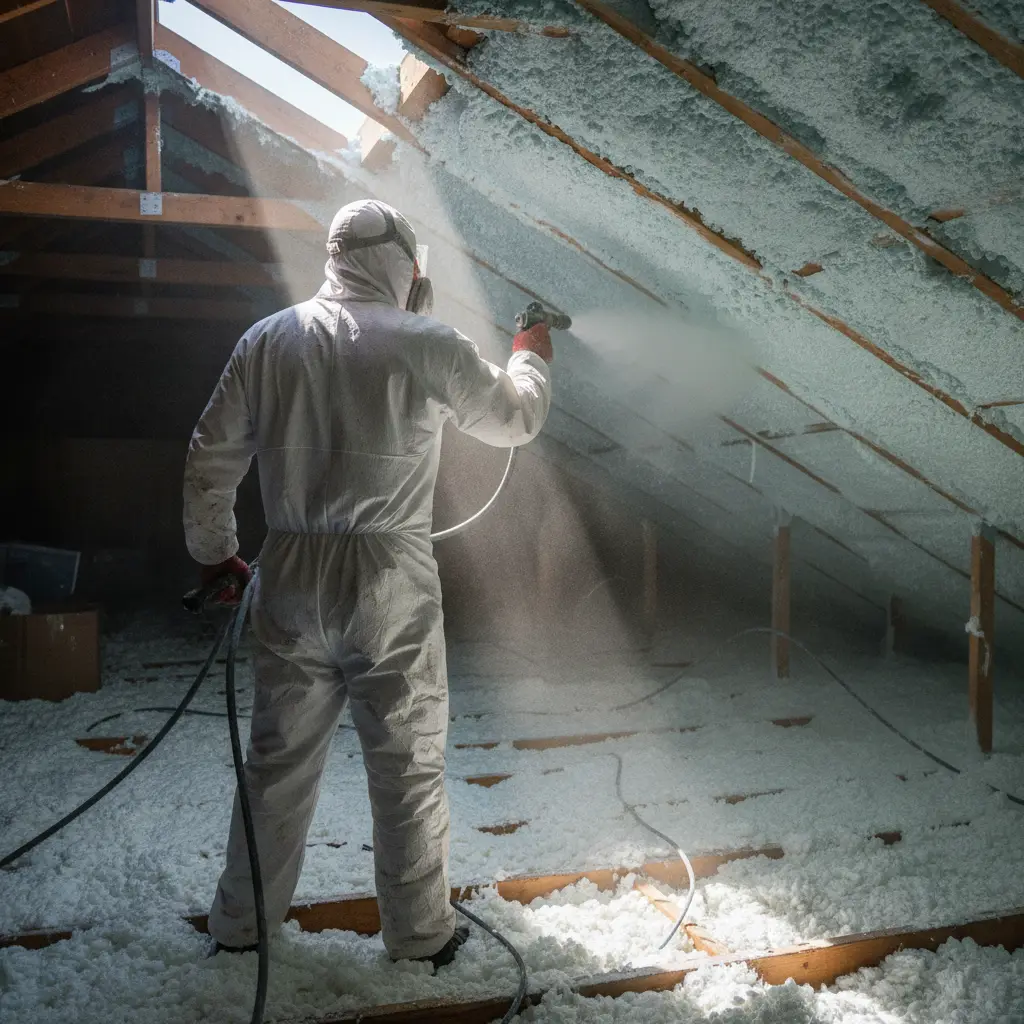
Our team in action — insulation professionals serving Los Angeles
Insulation Methods and Approaches We Use in Los Angeles
Spray Foam Insulation
Closed-cell and open-cell spray polyurethane foam provides both insulation and air sealing in a single application. Closed-cell spray foam achieves R-6 to R-7 per inch and creates a vapor barrier — ideal for crawl spaces and coastal-zone walls in neighborhoods like Culver City where marine layer moisture is a persistent concern. Open-cell spray foam at R-3.7 per inch is cost-effective for attic applications requiring complete air barrier coverage. Learn more about our spray foam insulation services
Blow-In Insulation
Blown cellulose (recycled paper) and blown fiberglass are the most common retrofit solutions for existing LA homes. Blow-in insulation can be added on top of existing attic insulation or injected into wall cavities through small-diameter holes, making it ideal for Craftsman and Spanish Revival homes where interior finishes must be preserved. Explore our blow-in insulation options
Attic Insulation
The attic is the single highest-impact location for insulation improvement in Los Angeles, where solar radiation heats roof surfaces to 150–180°F on summer afternoons. We specialize in attic insulation upgrades that meet or exceed Title 24’s R-38 minimum. See our attic insulation services
Crawl Space Insulation and Encapsulation
Many LA homes built between 1920 and 1960 feature raised foundations with exposed crawl spaces. We install floor insulation batts and full crawl space encapsulation systems using reinforced vapor barriers to control ground moisture, a particular challenge in clay-heavy soils common to the Los Angeles Basin. View crawl space insulation details Learn about crawl space encapsulation
Ready for Insulation Installation? Get Your Free Estimate Today.
Next Level Insulation of Los Angeles serves Los Angeles and the surrounding area — we’ll be on-site within 24 hours.
📞 Call (323) 765-3939Insulation Installation Cost in Los Angeles, CA
Understanding insulation installation costs helps you budget accurately and evaluate proposals. Here are typical price ranges for the Los Angeles market:
Attic Insulation
- Blown-in cellulose or fiberglass (standard attic, 1,000–1,500 sq ft): $1,200 – $2,800
- Spray foam attic insulation: $2,500 – $5,500 depending on depth and access
Crawl Space Insulation and Encapsulation
- Fiberglass batt floor insulation: $1,500 – $3,000
- Full crawl space encapsulation with vapor barrier: $3,000 – $7,000
Wall Insulation (Retrofit)
- Blow-in wall insulation (per 1,000 sq ft of wall area): $1,800 – $4,500
Insulation Removal
- Attic insulation removal: $800 – $2,200 depending on contamination level and access
Los Angeles-Specific Cost Factors
Insulation installation costs in Los Angeles run 15–25% higher than national averages due to California labor regulations, higher material transportation costs, and stricter disposal requirements for contaminated insulation under CalRecycle rules. Homes with limited attic access, complex rooflines (common in Alhambra’s ranch-style homes), or requiring asbestos testing add $200–$800 to project costs. LADWP and SCE both offer rebate programs that can offset $200–$600 of qualifying insulation installation costs — our team helps you identify and apply for available incentives. View detailed cost information
Insulation Installation Service Areas in Los Angeles
Pasadena and South Pasadena
These communities contain large inventories of early 20th-century Craftsman bungalows and Victorian-era homes, many of which were built with minimal or no wall insulation. Homes in this area also face the Santa Ana wind corridor, which drives hot, dry air from the desert interior directly into Pasadena neighborhoods — making attic and wall insulation critical for temperature control. Insulation installation in Pasadena
Glendale and Montebello
Post-war construction dominates both communities, featuring 2×4 framing with limited wall cavity depth. Retrofit blow-in insulation is the most practical upgrade path, and our team has extensive experience navigating the stucco exteriors and existing lath-and-plaster interiors common to this era of construction.
Culver City and West Hollywood
Both cities feature mixed-use developments, apartment buildings, and newer construction that must meet current Title 24 standards. Marine layer humidity exposure makes moisture management a priority in all insulation work here.
Bell Gardens, Huntington Park, and South Gate
Dense residential neighborhoods with high proportions of pre-1978 housing stock and active ADU development make these communities among the most active insulation upgrade markets in the county. Many properties here qualify for income-qualified weatherization assistance programs. Insulation installation in South Gate
Insulation Maintenance Tips for Los Angeles Homeowners
- Inspect your attic annually — Ideally each October before winter, check for pest intrusion, moisture staining, or compressed insulation that may have shifted during the previous earthquake season.
- After any felt earthquake (M3.0+), inspect attic access — Even minor seismic events can shift batts insulation in older framing. A quick visual check prevents years of undetected energy loss.
- Monitor for rodent entry points — Los Angeles has an active roof rat population. Seal all soffit vents and attic penetrations with hardware cloth to prevent nesting damage to insulation.
- Check crawl space vapor barriers every two years — Ground moisture beneath raised-foundation homes can compromise crawl space insulation. Look for pooling, tears, or displacement of vapor barrier material.
- Clean HVAC duct penetrations — Where ductwork passes through insulated areas, ensure seals remain intact. Duct leakage in LA’s older homes is a major contributor to energy waste.
- Apply for LADWP or SCE rebate programs proactively — Both utilities update rebate offerings annually. Check eligibility each January to capture available incentives before program funds are exhausted.
- Test attic ventilation annually — Proper ridge and soffit ventilation prevents heat buildup that degrades insulation materials over time, particularly important during LA’s 100°F+ summer periods.
Why Choose Next Level Insulation of Los Angeles
Next Level Insulation of Los Angeles is a locally focused insulation contractor serving the communities of the greater Los Angeles Basin. Our team works exclusively in insulation installation, removal, and replacement — we do not split our attention across unrelated trades, which means every project receives focused expertise.
We understand the specific building types, climate conditions, and regulatory requirements that define insulation work in Los Angeles. From navigating Title 24 documentation for ADU projects in Bell Gardens to performing post-earthquake insulation assessments in Pasadena, our technicians bring location-specific knowledge that out-of-area contractors simply cannot match.
We use thermal imaging as a standard part of every assessment — not an upsell — because LA’s diverse building stock requires accurate diagnostics before any materials are specified. Our team stays current with LADWP and SCE rebate programs so we can help you maximize any available financial incentives.
When you call Next Level Insulation of Los Angeles at (323) 765-3939, you speak directly with a knowledgeable team member who can answer your questions and schedule your free on-site assessment without delay.
Frequently Asked Questions: Insulation Installation in Los Angeles
How much does insulation installation cost in Los Angeles?
Most Los Angeles homeowners pay between $1,200 and $5,500 for attic insulation installation, and $3,000 to $7,000 for full crawl space encapsulation. Wall insulation retrofits typically range from $1,800 to $4,500. Exact costs depend on square footage, insulation type, existing conditions, and accessibility. Los Angeles labor and disposal costs run 15–25% above national averages.
How long does insulation installation take in a typical Los Angeles home?
A standard attic insulation upgrade in a 1,200–1,800 square foot Los Angeles home typically takes four to eight hours for a single-day completion. Projects requiring insulation removal first, or crawl space encapsulation, may span two to three days. Complex multi-story or commercial projects are scoped individually.
What R-value do I need for my attic in Los Angeles?
The California Energy Commission and Title 24 recommend R-38 as the minimum for attics in Los Angeles’s Climate Zone 3. For maximum performance — particularly important in inland neighborhoods like Pasadena and Alhambra that experience temperatures above 100°F — R-49 to R-60 provides significantly better heat resistance and lower long-term energy costs.
Does insulation installation require a permit in Los Angeles?
Standalone insulation installation typically does not require a permit in the City of Los Angeles. However, if insulation work is part of a larger permitted project — such as an ADU addition, HVAC replacement, or whole-home renovation — insulation must be documented for Title 24 compliance review. We provide all necessary documentation for permit packages.
Can insulation installation reduce my LADWP or SCE bill?
Yes, measurably. In a typical under-insulated Los Angeles home, adding proper attic insulation reduces cooling and heating energy consumption by 20–30%. With LADWP and SCE rates averaging $0.28–$0.35 per kWh, homeowners can realistically save $600–$1,400 annually, meaning most attic insulation projects pay back their installation cost within three to five years.
Is my older Los Angeles home likely to have asbestos in its existing insulation?
Vermiculite attic insulation, used in some homes built before 1980, may contain asbestos and requires testing before disturbance. Spray-on insulation applied to pipes or HVAC ducts in pre-1980 construction may also contain asbestos. We perform visual identification during our assessment and recommend professional sampling if any suspect materials are observed — in compliance with California OSHA and South Coast AQMD regulations.
What is crawl space encapsulation and do I need it?
Crawl space encapsulation involves sealing a home’s crawl space with a reinforced vapor barrier across floors and walls to prevent ground moisture from entering the structure. It is highly recommended for Los Angeles homes with raised foundations — particularly in neighborhoods like South Pasadena, Alhambra, and Bell — where clay soil retains moisture and the marine layer adds ambient humidity. Encapsulation improves insulation performance, air quality, and structural longevity. Learn about our crawl space encapsulation services
Do you serve areas outside the City of Los Angeles?
Yes. We serve the full greater Los Angeles area including Glendale, Pasadena, Monterey Park, Culver City, Downey, Montebello, South Gate, Huntington Park, Bell, Bell Gardens, Commerce, Maywood, Walnut Park, Alhambra, South Pasadena, East Los Angeles, West Hollywood, and Cudahy. Contact us to confirm service availability for your specific address.
Get Professional Insulation Installation in Los Angeles Today
If your Los Angeles home is uncomfortable during summer heat events, your energy bills are climbing, or you know your insulation is old or damaged, do not wait. Inadequate insulation costs you money every single month and puts unnecessary strain on your HVAC system during the extreme temperatures LA increasingly experiences.
Next Level Insulation of Los Angeles is ready to assess your home, recommend the right insulation solution, and complete the installation efficiently and to California code. We serve all communities across the greater Los Angeles Basin.
Call us now at (323) 765-3939 to schedule your free on-site insulation assessment. Our team is available to answer questions and book your appointment at a time that works for you. Take the next step toward a more comfortable, energy-efficient Los Angeles home today.
Schedule your free insulation assessment online