

Insulation Installation Cost in Los Angeles, CA
Transparent Insulation Installation Cost Pricing for Los Angeles, CA Homeowners — Free Estimates
Get accurate insulation installation cost estimates in Los Angeles, CA. Next Level Insulation serves all LA neighborhoods. Call (323) 765-3939 for a free quote.
- Licensed & Insured
- Locally Owned & Operated
- Free Inspection & Estimate
Request Your
Free EstimateUnderstanding insulation installation cost in Los Angeles, CA is the first step toward a more energy-efficient, comfortable home. Insulation installation refers to the professional process of placing thermal and acoustic barriers within walls, attics, crawl spaces, and floors to regulate indoor temperature, reduce energy consumption, and improve overall building performance.
Los Angeles presents a uniquely complex environment for insulation. The city’s Mediterranean climate—characterized by hot, dry summers that routinely push temperatures above 95°F in the San Fernando Valley and mild but damp winters—creates year-round thermal management challenges that demand properly specified and correctly installed insulation. Older housing stock, from 1920s Craftsman bungalows in Pasadena to mid-century stucco homes in Culver City, often suffers from outdated or deteriorated insulation that drives up utility bills dramatically.
At Next Level Insulation of Los Angeles, our team brings deep regional expertise to every project. We serve homeowners and commercial property managers across Greater Los Angeles, delivering accurate cost estimates and professional installations tailored to local building codes and climate realities. Call us today at (323) 765-3939 for a free assessment.
Understanding Insulation Installation Cost in Los Angeles
Insulation installation cost encompasses several variables: materials, labor, square footage, existing conditions, and the specific insulation type selected. At its core, insulation works by slowing the transfer of heat between the interior and exterior of a structure. The effectiveness of insulation is measured by its R-value—a rating of thermal resistance. Higher R-values mean greater insulating power.
Historically, Los Angeles building codes required relatively modest insulation standards compared to colder climates. Many homes constructed before the 1970s energy crisis were built with little to no wall insulation and minimal attic coverage—sometimes just two to three inches of deteriorated fiberglass batting. The 1973 oil embargo and subsequent California energy reforms gradually pushed stricter standards through Title 24 of the California Code of Regulations, which now mandates R-38 to R-60 for attic assemblies in Climate Zone 9, which covers much of Central and South Los Angeles.
The building types found throughout Los Angeles create a diverse range of insulation scenarios. Spanish Colonial Revival and Craftsman-style homes common in neighborhoods like South Pasadena and Alhambra frequently feature balloon-frame construction with uninsulated stud cavities. Post-war tract homes in Downey and Montebello often have original blown fiberglass that has compacted and settled over decades, reducing its effective R-value by as much as 40%. Modern multifamily buildings in West Hollywood and Culver City may require specialized acoustic insulation alongside thermal barriers to meet both energy and noise ordinance requirements.
Understanding what drives insulation installation costs locally helps homeowners budget accurately, avoid contractor markup surprises, and make informed decisions about which insulation type delivers the best return on investment for their specific property and climate zone. Learn more about our insulation installation services
Signs You Need Insulation Installation or Replacement in Los Angeles
Energy and Comfort Indicators
- Monthly electricity bills exceeding $180 to $250 for a home under 1,500 square feet during summer months
- Rooms in the back of the house or upper floors that are consistently 5°F to 10°F hotter than the rest of the home
- Air conditioning or heating systems cycling on more frequently than every 15 to 20 minutes
- Cold floors during winter months, particularly in homes with vented crawl spaces
Visual and Physical Symptoms
- Visible gaps, thin patches, or compressed insulation visible through attic access panels
- Insulation that appears gray, black, or matted—signs of moisture infiltration or age-related degradation
- Drafts near electrical outlets on exterior walls, a common indicator of missing or inadequate wall insulation
- Moisture stains on interior ceiling drywall, particularly along roof eaves
Health and Structural Urgency Indicators
- Musty odors in crawl spaces or basements, suggesting mold growth in deteriorated insulation
- Increased allergy symptoms indoors, which may indicate disturbed vermiculite or older fiberglass insulation releasing airborne particles
- Visible rodent nesting within insulation—a common issue in older homes throughout East Los Angeles and Montebello
If you recognize two or more of these signs, schedule a professional insulation assessment immediately. Delaying increases both energy costs and the risk of moisture-related structural damage. Learn about our insulation removal and replacement services
Our Insulation Installation Process in Los Angeles
Free On-Site Assessment (Day 1 — 1 to 2 Hours)
Our certified technician visits your property to conduct a visual inspection of all insulation zones: attic, walls, crawl space, and basement if applicable. We document existing R-values, identify air sealing failures, note any moisture damage or pest activity, and assess accessibility for installation equipment.
Infrared Thermal Scan (Day 1 — 30 to 60 Minutes)
Using FLIR infrared cameras, we map heat gain and loss patterns across your building envelope. This technology is particularly valuable in Los Angeles homes where wall cavities are inaccessible without demolition—infrared scanning reveals cold or hot zones that indicate missing or inadequate insulation behind drywall without invasive methods.
Detailed Written Estimate (Within 24 to 48 Hours)
We provide a line-item cost estimate specifying material type, R-value, square footage coverage, labor hours, and any preparatory work required (such as mold remediation, insulation removal, or air sealing). All estimates reference current California Title 24 compliance requirements for your specific climate zone.
Permits and Compliance Verification (2 to 5 Business Days)
For projects requiring permits under the Los Angeles Department of Building and Safety (LADBS) guidelines—particularly whole-home re-insulation or spray foam applications—we handle the permit application process. Permit timelines vary by project type and inspection scheduling at the local LADBS district office.
Preparatory Work (Day of Installation — 1 to 3 Hours)
Before new insulation goes in, we remove any damaged or contaminated existing material, seal air bypasses around plumbing penetrations and recessed lighting fixtures, and install vapor barriers where required. This step is critical in Los Angeles homes with vented crawl spaces exposed to coastal humidity.
Insulation Installation (Half Day to 2 Days Depending on Scope)
Our crews install your selected insulation type using calibrated equipment calibrated for local conditions—including adjusting spray foam mix ratios for LA’s ambient temperature ranges. All work is performed by trained installers following manufacturer specifications and California Energy Commission guidelines.
Post-Installation Inspection and Cleanup (1 to 2 Hours)
We conduct a final walkthrough, verify R-value coverage with depth gauges in blown-in applications, and confirm all access points are properly resealed. Your property is left clean, with all debris and old insulation material properly bagged and disposed of per Los Angeles County waste management regulations.
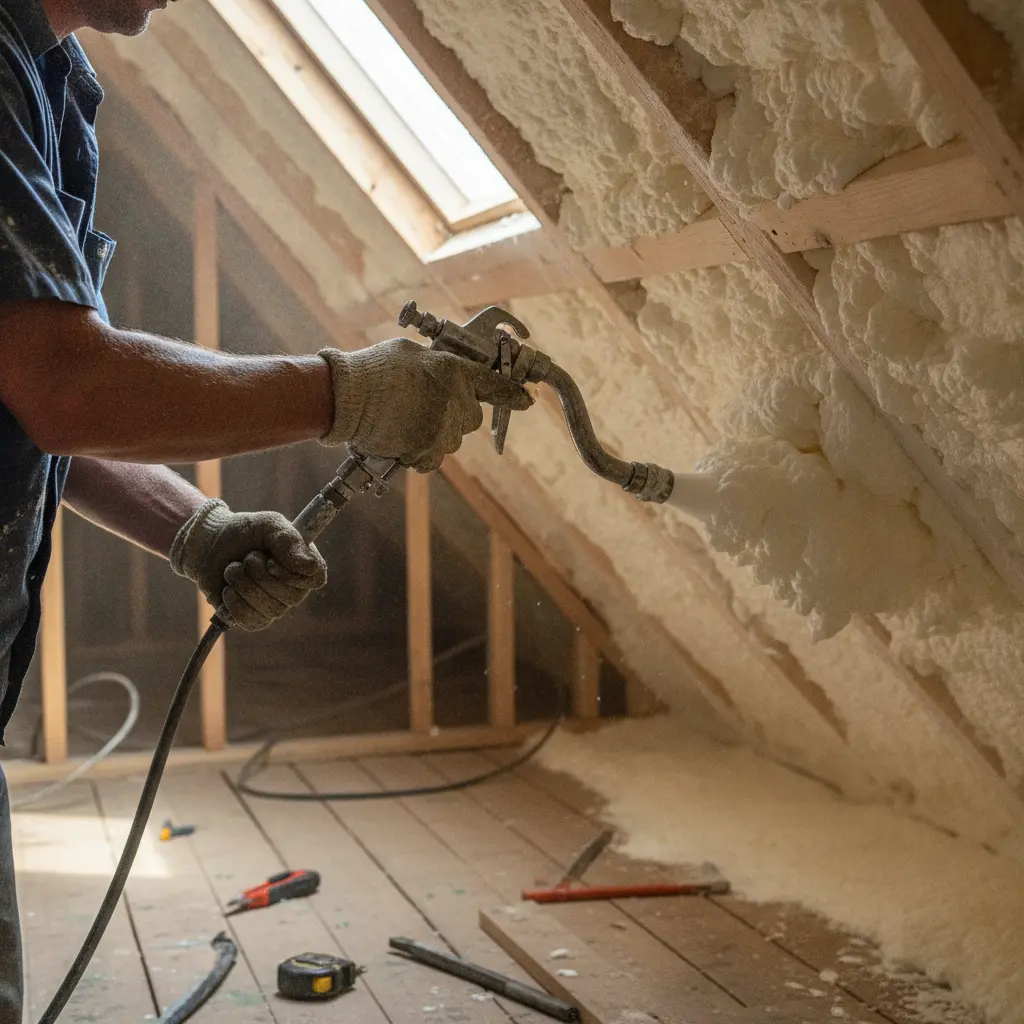
Our team in action — insulation professionals serving Los Angeles
Insulation Methods and Approaches Used in Los Angeles
Blown-In (Loose-Fill) Insulation
Blown-in cellulose or fiberglass is the most cost-effective solution for topping off existing attic insulation or filling irregular spaces in older LA homes. It conforms to framing obstructions common in pre-1950 construction and can achieve R-38 to R-60 in attic applications relatively quickly. Ideal for homes in Pasadena, South Pasadena, and Alhambra where attic access exists but budgets are limited. Learn more about our blown-in insulation services
Spray Foam Insulation
Open-cell and closed-cell spray foam provide superior air sealing alongside insulation—critical for homes near the 110 or 405 freeway corridors where outdoor air quality and noise penetration are concerns. Closed-cell spray foam delivers R-6.5 per inch and acts as a vapor barrier, making it the preferred choice for crawl space encapsulation in coastal-adjacent neighborhoods. Explore our spray foam insulation services
Fiberglass Batt Insulation
Pre-cut fiberglass batts are commonly used in new construction wall cavities and accessible floor systems. They are cost-effective for straightforward applications in standard 2×4 and 2×6 framing found in post-1978 tract homes across Downey, Montebello, and South Gate.
Crawl Space Encapsulation
Full crawl space encapsulation—combining vapor barrier installation, rim joist insulation, and conditioned air introduction—addresses the moisture-driven insulation failures common in the older pier-and-beam homes prevalent throughout the Los Angeles basin. Learn about crawl space encapsulation
Attic Insulation
Dedicated attic insulation upgrades targeting Title 24 compliance are among the highest-ROI improvements an LA homeowner can make, particularly given the region’s solar intensity—Los Angeles receives an average of 284 sunny days per year, driving substantial radiant heat load through roofing assemblies. Explore our attic insulation services
Ready for Insulation Installation Cost? Get Your Free Estimate Today.
Next Level Insulation of Los Angeles serves Los Angeles and the surrounding area — we’ll be on-site within 24 hours.
📞 Call (323) 765-3939Insulation Installation Cost in Los Angeles: What to Expect
Insulation installation costs in Los Angeles vary significantly based on insulation type, scope of work, and property characteristics. Below are current market ranges for Greater Los Angeles homeowners:
Typical Cost Ranges
- Blown-in attic insulation: $1,500 to $3,500 for an average 1,200 to 1,800 sq ft attic floor area, achieving R-38 to R-49
- Spray foam insulation (crawl space or attic): $2,500 to $7,500 depending on thickness and square footage; closed-cell averages $1.50 to $3.00 per board foot installed
- Fiberglass batt installation (walls or floors): $0.50 to $1.50 per square foot of coverage
- Crawl space encapsulation (full system): $3,000 to $8,000 for a typical LA-area home with 800 to 1,500 sq ft of crawl space
- Full attic insulation removal and replacement: $2,000 to $6,000 depending on contamination level and replacement material
Los Angeles-Specific Cost Factors
Labor costs in Los Angeles County run 20% to 35% higher than national averages, reflecting California’s prevailing wage standards and higher cost of living. Material costs also trend above national benchmarks due to regional supply chain logistics. LADBS permit fees add $150 to $500 for projects requiring inspection. Homes with existing asbestos-containing insulation—present in some pre-1980 Glendale and Alhambra properties—require licensed abatement prior to new installation, adding $1,500 to $4,000 or more to total project cost.
Most Los Angeles homeowners recoup insulation investment through reduced utility bills within 3 to 7 years. California utility rebates through SoCalGas and LADWP can reduce out-of-pocket costs by $200 to $1,000 for qualifying projects. Contact us at (323) 765-3939 for a precise estimate for your property.
Insulation Services Across Los Angeles Neighborhoods
Pasadena and South Pasadena
These communities contain some of Los Angeles County’s finest pre-war Craftsman and Colonial Revival homes, many built between 1905 and 1940. Balloon-frame construction and original plaster walls make wall insulation retrofits complex, but attic and crawl space upgrades deliver immediate performance gains. Historic designation on some properties may restrict certain exterior modifications, making interior-approach insulation methods essential. View insulation options for historic homes
East Los Angeles, Maywood, and Huntington Park
These densely populated communities feature high concentrations of post-war stucco homes built between 1945 and 1965. Proximity to the 710 and 5 freeway corridors creates both noise and air quality pressures that make closed-cell spray foam—which reduces both thermal transfer and sound penetration—a particularly effective solution. Many properties also have unencapsulated crawl spaces vulnerable to moisture.
Culver City and West Hollywood
Mid-century modern architecture and 1960s to 1980s apartment buildings define much of these neighborhoods. Flat and low-slope roofs present unique insulation challenges, as do shared walls in multifamily structures where acoustic insulation requirements align with California’s STC (Sound Transmission Class) standards. Marine layer moisture exposure demands vapor-resistant insulation solutions in all below-grade and crawl space applications.
Glendale and Alhambra
These inland communities experience more pronounced temperature swings than coastal LA, with summer highs regularly reaching 98°F to 105°F. Many homes date to the 1930s through 1960s and feature original fiberglass batts that have compressed to near-zero effective R-value over decades of thermal cycling and seismic movement.
Insulation Maintenance Tips for Los Angeles Homeowners
- Inspect your attic annually in late spring before peak summer heat arrives. Look for compressed, discolored, or missing insulation sections and check that soffit vents remain unobstructed—a common issue in older LA homes where insulation has shifted to block ventilation pathways.
- Check crawl space vapor barriers every two years for tears, pooling moisture, or pest damage. The marine layer season (May through September) is the highest-risk period for moisture accumulation in coastal-adjacent properties.
- Seal attic bypasses after any plumbing or electrical work. LA’s ongoing renovations and ADU (Accessory Dwelling Unit) additions frequently create new penetrations that compromise existing air sealing.
- Monitor for pest intrusion in insulation, particularly after warm, dry Santa Ana wind events (October through December) that drive rodents to seek shelter in attic and crawl space insulation.
- Recheck R-values after any seismic event of magnitude 4.0 or greater, which can displace batt insulation from stud cavities and shift blown-in material in attic assemblies.
- Review your LADWP and SoCalGas bills seasonally for unexplained consumption increases, which often signal insulation degradation before it becomes visually apparent.
- Keep attic access hatches properly weather-stripped and insulated—uninsulated pull-down attic stairs are one of the single largest thermal bypasses in LA’s older housing stock.
Why Choose Next Level Insulation of Los Angeles
Next Level Insulation of Los Angeles is a locally focused insulation contractor with deep expertise in the specific building types, climate zones, and regulatory environment of Greater Los Angeles. We do not take a generic, one-size-fits-all approach. Every project is assessed against the specific climate subzone, construction era, and occupancy pattern of your property—whether that’s a 1925 Craftsman in Pasadena, a 1960s stucco ranch in Downey, or a contemporary multifamily building in West Hollywood.
Our team is thoroughly familiar with Los Angeles Department of Building and Safety requirements, California Title 24 energy compliance standards, and the rebate programs offered through LADWP and SoCalGas that can meaningfully offset project costs for qualifying homeowners. We handle the permitting process on your behalf, so you never have to navigate LADBS directly.
We serve homeowners, property managers, and commercial building operators across our full service area—from Culver City and West Hollywood to Glendale, Pasadena, and all communities throughout the Los Angeles basin. Our process is transparent: detailed written estimates, honest timelines, and no-surprise final invoices.
Call (323) 765-3939 today to schedule your free on-site assessment and learn exactly what insulation installation will cost for your Los Angeles property.
Frequently Asked Questions: Insulation Installation Cost in Los Angeles
How much does attic insulation installation cost in Los Angeles?
For a typical Los Angeles single-family home with 1,200 to 1,800 square feet of attic floor area, blown-in insulation to achieve R-38 to R-49 generally costs between $1,500 and $3,500. Spray foam applications run higher, averaging $3,000 to $6,500 for the same area. Costs increase if existing contaminated insulation must be removed first, which adds $800 to $2,500 depending on the extent and type of contamination.
Does Los Angeles require permits for insulation installation?
Most straightforward attic insulation additions do not require a permit from the Los Angeles Department of Building and Safety. However, spray foam insulation, whole-home re-insulation projects, and any work involving changes to the building envelope in properties with historic designations typically do require permits. We assess permit requirements during your initial estimate and manage the application process at no additional charge.
Are there rebates available for insulation installation in Los Angeles?
Yes. LADWP customers may qualify for rebates under the Residential Energy Efficiency Program, which currently offers up to $200 for qualifying insulation upgrades. SoCalGas provides rebates of $0.10 to $0.20 per square foot for attic insulation improvements in gas-heated homes. Federal tax credits under the Inflation Reduction Act (IRA) also provide a 30% tax credit (up to $1,200 per year) for qualifying insulation improvements through 2032. We provide documentation to support your rebate and tax credit applications.
How long does insulation installation take for a typical Los Angeles home?
A standard attic blown-in insulation project for a 1,500 square foot home typically takes four to six hours of installation time. Full attic removal and replacement, or crawl space encapsulation projects, generally require one to two full days. Whole-home spray foam projects on larger properties may take two to three days. Permit-required projects add two to five business days for LADBS processing before work can begin.
What R-value do I need for my Los Angeles home?
California’s Title 24 energy code places most of Los Angeles in Climate Zone 9. For attics, the current minimum is R-38, but R-49 to R-60 is recommended for homes in the hotter inland areas of Glendale, Pasadena, and the eastern San Gabriel Valley communities. Wall assemblies in new construction require R-13 minimum, though R-21 is recommended. Crawl space floors are typically specified at R-19. We verify your specific climate zone during our assessment and recommend the appropriate R-values for maximum efficiency.
Does old insulation need to be removed before new insulation is installed?
Not always. In many cases, new blown-in insulation can be added directly over existing material to bring it up to current R-value standards. However, removal is necessary when existing insulation is contaminated by mold, pests, moisture, or asbestos; when it has been crushed or physically damaged; or when it contains rodent feces or urine, which poses biological hazards. Pre-1980 homes in areas like Alhambra and Glendale should be tested for asbestos-containing vermiculite before any insulation work begins. Learn more about our insulation removal process
How much can I save on energy bills after insulation installation in Los Angeles?
The U.S. Department of Energy estimates that proper insulation and air sealing can reduce heating and cooling costs by 15% to 20% on average. In Los Angeles, where summer cooling loads are high, homeowners upgrading from sub-code attic insulation to R-49 commonly report monthly electricity bill reductions of $50 to $150 during summer peak months. Homes in hotter inland areas—Pasadena, Glendale, Monterey Park—typically see the largest savings due to higher baseline cooling demand.
Can insulation help with noise reduction in Los Angeles?
Absolutely. Dense-pack cellulose and closed-cell spray foam offer meaningful acoustic attenuation in addition to thermal performance—a major benefit for homes near the 101, 110, 405, or 710 freeway corridors, LAX flight paths, or the rail lines running through East Los Angeles, Commerce, and South Gate. For maximum sound reduction in shared walls (particularly in West Hollywood and Culver City multifamily buildings), we recommend mineral wool (Rockwool) insulation, which achieves STC ratings of 45 to 52 in standard wall assemblies.
Get Your Free Insulation Installation Cost Estimate in Los Angeles Today
Overpaying for energy every month is avoidable. Whether your Los Angeles home has never been properly insulated, your existing insulation has degraded after decades of heat cycles and seismic activity, or you simply want to know what a professional upgrade would cost—Next Level Insulation of Los Angeles is ready to help.
We serve homeowners and property managers throughout Culver City, West Hollywood, Glendale, Pasadena, East Los Angeles, Downey, South Gate, Huntington Park, Montebello, Maywood, Alhambra, Monterey Park, Bell, Bell Gardens, Commerce, Walnut Park, and across Greater Los Angeles.
Call us now at (323) 765-3939 to schedule your free on-site assessment and receive a detailed, no-obligation cost estimate. Our team is standing by to help you take your home’s energy performance to the next level.
Schedule your free insulation assessment today