

Blown-In Attic Insulation in Orange, CA
Energy-Saving Blown-In Attic Insulation for Orange, CA Homes — Licensed & Insured
Get expert blown-in attic insulation in Orange, CA. Next Level Insulation serves Old Towne, Serrano Heights & beyond. Call (714) 266-2070 for a free estimate.
- Licensed & Insured
- Locally Owned & Operated
- Free Inspection & Estimate
Request Your
Free EstimateBlown-in attic insulation is a high-performance insulation method that uses a blowing machine to distribute loose-fill material — typically fiberglass or cellulose — evenly across your attic floor, filling every gap, crevice, and irregularity for a continuous thermal barrier. For homeowners in Orange, CA, this method is particularly effective given the region’s combination of intense summer heat, occasional cold snaps driven by Santa Ana wind patterns, and the aging housing stock found across many of the city’s established neighborhoods.
At Next Level Insulation of Orange, our technicians are trained specifically for the conditions found in Orange County. From the older craftsman bungalows near Old Towne to the sprawling ranch-style homes built during the post-war boom, we tailor every blown-in attic insulation project to the structure, climate exposure, and energy goals of each property. Call us today at (714) 266-2070 to schedule your free attic assessment.
Understanding Blown-In Attic Insulation
Blown-in attic insulation, also called loose-fill insulation, has been used in residential construction for well over a century. The modern version gained widespread adoption during the energy crisis of the 1970s, when federal programs began incentivizing homeowners to improve thermal efficiency. Today, blown-in insulation is one of the most recommended solutions by energy auditors and building scientists across the country — and for good reason.
The process works by feeding loose insulation material into a specialized blowing machine, which propels it through a flexible hose and deposits it in a uniform layer across the attic floor. The two most common materials are cellulose (made from recycled paper products treated with fire retardant) and fiberglass (spun glass fibers). Each material offers distinct advantages depending on the project, climate, and existing conditions in the attic.
In Orange, CA, the majority of residential housing was built between the 1940s and the 1980s, a period when insulation standards were significantly lower than today’s California Energy Code requirements. Many homes in this era were built with only 3 to 4 inches of original batt insulation — or none at all — in the attic. Current California Title 24 energy standards recommend a minimum R-38 insulation value for attics in Climate Zone 8, which covers Orange. That translates to approximately 10 to 14 inches of blown-in cellulose or fiberglass, depending on the product used.
Blown-in insulation is especially well-suited for Orange’s residential building stock because it can be installed on top of existing insulation without the need for complete removal, it conforms to irregular joist spacing and obstructions such as HVAC ducts and electrical boxes, and it achieves a consistent R-value across the entire attic floor — something that batt insulation frequently fails to accomplish due to compression and settling.
Beyond energy performance, blown-in attic insulation also contributes to improved indoor air quality by reducing the infiltration of outdoor allergens and particulates — a meaningful benefit in an area like Orange County, where wildfire smoke events and high pollen counts can affect air quality for weeks at a time.
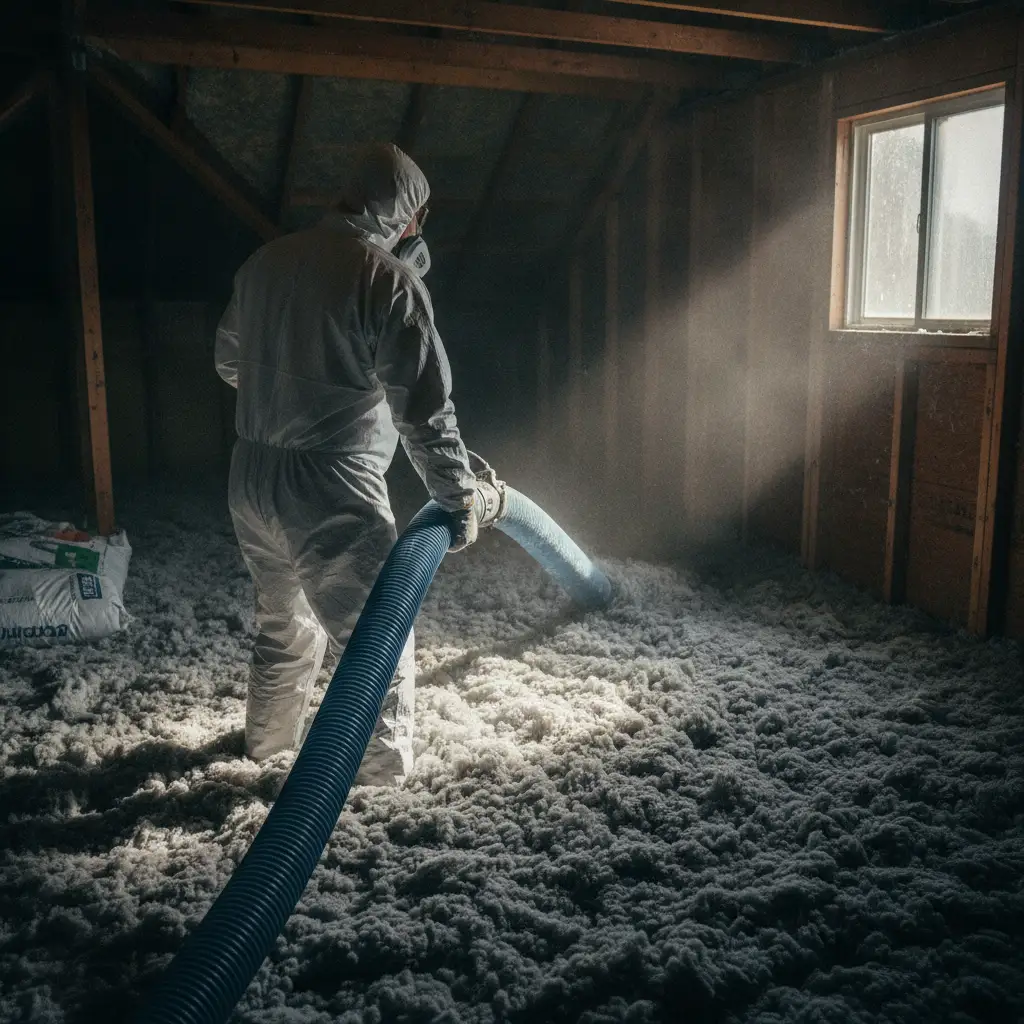
Our team in action — insulation professionals serving Orange
Why Blown-In Attic Insulation Is Needed in Orange, CA
Orange, California sits in Climate Zone 8 as defined by the California Energy Commission, a classification that reflects the city’s unique thermal profile: warm to hot dry summers with peak temperatures routinely exceeding 95°F in July and August, mild winters that occasionally dip into the high 30s, and the ever-present influence of the Santa Ana winds. These winds, which typically intensify in October through February, can drop relative humidity below 10% and dramatically alter indoor comfort levels, placing unusual stress on heating and cooling systems and exposing any weaknesses in a home’s thermal envelope.
The Santa Ana wind events of October 2007, which fueled the historic Witch Fire and other fires across the county, and the more recent Santa Ana episodes during the 2017–2018 fire seasons demonstrated just how thermally vulnerable older Orange County homes can be. During these events, outdoor temperatures and radiant heat loads spiked dramatically, and homes without adequate attic insulation saw indoor temperatures rise by as much as 10 to 15 degrees within hours — even with air conditioning running continuously.
Solar heat gain is a defining challenge in Orange. The city receives an average of 280 sunny days per year, and a poorly insulated attic can reach temperatures of 140°F to 160°F on summer afternoons. Without sufficient blown-in insulation acting as a thermal buffer, that heat transfers directly into living spaces below, forcing HVAC systems to work 30 to 40 percent harder than necessary. The result is elevated utility bills, accelerated equipment wear, and chronic indoor discomfort.
Orange’s housing stock adds another layer of urgency. Old Towne Orange, designated as a National Register Historic District, contains hundreds of homes built between 1905 and 1940 — many of which have never had their original attic insulation updated. The Chapman Hills and Serrano Heights neighborhoods, developed more recently on the city’s hillside terrain, face different challenges: elevation-related wind exposure and the complex rooflines common to custom and semi-custom construction can create insulation voids that standard batt insulation fails to address. Blown-in insulation, by contrast, fills these voids completely.
Orange’s crawl spaces and attic spaces are also vulnerable to moisture during the atmospheric river events that periodically drench Southern California. When existing insulation becomes wet, compressed, or molded, its R-value drops precipitously and it can become a breeding ground for mold and pests. The January 2023 atmospheric river events brought record rainfall to Orange County, with some areas receiving over 7 inches in 72 hours — conditions that left many attics with compromised insulation that needed replacement.
For investment property owners and landlords operating in Orange’s competitive rental market, the energy efficiency benefits of blown-in insulation translate directly into lower operating costs and improved tenant satisfaction — factors that support higher rental rates and lower vacancy rates in neighborhoods like West Orange and the areas surrounding Chapman University.
Signs You Need Blown-In Attic Insulation in Orange
Energy and Comfort Indicators
- Monthly utility bills that spike significantly during July and August, or that consistently run higher than comparable homes in your neighborhood
- Rooms that feel noticeably hotter than thermostat settings during peak afternoon hours
- An HVAC system that runs almost continuously without achieving the set temperature
- Cold drafts near the ceiling during winter months, particularly during Santa Ana wind events
Physical and Structural Symptoms
- Visible attic insulation that measures less than 10 inches in depth — the approximate threshold for R-38 compliance
- Insulation that appears flat, compressed, yellowed, or matted rather than fluffy and lofted
- Evidence of pest activity including rodent droppings or nesting material mixed into existing insulation
- Water staining or visible mold on attic framing members
Urgency Indicators
- Your home was built before 1980 and has never had insulation upgrades
- You recently had roof work done that disturbed or displaced existing insulation
- You experienced roof leaks during the 2023 or 2024 winter storm events
- An energy auditor or utility company assessment has flagged your attic as the primary source of energy loss
Blown-In Attic Insulation Methods and Approaches
Cellulose Blown-In Insulation
Made from recycled paper fiber treated with borate-based fire retardants, cellulose is the most commonly recommended material for Orange’s climate. It achieves an R-value of approximately 3.2 to 3.8 per inch, conforms exceptionally well to irregular spaces, and provides a modest level of sound dampening. Cellulose is our first recommendation for historic Old Towne homes and older construction where irregular joist spacing is common.
Fiberglass Blown-In Insulation
Blown-in fiberglass is moisture-resistant, non-organic, and will not support mold growth — making it an ideal choice for Orange homes with a history of roof leaks or attics with elevated humidity. It achieves R-2.2 to R-2.7 per inch, meaning greater depth is needed to hit target R-values, but its long-term durability in variable humidity conditions makes it a strong choice for properties in lower-lying areas of Orange that experienced flooding during the 2023 winter storms.
Dense-Pack Blown-In for Enclosed Cavities
For wall cavities and enclosed rafter bays — common in Orange’s older craftsman and Spanish Colonial Revival homes — dense-pack cellulose or fiberglass can be blown in at high density to fill the cavity completely, eliminating convective looping and achieving R-values of R-13 to R-15 per wall cavity without opening finished surfaces.
Blown-In Blanket System (BIBS)
The BIBS method uses a fabric mesh netting to contain blown-in fiberglass at high density within open framing — particularly useful for new construction or major renovation projects in Orange’s hillside neighborhoods like Serrano Heights where exposed rafter systems are common in custom home builds.
Ready for Blown-In Attic Insulation? Get Your Free Estimate Today.
Next Level Insulation of Orange serves Orange and the surrounding area — we’ll be on-site within 24 hours.
📞 Call (714) 266-2070Blown-In Attic Insulation Cost in Orange, CA
The cost of blown-in attic insulation in Orange, CA typically ranges from $1.50 to $3.50 per square foot, depending on the material selected, the target R-value, and the condition of the existing attic. For a typical Orange single-family home with 1,200 to 1,800 square feet of attic space, homeowners can expect total project costs in the range of $1,800 to $6,300.
Key Cost Factors
- Material choice: Cellulose typically costs $0.20 to $0.40 less per square foot than fiberglass at equivalent R-values
- Target R-value: Upgrading from R-11 to R-38 requires more material than topping off an attic already at R-30
- Existing insulation removal: If existing insulation is pest-contaminated or wet, removal adds $500 to $1,500 to the project cost. Learn more about our insulation removal services
- Air sealing scope: Extensive air sealing in older pre-1970 Orange homes can add $300 to $700
- Attic access difficulty: Complex rooflines, tight eave clearances, or limited hatch access common in Chapman Hills custom homes may add labor costs
Local Pricing Considerations
Orange County labor rates are generally 10 to 15 percent higher than national averages. However, Southern California Edison’s Energy Upgrade California rebate program currently offers up to $0.10 per square foot for qualifying attic insulation upgrades, which can offset a meaningful portion of project costs. We encourage homeowners to request a detailed, itemized estimate to fully understand their investment and available incentives.
Neighborhoods We Serve in Orange, CA
Old Towne Orange
Centered around the historic Orange Plaza traffic circle, Old Towne contains some of the oldest housing in Orange County, with many homes dating to the 1910s through 1930s. These craftsman bungalows and Spanish Colonial Revival properties often have original attic spaces with no insulation or heavily degraded historic materials. Our team is experienced in working within the constraints of these older structures while respecting their architectural integrity.
Serrano Heights and Canyon Hills
These hillside communities feature newer custom and semi-custom homes built in the 1990s and 2000s with complex rooflines, vaulted ceilings, and exposed rafter systems. Blown-in insulation is particularly effective here for filling irregular cavities and achieving code-compliant R-values around architectural features.
West Orange (Near Chapman University)
The dense residential neighborhoods surrounding Chapman University include a mix of 1950s and 1960s ranch-style homes, many of which are now rental properties. These homes frequently have outdated or compressed fiberglass batt insulation that benefits significantly from blown-in topping or full replacement.
Villa Park Adjacent and Orange Park Acres
These semi-rural and estate-style neighborhoods in the eastern portion of Orange feature larger homes on larger lots, often with detached garages and outbuildings that also benefit from blown-in attic insulation services.
Attic Insulation Maintenance Tips for Orange Homeowners
- Inspect annually after winter storm season: Following atmospheric river events — which can bring 4 to 7+ inches of rain to Orange in a 24-hour period — check your attic for signs of water intrusion or wet insulation near the eaves.
- Check depth every 5 years: Blown-in insulation can settle 10 to 20 percent over time. A quick measurement with a ruler ensures your attic is still meeting your target R-value.
- Keep attic vents clear: Orange’s tree canopy, particularly older liquid amber and pepper trees common in Old Towne, can deposit debris that blocks soffit and ridge vents, reducing ventilation effectiveness.
- Seal new penetrations promptly: Any new electrical work, recessed lighting, or HVAC modifications that penetrate the attic floor should be resealed with spray foam immediately.
- Monitor for pest activity: Rodents are prevalent in Orange’s urban-adjacent neighborhoods. Check for droppings or nesting material during your annual inspection.
- Assess after any roofing work: Re-roofing projects often disturb attic insulation. Confirm with your roofing contractor that insulation depth was restored after the project.
- Consider a radiant barrier: Adding a radiant barrier to your attic in combination with blown-in insulation can reduce cooling loads by an additional 5 to 10 percent during Orange’s peak summer heat. Explore our full attic insulation solutions
Why Choose Next Level Insulation of Orange
Next Level Insulation of Orange is a locally focused insulation contractor serving homeowners and property managers throughout Orange and the surrounding communities of Orange County. Our technicians understand the specific challenges posed by Orange’s Climate Zone 8 conditions, its aging housing stock, and the complex architectural diversity found across the city’s neighborhoods — from the historic bungalows of Old Towne to the custom hillside homes of Serrano Heights.
We offer a comprehensive range of insulation services under one roof, including spray foam insulation, crawl space insulation, crawl space encapsulation, and insulation removal and replacement — meaning we can address every aspect of your home’s thermal envelope in a single relationship with a single contractor.
Our project teams are fully equipped to assist with rebate documentation for Southern California Edison and SoCalGas incentive programs, helping Orange homeowners maximize their return on investment. We pride ourselves on transparent, itemized estimates with no hidden charges, and our work is performed to California Title 24 energy code standards. Contact us today at (714) 266-2070 to speak with one of our local experts.
Frequently Asked Questions: Blown-In Attic Insulation in Orange, CA
How much does blown-in attic insulation cost in Orange, CA?
For most Orange single-family homes, blown-in attic insulation costs between $1,800 and $6,300 depending on attic size, target R-value, material selection, and whether old insulation removal is required. Per-square-foot pricing generally ranges from $1.50 to $3.50. We provide free, no-obligation estimates so you know exactly what to expect before any work begins.
What R-value do I need for my attic in Orange, CA?
California’s Title 24 energy code and the California Energy Commission’s Climate Zone 8 guidelines recommend a minimum of R-38 for existing homes and R-49 for new construction in Orange. Many older homes in the city currently have R-11 or less, representing a significant efficiency gap. We assess your current R-value during our free inspection and recommend the appropriate upgrade.
How long does blown-in attic insulation installation take?
For a typical Orange single-family home with 1,200 to 1,800 square feet of attic space, the full installation process — including air sealing and blown-in material application — is typically completed in a single day, usually 4 to 6 hours of on-site work.
Can blown-in insulation be installed on top of my existing insulation?
In most cases, yes. If your existing insulation is dry, free of mold, and free of significant pest contamination, we can install blown-in insulation directly on top to bring your attic up to the target R-value. This approach saves the cost of removal and is the most common method used in Orange’s mid-century homes.
Will blown-in insulation help reduce my Southern California Edison electric bills?
Yes, significantly. Homes in Orange that upgrade from inadequate insulation to R-38 or R-49 typically see cooling-related energy consumption drop by 20 to 40 percent. Combined with Southern California Edison’s Energy Upgrade California rebate program, the payback period for blown-in attic insulation in Orange is often 3 to 5 years.
Is blown-in insulation safe for older homes in Old Towne Orange?
Yes. Modern blown-in cellulose and fiberglass insulation are both fire-resistant and safe for installation in older homes. We take special care in pre-1940 homes to identify and seal any knob-and-tube wiring or original electrical installations that may require additional clearance from insulation material, in compliance with California building code requirements.
How does blown-in insulation perform during Santa Ana wind events?
Blown-in insulation, when combined with proper attic air sealing, significantly reduces the infiltration of extremely dry Santa Ana air and outdoor heat into the living space. Properly insulated homes maintain indoor comfort far more effectively during the extreme low-humidity, high-temperature conditions that characterize Orange County’s Santa Ana wind events, typically occurring October through February.
Do you offer insulation removal services if my existing insulation is damaged?
Yes. We offer complete insulation removal and replacement services for attics with pest-contaminated, water-damaged, or mold-affected insulation. Our removal process uses commercial-grade vacuum equipment to safely extract degraded material before new blown-in insulation is installed.
Get Your Free Blown-In Attic Insulation Estimate in Orange, CA
Don’t let another Orange summer drive up your energy bills or push your HVAC system to its limits. Next Level Insulation of Orange is ready to assess your attic, identify your efficiency opportunities, and deliver a complete blown-in attic insulation solution tailored to your home’s specific needs and your family’s comfort goals.
Whether you’re in Old Towne, Serrano Heights, West Orange, or anywhere across the city, our team brings the local expertise and professional equipment to get the job done right — on schedule and on budget.
Call us today at (714) 266-2070 to schedule your free attic inspection and no-obligation estimate. Comfortable, energy-efficient living in Orange, CA starts with the right insulation — and Next Level Insulation of Orange is ready to deliver it.