
Rockwool Insulation in Chula Vista, CA
Energy-Saving Rockwool Insulation for Chula Vista, CA Homes — Licensed & Insured
Expert Rockwool insulation installation in Chula Vista, CA. Serving Otay Ranch, Eastlake & all South Bay areas. Call (619) 789-4273 for a free estimate today.
- Licensed & Insured
- Locally Owned & Operated
- Free Inspection & Estimate
Request Your
Free EstimateRockwool insulation — also known as mineral wool or stone wool insulation — is a high-performance thermal and acoustic insulation material manufactured from volcanic basalt rock and recycled steel slag. Unlike traditional fiberglass batts, Rockwool is naturally fire-resistant, water-repellent, and delivers superior sound dampening, making it one of the most versatile insulation solutions available for residential and commercial buildings.
In Chula Vista, CA, where coastal humidity rolling in from the San Diego Bay, warm Mediterranean summers, and the unique microclimates found between the bayfront and the eastern Otay Ranch foothills create distinct thermal challenges, Rockwool insulation offers a solution engineered to perform reliably year-round. At Next Level Insulation of Chula Vista, our team brings hands-on regional expertise to every Rockwool installation — whether you’re insulating a 1960s stucco ranch home in Bonita Mesa or a modern multi-family development near Eastlake Greens. Call us today at (619) 789-4273 to schedule your free assessment.
Understanding Rockwool Insulation
Rockwool insulation has a rich history dating back to the early 20th century when Danish engineers first discovered that natural volcanic rock could be melted and spun into wool-like fibers capable of trapping heat. The material gained widespread commercial adoption in the 1930s across Scandinavian countries and eventually spread throughout North America as building codes evolved to demand greater energy efficiency and fire safety in residential construction.
Today, Rockwool — sold under brand names such as ROCKWOOL (formerly Roxul) — is produced by melting basalt rock and recycled slag at temperatures exceeding 2,900°F, then spinning the molten material into dense, interlocking fibers. These fibers form rigid or semi-rigid batts and boards that resist heat transfer through conduction, convection, and radiation simultaneously. The result is an insulation material that achieves R-values between R-15 and R-23 for standard 2×4 and 2×6 wall cavities, respectively.
In Chula Vista specifically, Rockwool has become increasingly popular across several building types:
- Single-family stucco homes built throughout the 1970s and 1980s in neighborhoods like Rancho Del Rey, which were originally constructed with minimal wall insulation by today’s standards.
- New construction developments in eastern Chula Vista’s Otay Ranch community, where developers increasingly specify Rockwool to meet California’s Title 24 energy codes.
- Condominium and townhome complexes near the Third Avenue corridor, where inter-unit sound transmission is a significant quality-of-life concern for residents.
- Commercial and light industrial buildings near the Otay Mesa border crossing region, where fire-resistance ratings are a critical code requirement.
California’s progressive building energy standards under Title 24, among the most stringent in the United States, have accelerated Rockwool adoption statewide. Chula Vista’s own Climate Action Plan, adopted in 2017 and updated in subsequent years, sets greenhouse gas reduction targets that incentivize high-performance insulation upgrades across the city’s housing stock — making Rockwool an increasingly common solution for both new builds and retrofit projects throughout the region.
Beyond thermal performance, Rockwool’s inherent resistance to mold, mildew, and moisture absorption addresses a specific concern along Chula Vista’s coastal zones, where marine layer humidity can degrade conventional insulation materials over time. Its non-combustible nature also makes it particularly valuable in areas where wildfire interface risk — though lower than inland San Diego County communities — remains a planning consideration for local building officials.
Why Rockwool Insulation Is Needed in Chula Vista, CA
Coastal Humidity and Marine Layer Infiltration
Chula Vista’s western neighborhoods, including areas near the Bayfront Redevelopment Zone along Marina Parkway, regularly experience morning marine layer events that push relative humidity levels above 80% from approximately May through August — a phenomenon locals call “June Gloom,” which frequently extends well into late August. This persistent moisture creates conditions where conventional fiberglass batt insulation can absorb water vapor, lose effective R-value, and become a substrate for mold growth within wall cavities. Rockwool’s hydrophobic fiber structure repels water rather than absorbing it, maintaining its rated thermal performance even in these humid coastal conditions.
Temperature Swings Across Chula Vista’s Microclimates
A single day in Chula Vista can produce a 30°F to 40°F temperature differential between the bayfront and the Otay Ranch eastern boundary. During inland heat events — such as the extended September 2022 heat emergency that pushed temperatures in eastern Chula Vista above 105°F — homes without adequate insulation experience rapid heat gain that overwhelms HVAC systems and drives energy costs sharply higher. Rockwool’s dense fiber matrix provides superior resistance to convective heat transfer compared to fiberglass, making it particularly effective at maintaining interior comfort during these extreme thermal stress events.
Santa Ana Wind Events and Fire-Resistance Requirements
Chula Vista is periodically affected by Santa Ana wind events, most notably the October 2007 Harris Fire, which burned more than 90,000 acres in eastern San Diego County and reached areas within miles of the city’s eastern neighborhoods. California’s fire-resistance building requirements, codified in Chapter 7A of the California Building Code, apply to Wildland-Urban Interface (WUI) zones that include portions of Chula Vista’s eastern development corridors near Otay Lakes Road. Rockwool’s non-combustible composition — it does not ignite, melt, or emit toxic smoke — makes it the insulation of choice in these designated fire-risk areas.
Aging Housing Stock with Inadequate Original Insulation
A significant portion of Chula Vista’s residential housing stock was constructed between 1960 and 1990, during an era when California’s energy codes were far less demanding than today. Neighborhoods such as Castle Park, Harborside, and the established tracts along Telegraph Canyon Road contain thousands of homes that were originally built with R-11 or less in wall cavities — well below the R-15 to R-21 now required under California Title 24 standards. Upgrading these homes with Rockwool insulation through removal-and-replacement or blown-in mineral wool applications can reduce heating and cooling energy consumption by an estimated 20% to 35%, according to California Energy Commission data for comparable Southern California climate zones (Zone 7, which encompasses Chula Vista).
Sound Transmission in Dense Urban and Suburban Settings
Chula Vista’s rapid population growth — the city crossed 275,000 residents in recent census estimates — has accelerated multi-family and mixed-use development along corridors such as Broadway, Third Avenue, and H Street. In these denser settings, sound transmission between units, from street traffic, and from commercial neighbors creates livability concerns that fiberglass insulation addresses only partially. Rockwool’s dense fiber structure absorbs sound energy significantly better than equivalent-thickness fiberglass, making it the preferred choice for party walls, floor-ceiling assemblies, and exterior walls facing busy arterials.
Signs You Need Rockwool Insulation in Chula Vista
Thermal Comfort Issues
- Rooms that feel noticeably hotter than the rest of your home during Chula Vista’s inland heat events in July through October, even with air conditioning running continuously.
- Cold drafts along exterior walls or near windows during the winter months, particularly in hillside neighborhoods above 500 feet elevation such as those near Bonita Road.
- Uneven temperatures between rooms on the same floor, suggesting gaps or voids in existing wall insulation.
- HVAC system running for extended cycles without reaching the thermostat setpoint during summer afternoons.
Energy Cost Indicators
- SDG&E monthly electricity bills significantly higher than comparable homes in your neighborhood, particularly during peak summer months when time-of-use rates apply.
- Energy audit reports from SDG&E or a certified HERS rater indicating below-code insulation levels in walls, attics, or crawl spaces.
Moisture and Indoor Air Quality Concerns
- Musty odors from walls or attic spaces following winter rain events or extended marine layer periods — a potential sign that existing fiberglass insulation has become saturated.
- Visible mold staining on interior drywall surfaces, particularly on north-facing walls that receive less solar drying.
Sound and Fire Safety Urgency
- Excessive noise from neighbors, traffic, or adjacent units indicating inadequate acoustic insulation in shared walls.
- Home located in a California WUI-designated zone near Otay Lakes or Otay Mountain Wilderness where non-combustible insulation is required by code.
Our Rockwool Insulation Installation Process in Chula Vista
Free On-Site Assessment (1–2 Hours)
Every Rockwool installation begins with a thorough on-site evaluation by a Next Level Insulation technician. We inspect existing insulation conditions, measure wall cavity depths, assess attic and crawl space conditions, and identify moisture or air sealing issues that must be addressed before installation. In Chula Vista’s coastal zones, we pay particular attention to signs of marine layer moisture infiltration that could affect installation planning.
Detailed Proposal and Material Selection (24–48 Hours)
Following the assessment, we prepare a written proposal specifying the appropriate Rockwool product — ROCKWOOL Safe’n’Sound for acoustic applications, ROCKWOOL Comfortbatt for standard thermal applications, or ROCKWOOL Cavityrock for commercial assemblies — along with R-value targets aligned with California Title 24 Zone 7 requirements applicable to Chula Vista.
Air Sealing and Preparation (2–4 Hours on Installation Day)
Before any insulation is placed, our crew seals penetrations, bypasses, and gaps in the building envelope using fire-rated caulks and spray foam at top plates, electrical penetrations, and duct chases. This step is particularly important in Chula Vista’s older homes, where settling has often created gaps in framing that allow thermal bypass.
Rockwool Installation (4–8 Hours Depending on Scope)
Rockwool batts are friction-fit into wall cavities, floor joists, or roof rafters without the need for staples or adhesives. The material’s semi-rigid structure allows it to fill cavities completely, including around pipes and wiring, minimizing thermal bridging. For retrofit applications in finished walls, we may use the drill-and-fill blown mineral wool method to install insulation without opening wall surfaces.
Quality Inspection and Blower Door Testing (1–2 Hours)
Upon completion, our technician conducts a visual inspection of all installed areas and, where applicable, coordinates with a third-party HERS rater to verify that installation meets California Title 24 compliance requirements — a necessity for permitted renovations and new construction throughout Chula Vista.
Cleanup and Project Closeout (1 Hour)
All job-site waste, including Rockwool off-cuts and packaging, is collected and disposed of responsibly. We provide the homeowner with documentation of installed R-values, product specifications, and any permit inspection records for their files.
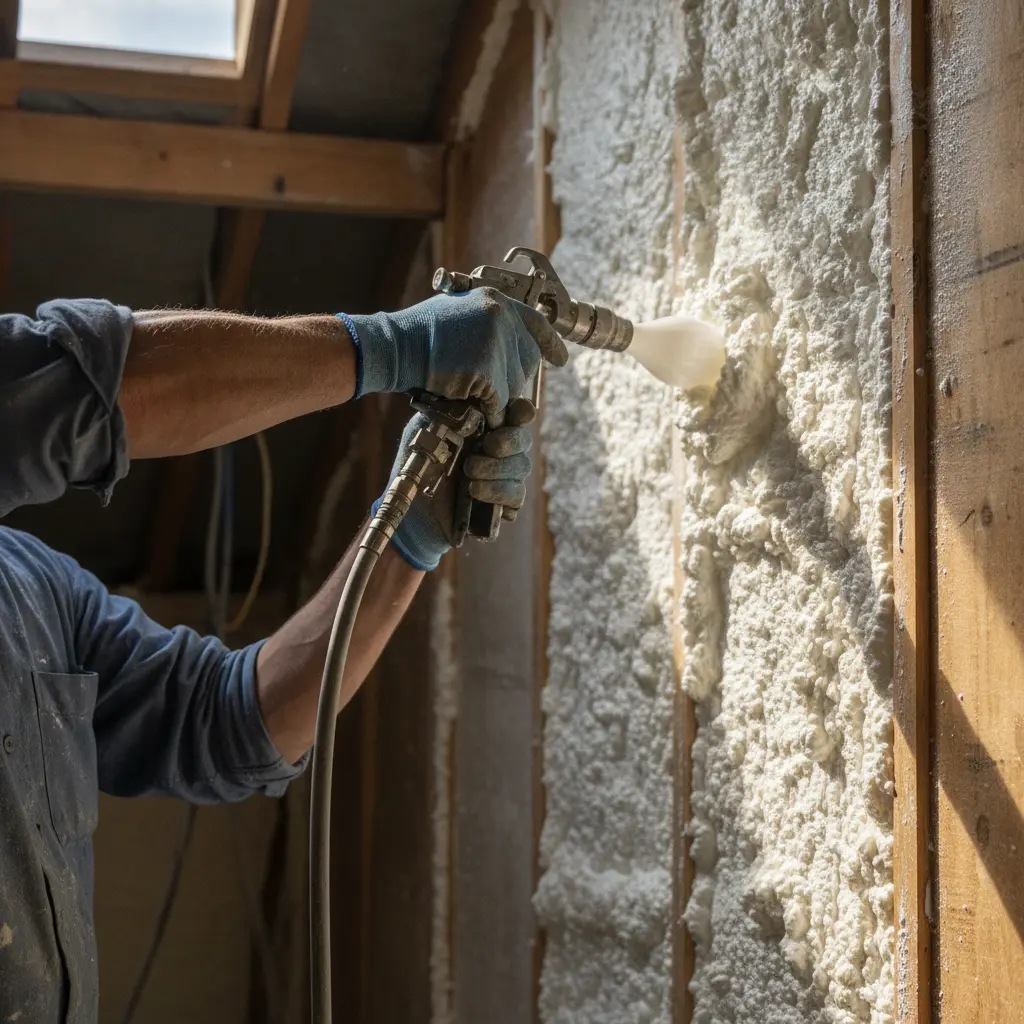
Our team in action — insulation professionals serving Chula Vista
Rockwool Insulation Methods and Approaches
Batt and Roll Installation
The most common Rockwool installation method involves pre-cut batts sized for standard 16-inch and 24-inch stud spacing. This method is ideal for new construction framing in Otay Ranch developments or open wall cavities during remodel projects. Rockwool batts friction-fit without sagging, maintaining full cavity coverage and rated R-values over the long term. Typical application: exterior walls, interior party walls for sound control, attic floor installations.
Blown-In Mineral Wool (Drill-and-Fill)
For retrofit applications in Chula Vista’s existing housing stock — particularly 1970s and 1980s homes in Rancho Del Rey or the established neighborhoods along East J Street — blown-in mineral wool allows insulation to be installed into closed wall cavities through small drilled holes, then patched. This approach avoids costly drywall demolition and is ideal for homeowners seeking to upgrade without a full interior renovation.
Continuous Exterior Insulation Boards
Rockwool rigid board products can be installed as a continuous exterior insulation layer on building facades, eliminating thermal bridging through studs. This method is increasingly specified in Chula Vista commercial projects and multi-family developments subject to the enhanced envelope requirements of California’s 2022 Title 24 energy code update.
Crawl Space and Underfloor Application
In homes with raised foundations — common in older Chula Vista neighborhoods near the Third Avenue historic district — Rockwool batts installed between floor joists provide both thermal and acoustic separation between the living floor and the crawl space below. Rockwool’s resistance to moisture makes it particularly suitable for crawl spaces in western Chula Vista where groundwater and humidity can be elevated. Learn more about our crawl space insulation services
Attic Insulation
Rockwool blown or batt products can be installed on attic floors or in cathedral ceiling rafter bays. Given Chula Vista’s warm summers, attic insulation upgrades offer some of the fastest energy payback periods of any building improvement. Explore our attic insulation options
Ready for Rockwool Insulation? Get Your Free Estimate Today.
Next Level Insulation of Chula Vista serves Chula Vista and the surrounding area — we’ll be on-site within 24 hours.
📞 Call (619) 789-4273Rockwool Insulation Cost in Chula Vista, CA
Understanding the cost of Rockwool insulation in Chula Vista helps homeowners and property managers plan their projects effectively. Pricing varies based on application type, scope, and specific site conditions.
Typical Price Ranges
- Wall batt installation (new construction or open cavity): $1.50–$2.50 per square foot of wall area, including material and labor. A typical 1,500 sq ft Chula Vista home with 8-foot ceilings might range from $2,800–$5,200 for full exterior wall insulation.
- Blown-in mineral wool retrofit (closed walls): $3.00–$5.00 per square foot of wall area, reflecting the additional labor for drilling, filling, and patching. Whole-home retrofits in a typical Chula Vista ranch home commonly run $4,500–$9,000.
- Attic floor Rockwool installation: $2.00–$3.50 per square foot. A 1,200 sq ft attic floor typically costs $2,400–$4,200 installed.
- Crawl space underfloor application: $2.50–$4.00 per square foot of floor area.
- Commercial rigid board exterior insulation: $4.00–$8.00 per square foot installed, depending on thickness and finish requirements.
Chula Vista-Specific Cost Factors
Several local factors influence final project pricing. Homes in western Chula Vista near the bayfront may require additional moisture assessment and pre-treatment steps. Projects requiring California Title 24 HERS verification add $150–$400 for third-party inspection fees. Permit fees through the City of Chula Vista Development Services Department typically range from $200–$600 for insulation permits on residential projects. California’s SDG&E utility rebate programs — including the Energy Upgrade California initiative — may offset costs by $500–$1,500 for qualifying projects, effectively reducing net investment for eligible Chula Vista homeowners.
Contact Next Level Insulation of Chula Vista at (619) 789-4273 for a precise, no-obligation written estimate tailored to your specific property.
Rockwool Insulation Service Areas in and Around Chula Vista
Otay Ranch
Chula Vista’s largest master-planned community, developed primarily from the late 1990s onward, features newer construction that is nonetheless approaching 20–25 years of age in its earliest phases. Many Otay Ranch homes are now undergoing insulation upgrades as original materials age and California’s Title 24 requirements have tightened significantly since original construction. We serve Villages 1, 2, 7, 11, and 12 throughout this eastern corridor.
Eastlake Greens
Built largely during the 1990s, Eastlake Greens features a mix of tract homes with stucco construction typical of San Diego County. Original wall insulation in many Eastlake homes was installed at R-11 or R-13 — below current standards — making Rockwool retrofit upgrades a high-value improvement. View our Eastlake Greens service page
Bonita
This semi-rural community south of National City features a mix of custom homes, many built in the 1960s through 1980s on larger lots with varied foundation types including raised foundations and slab-on-grade. Bonita’s hillside topography creates localized wind exposure that amplifies the importance of well-sealed, high-R insulation assemblies.
Castle Park and Harborside
Among Chula Vista’s older established neighborhoods, Castle Park and Harborside contain post-World War II housing stock from the 1950s and 1960s with minimal or degraded original insulation. These neighborhoods are priority areas for Rockwool retrofit projects, with many homes qualifying for SDG&E weatherization program support.
We also serve National City, Imperial Beach, La Mesa, Spring Valley, Lemon Grove, La Presa, and communities throughout San Diego including North Park, Hillcrest, University Heights, South Park, and Encanto. See our full service area
Rockwool Insulation Maintenance Tips for Chula Vista Homeowners
While Rockwool is one of the most durable and low-maintenance insulation materials available, proactive care helps preserve its performance over decades in Chula Vista’s coastal and inland conditions.
- Inspect attic insulation annually — particularly after the winter rainy season (November through March) — for signs of moisture intrusion from roof leaks that could affect Rockwool’s position and coverage, even though the material itself resists moisture absorption.
- Check crawl space conditions each spring for standing water or elevated humidity following winter rains, which can affect wood framing adjacent to Rockwool installations. Consider pairing Rockwool with crawl space encapsulation in western Chula Vista homes. Learn about crawl space encapsulation
- Seal attic penetrations such as recessed light fixtures, plumbing vents, and HVAC ducts annually to prevent air bypass that reduces Rockwool’s effective performance.
- Monitor interior humidity during extended marine layer periods (May–September) using an inexpensive hygrometer. Interior relative humidity above 60% consistently may indicate ventilation issues that can affect wall cavity conditions.
- Avoid compressing Rockwool batts during storage or renovation — compression reduces R-value. Ensure contractors working on plumbing or electrical projects in insulated cavities restore insulation to its full thickness.
- Schedule a professional insulation inspection every 10–15 years to verify that insulation remains at rated thickness and coverage, particularly in attics where settling, pest activity, or HVAC maintenance may have disturbed installations.
- After any significant roof or plumbing repairs, have the affected insulation zones inspected to confirm no damage or displacement occurred during the repair process.
Why Choose Next Level Insulation of Chula Vista
At Next Level Insulation of Chula Vista, we bring focused regional expertise to every Rockwool insulation project throughout Chula Vista and the greater South Bay. Our team understands the specific performance demands created by Chula Vista’s coastal humidity, Santa Ana wind exposure, and the dramatic temperature variation between the bayfront and eastern hill communities — knowledge that translates into insulation installations that genuinely perform in local conditions rather than generic installations designed for a one-size-fits-all national market.
We are familiar with the City of Chula Vista’s permitting requirements, California’s Title 24 energy code Zone 7 specifications, and the SDG&E rebate programs available to qualifying Chula Vista homeowners — helping our customers navigate paperwork and maximize available incentives. Our installations follow ROCKWOOL manufacturer specifications and California Building Code requirements to ensure compliance and long-term performance.
Beyond Rockwool, our full-service capabilities include spray foam insulation, blow-in insulation, insulation removal, and insulation replacement — giving Chula Vista property owners a single trusted partner for all insulation needs.
Call us at (619) 789-4273 to speak directly with a local insulation specialist who knows Chula Vista’s neighborhoods and building conditions firsthand.
Frequently Asked Questions: Rockwool Insulation in Chula Vista, CA
How much does Rockwool insulation cost in Chula Vista, CA?
Rockwool insulation in Chula Vista typically costs between $1.50 and $5.00 per square foot installed, depending on the application. Standard batt installation in open wall cavities runs $1.50–$2.50 per square foot, while blown-in retrofit applications for closed walls range from $3.00–$5.00 per square foot. A whole-home wall insulation retrofit for a typical Chula Vista single-family home generally falls between $4,500 and $9,000 before any available SDG&E utility rebates. Contact us at (619) 789-4273 for a free, property-specific estimate.
Is Rockwool better than fiberglass insulation for Chula Vista homes?
For most Chula Vista applications, Rockwool offers meaningful advantages over fiberglass. Its hydrophobic properties resist the moisture absorption that can degrade fiberglass batts in coastal western Chula Vista neighborhoods. Its non-combustible composition is beneficial in WUI-adjacent eastern Chula Vista zones. And its superior acoustic performance is valuable in the city’s increasingly dense multi-family and mixed-use developments. Fiberglass may still be appropriate in certain budget-sensitive applications where its specific limitations are less consequential.
How long does a Rockwool insulation installation take in a typical Chula Vista home?
Most residential Rockwool insulation projects in Chula Vista are completed in one to two days. A standard exterior wall insulation installation for a 1,500–2,000 sq ft single-story home typically takes six to eight hours for the installation phase itself. Blown-in retrofit applications may take slightly longer due to the drilling and patching process. Permit inspections, if required by the City of Chula Vista, may add one to three days to overall project timelines depending on the city’s current scheduling availability.
Does Rockwool insulation help with noise from neighbors or street traffic in Chula Vista?
Yes, significantly. Rockwool’s dense, open-cell fiber structure absorbs sound energy rather than reflecting it, making it substantially more effective at reducing airborne sound transmission than fiberglass of equivalent thickness. For Chula Vista homeowners near busy corridors like H Street, Broadway, or Third Avenue, or in multi-family buildings where inter-unit noise is a concern, ROCKWOOL Safe’n’Sound is specifically engineered for acoustic applications in interior party walls and floor-ceiling assemblies.
Do I need a permit to install Rockwool insulation in Chula Vista?
Permit requirements depend on the scope of work. In Chula Vista, insulation installations that involve opening wall cavities, attic work, or changes to the building envelope typically require a building permit through the City of Chula Vista Development Services Department. Simple like-for-like insulation replacements may qualify for permit exemptions. Our team handles permit research and application as part of our project process, ensuring your installation is code-compliant from the start.
Can Rockwool insulation help lower my SDG&E energy bills in Chula Vista?
Yes. Homes in California’s Climate Zone 7 (which includes Chula Vista) that upgrade from below-code insulation to current Title 24 levels using Rockwool can expect to reduce heating and cooling energy consumption by an estimated 20%–35%, according to California Energy Commission modeling. At SDG&E’s current residential electricity rates — among the highest in the continental United States at approximately $0.45–$0.55 per kWh under standard tiered pricing — insulation upgrades typically achieve payback periods of four to eight years depending on the home’s size and prior insulation condition.
Is Rockwool insulation safe for my family?
Rockwool manufactured by ROCKWOOL Group and other reputable producers has been classified as non-carcinogenic by the International Agency for Research on Cancer (IARC) since 2001. The product does not contain formaldehyde, asbestos, or fiberglass. Its non-combustible composition means it does not produce toxic smoke in fire conditions. During installation, our technicians wear appropriate respiratory protection as standard practice, and we ensure job sites are properly ventilated. Once installed, Rockwool poses no ongoing air quality concerns for building occupants.
Does Rockwool insulation work well in Chula Vista’s older crawl spaces?
Rockwool is an excellent choice for crawl space underfloor applications in Chula Vista’s older homes with raised foundations, particularly because its hydrophobic properties resist the elevated humidity common in crawl spaces near the bayfront. We often recommend pairing Rockwool underfloor installation with a full crawl space encapsulation using a vapor barrier to address both thermal performance and moisture management comprehensively.
Get a Free Rockwool Insulation Estimate in Chula Vista Today
If you’re ready to improve your home’s comfort, energy efficiency, fire resistance, or sound control with professional Rockwool insulation installation in Chula Vista, CA, the team at Next Level Insulation of Chula Vista is ready to help. We serve homeowners and property managers throughout Chula Vista — from the bayfront communities of Harborside to the hillside tracts of Otay Ranch — as well as National City, Bonita, Imperial Beach, La Mesa, Spring Valley, and communities throughout San Diego County.
Call us directly at (619) 789-4273 to speak with a local insulation specialist and schedule your free, no-obligation on-site assessment. We’ll evaluate your property’s specific conditions, recommend the right Rockwool solution for your needs, and provide a detailed written estimate — at no cost and with no pressure.
Next Level Insulation of Chula Vista — Serving Chula Vista and South Bay San Diego with Professional Rockwool Insulation Solutions.