

Insulation Materials & Types in Chula Vista, CA
Energy-Saving Insulation Materials & Types in Chula Vista for Chula Vista, CA Homes — Licensed & Insured
Explore every insulation material for Chula Vista homes — R-values, costs, climate fit, and expert guidance from Next Level Insulation of Chula Vista. Call 619-789-4273.
- Licensed & Insured
- Locally Owned & Operated
- Free Inspection & Estimate
Request Your
Free EstimateChoosing the right insulation material for your Chula Vista home is more consequential than many homeowners realize. Chula Vista sits in California Climate Zone 7, where summer temperatures regularly climb into the 90s, marine layer humidity drifts in from the nearby Pacific coast, and temperature swings between day and night can exceed 30°F. Coastal air accelerates moisture intrusion, while the region’s wildland-urban interface creates a measurable wildfire risk for communities near the eastern hills and Otay Ranch area.
R-value measures a material’s resistance to heat flow — the higher the number, the better it resists thermal transfer. In Chula Vista’s climate, selecting the correct R-value for your attic, walls, and crawl space directly determines how hard your HVAC system works and how much you spend on energy bills year-round.
This guide breaks down every major insulation material available to Chula Vista homeowners — how each performs in local conditions, what it costs, where it belongs in your home, and how to match the right material to your specific project and budget.
Understanding Insulation Types for Chula Vista Homes
Insulation materials fall into several broad categories: loose-fill, batt and roll, spray-applied, rigid board, and structural insulated panels. Each category behaves differently when exposed to the heat, humidity, and occasional coastal fog that define Chula Vista’s Mediterranean-influenced climate.
California’s Title 24 Building Energy Efficiency Standards set minimum R-value requirements for new construction and qualifying renovations in Climate Zone 7. These standards generally require R-38 or higher for attics and R-13 or better for exterior walls, though the specific requirement depends on your project type and permit category. Meeting — or exceeding — these minimums is not just a code issue; it is a comfort and cost issue in a region where attic temperatures can exceed 140°F during summer afternoons.
Chula Vista’s housing stock ranges from mid-century ranch homes in the western neighborhoods to newer two-story construction in Eastlake, Otay Ranch, and Rolling Hills Ranch. Older homes frequently have little to no wall insulation and aging attic batts that have settled or become moisture-damaged over decades. Newer tract homes may be code-compliant but often leave room for performance upgrades, especially in attic air sealing.
The right material depends on construction type, existing conditions, accessibility, local fire-resistance requirements, and your budget. The sections below walk through each option in detail.
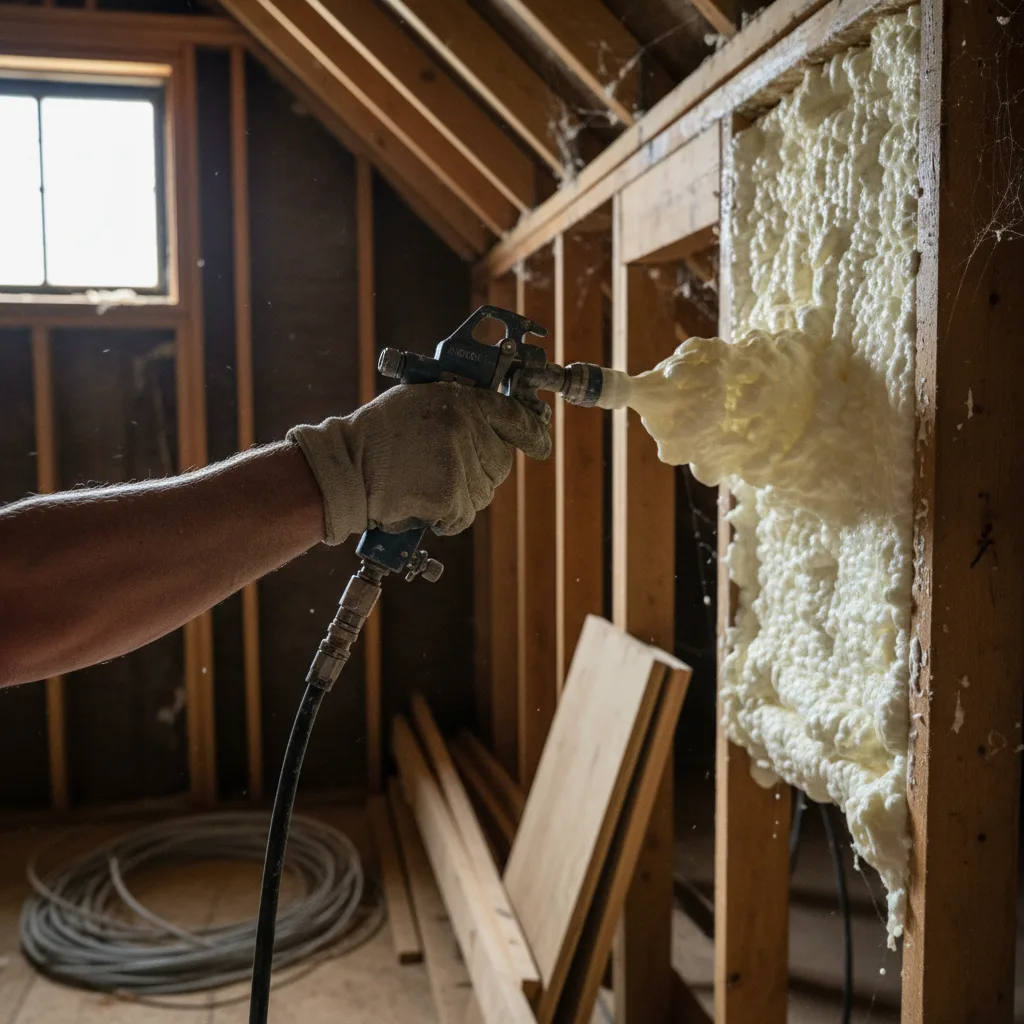
Our team in action — insulation professionals serving Chula Vista
How Chula Vista’s Climate Affects Your Insulation Material Choice
Chula Vista’s position between the Pacific Ocean and the inland desert creates a layered set of insulation challenges. West of Interstate 805, marine layer moisture keeps humidity levels elevated — a condition that favors closed-cell spray foam and mineral wool over standard fiberglass batts in wall assemblies. East of I-805 and through the Otay Ranch corridor, temperatures climb faster, humidity drops, and proximity to wildland areas elevates fire risk, making mineral wool and fire-rated spray foam smart choices.
For attics — the single highest-impact area in most Chula Vista homes — blown-in insulation combined with thorough air sealing delivers the fastest return on investment. Attic floor temperatures can exceed 140°F in July and August; an under-insulated attic radiates that heat directly into living spaces, forcing air conditioners to run continuously. The California Energy Commission recommends a minimum of R-38 for attics in Climate Zone 7, but R-49 or higher is increasingly common in high-performance retrofits.
For walls in existing homes, dense-pack cellulose or open-cell spray foam offers a practical retrofit path without full demolition. In new construction, mineral wool batts or closed-cell foam provide the best combination of thermal performance and coastal moisture resistance.
Crawl spaces in Chula Vista’s older neighborhoods benefit from closed-cell spray foam or rigid XPS boards applied to foundation walls, transforming a vented crawl space into a conditioned one and eliminating a major moisture and pest pathway. Matching the material to the application — rather than defaulting to the cheapest option — is the key to long-term performance in this climate.
Insulation Materials Available in Chula Vista, CA
Spray Foam Insulation
Spray polyurethane foam (SPF) expands on contact to fill gaps, cracks, and irregular cavities. It comes in two forms: open-cell (lower density, R-3.5–3.7 per inch) and closed-cell (denser, R-6–7 per inch). For Chula Vista homes, closed-cell foam excels in coastal-adjacent areas where moisture vapor is a concern, because its low permeability acts as an integrated vapor retarder. Open-cell foam works well for interior applications like rim joists and interior walls. Both types create an air seal that dramatically reduces infiltration — a significant energy driver in older Chula Vista homes. Spray foam is ideal for attic roof decks, crawl space walls, and hard-to-reach cavities. It carries high fire-resistance ratings important for wildfire-adjacent zones. Installed cost typically ranges from $1.50–$3.50 per square foot for open-cell and $2.50–$5.00 per square foot for closed-cell.
Blown-In (Loose-Fill) Insulation
Loose-fill insulation — typically fiberglass or cellulose — is machine-blown into attic floors, enclosed wall cavities, and hard-to-access spaces. It conforms around obstructions and fills irregularly shaped areas without cutting. In Chula Vista attics, blown-in fiberglass achieves R-2.2–2.7 per inch while blown-in cellulose reaches R-3.2–3.8 per inch. This method is particularly cost-effective for topping up existing attic insulation in Chula Vista’s older homes where current levels fall below Title 24 recommendations. Blown-in material settles slightly over time and can shift in attics with poor air sealing. Installed cost generally runs $1.00–$2.00 per square foot, making it one of the most budget-friendly upgrades available to Chula Vista homeowners.
Fiberglass Batt Insulation
Fiberglass batts are the familiar pink or yellow pre-cut blankets sized to fit standard stud and joist spacing. They offer R-11 to R-38 depending on thickness, and they perform predictably in the moderate humidity levels common in western Chula Vista neighborhoods. Batts are straightforward to install in open wall cavities during renovations or new construction but lose effectiveness when compressed, cut improperly, or installed around obstructions. In an already-humid coastal microclimate, batts without proper vapor management can accumulate moisture over time. They are best suited for new construction or gut-renovation wall assemblies, floor cavities, and attic floors. Fire-resistant versions are available. Installed cost ranges from $0.50–$1.50 per square foot, making them the most economical upfront choice.
Mineral Wool / Rockwool Insulation
Mineral wool (often sold under the Rockwool brand) is manufactured from volcanic rock or steel-mill slag spun into dense fiber batts or boards. It delivers R-3.0–3.3 per inch and is naturally non-combustible — a significant advantage for Chula Vista homes in or near Very High Fire Hazard Severity Zones in the eastern portions of the city. Mineral wool is water-resistant, dimensionally stable, and does not support mold growth, making it well-suited to coastal humidity conditions. It also provides superior sound attenuation for party walls and interior partitions. Best applications include exterior walls, garage-to-living space assemblies, and any location where fire resistance is a priority. Installed cost typically runs $1.00–$2.50 per square foot — moderately higher than fiberglass but often justified by its durability and fire-safety profile.
Cellulose Insulation
Cellulose is made from recycled newsprint treated with borate compounds that provide fire, pest, and mold resistance. It achieves R-3.2–3.8 per inch and is one of the most environmentally sustainable insulation options available. In Chula Vista’s climate, dense-pack cellulose performs exceptionally in retrofit wall cavities of older wood-frame homes, where it fills voids without major demolition. Its high density reduces air infiltration even without a separate air barrier. However, cellulose can absorb moisture if exposed to persistent leaks, so proper vapor management is essential in coastal applications. Best suited for attic floors, dense-pack walls, and floor cavities. As a recycled-content product, it qualifies for some California green building incentives. Installed cost typically ranges from $0.80–$2.00 per square foot.
Foam Board (Rigid) Insulation
Rigid foam panels — including expanded polystyrene (EPS, R-3.6–4.2 per inch), extruded polystyrene (XPS, R-5 per inch), and polyisocyanurate (polyiso, R-6–6.5 per inch) — are cut-to-fit boards used where thin profiles must deliver high R-values. In Chula Vista, rigid foam is commonly applied to exterior wall sheathing during re-siding projects, under slab foundations, and on basement or crawl space walls. Polyiso performs best in the warm temperatures typical of Chula Vista summers; XPS is preferred in below-grade or crawl space applications due to its moisture resistance. Rigid boards must be covered with a fire-rated assembly per California code when used on interior surfaces. Installed cost ranges from $0.70–$2.50 per square foot depending on board type and thickness.
Ready for Insulation Materials & Types? Get Your Free Estimate Today.
Next Level Insulation of Chula Vista serves Chula Vista and the surrounding area — we’ll be on-site within 24 hours.
📞 Call 619-789-4273Why Chula Vista Homeowners Trust Next Level Insulation of Chula Vista for Insulation
Next Level Insulation of Chula Vista is the locally focused insulation contractor Chula Vista homeowners rely on for honest assessments and quality installations across every material type. Here is what sets our team apart:
Insulation Materials FAQ for Chula Vista Homeowners
What is the best insulation type for Chula Vista’s climate?
There is no single best material — the right choice depends on location within the home and your specific conditions. For attics, blown-in fiberglass or cellulose combined with air sealing delivers excellent performance and value. For walls in coastal or high-humidity areas, closed-cell spray foam or mineral wool resists moisture best. For retrofit wall cavities, dense-pack cellulose is often the most practical. A professional assessment of your home helps match material to application accurately.
What R-value does my Chula Vista home need?
California’s Title 24 energy code places Chula Vista in Climate Zone 7. Minimum requirements for attics are generally R-38, though R-49 is recommended for maximum comfort and energy savings. Exterior walls typically require R-13 minimum in standard framing. Floors over unconditioned spaces generally need R-19. Older Chula Vista homes often fall well below these minimums, making targeted upgrades one of the highest-ROI home improvements available.
How do insulation material costs compare in Chula Vista?
Fiberglass batts are the least expensive upfront at roughly $0.50–$1.50 per square foot installed. Blown-in insulation runs $1.00–$2.00. Cellulose is similar at $0.80–$2.00. Mineral wool averages $1.00–$2.50. Rigid foam boards range from $0.70–$2.50 depending on type. Spray foam is the most expensive at $1.50–$5.00 per square foot but provides the highest R-value per inch and the best air-sealing performance, often reducing long-term energy costs enough to justify the investment.
Is attic insulation or wall insulation more important in Chula Vista?
Attic insulation almost always delivers a faster return on investment in Chula Vista because heat gain through an under-insulated attic is the dominant driver of summer cooling costs. Attic upgrades are also more accessible and less disruptive than wall work in existing homes. That said, wall insulation becomes the priority in older homes with no wall insulation at all, where air infiltration and heat transfer through walls is substantial. An energy audit helps determine where your home loses the most energy.
How much can I save on energy bills by upgrading insulation in Chula Vista?
The U.S. Department of Energy estimates that homeowners can save 10–20% on total heating and cooling costs with proper insulation and air sealing. In Chula Vista, where SDG&E rates are among California’s highest, that translates to meaningful annual savings. Homes with severely under-insulated attics often see cooling bill reductions of 20–30% after a full attic insulation and air-sealing project. Actual savings depend on your home’s current condition, size, and how efficiently your HVAC system operates.
Are there rebates or tax credits available for insulation in California?
Yes. SDG&E offers rebates through its Energy Savings Assistance and Home Upgrade programs for qualifying insulation improvements. The federal Inflation Reduction Act’s 25C tax credit allows homeowners to claim up to 30% of insulation material costs (up to $1,200 per year) on their federal taxes for qualified improvements. California’s TECH Clean California initiative and HERO financing options may also apply. Eligibility and amounts change periodically, so confirming current availability with your contractor and tax advisor is recommended.
Can I add insulation on top of existing insulation in my Chula Vista attic?
In most cases, yes. If existing attic insulation is dry, undamaged, and free of mold, blown-in insulation can be added directly on top to bring R-values up to current standards. However, the attic should first be inspected for air leaks at top plates, recessed lights, and HVAC penetrations, and those gaps should be sealed before adding insulation. Adding material over significant air leaks reduces the effectiveness of the upgrade considerably. A professional assessment determines whether topping up is appropriate or whether full removal and replacement is warranted.
Is spray foam insulation safe for my family and pets?
Once fully cured — typically 24 hours after installation — spray polyurethane foam is inert and poses no off-gassing risk. During and immediately after installation, occupants and pets should vacate the space until the foam is fully cured and the area has been adequately ventilated. Licensed spray foam contractors use proper respiratory protection during application. Choosing an experienced, certified installer ensures the correct formulation and cure time protocols are followed for indoor air quality safety.
Get a Free Insulation Assessment in Chula Vista
Not sure which insulation material is right for your home? Next Level Insulation of Chula Vista offers a free, no-obligation insulation assessment for Chula Vista homeowners. Our licensed and insured team will evaluate your current insulation levels, identify air leaks, check for moisture issues, and recommend the most effective material and R-value upgrade for your specific home, climate zone, and budget.
We understand Chula Vista’s unique combination of coastal humidity, summer heat, and Title 24 code requirements — and we help you navigate SDG&E rebate programs and federal tax credits to make your investment go further.
Call us today at 619-789-4273 to schedule your free insulation assessment. Serving Chula Vista and surrounding South Bay communities.