

Insulation Replacement in Chula Vista, CA
Quality Insulation Replacement in Chula Vista, CA in Chula Vista, CA — Built to Last
Need insulation replacement in Chula Vista, CA? Next Level Insulation offers expert removal & install for attics, walls & crawl spaces. Call 619-789-4273 today.
- Licensed & Insured
- Locally Owned & Operated
- Free Inspection & Estimate
Request Your
Free EstimateInsulation replacement is the process of removing degraded, damaged, or inefficient insulating material from your home or commercial property and installing fresh, high-performance insulation in its place. Over time, insulation breaks down due to moisture intrusion, pest activity, settling, and simple age — leaving your property vulnerable to energy loss and uncomfortable temperatures year-round.
In Chula Vista, CA, the coastal marine layer, high summer humidity swings, and the region’s distinctive mix of 1960s–1980s tract homes and newer master-planned communities create insulation challenges that are genuinely unique to this part of San Diego County. Properties near the Sweetwater Marsh National Wildlife Refuge, for example, regularly experience moisture-driven insulation deterioration that inland communities rarely see.
At Next Level Insulation of Chula Vista, we bring specialized expertise in diagnosing and replacing insulation across the full range of building types found throughout Chula Vista and the surrounding South Bay. Call us today at 619-789-4273 to schedule your free assessment.
Understanding Insulation Replacement
Insulation replacement is far more than simply pulling out old material and stuffing in something new. It is a technically precise process that requires a thorough understanding of building science, thermal dynamics, and the specific performance demands of your local climate. Modern insulation systems are rated by their R-value — a measure of thermal resistance — and the U.S. Department of Energy recommends that homes in California’s Climate Zone 7, which encompasses Chula Vista, maintain attic insulation at R-38 to R-60, with wall cavity insulation at R-13 to R-21 depending on construction type.
Historically, many Chula Vista homes built during the post-war and Cold War development booms of the 1950s through 1970s were insulated with materials we now know to be problematic. Vermiculite, which sometimes contained asbestos, was used in some attic applications. Early fiberglass batts were installed without vapor barriers, and many original blown-in installations used cellulose that has long since compacted to a fraction of its original thickness. In the Eastlake and Rolling Hills Ranch planned communities developed in the late 1980s and 1990s, fiberglass batt insulation is now approaching or exceeding its effective lifespan of 25–30 years.
Replacement becomes necessary when insulation loses its structural integrity, becomes contaminated, or simply no longer meets current energy codes. California’s Title 24 Energy Code requires that replacement insulation in permitted work meet current R-value standards — a bar that much of Chula Vista’s existing housing stock cannot meet without a full replacement.
Beyond energy performance, insulation serves as a critical component of indoor air quality management, moisture control, and acoustic separation between living spaces. In a city where homes in densely packed neighborhoods like Otay Ranch sit close together and where Pacific Coast breezes carry salt and moisture year-round, insulation does double and triple duty as a thermal, acoustic, and moisture barrier simultaneously.
Understanding these layered functions is essential to choosing the right replacement approach — and it is why a truly professional assessment matters before any removal work begins.
Why Insulation Replacement Is Needed in Chula Vista, CA
Moisture and the Marine Layer
The Pacific marine layer pushes onshore regularly from June through September, blanketing western Chula Vista neighborhoods like Otay Ranch, Eastlake, and the streets bordering the Sweetwater Regional Park in dense morning fog. This moisture infiltrates attic spaces through ridge vents, soffit vents, and any gaps in the building envelope. Over years and decades, fiberglass batts absorb this moisture, causing them to sag, compress, and eventually develop mold colonies. A sagging batt that has lost just 25% of its thickness can lose up to 40% of its effective R-value — a dramatic performance drop that directly translates to higher SDG&E utility bills.
Rodent and Pest Activity in the South Bay
Chula Vista’s proximity to open space preserves — including the nearly 2,400-acre Otay Valley Regional Park — means that roof rats, mice, and occasionally squirrels are persistent inhabitants of attic spaces throughout the city. The San Diego County Department of Environmental Health has documented elevated rodent activity along the Otay River corridor and in older neighborhoods like Harborside and Castle Park, where mature landscaping provides nesting habitat adjacent to homes. Rodents nest in, urinate on, and physically shred insulation batts. Once contaminated with rodent waste, insulation must be fully removed and replaced — partial replacement is insufficient and potentially hazardous.
Seismic Settlement and Structural Movement
Chula Vista sits near several active fault systems, including the Rose Canyon Fault to the north and the San Miguel-Vallecitos fault system to the east. The magnitude 5.1 Encanto earthquake of 2010 and numerous smaller seismic events cause micro-settlement in wall cavities and attic framing, creating gaps and compressed zones in batt insulation installations. Blown-in cellulose and fiberglass also naturally settle 15–20% over 10–15 years in California’s temperature-cycling environment, reducing R-values below code minimums without any visible exterior warning signs.
Age of Housing Stock
A substantial portion of Chula Vista’s housing stock — particularly in neighborhoods like Sunbow, Telegraph Canyon Estates, and the older sections near Third Avenue — was constructed during the 1965–1985 period. Insulation installed during this era is now 40–60 years old, well past the 25–30 year functional lifespan for fiberglass batts. Many of these properties have never had insulation upgraded, resulting in energy performance equivalent to an uninsulated building by modern standards.
Signs You Need Insulation Replacement
Energy Performance Indicators
- SDG&E electricity bills consistently 20–30% higher than comparable Chula Vista homes in your neighborhood
- HVAC system running continuously during summer months without reaching set temperature
- Noticeable temperature differences of 5°F or more between rooms on the same floor
- Condensation forming on interior walls or ceilings during winter months
Physical Warning Signs
- Visible insulation sagging, discoloration, or wet patches visible from attic access hatch
- Musty or ammonia-like odors in attic spaces, indicating mold or rodent contamination
- Rodent droppings, nesting material, or tracks visible in attic or crawl space areas
- Insulation depth measuring less than 10 inches in attic (below R-30 threshold)
Structural and Age Indicators
- Home was built before 1990 and insulation has never been upgraded or assessed
- Recent water intrusion event such as a roof leak or plumbing failure in wall cavities
- Visible air gaps around recessed lighting, attic hatches, or ductwork penetrations
Urgency Note: Mold-contaminated or rodent-fouled insulation poses active health risks including respiratory irritation and hantavirus exposure. These situations require immediate professional removal — do not disturb contaminated material without proper protective equipment.
Our Insulation Replacement Process
Comprehensive Property Assessment (Day 1 — 1–2 Hours)
Our certified technician performs a full visual and thermal inspection of your attic, crawl space, and accessible wall cavities. We measure current insulation depth and R-values, document any contamination, moisture damage, or pest activity, and photograph all findings. For Chula Vista properties near the bay or Sweetwater Marsh, we pay particular attention to moisture infiltration patterns and vapor barrier conditions.
Detailed Written Estimate and Material Recommendation (Day 1–2)
We provide a line-item estimate specifying removal costs, disposal fees, new material specifications, R-value targets meeting California Title 24 requirements, and total project timeline. We explain why we recommend specific materials — such as spray foam for homes with irregular framing common in older Castle Park properties — versus blown-in cellulose for standard attic decks.
Preparation and Containment Setup (Project Day 1 — 1–2 Hours)
Before any removal begins, we seal HVAC registers, cover living space access points, and establish negative air pressure containment when mold or rodent contamination is present. This prevents cross-contamination of living spaces — a critical step in Chula Vista homes where open floor plans can allow attic air to migrate rapidly through the structure.
Old Insulation Removal (Project Day 1 — 2–8 Hours Depending on Scope)
We use industrial-grade vacuum systems to extract blown-in material and carefully bag and remove all batt insulation. All contaminated material is double-bagged and disposed of in compliance with San Diego County waste management regulations.
Substrate Treatment and Air Sealing (Project Day 1–2)
After removal, we seal all air penetrations — including recessed light fixtures, top plates, and duct penetrations — with appropriate foam or caulk. This air sealing step alone can reduce heating and cooling costs by 10–20% and is required for Title 24 compliance on permitted work.
New Insulation Installation (Project Day 1–2)
We install your selected insulation material to manufacturer specifications and local code requirements, verifying depth and coverage with calibrated measuring tools before completing the installation.
Final Inspection and Documentation (Project Day 2 — 1 Hour)
We conduct a final walkthrough, provide photo documentation of the completed installation, and supply all material data sheets and R-value certifications needed for permit closeout or utility rebate applications through SDG&E’s energy efficiency programs.
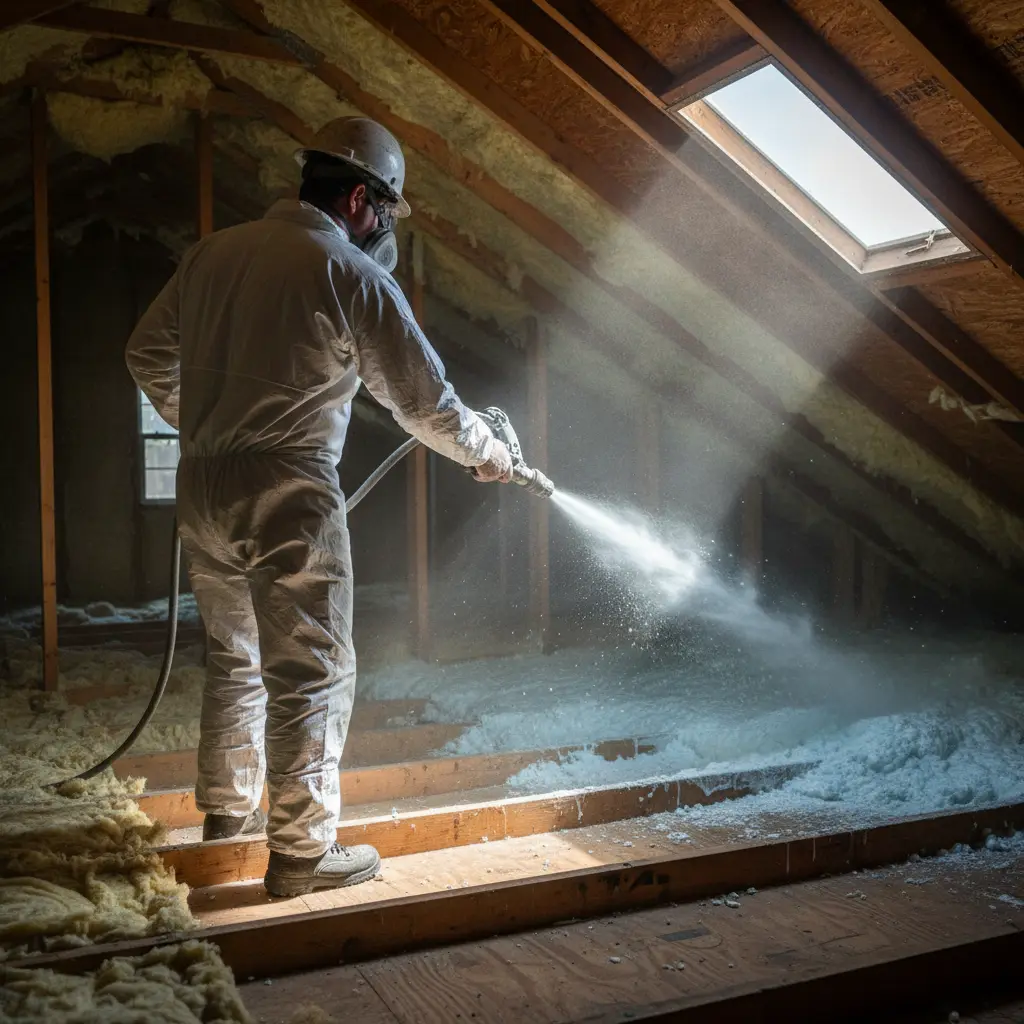
Our team in action — insulation professionals serving Chula Vista
Insulation Replacement Methods and Approaches
Blown-In Fiberglass or Cellulose (Most Common for Chula Vista Attics)
Blown-in insulation is the standard solution for open attic decks throughout Chula Vista. We install cellulose (R-3.7 per inch) or fiberglass (R-2.7 per inch) to achieve the R-38 to R-60 recommended for San Diego Climate Zone 7. Blown-in material conforms to irregular framing and seals around obstructions, making it ideal for the varied framing found in 1970s Chula Vista tract homes. Learn more about blown-in insulation services
Spray Foam Insulation (Best for Sealed Attics and Moisture-Prone Areas)
Closed-cell spray foam (R-6.5 per inch) creates an air-impermeable barrier ideal for homes in western Chula Vista neighborhoods with persistent marine layer moisture exposure. It doubles as a vapor retarder, making it the preferred choice for homes near the bayfront and Sweetwater Marsh. Open-cell foam (R-3.7 per inch) is used for interior wall applications and soundproofing. Explore spray foam insulation options
Fiberglass Batt Replacement (Standard for Wall Cavities)
For permitted wall cavity work in older Chula Vista homes, faced or unfaced fiberglass batts cut to standard 2×4 or 2×6 stud spacing provide cost-effective R-13 to R-21 performance. This method is used during renovation projects when walls are already open.
Combination Approaches
Many Chula Vista properties benefit from a combination strategy — spray foam for air sealing and critical moisture areas, blown-in for bulk attic coverage. This hybrid approach maximizes energy performance while managing project costs effectively.
Ready for Insulation Replacement? Get Your Free Estimate Today.
Next Level Insulation of Chula Vista serves Chula Vista and the surrounding area — we’ll be on-site within 24 hours.
📞 Call 619-789-4273Insulation Replacement Cost in Chula Vista, CA
Understanding the cost of insulation replacement in Chula Vista helps you plan and evaluate quotes accurately. Pricing varies based on property size, existing conditions, material choice, and access difficulty.
Typical Price Ranges
- Attic insulation removal and replacement (1,200–1,500 sq ft home): $1,800–$3,500 for blown-in fiberglass or cellulose to R-38
- Spray foam attic or crawl space application: $3,500–$7,500 depending on scope and foam type
- Wall cavity insulation replacement (per linear foot, open wall): $1.50–$3.50 installed
- Contaminated insulation removal with biohazard disposal (rodent or mold): Add $500–$1,500 to base removal costs depending on severity
- Full attic removal, air sealing, and premium blown-in to R-49 (2,000 sq ft): $4,500–$7,000
Chula Vista-Specific Cost Factors
Homes in Eastlake, Otay Ranch, and Rolling Hills Ranch generally have larger attic footprints with complex HVAC duct layouts that add labor time. Older properties near Third Avenue and Castle Park often require additional air sealing work due to decades of settling. Contamination remediation from rodent activity — common in properties backing up to open space preserves — adds meaningful cost but is non-negotiable for health and performance reasons.
Available Rebates
SDG&E customers may qualify for energy efficiency rebates of $0.10–$0.25 per square foot on qualifying insulation upgrades through the California Energy Upgrade program. Ask our team for current rebate eligibility details at the time of your assessment.
Neighborhoods We Serve in Chula Vista and the South Bay
Eastlake and Eastlake Greens
Developed primarily between 1987 and 2005, Eastlake’s two-story stucco homes have original fiberglass batt installations that are now 20–35 years old. Many properties show early signs of moisture-driven compression due to proximity to the Eastlake Trails open space and Salt Creek corridor.
Otay Ranch
Chula Vista’s largest master-planned community features homes built from the mid-1990s through the 2010s with varying insulation quality. Homes along the eastern edges of Otay Ranch face elevated dust and temperature extremes from the Otay Mountains that accelerate insulation settling in attic spaces.
Castle Park and Harborside
These older Chula Vista neighborhoods, developed in the 1950s–1970s, frequently have original insulation that has never been replaced. Many properties have R-values of R-11 or below in attics — less than one-third of current code recommendations. Rodent activity is elevated due to mature landscaping.
Bonita and National City
Our service area extends into neighboring Bonita and National City, where similar South Bay climate conditions and housing vintages create parallel insulation replacement needs. View all service areas
Imperial Beach and South Park
Coastal Imperial Beach properties face the most aggressive marine layer moisture exposure in our service area, making spray foam the preferred replacement material for attic and crawl space applications.
Insulation Maintenance Tips for Chula Vista Homeowners
- Inspect attic insulation annually — Check depth and look for sagging, discoloration, or moisture staining every spring before the marine layer season intensifies in June.
- Maintain attic ventilation — Keep soffit vents and ridge vents clear of debris. Blocked ventilation accelerates moisture buildup in Chula Vista’s humid coastal mornings.
- Seal rodent entry points proactively — Inspect roofline gaps, fascia boards, and utility penetrations annually, especially in homes backing up to Otay Valley or Sweetwater open space areas.
- Monitor your SDG&E bills — A sudden 15–20% increase in summer cooling costs without a rate change is a reliable early indicator of insulation performance decline.
- Address roof leaks immediately — Even minor roof leaks above insulated attic spaces cause rapid moisture saturation. Don’t delay repairs — wet insulation loses R-value within days.
- Keep attic access hatches weatherstripped — An unsealed attic hatch is equivalent to leaving a 1-square-foot hole in your ceiling, allowing conditioned air to escape year-round.
- Schedule a professional assessment every 10 years — Insulation performance degrades gradually and invisibly. Decade-interval professional inspections catch deterioration before it becomes costly.
Why Choose Next Level Insulation of Chula Vista
At Next Level Insulation of Chula Vista, we are not a national franchise applying generic solutions to Chula Vista’s distinctly South Bay challenges. We are local insulation specialists who understand the difference between what a home in Eastlake Greens needs versus a 1960s Castle Park property near the bayfront — and we build every project plan around those specific realities.
We specialize in spray foam insulation, blown-in insulation, attic upgrades, and garage insulation — covering the full range of replacement scenarios that Chula Vista homeowners and commercial property owners face. Our team brings meticulous attention to detail, clean jobsite practices, and transparent pricing to every project.
We serve homeowners and businesses across Chula Vista, National City, Imperial Beach, Bonita, La Mesa, Spring Valley, Lemon Grove, La Presa, and throughout San Diego County’s South Bay region. Whether you need a straightforward attic re-insulation or a complex remediation and replacement following pest damage, we deliver professional results built to last in Chula Vista’s unique coastal climate.
Call us at 619-789-4273 to schedule your free, no-obligation assessment. Contact us online
Frequently Asked Questions About Insulation Replacement in Chula Vista
How much does insulation replacement cost in Chula Vista, CA?
Most Chula Vista homeowners pay between $1,800 and $7,000 for attic insulation replacement depending on home size, material choice, and existing conditions. A standard 1,500 sq ft attic replacement with blown-in fiberglass to R-38 typically runs $1,800–$3,200. Contamination remediation, spray foam upgrades, or large-footprint homes in Otay Ranch or Eastlake will fall toward the higher end of that range. We provide detailed written estimates after every free assessment.
How long does insulation replacement take?
Most residential attic insulation replacement projects in Chula Vista are completed in one to two days. Smaller homes in Castle Park or National City may be completed in a single day. Larger two-story homes in Eastlake Greens or Otay Ranch with complex HVAC duct layouts typically require two days. Contamination remediation projects involving biohazard removal may require an additional day for treatment and drying.
Do I need a permit for insulation replacement in Chula Vista?
Most like-for-like attic insulation replacement projects do not require a building permit in Chula Vista. However, if the work is part of a broader renovation or if structural work is involved, a permit may be required. Work requiring a permit must meet California Title 24 R-value minimums. We advise on permit requirements during your assessment and can assist with documentation for SDG&E rebate applications.
Is old insulation in Chula Vista homes likely to contain asbestos?
Homes built before 1980 in Chula Vista, particularly in neighborhoods like Harborside, Castle Park, and older sections near Third Avenue, have a meaningful risk of containing asbestos-containing vermiculite attic insulation or asbestos-wrapped pipe insulation. If your home was built before 1980 and has never had insulation tested, we recommend asbestos testing before any removal work begins. We can connect you with certified San Diego County asbestos testing services.
Can I add new insulation on top of my old insulation instead of replacing it?
In some cases, adding new blown-in insulation on top of existing material is acceptable if the existing insulation is clean, dry, and structurally sound. However, if contamination, moisture damage, or pest activity is present — conditions we find frequently in Chula Vista homes near open space preserves — full removal is required. Adding new material over contaminated insulation traps moisture and biological hazards against your ceiling structure.
How does Chula Vista’s climate affect which insulation type I should choose?
Chula Vista’s marine layer moisture environment makes vapor management a key consideration. For western Chula Vista neighborhoods with direct coastal exposure — including areas near Bayfront, Harborside, and Imperial Beach — closed-cell spray foam is often the superior choice because it resists moisture absorption. For eastern neighborhoods like Otay Ranch and Rolling Hills Ranch, which are drier and more temperature-extreme, blown-in cellulose or fiberglass provides excellent cost-effective performance.
Will new insulation actually lower my SDG&E bill in Chula Vista?
Yes — measurably. Upgrading from R-11 to R-38 attic insulation in a typical 1,500 sq ft Chula Vista home typically reduces heating and cooling energy consumption by 15–25%, which translates to $150–$400 in annual SDG&E savings depending on usage patterns. Homes with the oldest insulation see the largest improvements. Combined with the air sealing we perform during every replacement project, the total energy reduction can exceed 30% in some cases.
Do you serve areas outside of Chula Vista?
Yes. We serve the full South Bay and greater San Diego region, including National City, Imperial Beach, Bonita, La Mesa, Spring Valley, Lemon Grove, La Presa, and neighborhoods throughout San Diego such as Encanto, Hillcrest, North Park, University Heights, and South Park. See our complete service area
Ready to Replace Your Insulation? Contact Next Level Insulation of Chula Vista Today
Don’t let degraded insulation drive up your SDG&E bills and leave your family uncomfortable through another Chula Vista summer. Whether you’re dealing with decades-old fiberglass batts in a Castle Park home, moisture damage near the Eastlake Trails open space, or rodent contamination in an Otay Ranch attic, Next Level Insulation of Chula Vista has the expertise, equipment, and local knowledge to get it done right.
We offer free, no-obligation property assessments with detailed written estimates — no pressure, just honest professional advice tailored to your home and your South Bay climate.
Call us now at 619-789-4273 to schedule your assessment. Our team is ready to bring your home to the next level of comfort and efficiency. Request a free estimate online