

Ceiling Insulation in Burbank, CA
Energy-Saving Ceiling Insulation for Burbank, CA Homes — Licensed & Insured
Get expert ceiling insulation in Burbank, CA from Next Level Insulation. Free estimates, R-38+ installs, and local expertise. Call (818) 514-7541 today.
- Licensed & Insured
- Locally Owned & Operated
- Free Inspection & Estimate
Request Your
Free EstimateCeiling insulation is the thermal and acoustic barrier installed between your living space and the area above — whether that’s an attic, a second floor, or the roof deck itself. In Burbank, CA, where summer temperatures routinely climb past 100°F in the San Fernando Valley heat corridor and utility bills spike accordingly, ceiling insulation is one of the highest-return home improvements a property owner can make.
At Next Level Insulation of Burbank, we specialize in ceiling insulation installation, replacement, and removal for residential and commercial properties throughout Burbank and the surrounding communities. Our team understands the specific construction styles found here — from the post-war ranch homes near Magnolia Park to the mid-century apartment complexes along Victory Boulevard — and we tailor every project to the building’s age, existing materials, and the local climate demands that make proper ceiling insulation not just a comfort upgrade, but a necessity.
Call us today at (818) 514-7541 to schedule a free ceiling insulation assessment.
Understanding Ceiling Insulation in Burbank, CA
Ceiling insulation refers to any insulating material installed at the ceiling plane of a conditioned space, preventing heat transfer between the interior living areas and unconditioned spaces above. The most common installation point is directly above the ceiling drywall, within the attic floor cavity, though insulation can also be installed at the roof deck level in unvented attic assemblies.
The concept of insulating homes for thermal comfort has evolved significantly. Early Burbank homes built during the 1940s and 1950s — a period of explosive residential development tied to the growth of the Lockheed plant and Warner Bros. studios — were often constructed with little to no ceiling insulation, or with materials like vermiculite and early fiberglass batts that have since degraded or proven hazardous. California’s Title 24 energy code, which has been progressively tightened since its introduction in 1978, now mandates minimum R-values that many of these older homes fall far short of.
In Burbank specifically, the housing stock is remarkably diverse. You’ll find 1940s and 1950s single-story ranch homes in the Rancho District, post-war bungalows in the Magnolia Park neighborhood, 1960s and 1970s apartment complexes near Downtown Burbank, and newer construction in the foothills closer to the Verdugo Mountains. Each building era brings different ceiling construction: older homes typically have plaster ceilings with minimal attic depth, while mid-century and later homes have standard drywall with accessible attic cavities well-suited for blown-in insulation upgrades.
Ceiling insulation performance is measured in R-value — a rating of thermal resistance. California’s climate zone system places Burbank in Climate Zone 9, where the California Energy Commission recommends a minimum ceiling insulation R-value of R-38 for residential properties. Many Burbank homes, particularly those built before 1980, have R-11 or less in their ceiling cavities — meaning they are operating at less than 30% of the recommended thermal resistance. This gap translates directly into higher energy bills, uneven indoor temperatures, and overworked HVAC systems every summer and winter.
Beyond thermal performance, ceiling insulation also provides meaningful acoustic benefits — important in Burbank neighborhoods affected by air traffic from Hollywood Burbank Airport (BUR) and by the general urban density of Los Angeles County.
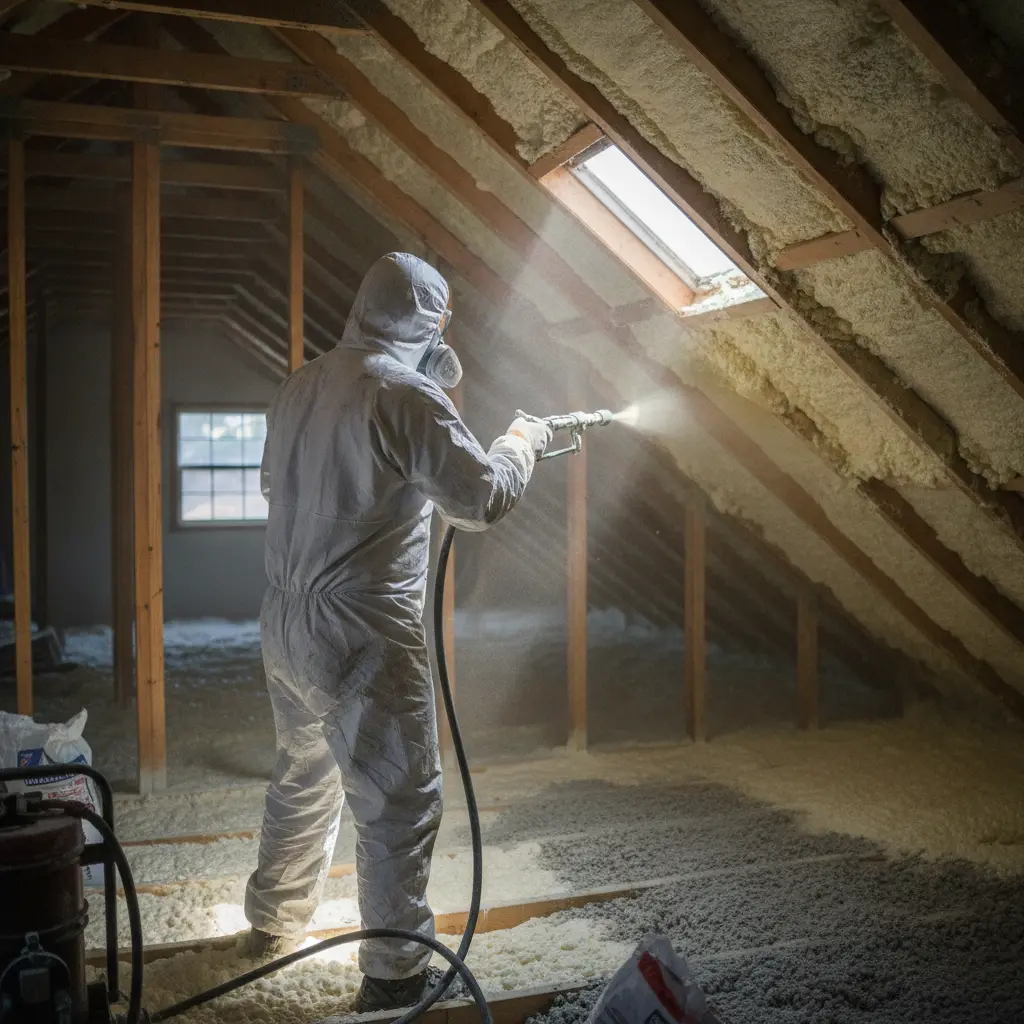
Our team in action — insulation professionals serving Burbank
Why Ceiling Insulation Is Needed in Burbank, CA
The Burbank Heat Island Effect and Valley Climate
Burbank sits at the eastern end of the San Fernando Valley, nestled between the Santa Monica Mountains to the south and the Verdugo Mountains to the northeast. This geography creates a bowl-like effect that traps heat and limits coastal air circulation. During summer, the National Weather Service regularly records temperatures at the Burbank area stations exceeding 105°F — well above the 10°F-or-more premium over coastal Los Angeles communities like Santa Monica or Culver City.
The infamous September 2020 heat event saw temperatures in the San Fernando Valley approach record territory, with Burbank recording temperatures above 108°F for multiple consecutive days. Without adequate ceiling insulation, radiant heat from a sun-baked roof deck transfers directly into living spaces, forcing air conditioning systems to work at maximum capacity. Studies by the Lawrence Berkeley National Laboratory show that an attic can reach 150°F to 160°F on a hot summer day, and a ceiling with only R-11 insulation allows that radiant heat to penetrate interior spaces rapidly.
Santa Ana Wind Events and Winter Heat Loss
While Burbank’s summers are punishing, its winters are marked by the Santa Ana wind events that periodically drive hot, dry air through the region and by genuinely cold nights — temperatures regularly drop into the low 40s°F between December and February. Poor ceiling insulation means that heat generated by furnaces and heat pumps escapes upward through the ceiling plane, raising energy consumption and reducing comfort. The Diablo and Santa Ana wind events of October 2019 and November 2021 highlighted how rapidly indoor temperatures can shift when the building envelope is compromised.
Hollywood Burbank Airport Noise Corridor
Properties located beneath or near the flight approaches to Hollywood Burbank Airport (BUR) — including neighborhoods like Magnolia Park, the Rancho District, and properties along Victory Boulevard — experience consistent aircraft noise. Dense-pack and spray foam ceiling insulation materials provide meaningful sound attenuation, with spray foam delivering an STC (Sound Transmission Class) rating improvement of 30–40 points compared to an uninsulated ceiling assembly. For Burbank homeowners and renters near flight corridors, ceiling insulation serves a dual thermal and acoustic function.
Aging Housing Stock and Degraded Materials
A significant portion of Burbank’s housing stock predates modern energy codes. The California Department of Housing data identifies approximately 60% of Burbank’s residential units as having been built before 1980. Many of these properties contain degraded fiberglass batt insulation that has compressed over decades, losing R-value. Some properties built during the 1940s and 1950s contain vermiculite ceiling insulation, which has been associated with asbestos contamination and requires professional testing and removal before any new insulation can be installed.
Solar Heat Gain and Dark Roofing Materials
Burbank receives an average of 284 sunny days per year — significantly above the national average of 205. Many older Burbank homes feature dark composite shingles that absorb solar radiation aggressively. Without adequate ceiling insulation creating a thermal break, this solar heat gain directly affects interior comfort and energy costs throughout the eight to nine months of warm weather that characterize the Burbank climate.
Signs You Need Ceiling Insulation in Burbank
Temperature and Comfort Indicators
- Upstairs or top-floor rooms that are significantly hotter than the rest of the home during summer months
- Cold ceilings and drafty rooms during winter nights, particularly in homes near the Verdugo foothills
- HVAC system running continuously during peak summer heat without effectively cooling certain rooms
- Noticeable hot spots directly beneath your roofline or attic hatch
Energy Cost Indicators
- Utility bills from Southern California Edison that spike dramatically during June through September
- Monthly cooling costs significantly higher than comparable homes in your neighborhood
- Unexplained increases in energy bills in a home where you haven’t changed usage habits
Physical and Visual Indicators
- Visible compressed, thin, or absent insulation material when inspecting the attic
- Grainy, gray, or blue-gray attic material that may indicate vermiculite (requires professional testing)
- Water stains on ceilings indicating past roof leaks that may have saturated and damaged existing insulation
- Pest evidence — rodent nesting or insect activity — within attic insulation layers
- Musty or stale odors in upper rooms, which can indicate compromised insulation and poor attic ventilation
Urgency Indicators
If your home was built before 1978 and insulation has never been inspected, schedule a professional assessment immediately. Asbestos-containing materials require licensed abatement before any insulation work can proceed.
Ceiling Insulation Methods and Approaches
Blown-In Fiberglass Insulation
Blown-in fiberglass is one of the most widely used ceiling insulation methods in Burbank’s residential market. Fine glass fiber particles are blown into the attic cavity using a high-powered machine, conforming to irregular spaces, around joists, and over existing partial insulation. It achieves R-2.2 to R-2.7 per inch and is non-combustible — an important consideration given Burbank’s proximity to the Verdugo Mountains and its wildfire interface zones. Ideal for homes in the Rancho District and Magnolia Park where attic access is standard. Explore our blow-in insulation options
Blown-In Cellulose Insulation
Made from recycled paper treated with fire retardants, blown-in cellulose achieves R-3.2 to R-3.8 per inch and provides excellent coverage in older, irregularly framed attics common in Burbank’s 1940s and 1950s housing stock. Cellulose also offers superior sound dampening — beneficial for homes near Hollywood Burbank Airport’s flight path.
Spray Foam Insulation
Open-cell and closed-cell spray foam can be applied directly to the underside of the roof deck to create an unvented attic assembly. This approach completely eliminates the attic as a heat-accumulating space and is ideal for Burbank homes with HVAC equipment installed in the attic — moving that equipment into conditioned space dramatically reduces system load and improves efficiency. Closed-cell spray foam achieves R-6.0 to R-7.0 per inch. Learn more about spray foam insulation
Fiberglass Batt Insulation
Pre-cut fiberglass batts are suitable for new construction or attic spaces with uniform, accessible framing. While less flexible than blown-in materials for existing Burbank homes with irregular attic layouts, batts offer a cost-effective solution for specific ceiling sections or new additions.
Insulation Removal and Replacement
Many Burbank homes require complete removal of failed or hazardous ceiling insulation before new materials can be installed. We provide full insulation removal and replacement services using commercial vacuum equipment that captures old material without contaminating the living space below.
Ready for Ceiling Insulation? Get Your Free Estimate Today.
Next Level Insulation of Burbank serves Burbank and the surrounding area — we’ll be on-site within 24 hours.
📞 Call (818) 514-7541Ceiling Insulation Cost in Burbank, CA
Understanding the cost of ceiling insulation in Burbank helps homeowners plan effectively and evaluate quotes accurately. Below are general price ranges based on typical Burbank residential projects.
Typical Cost Ranges
- Blown-in fiberglass or cellulose (attic floor): $1.50–$3.50 per square foot installed, or $1,500–$4,500 for a typical 1,200–1,800 sq ft Burbank home
- Spray foam (roof deck/unvented attic): $3.00–$7.00 per square foot installed, totaling $4,000–$12,000 for full attic coverage depending on depth required
- Fiberglass batt installation: $1.00–$2.50 per square foot installed
- Insulation removal (prior to replacement): $1.00–$2.00 per square foot, or $1,200–$3,500 for a full attic removal
- Hazardous material (vermiculite/asbestos) abatement: $2,000–$10,000+ depending on extent, per licensed California abatement contractor rates
Factors That Affect Ceiling Insulation Cost in Burbank
- Attic access difficulty: Many Burbank homes have low-pitch or hip roofs with limited attic headroom, increasing labor time
- Existing insulation condition: Removal and disposal of old insulation adds cost but is often necessary for proper R-value achievement
- Air sealing requirements: Older Burbank homes typically have more penetrations and air bypasses to seal
- Target R-value: Upgrading to R-49 or R-60 requires more material than the code minimum R-38
- California rebates: Southern California Edison and SoCalGas offer insulation upgrade rebates that can offset $200–$600 or more of project costs
Contact us at (818) 514-7541 for a detailed, written estimate specific to your Burbank property.
Neighborhoods We Serve in Burbank and Surrounding Areas
Magnolia Park, Burbank
One of Burbank’s most charming neighborhoods, Magnolia Park is defined by its 1930s through 1950s Craftsman bungalows and Spanish Revival homes. These properties almost universally have insufficient ceiling insulation by modern standards, with many containing original fiberglass batts from the 1960s that have compressed to effectively R-7 or less. We regularly perform blown-in insulation upgrades over existing materials in this neighborhood.
Rancho District, Burbank
Burbank’s Rancho District features larger single-family homes on generous lots, many built in the 1940s and 1950s during the post-war boom tied to Lockheed and Warner Bros. employment. Flat or low-slope roof sections are common here, requiring specialized insulation approaches to address limited attic depth.
North Hollywood and Valley Village
These adjacent communities feature a high concentration of multi-family apartment buildings constructed in the 1960s and 1970s. Attic insulation upgrades in these properties often require coordination with HOAs and property management companies, a process our team navigates regularly.
Toluca Lake and Studio City
Higher-end residential properties in Toluca Lake and Studio City often have custom or complex roof lines that require spray foam applications at the roof deck rather than standard blown-in attic floor insulation. We serve these communities with the specialized approach their architecture demands.
We also serve Glendale, Pasadena, Hollywood, Beverly Hills, Sherman Oaks, Sun Valley, Universal City, and many additional communities throughout the Los Angeles area. View all of our service areas
Ceiling Insulation Maintenance Tips for Burbank Homeowners
- Inspect your attic annually: Schedule a visual check each spring — before Burbank’s intense summer heat begins — to look for signs of pest activity, moisture damage, or disturbed insulation.
- Check after significant rainfall: Burbank’s rainy season (roughly November through March) can expose roof vulnerabilities. Water-damaged insulation loses R-value and can harbor mold; inspect ceiling stains after heavy rain events.
- Keep attic vents clear: Burbank’s dry summers send leaf debris and dust into soffit vents. Check and clean soffit and ridge vents annually to maintain proper attic ventilation.
- Avoid attic storage that compresses insulation: A common issue in Burbank’s compact ranch homes — placing boxes or items on top of attic insulation compresses it significantly, reducing its effective R-value.
- Address roof repairs promptly: The high UV exposure in Burbank accelerates roofing material aging. A compromised roof allows moisture intrusion that degrades insulation rapidly.
- Test for pests after Santa Ana wind seasons: Rodents displaced by wildfire activity near the Verdugo Mountains sometimes seek attic shelter. Rodent nesting heavily damages blown-in insulation.
- Monitor energy bills seasonally: An unexpected summer spike in your Southern California Edison bill can indicate insulation settling or damage worth investigating.
Why Choose Next Level Insulation of Burbank
At Next Level Insulation of Burbank, we focus exclusively on the insulation needs of properties in Burbank and the surrounding Los Angeles communities. We are not a generalist contractor — insulation is what we do, every day, in buildings we know well because they are in the neighborhoods where we work.
We understand the specific challenges of insulating Burbank properties: the aging housing stock in Magnolia Park and the Rancho District, the noise challenges near Hollywood Burbank Airport, the extreme heat demands of the San Fernando Valley summer, and the California Title 24 energy code requirements that apply to renovation projects.
Our team is trained in the full range of ceiling insulation methods — from blown-in fiberglass and cellulose for standard attic upgrades to spray foam for roof deck applications in homes with attic HVAC systems. We also provide complete insulation removal services, crawl space encapsulation, and attic insulation as a full-service insulation contractor.
We offer free, no-obligation assessments and written estimates for every project. Call us at (818) 514-7541 to speak with a ceiling insulation specialist today.
Frequently Asked Questions: Ceiling Insulation in Burbank, CA
How much does ceiling insulation cost in Burbank?
For a typical Burbank single-family home of 1,200 to 1,800 square feet, blown-in ceiling insulation installation generally costs between $1,500 and $4,500. Spray foam applications at the roof deck level range from $4,000 to $12,000 or more. Factors like attic access difficulty, the need for insulation removal, and the target R-value all affect the final cost. Southern California Edison rebates can offset a portion of the investment. Contact us at (818) 514-7541 for a free written estimate.
What R-value does ceiling insulation need to be in Burbank?
Burbank falls within California Climate Zone 9. California’s Title 24 energy code requires a minimum of R-38 for ceiling insulation in climate zone 9 for new construction and major renovations. For maximum energy efficiency in Burbank’s demanding summer climate, we typically recommend targeting R-49 to R-60, particularly in homes with dark roofing materials or those directly beneath the sun-exposed Verdugo Mountain slopes.
How long does ceiling insulation installation take in Burbank?
For most Burbank single-family homes, a standard blown-in ceiling insulation project can be completed in one day — typically 4 to 8 hours for the installation itself, plus 2 to 4 additional hours for air sealing and preparation. Larger projects, homes requiring insulation removal first, or properties with hazardous materials requiring abatement will take longer, potentially spanning 2 to 5 days total.
My Burbank home was built in the 1950s — do I have asbestos in my ceiling insulation?
Homes built between the 1940s and late 1970s in Burbank may contain vermiculite attic insulation, which has been associated with asbestos contamination, particularly if it originated from the Libby, Montana mine. Before any insulation work is performed in a pre-1980 Burbank home, we recommend professional sampling and laboratory testing. If asbestos is confirmed, licensed abatement is required under California regulations before new insulation can be installed. We can coordinate this process for you.
Does ceiling insulation really help with noise from Hollywood Burbank Airport?
Yes — particularly dense-pack cellulose and spray foam insulation materials provide measurable sound attenuation in addition to thermal performance. Blown-in cellulose can improve the STC (Sound Transmission Class) rating of a ceiling assembly significantly, reducing the penetration of low-frequency aircraft noise. Properties in Magnolia Park, the Rancho District, and along Victory Boulevard that are beneath BUR’s flight approaches see meaningful acoustic improvements with ceiling insulation upgrades.
Can I add insulation on top of my existing ceiling insulation in Burbank?
In most cases, yes — if the existing insulation is dry, free of mold, and not contaminated with hazardous materials, new blown-in insulation can be installed directly over the existing layer to bring the total R-value up to current recommendations. However, if old insulation is compressed, water-damaged, or contains pest contamination, removal and replacement is the better approach. Our free assessment determines which option is appropriate for your specific Burbank home.
Do you offer ceiling insulation services in other cities near Burbank?
Yes. In addition to Burbank, we serve Studio City, Sherman Oaks, North Hollywood, Sun Valley, Toluca Lake, Universal City, Valley Village, Glendale, Pasadena, Hollywood, Beverly Hills, and many additional Los Angeles communities. View our complete service area list
Is ceiling insulation installation messy? Will it affect my daily routine?
Blown-in insulation work is contained to the attic space in most Burbank homes. We seal the attic access hatch and take precautions to prevent dust or material from entering the living space below. Most homeowners can remain in the home during installation. Our crew cleans the work area thoroughly before leaving. For spray foam roof deck applications, slightly more preparation is involved, but the living space impact remains minimal.
Get Your Free Ceiling Insulation Estimate in Burbank Today
If your Burbank home is uncomfortable during the summer heat, your utility bills are higher than they should be, or your ceiling insulation hasn’t been inspected in years, now is the time to act. Next Level Insulation of Burbank is ready to assess your property, provide a transparent written estimate, and deliver a ceiling insulation installation that meets California Climate Zone 9 standards and the specific demands of Burbank’s climate.
Don’t let another sweltering San Fernando Valley summer drain your comfort and your wallet. Call us at (818) 514-7541 to schedule your free, no-obligation ceiling insulation assessment. We serve Burbank and all surrounding communities including Glendale, Pasadena, North Hollywood, Studio City, and beyond.
Contact Next Level Insulation of Burbank online or call (818) 514-7541 now.