

Crawl Space Encapsulation in Burbank, CA
Professional Crawl Space Encapsulation in Burbank, CA in Burbank, CA — Licensed, Insured & Locally Owned
Need crawl space encapsulation in Burbank, CA? Next Level Insulation offers expert sealing, vapor barriers & moisture control. Call (818) 514-7541 for a free estimate.
- Licensed & Insured
- Locally Owned & Operated
- Free Inspection & Estimate
Request Your
Free EstimateCrawl space encapsulation is the process of sealing your home’s crawl space with heavy-duty vapor barriers, rigid foam insulation, and moisture control systems to create a clean, dry, and energy-efficient environment beneath your home. In Burbank, CA — where the semi-arid climate delivers dry Santa Ana wind events alongside seasonal moisture intrusion — an unprotected crawl space can quickly become a source of mold, pest infestations, and skyrocketing energy bills.
At Next Level Insulation of Burbank, we bring over 20 years of hands-on experience delivering high-performance encapsulation solutions tailored specifically to the soil conditions, building stock, and climate patterns found throughout Burbank and the surrounding San Fernando Valley communities. Our team understands the unique challenges that local homes face, and we engineer every encapsulation project to provide long-lasting comfort, improved indoor air quality, and measurable energy savings. Call us today at (818) 514-7541 for your free estimate.
Understanding Crawl Space Encapsulation
A crawl space is the shallow, unfinished area beneath a home that provides access to plumbing, electrical wiring, and HVAC ductwork. Historically, builders in Southern California — including Burbank — constructed homes with “vented” crawl spaces, believing that outside air circulation would naturally carry away moisture. This building practice, common in homes constructed from the 1940s through the 1980s, was later proven to introduce more humidity than it removed, particularly in regions where ground moisture migrates upward through the soil.
Crawl space encapsulation evolved as the modern solution to this design flaw. Rather than venting the space to the outside, encapsulation seals the crawl space completely using a continuous vapor barrier — typically a 20-mil reinforced polyethylene liner — applied across the floor and up the foundation walls. When combined with rigid foam board insulation, spray foam at penetrations, and a dehumidifier or conditioned air supply, the crawl space becomes what building scientists call a “conditioned” or “semi-conditioned” space, meaning its temperature and humidity levels remain stable year-round.
In Burbank specifically, a large proportion of the residential housing stock consists of post-World War II single-family homes and bungalows built between 1945 and 1965. Many of these homes sit on raised foundations with crawl spaces ranging from 18 inches to 36 inches in height. These older structures were built before modern moisture management standards existed and are particularly vulnerable to ground moisture vapor transmission, especially in lower-elevation neighborhoods near the Los Angeles River flood plain. Additionally, Burbank’s aging stock of stucco-clad homes, popular in neighborhoods like Magnolia Park and Rancho District, often shows signs of air infiltration from below that encapsulation directly addresses.
Today, the California Building Energy Efficiency Standards (Title 24) increasingly incentivize sealed crawl space designs, and more Burbank homeowners are turning to encapsulation as a prerequisite to achieving whole-home energy efficiency upgrades.
Why Crawl Space Encapsulation Is Needed in Burbank, CA
Santa Ana Wind Events and Pressure Differentials
Burbank experiences some of the San Fernando Valley’s most intense Santa Ana wind episodes, with recorded gusts exceeding 60 mph during events such as the November 2019 Easy Fire and the January 2022 wind event that caused widespread utility damage across the 91505 and 91506 zip codes. These high-velocity, low-humidity winds create negative pressure differentials that actively draw air — and the moisture, allergens, and radon it carries — up through crawl space vents and into the home’s living space. Encapsulation eliminates these air pathways entirely.
Alluvial Soil and Ground Moisture
Much of Burbank’s residential land sits atop alluvial fan deposits laid down by the Los Angeles River and Tujunga Wash. These sandy loam and silty soils, classified by the USDA as Hanford and Tujunga series, retain subsurface moisture after winter rains and release it as vapor throughout the spring months. Studies of San Fernando Valley soils indicate that ground vapor transmission rates can reach 10–15 pints of moisture per 1,000 square feet per day during peak seasonal periods — enough to raise a crawl space’s relative humidity above 70%, the threshold at which mold colonies begin to establish within 24–48 hours.
Seasonal Temperature Swings
Burbank’s climate is classified as a semi-arid BSk/Csa hybrid, with summer highs regularly exceeding 100°F (the city recorded 113°F during the September 2022 heat event) and winter lows occasionally dropping to 34–38°F. These dramatic seasonal swings cause condensation to form on cold crawl space surfaces during winter mornings, adding liquid moisture on top of vapor migration. Neighborhoods at lower elevations — including Magnolia Park, near Victory Boulevard, and the flats of the Rancho District near Scott Road — are especially susceptible due to their proximity to impervious surfaces and irrigation runoff from surrounding commercial properties.
HVAC Efficiency Loss
Because many Burbank homes route HVAC ductwork through the crawl space, an unencapsulated environment can cause duct insulation to become saturated, reducing R-value by up to 40% and forcing HVAC systems to work significantly harder. Southern California Edison data for Burbank ZIP codes shows that homes with poorly conditioned crawl spaces consume 15–22% more energy for heating and cooling than comparable encapsulated homes. Given Burbank’s average annual electricity cost of approximately $180–$220 per month for a mid-size household, encapsulation offers a substantial return on investment.
Signs You Need Crawl Space Encapsulation
Moisture and Mold Indicators
- Visible standing water or puddles under the home after winter rains
- White efflorescence (mineral deposits) on foundation walls, common in Burbank’s alluvial soil areas
- Musty or earthy odors inside the home, especially in ground-floor rooms
- Visible mold or mildew on floor joists, sub-flooring, or ductwork
Structural and Material Symptoms
- Soft, spongy, or uneven flooring — a sign that subfloor wood is absorbing moisture
- Warping or cupping of hardwood floors on the first floor
- Deteriorating or sagging insulation batts hanging from the crawl space ceiling
- Wood rot on floor joists or sill plates
Energy and Comfort Warning Signs
- Cold floors during Burbank’s winter months despite adequate heating
- Unexplained spikes in your Southern California Edison or SoCal Gas bill
- Inconsistent room temperatures throughout the first floor
Pest and Air Quality Urgency Indicators
- Evidence of rodents, termites, or cockroaches in the crawl space — pests are drawn to humid environments
- Allergy symptoms that worsen indoors, suggesting mold spores or allergens entering from below
- Damaged or compromised existing vapor barrier (torn, displaced, or missing sections)
Our Crawl Space Encapsulation Process
At Next Level Insulation of Burbank, we follow a rigorous, multi-step encapsulation process refined through years of working in San Fernando Valley homes. Each project is adapted to the specific conditions found in your crawl space.
Comprehensive Inspection and Moisture Assessment (1–2 Hours)
Our technicians conduct a thorough crawl space inspection using moisture meters, thermal imaging cameras, and relative humidity gauges. We document existing conditions including mold presence, structural integrity, pest activity, and existing insulation status. For Burbank homes near the Tujunga Wash or in lower-elevation flood plain zones, we pay special attention to hydrostatic pressure indicators.
Debris Removal and Remediation (Half to Full Day)
We remove all existing old insulation, debris, standing water, and any contaminated materials. If mold or pest evidence is detected, we coordinate remediation prior to encapsulation to ensure a clean substrate.
Foundation Wall and Floor Preparation (2–4 Hours)
Concrete piers, foundation walls, and the crawl space floor are cleaned and treated. Any cracks in the foundation — a concern in Burbank given its proximity to the Verdugo Fault zone — are sealed with hydraulic cement or polyurethane foam.
Vapor Barrier Installation (Half to Full Day)
We install a minimum 20-mil reinforced polyethylene vapor barrier across the entire crawl space floor, lapping up foundation walls and securing with mechanical fasteners and waterproof tape at all seams. All penetrations for plumbing, electrical, and HVAC are sealed with spray foam.
Rigid Foam Insulation on Foundation Walls (2–4 Hours)
EPS or XPS rigid foam boards are installed on the interior foundation walls to insulate the conditioned crawl space envelope, achieving R-10 to R-15 depending on wall height — meeting and exceeding California Title 24 requirements.
Vent Sealing and Air Sealing (1–2 Hours)
Existing crawl space vents are permanently sealed with foam board inserts and spray foam, converting the space from a vented to a sealed system per current building science best practices.
Dehumidifier or Conditioned Air Connection and Final Inspection (1–2 Hours)
A crawl space dehumidifier or conditioned air supply is installed to maintain relative humidity below 50%. We conduct a final moisture reading and provide the homeowner with a written report. Total project timeline is typically 1–2 days for most Burbank residential properties.
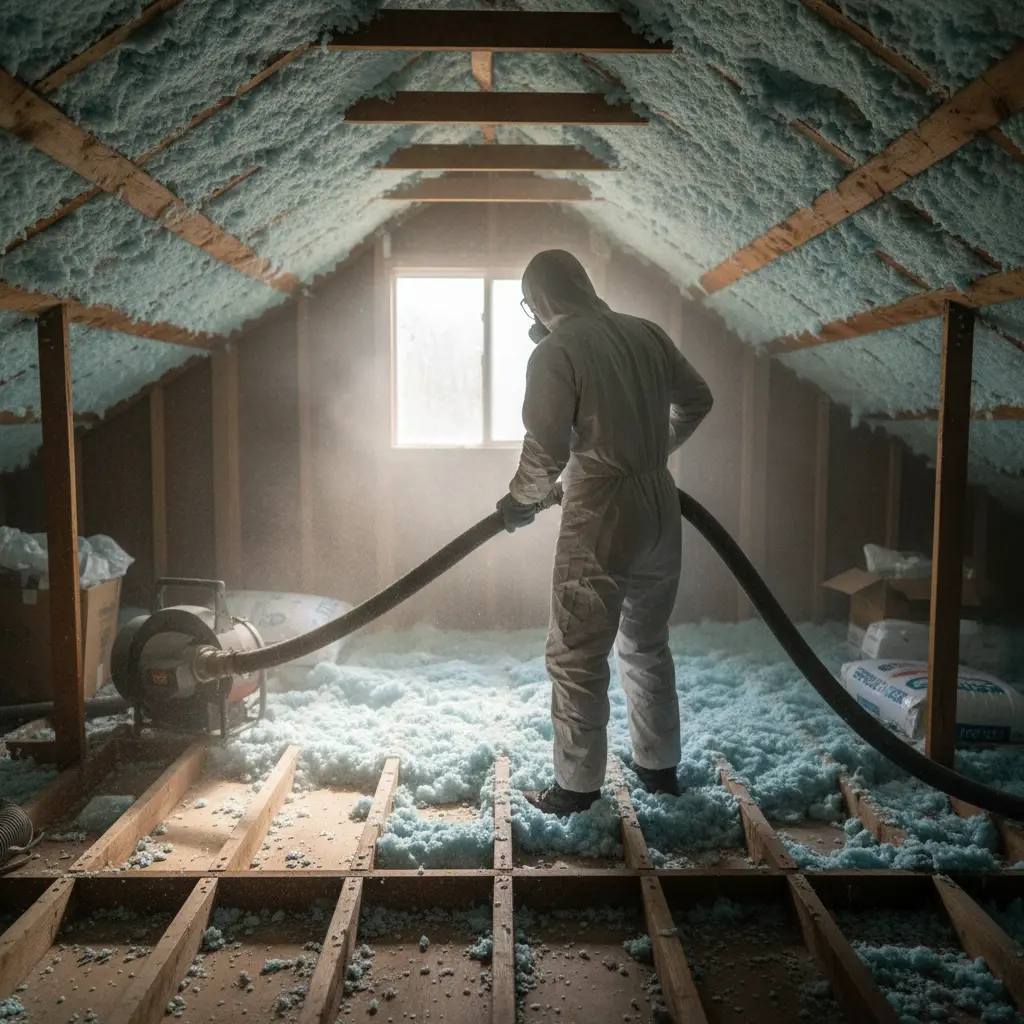
Our team in action — insulation professionals serving Burbank
Crawl Space Encapsulation Methods and Approaches
Full Encapsulation with Dehumidification
The most comprehensive solution, combining a continuous vapor barrier, rigid foam wall insulation, vent sealing, and a dedicated crawl space dehumidifier. Best suited for Burbank homes with active moisture intrusion, especially those in lower-elevation neighborhoods like Magnolia Park or near the Los Angeles River corridor. This method produces the most consistent year-round humidity control and is ideal for homes with HVAC ductwork in the crawl space.
Conditioned Crawl Space (HVAC-Integrated)
Instead of a standalone dehumidifier, a small supply duct from the home’s existing HVAC system is routed into the sealed crawl space. This approach is cost-effective for Burbank homes with modern, high-efficiency HVAC systems and is compliant with California Title 24 Part 6 energy standards when properly sized.
Partial Encapsulation (Vapor Barrier Upgrade)
For homes with moderate moisture levels and good structural integrity, a heavy-duty vapor barrier installation alone — without full wall insulation — can provide significant improvement. This is a common entry-level solution for Burbank bungalows on tight budgets, though it is typically recommended as a first phase of full encapsulation.
Spray Foam Crawl Space Encapsulation
In some Burbank homes with irregular foundation configurations or extremely tight crawl spaces (under 18 inches), closed-cell spray foam is applied directly to the underside of the subfloor and foundation walls, creating an air and vapor barrier in a single application. Learn more about our spray foam insulation services
Ready for Crawl Space Encapsulation? Get Your Free Estimate Today.
Next Level Insulation of Burbank serves Burbank and the surrounding area — we’ll be on-site within 24 hours.
📞 Call (818) 514-7541Crawl Space Encapsulation Cost in Burbank, CA
Understanding the cost of crawl space encapsulation in Burbank helps homeowners plan their investment and evaluate their options. Pricing varies based on crawl space size, existing conditions, and the scope of work required.
Typical Price Ranges
- Basic vapor barrier installation only: $1,500 – $3,500 for a standard 1,000–1,500 sq. ft. Burbank home
- Full encapsulation (vapor barrier + wall insulation + vent sealing): $4,500 – $9,000
- Full encapsulation with dehumidifier: $6,000 – $12,000
- Spray foam crawl space encapsulation: $5,000 – $14,000 depending on coverage area
Factors That Affect Crawl Space Encapsulation Cost in Burbank, CA
- Crawl space height and accessibility: Burbank homes with low-clearance crawl spaces under 24 inches require more labor time
- Pre-existing damage: Mold remediation or joist repair adds $500–$3,000 depending on extent
- Existing insulation removal: Removal and disposal of old fiberglass batts adds $300–$800
- Dehumidifier grade: Commercial-grade units for larger Burbank homes run $800–$1,800 for equipment alone
- Square footage: Larger ranch-style homes common in Burbank’s Rancho District cost proportionally more
Burbank-Specific Pricing Notes
Los Angeles County labor rates are higher than national averages, contributing to Burbank encapsulation costs running approximately 10–15% above the U.S. median. However, Southern California Edison’s Energy Savings Assistance Program and select local rebates may offset a portion of qualifying projects. Contact us at (818) 514-7541 for a detailed, no-obligation estimate.
Neighborhoods We Serve in and Around Burbank
Magnolia Park, Burbank
This historic neighborhood features a high concentration of 1940s–1950s Craftsman bungalows and ranch-style homes, many of which have original vented crawl spaces and deteriorating fiberglass batt insulation. Ground moisture from the Victory Boulevard commercial corridor’s irrigation runoff makes encapsulation particularly urgent here.
Rancho District, Burbank
Larger lot homes in the Rancho District often have expansive crawl spaces exceeding 1,800 sq. ft. Built primarily in the 1950s–1970s, these properties frequently show evidence of alluvial soil moisture migration and are ideal candidates for full encapsulation with dehumidification systems.
North Hollywood and Sun Valley
These neighboring communities share Burbank’s soil profile and post-war housing stock. Sun Valley, in particular, has a history of localized flooding near the Tujunga Wash, making moisture control beneath homes a critical need. View all our service areas
Toluca Lake and Studio City
These affluent neighborhoods feature mid-century modern and custom homes with unique foundation configurations. We tailor our encapsulation approach to the specific architectural requirements of these properties while meeting the stringent HOA and permit requirements common in these communities.
Crawl Space Encapsulation Maintenance Tips for Burbank Homeowners
- Inspect annually after the rainy season (March–April): Burbank’s winter rains, which average 14–18 inches annually, create peak moisture pressure. Schedule a post-rain inspection each spring.
- Monitor your dehumidifier monthly: Check the drainage line for clogs and verify the unit is maintaining humidity below 50% RH.
- Inspect the vapor barrier for tears or displacement: Pest activity — particularly from the roof rats common in Burbank’s older tree-lined neighborhoods — can puncture liners.
- Keep perimeter gutters and downspouts clear: Clogged gutters during Burbank’s December–February rain season direct water toward foundations, overwhelming encapsulation systems.
- Recheck vent seals after major Santa Ana wind events: Extreme pressure differentials can dislodge foam inserts in older foundation vent openings.
- Ensure exterior grading slopes away from the foundation: Positive drainage away from the home reduces the hydrostatic load on your vapor barrier.
- Schedule a professional inspection every 3–5 years: A trained technician can catch early signs of liner degradation, mold recurrence, or dehumidifier failure before they escalate.
Why Choose Next Level Insulation of Burbank
Next Level Insulation of Burbank is the San Fernando Valley’s trusted choice for crawl space encapsulation, backed by over 20 years of experience serving homeowners throughout Burbank, Glendale, Pasadena, and the greater Los Angeles area. We know Burbank’s housing stock intimately — from the original Craftsman bungalows of Magnolia Park to the sprawling ranch homes of the Rancho District — and we customize every encapsulation project to the specific conditions beneath your home.
Our team uses only premium materials, including 20-mil reinforced vapor barriers and commercial-grade dehumidification equipment, ensuring solutions that outlast the competition. We take pride in transparent pricing with no hidden fees, detailed written proposals, and clear communication throughout every project.
Beyond crawl space encapsulation, we offer a full suite of insulation services — including attic insulation, spray foam insulation, and rodent-proof insulation — making us your single-source partner for complete home energy efficiency. Call us today at (818) 514-7541 to schedule your free estimate.
Frequently Asked Questions About Crawl Space Encapsulation in Burbank, CA
How much does crawl space encapsulation cost in Burbank, CA?
In Burbank, full crawl space encapsulation typically costs between $4,500 and $12,000 depending on the size of the crawl space, existing moisture damage, and whether a dehumidifier is included. Basic vapor barrier upgrades start around $1,500–$3,500. Los Angeles County labor costs are slightly above the national average, so Burbank pricing tends to run 10–15% higher than the national median. We provide free, detailed estimates — call (818) 514-7541 to schedule yours.
How long does crawl space encapsulation take in Burbank?
Most standard Burbank single-family homes can be fully encapsulated in 1–2 days. Larger properties, homes requiring mold remediation, or crawl spaces with access challenges may take 3–4 days. We provide a specific timeline during your initial assessment.
Does Burbank require a permit for crawl space encapsulation?
In most cases, vapor barrier installation alone does not require a permit in Burbank. However, sealing foundation vents and adding conditioned air supply to a crawl space may require a building permit under the City of Burbank’s building code. Our team is familiar with local permitting requirements and will advise you on what is needed for your specific project.
Will crawl space encapsulation help with the musty smell in my Burbank home?
Yes. The musty odor common in many older Burbank homes — particularly those in Magnolia Park and the Rancho District — is typically caused by mold and mildew growth in a damp, unencapsulated crawl space. By sealing the space and controlling humidity, encapsulation eliminates the moisture source that feeds mold growth, and indoor air quality typically improves noticeably within weeks.
Is crawl space encapsulation worth it in Southern California’s dry climate?
Absolutely. While Burbank is semi-arid overall, ground moisture vapor from alluvial soils is present year-round, and winter rains add significant moisture loading. Additionally, Santa Ana wind events create air infiltration pathways that an unsealed crawl space cannot prevent. Homeowners in Burbank consistently report 15–22% reductions in heating and cooling costs after encapsulation, making it a high-return investment.
Can crawl space encapsulation help with pest problems?
Yes. Rodents, cockroaches, and termites are attracted to the dark, humid conditions of an unencapsulated crawl space. Sealing the space eliminates the moist habitat and closes off many entry points. We also offer rodent-proof insulation as a complementary service for comprehensive pest exclusion.
What is the difference between a vapor barrier and full encapsulation?
A vapor barrier is a single plastic liner placed on the crawl space floor to block ground moisture. Full encapsulation goes further — it includes the floor liner, insulation on foundation walls, sealed crawl space vents, air-sealed penetrations, and a humidity control system. Full encapsulation creates a truly conditioned space and is the recommended standard for Burbank homes with significant moisture exposure.
Do you serve areas outside of Burbank?
Yes. Next Level Insulation serves the entire greater Los Angeles area, including Studio City, Sherman Oaks, North Hollywood, Sun Valley, Toluca Lake, Universal City, Valley Village, Monterey Park, Hollywood, Beverly Hills, Glendale, Pasadena, Alhambra, Culver City, East Los Angeles, South Pasadena, La Cañada Flintridge, San Gabriel, and West Hollywood. See our full service area list
Get Your Free Crawl Space Encapsulation Estimate in Burbank, CA
Don’t let moisture, mold, and energy loss compromise your Burbank home. Next Level Insulation of Burbank is ready to transform your crawl space into a clean, dry, energy-efficient asset. Whether you’re in Magnolia Park, the Rancho District, or anywhere across the San Fernando Valley, our experienced team will assess your crawl space, provide a transparent written estimate, and deliver a solution built to last in Burbank’s unique climate.
Call us today at (818) 514-7541 to schedule your free, no-obligation crawl space inspection. You can also reach out through our website to request an estimate online. Take your home’s energy efficiency to the next level — with Next Level Insulation of Burbank.