

Spray Foam Insulation in Burbank, CA
Energy-Saving Spray Foam Insulation in Burbank, CA for Burbank, CA Homes — Licensed & Insured
Need spray foam insulation in Burbank, CA? Next Level Insulation offers expert open & closed-cell spray foam solutions. 20+ years experience. Call (818) 514-7541 today!
- Licensed & Insured
- Locally Owned & Operated
- Free Inspection & Estimate
Request Your
Free EstimateSpray foam insulation is a high-performance thermal and air-sealing solution that expands on contact to fill gaps, cracks, and cavities throughout your home or commercial building. Unlike traditional batt insulation, spray foam creates a seamless barrier that dramatically reduces heat transfer and air infiltration — two of the biggest energy challenges facing Burbank property owners.
Burbank’s unique climate sits in the eastern San Fernando Valley, where summer temperatures regularly exceed 100°F and dry Santa Ana winds create extreme thermal stress on building envelopes. These conditions make quality insulation not a luxury but a necessity.
At Next Level Insulation of Burbank, we bring over 20 years of hands-on experience delivering spray foam solutions to homeowners and businesses across Burbank and the greater Los Angeles area. Whether you own a post-war bungalow near Magnolia Park or manage a commercial facility off the Golden State Freeway corridor, our expert team is ready to help. Call us today at (818) 514-7541 for a free estimate.
Understanding Spray Foam Insulation
Spray polyurethane foam (SPF) insulation was first developed for commercial use in the 1940s and gained widespread residential adoption during the energy crises of the 1970s. Today, it is recognized by the U.S. Department of Energy as one of the most effective insulating materials available, capable of achieving R-values between R-3.7 and R-6.5 per inch depending on the formulation used.
Spray foam works through a chemical reaction between two liquid components — isocyanate and polyol resin — which are combined at the spray tip and expand rapidly upon application. Within seconds, the foam expands up to 100 times its original liquid volume, filling every void and hardening into a rigid or semi-flexible insulating layer.
There are two primary types of spray foam:
- Open-Cell Spray Foam: A softer, more flexible foam with an R-value of approximately R-3.5 to R-3.7 per inch. It allows slight moisture vapor transmission and is commonly used in interior walls, floors, and attic spaces where breathability is beneficial.
- Closed-Cell Spray Foam: A denser, more rigid foam with an R-value of R-6.0 to R-6.5 per inch. It acts as both an insulator and a vapor barrier, making it ideal for exterior walls, crawl spaces, and rooflines — especially critical in Burbank’s climate zone.
Burbank falls within California’s Climate Zone 9, as defined by the California Energy Commission (CEC). This zone is characterized by hot, dry summers with modest winter lows, demanding insulation systems that perform across a broad temperature range. Many of Burbank’s residential neighborhoods contain homes built between the 1940s and 1970s — an era when insulation standards were far below today’s Title 24 energy code requirements. These older structures are prime candidates for spray foam retrofits that can dramatically cut cooling and heating costs.
Commercial properties along Burbank’s media corridor — including production studios, office parks, and mixed-use developments near Downtown Burbank — also benefit substantially from spray foam’s dual role as insulation and air barrier, reducing HVAC load and improving acoustic comfort simultaneously.
Why Spray Foam Insulation Is Needed in Burbank, CA
Burbank’s geographic and climatic profile creates a demanding environment for building envelopes. Located in the southeastern corner of the San Fernando Valley, the city is flanked by the Verdugo Mountains to the northeast and the Santa Monica Mountains to the south, creating a natural heat basin effect during summer months. The National Weather Service consistently records summer highs at Bob Hope Airport (BUR) exceeding 100°F during peak heat events, with the all-time record of 108°F set in September 2020 during an unprecedented regional heat wave.
This extreme heat places enormous strain on buildings that lack adequate insulation. The California Energy Commission estimates that poorly insulated homes in Climate Zone 9 lose up to 40% of their conditioned air through the building envelope — primarily through attic spaces, wall cavities, and rim joists. For a typical 1,800-square-foot Burbank home, that translates to hundreds of dollars in wasted energy every single year.
The Santa Ana Wind Factor: Burbank experiences some of the most intense Santa Ana wind events in Los Angeles County. These offshore winds, which can gust to 60–80 mph in the Verdugo foothills neighborhoods like Magnolia Park and the Rancho District, create significant negative pressure differentials across building walls. Homes with air gaps and insufficient insulation experience dramatic infiltration of hot, dry air during these events, overwhelming HVAC systems and spiking energy bills overnight.
Wildfire Smoke and Air Quality: The Station Fire of 2009 — which burned over 160,000 acres in the nearby San Gabriel Mountains — sent smoke and particulates blanketing Burbank for weeks. More recently, the 2019 Saddleridge Fire and the 2020 Bobcat Fire created hazardous air quality conditions that lasted days at a time. Spray foam insulation’s air-sealing properties significantly reduce the infiltration of smoke and particulate matter into living spaces, a benefit with direct public health implications for Burbank residents.
Aging Housing Stock: Over 60% of Burbank’s residential buildings were constructed before 1980, according to city planning records. Neighborhoods like Chandler Estates, Hillside, and the Morningside Park area contain dense concentrations of post-war single-family homes built with minimal wall insulation — often just 2×4 framing with no insulation or degraded fiberglass batts. These homes operate with leaky envelopes that dramatically reduce comfort and increase energy costs.
Title 24 Compliance Pressure: California’s Title 24 Building Energy Efficiency Standards have become increasingly stringent with each update cycle. The 2022 Title 24 standards require higher R-value performance than previous versions, making spray foam one of the few practical retrofit solutions for achieving compliance in existing older structures where wall cavity depth is limited.
Media Industry Buildings: Burbank’s identity as the “Media Capital of the World” means a high concentration of sound stages, production offices, and broadcast facilities along the Olive Avenue and Alameda Avenue corridors. These specialized buildings require not just thermal insulation but also superior acoustic dampening — a dual function spray foam delivers effectively.
Signs You Need Spray Foam Insulation
Energy and Comfort Warning Signs
- Monthly electricity bills exceeding $250–$350 during Burbank summers despite standard HVAC use
- Rooms that remain 5–10°F warmer or cooler than the thermostat setting, especially second-floor bedrooms
- HVAC system running continuously for hours without reaching the set temperature on days above 95°F
- Drafts felt near electrical outlets, baseboards, or window frames during Santa Ana wind events
Physical and Structural Signs
- Visible gaps, cracks, or compressed fiberglass batts in the attic floor or along rooflines
- Moisture staining or condensation on interior walls or ceiling surfaces during winter months
- Rodent or pest entry through wall gaps — a common issue in older Burbank bungalows near Magnolia Park
- Ice damming or unusual roofline temperature variations visible from the exterior
Urgency Indicators
- Home was built before 1980 and insulation has never been upgraded
- Recent smoke or wildfire events resulted in noticeable indoor air quality issues
- Preparing for a property sale requiring Title 24 compliance documentation
- HVAC system replacement is planned — upgrading insulation first maximizes new equipment efficiency
Our Spray Foam Insulation Process
At Next Level Insulation of Burbank, we follow a structured, professional installation process designed specifically for the building types and climate conditions found throughout Burbank and the San Fernando Valley.
Free On-Site Assessment (Day 1 — 60 to 90 Minutes)
Our certified technician visits your property to conduct a thorough thermal inspection, including a visual review of attic spaces, wall assemblies, crawl spaces, and rim joists. We identify existing insulation conditions, air leakage points, and moisture concerns specific to your home’s construction era and neighborhood. Homes in the Rancho District and Hillside area often present unique roofline configurations requiring custom approach planning.
Detailed Written Estimate and Product Selection (Day 1–2)
Following the assessment, we prepare a written estimate with line-item pricing, recommended foam type (open-cell vs. closed-cell), and projected R-value outcomes. We review California Title 24 requirements relevant to your project and identify any available utility rebates through Southern California Edison or SoCalGas that may apply.
Site Preparation (Installation Day — 1 to 2 Hours)
We protect all surfaces, fixtures, and HVAC components from overspray using professional-grade masking and sheeting. Ventilation is established per California OSHA requirements and AIHA guidelines. Occupants and pets are asked to vacate the premises for a minimum of 24 hours post-application.
Spray Foam Application (Installation Day — 2 to 6 Hours)
Our trained applicators use professional-grade spray foam rigs calibrated for Burbank’s ambient temperatures. During summer months, early-morning application is often scheduled to work within the 60–90°F substrate temperature sweet spot required for optimal foam adhesion and expansion. Application is completed in measured lifts to prevent heat buildup in thick sections.
Curing and Inspection (24–48 Hours Post-Application)
Foam is allowed to fully cure. Our team returns to trim any excess material, verify R-value depth using a calibrated probe, and conduct a final visual inspection. In attic spaces, we confirm proper ventilation pathways are maintained per California Building Code requirements.
Final Walkthrough and Documentation (Day 2–3)
We walk the completed project with the property owner, provide documentation of installed R-values and product specifications, and supply all records needed for Title 24 compliance reporting or utility rebate applications.
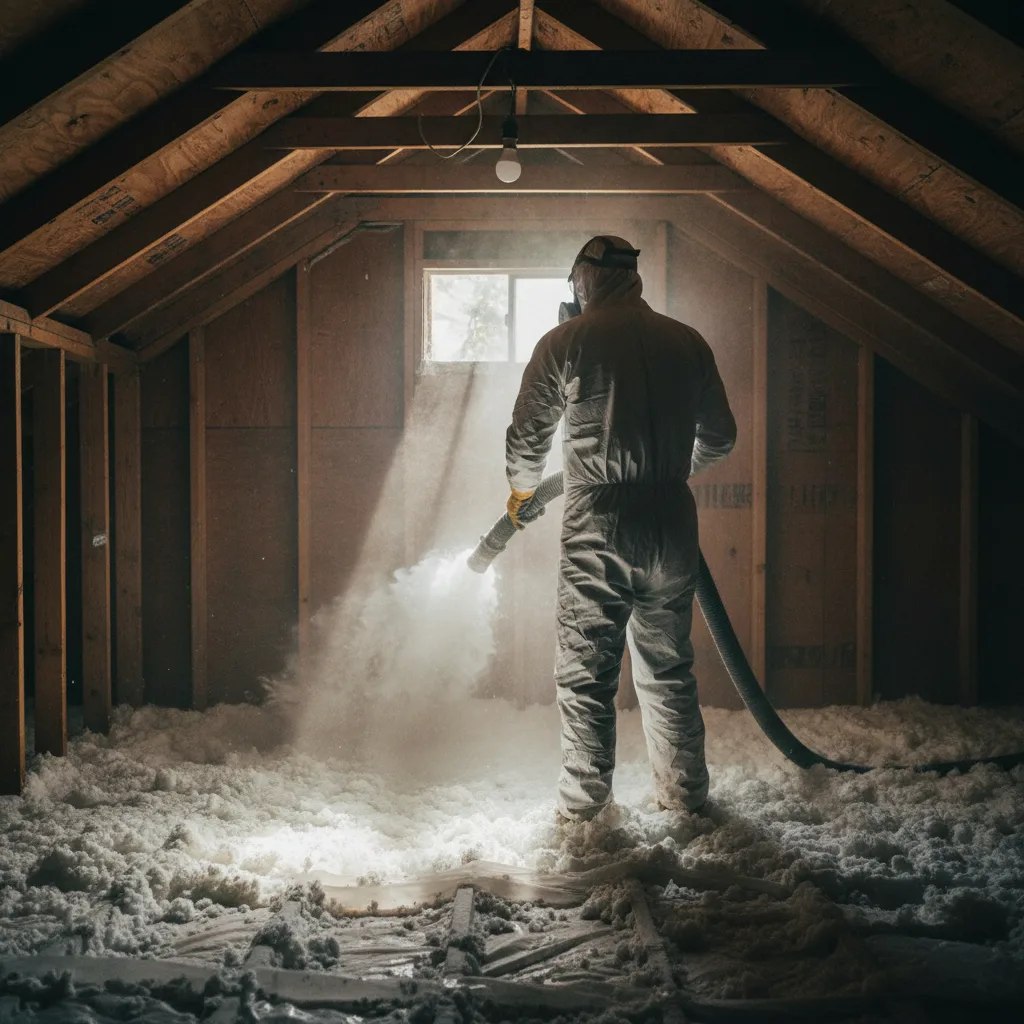
Our team in action — insulation professionals serving Burbank
Spray Foam Methods and Approaches
Closed-Cell Spray Foam for Exterior Walls and Rooflines
Closed-cell SPF at 2 inches achieves approximately R-13, and at 3.5 inches reaches R-21 — meeting or exceeding California Title 24 requirements for Climate Zone 9 wall assemblies. This method is the go-to solution for Burbank homes being retrofitted from the exterior during renovation or re-roofing projects. Its rigidity also adds measurable structural bracing value, a practical benefit given Southern California seismic activity.
Open-Cell Spray Foam for Attic Roof Decks
Applying open-cell foam to the underside of the roof deck — rather than the attic floor — creates an unvented conditioned attic. This approach moves HVAC equipment and ductwork inside the thermal envelope, often reducing duct leakage losses by 20–30% in older Burbank homes where ductwork runs through attic spaces exposed to 140–160°F summer temperatures.
Two-Component Injection Foam for Closed Wall Cavities
For finished walls in Chandler Estates bungalows or Morningside Park ranch homes where opening walls is impractical, we use injection foam systems that fill wall cavities through small drill holes without requiring major demolition. This minimally invasive approach is ideal for preserving the character of Burbank’s historic residential neighborhoods.
Crawl Space and Rim Joist Application
Burbank homes with raised foundations — common in pre-1960 construction throughout the Magnolia Park and Riverside Drive neighborhoods — benefit significantly from closed-cell foam applied to rim joists and crawl space walls. This eliminates a major cold-air infiltration pathway that contributes to cold floors and higher heating costs.
Commercial and Industrial SPF Roofing Systems
For Burbank’s production facilities and warehouse buildings, we offer seamless SPF roofing systems applied directly to flat or low-slope roof decks. These systems provide both insulation and waterproofing in a single application, reducing roof surface temperatures by up to 50°F compared to uncoated surfaces.
Ready for Spray Foam Insulation? Get Your Free Estimate Today.
Next Level Insulation of Burbank serves Burbank and the surrounding area — we’ll be on-site within 24 hours.
📞 Call (818) 514-7541Spray Foam Insulation Cost in Burbank, CA
Understanding the cost of spray foam insulation in Burbank helps property owners budget accurately and evaluate the return on investment. Costs vary based on foam type, application area, thickness required, and site-specific conditions.
Typical Price Ranges
- Open-Cell Spray Foam: $1.00–$1.50 per board foot (1 square foot at 1 inch thick). A 1,500-square-foot attic roof deck application at 5.5 inches typically ranges from $3,500–$5,500.
- Closed-Cell Spray Foam: $1.75–$3.00 per board foot. Exterior wall application for an average 1,800-square-foot Burbank home typically ranges from $6,500–$12,000 depending on wall area and access conditions.
- Rim Joist and Crawl Space Applications: $1,500–$4,000 for a typical Burbank raised-foundation home, depending on crawl space dimensions and accessibility.
- Commercial Projects: Large-scale projects are quoted per square foot; typical commercial SPF roofing systems range from $4.00–$7.00 per square foot installed.
Burbank-Specific Cost Factors
Labor costs in Burbank and Los Angeles County run approximately 15–25% higher than the national average, reflecting regional wage scales and contractor overhead. However, Southern California Edison’s Energy Efficiency rebate programs and SoCalGas’s Home Energy Efficiency rebates can offset project costs by $200–$1,500 depending on scope and qualifying criteria. Many Burbank homeowners also benefit from federal tax credits under the Inflation Reduction Act, which provides a 30% credit on qualifying insulation improvements through 2032.
Call (818) 514-7541 for a free, no-obligation on-site estimate tailored to your specific property and goals. Request Your Free Estimate Today
Neighborhoods We Serve in and Around Burbank
Magnolia Park, Burbank
One of Burbank’s most charming historic districts, Magnolia Park features dense concentrations of 1920s–1950s craftsman bungalows and Spanish Colonial Revival homes. These structures almost universally lack adequate wall insulation and suffer from significant air leakage through aged plaster walls. Injection foam and open-cell attic applications are the most common solutions we deliver here.
Rancho District, Burbank
The Rancho District contains a mix of post-war ranch homes and newer construction along the foothills of the Verdugo Mountains. Hillside exposure makes these homes particularly vulnerable to Santa Ana wind-driven infiltration. Closed-cell foam for wind-facing wall assemblies and unvented attic systems are frequently specified for this neighborhood.
North Hollywood and Sun Valley
Industrial and mixed-use neighborhoods in North Hollywood and Sun Valley include significant numbers of commercial warehouses and production support facilities. We regularly perform SPF roofing and wall insulation for these building types, addressing both thermal performance and condensation control in high-bay spaces.
Studio City and Toluca Lake
These affluent communities just west of Burbank feature higher-value homes where occupant comfort expectations are premium. Custom closed-cell wall assemblies and conditioned attic systems are frequently requested, and projects often include acoustic spray foam applications for home theaters and media rooms — a natural fit given the neighborhood’s ties to the entertainment industry.
Glendale and Pasadena
We extend our spray foam services into neighboring Glendale and Pasadena, where Craftsman-era bungalows and early 20th-century construction present insulation challenges nearly identical to those found in Burbank’s older neighborhoods. View All Service Areas
Spray Foam Insulation Maintenance Tips for Burbank Homeowners
- Annual Attic Inspection: Inspect attic spaces each fall before Burbank’s rainy season (typically November–March) for any foam cracking, separation at framing joints, or signs of pest intrusion along foam edges.
- UV Protection for Exposed Foam: Open-cell foam exposed to sunlight — such as in uncovered crawl spaces or garages — degrades over time. Apply a protective coating if foam remains exposed more than 90 days after installation, as required by most foam manufacturer warranties.
- HVAC Filter Maintenance: Spray foam’s superior air sealing reduces particulate infiltration, but regularly replacing HVAC filters every 60–90 days remains important — especially during Burbank’s wildfire smoke season (August–November).
- Plumbing Penetration Checks: Inspect areas where plumbing and electrical penetrations pass through foamed walls or floors annually, as these are common points of future air gap development due to thermal expansion cycles.
- Roof and Flashing Integrity: In homes with SPF applied to the roof deck underside, ensure roofing materials and flashing above remain watertight. Water intrusion above foamed roof decks can be difficult to detect without periodic inspection.
- Post-Earthquake Inspection: Following any seismic event of Magnitude 4.0 or greater felt in Burbank, perform a visual check of foamed wall and ceiling assemblies for cracking or separation at structural joints.
- Document Your Insulation: Keep records of installed foam type, R-value, and installation date for Title 24 compliance, insurance purposes, and future property sale disclosures.
Why Choose Next Level Insulation of Burbank
Next Level Insulation of Burbank has been a trusted name in thermal performance solutions for homeowners and businesses throughout the San Fernando Valley and greater Los Angeles area for over 20 years. Our deep familiarity with Burbank’s specific building stock — from Magnolia Park craftsman bungalows to Olive Avenue production facilities — means we bring context and expertise that generalist contractors simply cannot match.
We specialize exclusively in insulation services, including spray foam, attic insulation, fiberglass, sound insulation, and rodent-proof insulation systems. This specialization means our technicians are not generalist handymen — they are dedicated insulation professionals who install spray foam systems day in, day out.
Our team stays current with California Title 24 energy code requirements, Southern California Edison and SoCalGas rebate programs, and the latest spray foam product certifications. We help our clients navigate available incentives to reduce out-of-pocket costs wherever possible.
We serve Burbank and all surrounding communities including Studio City, Sherman Oaks, North Hollywood, Sun Valley, Toluca Lake, Universal City, Valley Village, Glendale, Pasadena, Beverly Hills, Hollywood, and beyond. Learn More About Our Team
Call us today at (818) 514-7541 to schedule your free estimate.
Frequently Asked Questions About Spray Foam Insulation in Burbank, CA
How much does spray foam insulation cost in Burbank, CA?
Spray foam insulation in Burbank typically costs between $1.00–$1.50 per board foot for open-cell foam and $1.75–$3.00 per board foot for closed-cell foam. A full attic application for an average Burbank home ranges from $3,500–$8,500 depending on attic size, foam type, and accessibility. Los Angeles County labor rates add approximately 15–25% compared to national averages. Contact us at (818) 514-7541 for a free on-site estimate with detailed pricing for your specific property.
Is spray foam insulation worth it for older Burbank homes?
Absolutely. Over 60% of Burbank’s housing stock was built before modern insulation standards existed. Upgrading to spray foam in an older home in neighborhoods like Magnolia Park or Chandler Estates can reduce annual energy costs by 20–40%, with many homeowners recovering their investment within 4–7 years through energy savings alone. The improved comfort during Burbank’s 100°F+ summer heat events is an additional benefit that is difficult to quantify financially but is highly valued by residents.
How long does spray foam insulation installation take?
Most residential spray foam projects in Burbank are completed in a single day. A standard attic application takes 2–4 hours of active spray time. Larger projects involving multiple zones — such as attic, walls, and crawl space simultaneously — may require two days. Occupants need to vacate the property for a minimum of 24 hours following application to allow complete off-gassing per California indoor air quality guidelines.
Does spray foam insulation help with wildfire smoke in Burbank?
Yes. Spray foam’s primary benefit is air sealing, which directly reduces the infiltration of outdoor air — including smoke, ash, and particulates from wildfire events like the 2020 Bobcat Fire and 2019 Saddleridge Fire that impacted air quality across Burbank for extended periods. Properly sealed homes with spray foam insulation see measurable improvements in indoor air quality during smoke events compared to homes with conventional batt insulation.
What is the difference between open-cell and closed-cell spray foam for Burbank conditions?
For Burbank’s hot, dry climate, closed-cell foam is generally preferred for exterior walls, roof decks, and crawl spaces because its higher R-value per inch (R-6.0–6.5) and vapor barrier properties perform best in Climate Zone 9. Open-cell foam is appropriate for interior applications such as interior walls, floors, and attic roof decks where some vapor permeability is acceptable. Our technicians will recommend the correct foam type during your free assessment based on your building’s specific construction and performance goals.
Can spray foam insulation be installed in finished walls without demolition?
Yes. We use two-component injection foam systems that are injected through small drill holes (typically 5/8-inch diameter) placed in mortar joints or inconspicuous locations. This allows full wall cavity filling with minimal disruption to finished surfaces — ideal for Burbank’s historic craftsman and ranch homes where wall demolition is not practical or desirable.
Does spray foam insulation qualify for California energy rebates?
Many spray foam projects qualify for rebates through Southern California Edison’s Energy Efficiency Program and SoCalGas’s Energy Efficiency rebate offerings, which can provide $200–$1,500 in incentives depending on project scope. Additionally, qualifying insulation improvements are eligible for a 30% federal tax credit under the Inflation Reduction Act through 2032, with a maximum annual credit of $1,200. We help our Burbank clients identify and document all available incentives during the estimate process.
How long does spray foam insulation last?
High-quality spray foam insulation, when properly installed, has an effective service life of 80+ years with minimal degradation. Unlike fiberglass batts, which can sag, settle, and lose R-value over time — particularly in Burbank attics exposed to extreme summer heat — spray foam maintains its structure and thermal performance indefinitely when protected from UV exposure and physical damage.
Get Your Free Spray Foam Insulation Estimate in Burbank Today
Don’t let another brutal Burbank summer or a devastating Santa Ana wind event expose your home’s energy vulnerabilities. Next Level Insulation of Burbank is ready to deliver a professional spray foam insulation solution that improves comfort, cuts energy costs, and protects your home year-round.
With over 20 years of experience serving Burbank and communities throughout the San Fernando Valley and greater Los Angeles area, we bring the local expertise your project demands.
Call us now at (818) 514-7541 to schedule your free, no-obligation on-site assessment. Our team typically offers same-week appointments for Burbank-area properties.
Schedule Your Free Estimate Online
Serving Burbank, Studio City, Sherman Oaks, North Hollywood, Sun Valley, Toluca Lake, Glendale, Pasadena, Beverly Hills, Hollywood, and all surrounding communities.