

Floor Insulation in Burbank, CA
Energy-Saving Floor Insulation for Burbank, CA Homes — Licensed & Insured
Need floor insulation in Burbank, CA? Next Level Insulation of Burbank installs R-19 to R-30 floor insulation for crawl spaces & more. Call (818) 514-7541 today.
- Licensed & Insured
- Locally Owned & Operated
- Free Inspection & Estimate
Request Your
Free EstimateFloor insulation is the installation of thermal and acoustic barrier materials beneath the flooring surface or within the subfloor cavity to regulate indoor temperatures, reduce energy loss, and minimize sound transmission between levels. In Burbank, CA — a city nestled in the southeastern end of the San Fernando Valley — the combination of intense summer heat, cool winter nights, and a significant proportion of older raised-foundation homes makes floor insulation a critical component of any complete home energy system.
At Next Level Insulation of Burbank, we specialize in diagnosing and resolving floor insulation deficiencies unique to Burbank’s building stock and Mediterranean climate. Whether your home sits on a crawl space beneath the Verdugo Mountains foothills or your mid-century bungalow near Magnolia Park has never had proper underfloor treatment, our team brings local expertise to every job. Call us today at (818) 514-7541 to schedule your assessment.
Understanding Floor Insulation
Floor insulation encompasses any material or system placed beneath a finished floor or within the structural floor cavity to impede heat transfer between conditioned living space and unconditioned areas below — typically a crawl space, unheated basement, or open air. The science behind it is straightforward: heat naturally moves from warm areas to cooler ones, and in winter, floors act as one of the largest thermal bridges in an older home. In summer, radiant heat from hot ground surfaces can work its way upward, raising indoor floor temperatures and forcing air conditioning systems to work harder.
Historically, floor insulation was largely ignored in California residential construction until energy codes began tightening in the 1970s following the oil embargo. Homes built in Burbank before 1978 — which represents a substantial portion of the city’s housing stock, particularly in neighborhoods like Magnolia Park, Rancho, and the Hillside District — were typically constructed with little or no underfloor insulation. Even homes built through the 1990s often relied on minimal batt insulation that has since degraded, sagged, or been colonized by pests.
Modern floor insulation strategies go well beyond simply stuffing fiberglass batts between floor joists. Today’s approaches include rigid foam board installation, spray polyurethane foam (both open-cell and closed-cell), blown-in loose-fill insulation, and comprehensive crawl space encapsulation systems that treat the entire under-floor environment as a controlled zone. Each method serves different structural configurations, moisture conditions, and performance goals.
In Burbank specifically, raised-foundation construction — common in homes built between the 1920s and 1960s — means a large percentage of residential properties have accessible crawl spaces beneath their living floors. This architectural characteristic creates both a vulnerability and an opportunity: without proper insulation and moisture management, these crawl spaces become conduits for energy loss, pest infiltration, and humidity-driven wood degradation. With the right insulation approach, that same crawl space can become an asset that dramatically improves home comfort and efficiency.
Understanding which type of floor insulation is appropriate requires evaluating floor joist depth, existing moisture levels, pest history, and local climate data — all factors our Burbank team assesses during every inspection. Learn more about our crawl space insulation services
Why Floor Insulation Is Needed in Burbank, CA
Extreme Temperature Swings in the San Fernando Valley
Burbank sits at an elevation of approximately 580 feet in the southeastern San Fernando Valley, where the surrounding mountains create a basin effect that amplifies temperature extremes. Summer daytime highs routinely reach 95–105°F, particularly during the late-July through September heat season. The September 2020 heat wave pushed Burbank temperatures to 111°F, among the highest ever recorded in the city. Meanwhile, winter nights regularly drop to the low 40s and occasionally into the upper 30s. This 60–70°F daily and seasonal temperature range places enormous stress on building envelopes — and floors without insulation become the path of least resistance for thermal energy to escape or enter.
Crawl Space Moisture From Valley Groundwater Patterns
The Verdugo aquifer system and the Burbank Operable Unit — a designated groundwater contamination zone that has been subject to EPA oversight since the 1990s — underscores how active Burbank’s subsurface moisture environment is. Seasonal groundwater fluctuations, particularly following winters with above-average rainfall (such as the 2022–2023 season that delivered over 150% of normal precipitation to the region), drive moisture vapor up through soil and into crawl spaces. Uninsulated or poorly insulated floors over these crawl spaces absorb that moisture, leading to wood rot in floor joists, mold growth on subfloor sheathing, and degradation of any existing batt insulation. Neighborhoods like Rancho adjacent to the Los Angeles River corridor and properties near Wildwood Canyon tend to experience the highest crawl space humidity readings.
Aging Housing Stock With No Thermal Envelope Below the Floor
Approximately 60% of Burbank’s single-family homes were built before 1970, according to city planning data. Title 24 energy compliance requirements for underfloor insulation did not become enforceable until later code cycles. This means tens of thousands of homes in areas like Magnolia Park (predominantly 1940s–1950s construction), the Hillside District along Kenneth Road (1950s–1960s), and the Chandler Boulevard corridor are operating with subfloor thermal performance values of R-0 to R-11 — far below the current California Energy Commission minimum of R-19 for floors over unconditioned crawl spaces in Climate Zone 9, which encompasses Burbank.
Pest Activity Degrading Existing Insulation
Burbank’s warm climate and proximity to natural habitat areas including the Verdugo Mountains sustains active populations of rodents, in particular Norway rats and roof rats, which regularly nest within underfloor insulation batts. The City of Burbank’s vector control division reports elevated rodent activity each fall as temperatures cool. Rodent nesting compresses and contaminates fiberglass insulation, reducing its effective R-value by 30–60% and introducing biological hazards that require full insulation removal and replacement before new materials can perform correctly. Learn about our insulation removal services
Studio and Production Facility Neighbors
Burbank is home to major entertainment campuses including Warner Bros. Studios on Olive Avenue and Walt Disney Studios on Buena Vista Street. Residential neighborhoods surrounding these facilities, particularly in the Rancho area and near the Burbank Airport corridor, experience elevated ambient noise levels. Floor insulation with appropriate acoustic properties helps residents in these zones maintain interior sound comfort — a concern not often addressed by standard insulation contractors unfamiliar with Burbank’s unique urban acoustic environment.
Signs You Need Floor Insulation in Burbank
Thermal Comfort Indicators
- Floors feel noticeably cold in winter mornings even when the thermostat reads 68°F or higher
- Significant room-to-room temperature variation, particularly between ground-floor rooms and those directly above a crawl space
- Your HVAC system runs longer cycles during summer heat waves above 100°F without achieving target temperature
- Barefoot floor temperature feels uncomfortable regardless of indoor thermostat setting
Energy and Utility Bill Signals
- Monthly Southern California Edison or SoCalGas bills consistently higher than comparable homes on your block
- Heating and cooling costs increased significantly without changes in usage habits
- Your home failed a utility energy audit or home performance assessment
Structural and Moisture Warning Signs
- Musty or earthy odors emanating from floors or floor vents — a common indicator of crawl space moisture accumulation
- Visible sagging or dark staining on subfloor sheathing observed during crawl space inspection
- Evidence of pest activity including rodent droppings, nesting material, or insulation displacement
- Soft spots or springiness in floor areas that may indicate joist moisture damage
Urgency Indicators
If you observe active water pooling in your crawl space following winter rains, detect mold odor below flooring, or find evidence of active rodent nesting in existing insulation, these conditions require immediate professional assessment. Delayed action accelerates structural wood degradation and indoor air quality decline. Call (818) 514-7541 now for priority scheduling.
Our Floor Insulation Process in Burbank
Initial Consultation and Site Assessment (Day 1 — 1–2 Hours)
We begin with a comprehensive on-site evaluation of your Burbank home’s existing floor system. Our technician inspects accessible crawl space areas, measures existing insulation R-values using calibrated equipment, checks for moisture with a pin-type moisture meter, and photographs all conditions. We note crawl space height (critical in many older Burbank homes where clearance can be as low as 18 inches), existing vapor barrier status, and any evidence of pest activity or moisture damage.
Moisture Testing and Crawl Space Analysis (Day 1 — Included in Assessment)
Because Burbank’s seasonal moisture patterns present real risk to underfloor systems, we conduct relative humidity readings at multiple crawl space locations, assess soil moisture, and evaluate existing foundation venting. This data directly informs our material and method recommendations and determines whether crawl space encapsulation should be performed prior to insulation installation.
Proposal and Material Selection (Days 2–3)
We provide a detailed written proposal specifying materials, target R-values meeting or exceeding California Title 24 Zone 9 requirements (minimum R-19), installation method, timeline, and cost breakdown. We explain trade-offs between methods in plain language so Burbank homeowners can make informed decisions.
Insulation Removal (If Required — Day 1 of Installation)
Where existing insulation is pest-contaminated, moisture-damaged, or degraded below functional R-value, our team performs complete removal using HEPA-equipped vacuum systems and negative air pressure containment. All removed material is bagged and disposed of in compliance with Los Angeles County waste regulations. Learn more about insulation removal
Surface Preparation and Vapor Control (Day 1 of Installation)
We install or repair vapor barriers on crawl space soil floors using minimum 6-mil poly sheeting, sealed at seams and to foundation walls with approved tape. In homes with high moisture readings, we recommend upgrading to 12-mil or reinforced encapsulation liners.
Floor Insulation Installation (Days 1–2)
Insulation material is installed to specified depth and coverage, ensuring full contact with subfloor surfaces and no voids at joist edges. Wire supports or staple systems are used to secure batt insulation. Spray foam applications are conducted by certified technicians. Work is inspected for coverage consistency before close-out.
Final Inspection and Documentation (Day 2 — 1 Hour)
We conduct a post-installation walkthrough, provide photographic documentation of all installed work, and deliver a summary report suitable for homeowner records, real estate disclosure, or utility rebate applications with Los Angeles Department of Water and Power or SoCal Gas.
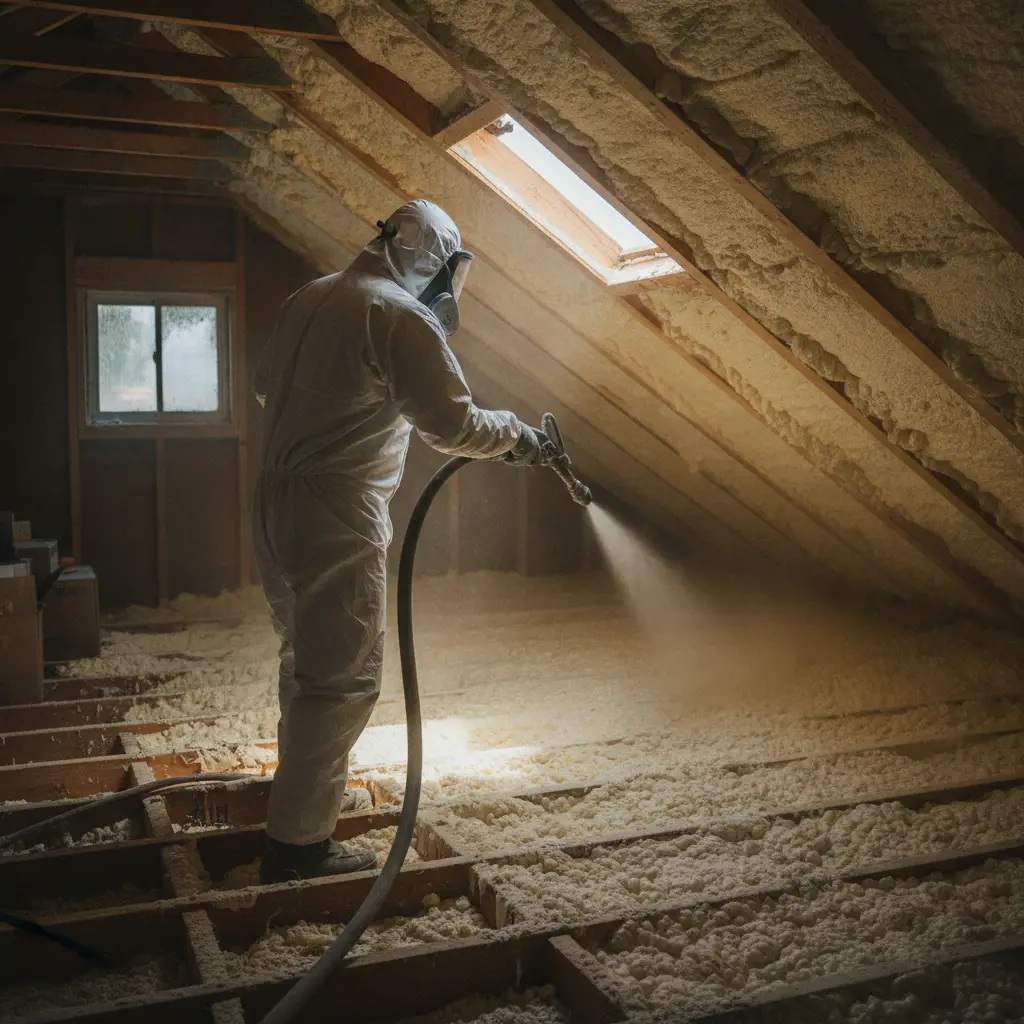
Our team in action — insulation professionals serving Burbank
Floor Insulation Methods We Use in Burbank
Fiberglass Batt Insulation
Pre-cut fiberglass batts sized to standard 16-inch or 24-inch joist spacing are the most common method for floor insulation in Burbank’s raised-foundation homes. Available in R-19, R-25, and R-30 values, batts are installed friction-fit between floor joists and secured with wire rods or mesh supports to prevent sagging. Best suited for dry crawl spaces with adequate clearance (18 inches or more). Most cost-effective option for straightforward installations in homes throughout Magnolia Park and the Rancho neighborhood.
Spray Foam Insulation
Closed-cell spray polyurethane foam applied directly to the underside of the subfloor creates an air-impermeable thermal and moisture barrier in a single application. Achieves R-6 to R-7 per inch, allowing high R-values in shallow joist bays. Particularly valuable in Burbank homes with non-standard joist spacing, irregular framing from post-earthquake retrofits, or where pest exclusion at penetrations is a priority. Open-cell spray foam is used where acoustic performance is the primary goal. Explore our spray foam insulation services
Blown-In (Loose-Fill) Insulation
Cellulose or fiberglass loose-fill blown into enclosed floor cavities or over existing materials to fill voids and boost R-value. Ideal for floor systems with enclosed cavities inaccessible from below, or as a supplemental layer over degraded existing batts. Provides excellent coverage around pipes, wires, and irregular framing common in Burbank’s older Craftsman and Spanish Revival homes. Learn about blow-in insulation
Crawl Space Encapsulation With Continuous Insulation
For Burbank homes with chronic moisture issues, full crawl space encapsulation — including soil vapor barrier, wall insulation, and conditioned air management — converts the crawl space into a semi-conditioned zone. When combined with rigid foam board on foundation walls, this approach often outperforms traditional floor-level insulation alone in energy performance and moisture control. Discover crawl space encapsulation options
Rigid Foam Board
EPS or polyisocyanurate rigid panels cut to fit between joists or applied as a continuous layer provide high R-values with minimal thickness and excellent moisture resistance. Used in low-clearance crawl spaces or as thermal breaks at foundation sill plates common in Burbank’s post-Northridge retrofit construction.
Ready for Floor Insulation? Get Your Free Estimate Today.
Next Level Insulation of Burbank serves Burbank and the surrounding area — we’ll be on-site within 24 hours.
📞 Call (818) 514-7541Floor Insulation Cost in Burbank, CA
Understanding floor insulation costs in Burbank requires accounting for the specific variables that affect local pricing, including crawl space accessibility, existing insulation condition, chosen material, and total square footage.
Typical Price Ranges
- Fiberglass Batt Installation (R-19 to R-30): $1.50–$3.00 per square foot installed. A 1,200 sq ft Burbank bungalow floor typically runs $1,800–$3,600 for batt insulation.
- Spray Foam (Closed-Cell, 2 inches): $3.00–$5.50 per square foot. Full floor treatment of a 1,500 sq ft home ranges from $4,500–$8,250.
- Blown-In Loose-Fill: $1.75–$3.25 per square foot depending on target R-value and accessibility.
- Crawl Space Encapsulation (with floor insulation): $5,000–$15,000+ depending on crawl space size, condition, and chosen liner system. Burbank homes with moisture history from winter rains typically fall in the $7,000–$12,000 range for comprehensive treatment.
- Insulation Removal (Prior to New Installation): $1.00–$2.50 per square foot, with pest-contaminated material on the higher end due to containment requirements.
Burbank-Specific Cost Factors
Labor costs in the Burbank / greater Los Angeles market reflect regional wages and typically run 15–25% higher than national averages. Low-clearance crawl spaces (under 24 inches) — common in pre-1950 Burbank construction — add $0.50–$1.00 per square foot due to restricted access. Homes near Burbank Airport or the Warner Bros. lot that require acoustic-grade materials may see material cost premiums of 10–20%.
Rebates and Incentives
Southern California Gas Company and Los Angeles Department of Water and Power offer rebates for qualifying insulation upgrades. Burbank Water and Power, the city’s municipally owned utility, periodically offers energy efficiency incentive programs. Ask our team about current rebate opportunities when you call (818) 514-7541.
Burbank Neighborhoods We Serve
Magnolia Park
This beloved Burbank neighborhood centered on Magnolia Boulevard is characterized by 1940s and 1950s single-family homes with raised foundations and original crawl spaces. Many properties have never had professional floor insulation installed. We frequently encounter badly degraded original batt insulation and evidence of historic rodent nesting in this area. Full replacement with R-25 batt or closed-cell spray foam is typically recommended.
Hillside District
Homes along Kenneth Road and the hillside avenues climbing toward the Verdugo Mountains feature variable topography that creates irregular crawl space heights and moisture gradients. Some lots experience seasonal seepage from uphill drainage. Our team adapts vapor control measures and insulation thickness to account for these elevation-related moisture dynamics unique to this Burbank area.
Rancho / South Burbank
The Rancho neighborhood near the Los Angeles River corridor includes post-war tract homes from the late 1940s through 1960s. Proximity to the river basin means seasonal groundwater fluctuation is a real factor. Crawl space encapsulation combined with floor insulation is commonly recommended here to manage the dual challenge of energy performance and moisture control.
Downtown Burbank / Civic Center Area
Mixed residential and commercial properties in central Burbank often involve multi-unit buildings and condominiums where floor insulation between units addresses both thermal and acoustic separation. Our team is experienced with common-wall and multi-story assemblies in addition to single-family crawl space applications.
Floor Insulation Maintenance Tips for Burbank Homeowners
- Annual Crawl Space Visual Inspection: Every fall before Burbank’s rainy season (typically November through March), visually inspect your crawl space for signs of water intrusion, pest activity, or insulation displacement.
- Check Foundation Vents After Storms: After significant rainfall — particularly in seasons following dry years when soil shrinks and shifts — confirm foundation vents are unobstructed and functional to allow moisture to escape.
- Monitor Crawl Space Humidity: Install an inexpensive wireless hygrometer in your crawl space. Readings consistently above 60% relative humidity signal a moisture management problem that will degrade insulation over time.
- Rodent Exclusion Maintenance: Seal any foundation vent screen damage promptly. Burbank vector control recommends inspection each October as cooler temperatures drive rodent ingress. Breached insulation should be replaced, not patched.
- Inspect After Seismic Events: The Burbank area sits near the Hollywood Fault and experiences periodic moderate seismic activity. After any earthquake of magnitude 4.0 or greater, check that floor insulation batts have not been dislodged from joist bays.
- Maintain Gutters and Downspout Extensions: Proper water management away from the foundation reduces crawl space moisture loading — the primary enemy of long-term insulation performance in Burbank’s winter rain climate.
- Schedule Professional Re-Assessment Every 7–10 Years: Insulation materials compress and degrade over time. A professional assessment ensures your floor insulation is still performing to its rated R-value.
Why Choose Next Level Insulation of Burbank
Next Level Insulation of Burbank is a locally focused insulation company serving Burbank and the surrounding San Fernando Valley and greater Los Angeles communities. Our team understands the specific challenges of Burbank’s housing stock — from the aging crawl spaces of Magnolia Park to the moisture-prone foundations of Rancho — because we work in these neighborhoods every day.
We offer a complete range of insulation services including floor insulation, attic insulation, spray foam insulation, crawl space encapsulation, insulation removal, and insulation replacement. This full-service capability means we can address the complete thermal envelope of your home in a coordinated plan rather than piecemeal repairs.
We provide thorough written documentation of all work performed, and our recommendations are always grounded in actual site assessment data rather than generic sales approaches. When you call Next Level Insulation of Burbank at (818) 514-7541, you reach a local team that knows Burbank — its climate, its building history, and its neighborhoods.
Frequently Asked Questions About Floor Insulation in Burbank
How much does floor insulation cost in Burbank, CA?
Floor insulation in Burbank typically ranges from $1.50 to $5.50 per square foot depending on the method used. A fiberglass batt installation for a 1,200 square foot home usually falls between $1,800 and $3,600, while spray foam applications for the same area may run $4,500 to $8,250. Homes requiring prior insulation removal or crawl space moisture remediation will have additional costs. Call (818) 514-7541 for a free on-site estimate specific to your Burbank home.
How long does floor insulation installation take in Burbank?
Most standard floor insulation installations in Burbank single-family homes are completed in one to two days. Larger projects involving extensive insulation removal, crawl space encapsulation, or difficult access conditions may require three to four days. We provide project-specific timelines in every written proposal.
What R-value is required for floor insulation in Burbank?
Burbank falls within California’s Climate Zone 9. The California Energy Code (Title 24) requires a minimum of R-19 for floors over unconditioned crawl spaces in this zone. We typically recommend R-25 or R-30 for homes with older construction and no prior insulation, as this provides a meaningful improvement in comfort and energy savings.
Do I need crawl space encapsulation along with floor insulation?
Not always, but it depends on your crawl space moisture conditions. Burbank homes in low-lying areas near the Los Angeles River corridor or those with a history of seasonal water intrusion often benefit significantly from encapsulation combined with floor insulation. Our site assessment includes moisture testing that directly answers this question for your specific property.
Can floor insulation help with noise between floors?
Yes. Homes near Burbank Airport flight paths, the Warner Bros. Studio area on Olive Avenue, or busy corridors like Magnolia Boulevard and San Fernando Road can benefit from floor insulation materials that provide acoustic attenuation in addition to thermal performance. Open-cell spray foam and dense-pack cellulose offer better sound isolation characteristics than standard fiberglass batts.
How do I know if my existing floor insulation needs to be replaced?
Key indicators include visible sagging or fallen batts in the crawl space, musty odors from floors, pest nesting material mixed with insulation, or moisture damage to existing materials. If your home was built before 1978 and has never had a professional insulation assessment, it is very likely that existing materials are underperforming significantly. Learn about our insulation removal and replacement services
Is floor insulation installation disruptive to my daily routine?
For homes with accessible crawl spaces, most of the work occurs below the floor and requires no disruption to your interior living spaces. There is no need to remove flooring or furniture. Our crews access the crawl space from the exterior access panel. The primary inconvenience is the temporary presence of our crew and equipment on the exterior of the home.
Are there rebates available for floor insulation in Burbank?
Yes. Burbank Water and Power, Southern California Gas Company, and the Los Angeles Department of Water and Power each offer periodic rebates for qualified insulation installations. Eligibility depends on existing conditions, installed R-value improvement, and current program availability. Our team can advise you on current rebate programs when we provide your project proposal.
Get Professional Floor Insulation in Burbank Today
Whether your Burbank home has never been properly insulated below the floor or your existing materials have been compromised by moisture, pests, or age, Next Level Insulation of Burbank is ready to help. We serve homeowners throughout Burbank and the surrounding communities including Studio City, Sherman Oaks, North Hollywood, Glendale, Pasadena, Beverly Hills, and beyond.
Don’t let another San Fernando Valley summer pass with uncomfortable floors and high energy bills. Our team provides fast, thorough site assessments with no-pressure written proposals so you can make the best decision for your home and budget.
Call us now at (818) 514-7541 to schedule your floor insulation assessment in Burbank, CA. Appointments are available Monday through Saturday, and we offer priority scheduling for homes with active moisture or pest concerns.
Contact us online to request a free estimate