

Crawl Space Insulation in Burbank, CA
Energy-Saving Crawl Space Insulation in Burbank, CA for Burbank, CA Homes — Licensed & Insured
Need crawl space insulation in Burbank, CA? Next Level Insulation offers expert installation, free estimates & 20+ years of local experience. Call (818) 514-7541.
- Licensed & Insured
- Locally Owned & Operated
- Free Inspection & Estimate
Request Your
Free EstimateCrawl space insulation is the process of thermally sealing and insulating the underside of your home’s floor system — including rim joists, subfloor, and foundation walls — to prevent energy loss, moisture intrusion, and pest infiltration. For Burbank homeowners, this service is especially critical given the city’s warm, dry Mediterranean climate that transitions into cold nights and the region’s well-documented seismic activity, which can shift foundation walls and compromise existing insulation barriers over time.
At Next Level Insulation of Burbank, we bring over 20 years of hands-on experience delivering crawl space insulation solutions tailored to the unique building stock and environmental conditions found throughout Burbank, CA. From mid-century ranch homes in Magnolia Park to post-war bungalows near Downtown Burbank, our team assesses, prepares, and installs high-performance insulation systems designed to last. Call us today at (818) 514-7541 for a free estimate and take your home’s comfort to the next level.
Understanding Crawl Space Insulation
A crawl space is the shallow, unfinished area beneath a home’s ground floor — typically ranging from 18 inches to 4 feet in height — that provides access to plumbing, electrical wiring, and HVAC ductwork. Unlike a full basement, a crawl space is not designed for habitation, yet it plays an enormous role in the overall energy performance, air quality, and structural integrity of your home.
Crawl space insulation was largely overlooked in residential construction through much of the 20th century. Homes built before the 1970s energy crisis — which represent a substantial portion of Burbank’s housing inventory — were constructed with little to no underfloor insulation. It wasn’t until the energy shocks of 1973 and 1979 and the subsequent California Title 24 Building Energy Efficiency Standards (first adopted in 1978) that crawl space thermal barriers became a standard construction requirement. Even then, many older properties throughout the San Fernando Valley were retrofitted poorly or not at all.
There are two primary philosophies for crawl space conditioning: the vented crawl space model, where the space is left open to outside air with insulation placed between the floor joists above, and the encapsulated or conditioned crawl space model, where the entire crawl space is sealed from the outside environment with insulation applied to the foundation walls and a vapor barrier covering the ground. Modern building science — and California’s evolving Title 24 standards — increasingly favors the encapsulated approach, particularly in regions like Burbank where diurnal temperature swings can exceed 30°F and ground moisture can migrate upward during winter months.
Burbank’s residential building stock is diverse. The city features a mix of craftsman bungalows from the 1920s and 1930s, post-World War II tract homes from the late 1940s through the 1960s, and more modern construction from the 1990s onward. Each era presents distinct crawl space challenges — from deteriorated kraft-faced fiberglass batts in mid-century homes to inadequate vapor barriers in Depression-era construction. Understanding the history of your specific structure is the foundation of an effective insulation strategy.
Signs You Need Crawl Space Insulation in Burbank
Comfort and Energy Indicators
- Floors that feel noticeably cold in the morning during Burbank’s winter months (December–February), even with heating running
- Rooms on the ground floor that are consistently 5°F–8°F cooler or warmer than upper floors
- Unexplained spikes in your Burbank Water and Power energy bill during extreme heat or cold periods
- HVAC system running continuously without reaching the set thermostat temperature
Moisture and Structural Indicators
- Visible condensation or standing water in the crawl space following winter rain events
- Musty or earthy odors emanating from floor vents or ground-floor rooms
- Warping, buckling, or soft spots in hardwood or laminate flooring on the ground level
- Visible mold growth on the subfloor or floor joists during a crawl space inspection
Pest and Physical Indicators
- Evidence of rodent activity — droppings, nesting material, or gnaw marks — in or near the crawl space access hatch
- Insulation visibly sagging, falling away from floor joists, or showing compression damage
- Torn or missing vapor barrier sections on the crawl space floor
Urgency note: If you observe standing water combined with mold growth, contact a professional immediately — these conditions indicate active moisture intrusion that can cause rapid structural deterioration in Burbank’s older wood-framed homes.
Our Crawl Space Insulation Process in Burbank
At Next Level Insulation of Burbank, we follow a structured, multi-step installation process designed to address the specific conditions found in Burbank homes — from the clay-heavy soils near the Verdugo Hills foothills to the flat-lot tract homes of Magnolia Park.
Free On-Site Assessment (Day 1 — 1–2 Hours)
Our technician physically enters and inspects your crawl space, measuring its dimensions, documenting current insulation R-values, checking for moisture intrusion, identifying pest activity, and photographing any structural concerns. We also review your home’s age and building permit history to understand what insulation standards were in place at time of construction.
Detailed Written Proposal (Within 24–48 Hours)
We provide a line-item estimate specifying materials, R-values, installation method, and projected completion timeline. All proposals reference current California Title 24 compliance requirements for Burbank’s Climate Zone 9.
Existing Insulation and Debris Removal (Day 1 of Installation — 2–6 Hours)
Contaminated, degraded, or rodent-damaged insulation is carefully removed using commercial-grade vacuum equipment and sealed in heavy-duty bags for proper disposal. This step is critical in Burbank homes that experienced the 1994 Northridge Earthquake, which often left fiberglass batts dislodged and undetected for decades.
Pest Exclusion and Sealing (Same Day — 1–3 Hours)
All crawl space vents, foundation cracks, and pipe penetrations are sealed using wire mesh, foam sealant, and sheet metal collars to prevent re-entry by rodents and insects common to the Burbank urban corridor.
Vapor Barrier Installation (Same Day — 1–4 Hours)
A minimum 6-mil polyethylene vapor barrier (we recommend and install 12-mil reinforced barrier on most Burbank projects) is installed across the entire crawl space floor and lapped up the foundation walls, taped at all seams to create a continuous moisture shield.
Insulation Installation (Day 1–2 — 3–8 Hours)
Depending on the selected method, we install fiberglass batts between floor joists, spray closed-cell foam along the foundation walls, or a combination of both — achieving a minimum R-19 per Title 24 for floor applications and R-13 minimum for foundation walls.
Final Inspection and Documentation (Day 2 — 1 Hour)
We photograph the completed installation, provide you with a written record of materials and R-values installed, and review maintenance recommendations specific to Burbank’s seasonal conditions.
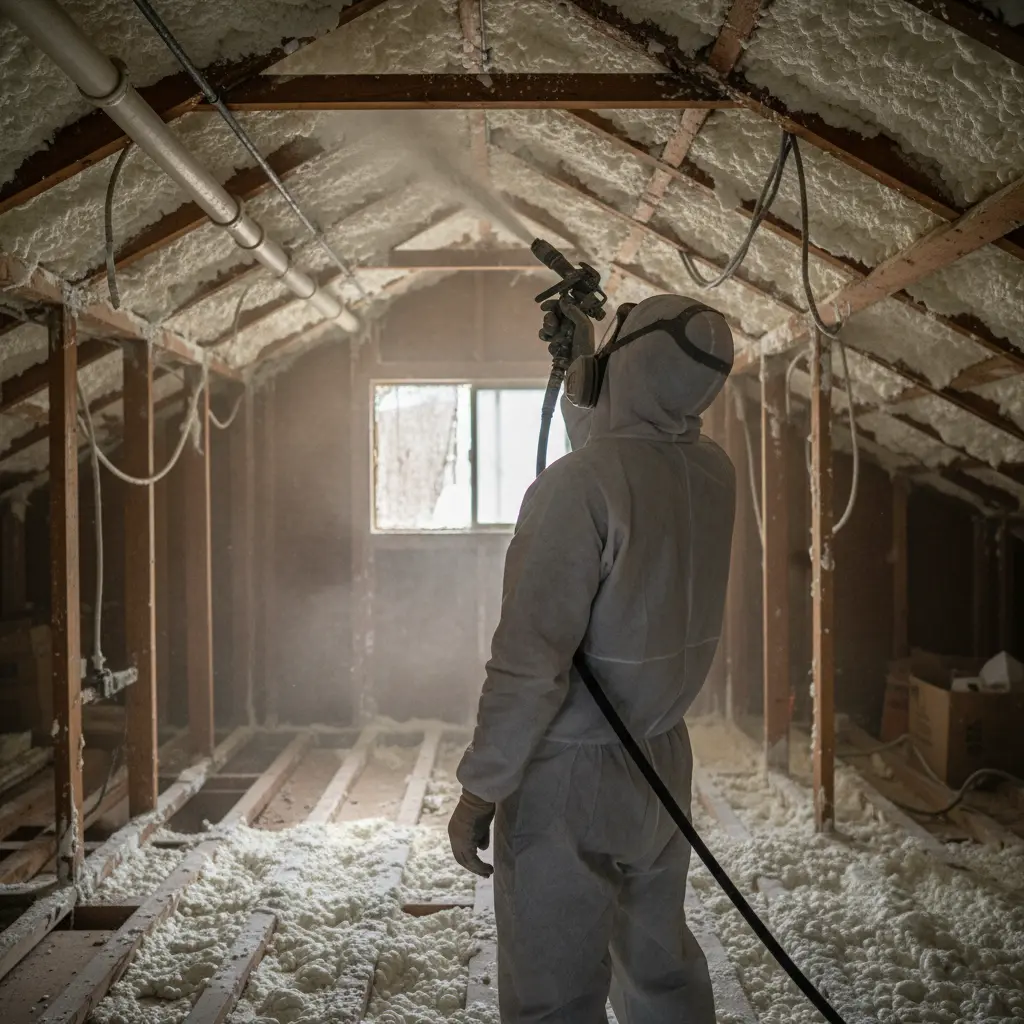
Our team in action — insulation professionals serving Burbank
Crawl Space Insulation Methods and Approaches
Fiberglass Batt Insulation (Vented Crawl Space Application)
Kraft-faced or unfaced fiberglass batts are installed between floor joists in the vented crawl space model. This is the most common approach in Burbank’s post-war tract homes from the 1950s–1960s. We install batts at R-19 or R-30 depending on joist depth, with wire hangers securing batts flush against the subfloor. Best suited for homes with dry crawl spaces and functional foundation venting.
Spray Foam Insulation (Encapsulated Application)
Closed-cell spray polyurethane foam (SPF) applied to the interior of foundation walls and rim joists creates a continuous air and moisture barrier. This is our recommended approach for Burbank homes with moisture history, seismic crack exposure, or those transitioning to a conditioned crawl space model. Closed-cell foam achieves R-6 to R-7 per inch, making it highly efficient in tight crawl spaces. Learn more about our spray foam insulation services
Rigid Foam Board Insulation
Extruded polystyrene (XPS) or polyisocyanurate rigid board panels are adhered to foundation walls, offering R-5 per inch of thickness. Commonly used in Burbank’s craftsman bungalows from the 1920s–1940s where foundation wall access is easier than floor joist access.
Combination Systems
Many Burbank homes benefit from a hybrid approach: spray foam on rim joists and foundation walls combined with fiberglass batts between floor joists. This addresses both the primary heat loss pathways and accommodates existing venting infrastructure without requiring full encapsulation permits.
Ready for Crawl Space Insulation? Get Your Free Estimate Today.
Next Level Insulation of Burbank serves Burbank and the surrounding area — we’ll be on-site within 24 hours.
📞 Call (818) 514-7541Crawl Space Insulation Cost in Burbank, CA
Understanding the true cost of crawl space insulation in Burbank requires accounting for several project-specific variables. Below are representative price ranges for the Burbank market based on current material and labor costs.
Typical Price Ranges
- Fiberglass Batt Installation (floor joists only): $1.50–$3.00 per square foot, or approximately $1,500–$4,500 for a typical 1,000–1,500 sq ft Burbank home crawl space
- Spray Foam (rim joists and foundation walls): $2,500–$6,000 depending on linear footage of foundation and foam thickness
- Full Encapsulation with Vapor Barrier: $3,500–$8,000 including vapor barrier material, sealing, and insulation installation
- Old Insulation Removal: $1.00–$2.00 per square foot, often necessary for homes built before 1980
- Pest Exclusion and Sealing: $300–$900 as a standalone add-on service
Burbank-Specific Cost Factors
Labor rates in Los Angeles County — including Burbank — run approximately 15%–20% higher than national averages due to prevailing wage conditions and cost of living. Homes in hillside areas near the Verdugo Mountains may incur access premiums of $200–$500 due to limited crawl space entry points. Burbank Water and Power periodically offers energy efficiency rebates for qualifying insulation upgrades — our team can help you identify and apply for applicable rebates that can offset $200–$600 of project costs.
Call (818) 514-7541 for a free, no-obligation on-site estimate tailored to your specific home and crawl space conditions.
Crawl Space Insulation Services Across Burbank Neighborhoods
Magnolia Park
One of Burbank’s most established residential districts, Magnolia Park features a high concentration of 1930s–1950s craftsman and ranch-style homes, many with original crawl spaces that have never been re-insulated. Ground-level moisture from seasonal rain and aging vapor barriers is the primary concern in this neighborhood.
Toluca Lake / Toluca Woods
This upscale enclave features a mix of 1940s–1960s construction and newer custom builds. Proximity to the Los Angeles River flood control channel means elevated ground moisture levels, making full crawl space encapsulation particularly valuable for homes in the western portions of this area.
Rancho / Downtown Burbank Adjacent
Post-war tract homes from 1946–1958 dominate this area. Many have original kraft-faced insulation that has deteriorated significantly, with widespread evidence of rodent nesting due to proximity to commercial corridors along Burbank Boulevard and Victory Boulevard.
We also proudly serve: Studio City, Sherman Oaks, North Hollywood, Sun Valley, Universal City, Valley Village, Hollywood, Glendale, Pasadena, Beverly Hills, and surrounding communities. View all service areas
Crawl Space Insulation Maintenance Tips for Burbank Homeowners
Protecting your crawl space insulation investment requires periodic attention, especially given Burbank’s climate cycles and pest pressure. Follow these location-specific maintenance recommendations:
- Annual Visual Inspection (every October): Before Burbank’s rainy season begins, inspect your crawl space access hatch and visually check for signs of sagging insulation, torn vapor barriers, or standing water from early rains.
- Post-Rain Check (after any rainfall exceeding 1 inch): Following significant rain events — typically November through March — check for moisture intrusion. Burbank averages 3–5 significant rain events per season.
- Rodent Exclusion Review: Inspect foundation vent screens and crawl space entry seals every spring, as rat activity in the San Fernando Valley peaks between March and June.
- Vapor Barrier Inspection: Check that your vapor barrier remains intact, sealed at seams, and free from pooling water at least once per year.
- HVAC Duct Inspection: Ensure any ductwork running through the crawl space remains properly insulated and connected — disconnected ducts are common in homes that experienced the 1994 Northridge Earthquake.
- Post-Earthquake Check: Following any earthquake exceeding magnitude 4.0 — which Burbank experiences several times annually — visually inspect foundation vents and rim joists for new cracking.
- Professional Re-Inspection Every 5–7 Years: Schedule a professional evaluation to assess R-value integrity and address any degradation before it impacts energy bills.
Why Choose Next Level Insulation of Burbank
When it comes to crawl space insulation in Burbank, CA, homeowners deserve a contractor who understands the specific demands of this city — not a generalist who treats every project the same regardless of location.
Next Level Insulation brings over 20 years of experience serving Burbank and the broader San Fernando Valley and Los Angeles region. Our team has worked on hundreds of Burbank homes ranging from pre-war craftsman bungalows to contemporary builds, and we understand how Burbank’s seismic history, Santa Ana wind cycles, and Mediterranean climate patterns interact with crawl space systems in ways that contractors from outside the region simply don’t.
We specialize in the full spectrum of insulation services, including attic insulation, spray foam insulation, rodent-proof insulation, and sound insulation — meaning we can address your entire home’s thermal envelope in a single partnership. Our estimates are always free, our recommendations are always honest, and our installations are always built to meet or exceed California Title 24 standards for Climate Zone 9. Call (818) 514-7541 today.
Frequently Asked Questions About Crawl Space Insulation in Burbank, CA
How much does crawl space insulation cost in Burbank, CA?
Crawl space insulation in Burbank typically ranges from $1,500 to $8,000 depending on the size of your crawl space, the insulation method selected, whether existing insulation needs to be removed, and the level of vapor barrier and pest exclusion work required. Fiberglass batt projects for average-sized homes generally fall between $1,500 and $4,500, while full encapsulation with spray foam can reach $6,000–$8,000 for larger properties. Contact us at (818) 514-7541 for a free on-site estimate specific to your home.
How long does crawl space insulation installation take in Burbank?
Most standard crawl space insulation projects in Burbank are completed in 1–2 days. Smaller homes with straightforward access and no existing insulation removal may be completed in a single day. Larger homes, full encapsulation projects, or those requiring significant pest exclusion work may require two full days.
Does Burbank require a permit for crawl space insulation?
In most cases, insulation-only projects do not require a building permit in the City of Burbank. However, if the project involves changes to crawl space venting, foundation wall sealing that transitions the space from vented to conditioned, or structural repairs, a permit from the Burbank Building and Safety Division may be required. Our team is familiar with Burbank’s permitting requirements and will advise you accordingly during the assessment phase.
What R-value does Burbank require for crawl space insulation?
Burbank falls within California Climate Zone 9 under Title 24. The current prescriptive minimum for floor insulation (between joists above a vented crawl space) is R-19. For conditioned or encapsulated crawl spaces with insulation on foundation walls, a minimum of R-13 is required for walls. We always recommend exceeding minimums — R-30 floor insulation is achievable in most Burbank homes with standard joist depths.
Is crawl space insulation worth it in Burbank’s warm climate?
Absolutely. While Burbank is not a cold-weather city, the significant temperature swings between day and night — particularly in fall and spring — mean floors above uninsulated crawl spaces are uncomfortable for a meaningful portion of the year. More importantly, crawl space insulation in Burbank reduces summer cooling loads by blocking radiant heat gain from the ground, which can be substantial during July and August when ground temperatures remain elevated even overnight.
How do I know if my crawl space insulation was damaged in the 1994 Northridge Earthquake?
The January 17, 1994 Northridge Earthquake caused widespread foundation cracking and pier movement throughout Burbank. If your home was built before 1994 and the crawl space insulation has never been professionally inspected or replaced, there is a real possibility that batts were dislodged by ground movement or that foundation cracks created new air and moisture infiltration pathways. A professional inspection is the only reliable way to assess the condition. We offer free assessments — call (818) 514-7541.
Can crawl space insulation help with rodent problems in Burbank?
Yes — but only when combined with proper pest exclusion sealing. Insulation alone does not deter rodents; in fact, fiberglass batts are attractive nesting material for the roof rat populations common throughout Burbank and the San Fernando Valley. Our process always includes sealing all entry points with wire mesh and expanding foam before installing new insulation, and we offer rodent-proof insulation options that incorporate materials less hospitable to nesting. Learn more about our rodent-proof insulation services
Do you serve areas outside of Burbank?
Yes. While Burbank is our primary service hub, Next Level Insulation proudly serves homeowners throughout the greater Los Angeles area including Glendale, Pasadena, Studio City, Sherman Oaks, North Hollywood, Sun Valley, Toluca Lake, Universal City, Valley Village, Hollywood, Beverly Hills, Culver City, West Hollywood, Alhambra, San Gabriel, South Pasadena, Monterey Park, East Los Angeles, and La Cañada Flintridge. View our full service area
Get a Free Crawl Space Insulation Estimate in Burbank, CA
Don’t let an under-insulated crawl space drain your energy budget or compromise your Burbank home’s comfort season after season. Whether you’re dealing with cold floors in January, high summer cooling bills, moisture damage from this past winter’s rains, or rodent-damaged insulation, Next Level Insulation of Burbank is ready to provide a permanent, high-performance solution.
Our team serves all Burbank neighborhoods and surrounding communities throughout Los Angeles. Estimates are always free, no-obligation, and conducted in person so we can give you an accurate, honest assessment — not a ballpark figure based on square footage alone.
Call us today at (818) 514-7541 to schedule your free crawl space insulation assessment. You can also reach us online through our contact page. Take your home’s energy efficiency to the next level.