

Spray Foam Attic Insulation in Orange, CA
Energy-Saving Spray Foam Attic Insulation for Orange, CA Homes — Licensed & Insured
Get expert spray foam attic insulation in Orange, CA. Next Level Insulation serves all Orange neighborhoods. Call (714) 266-2070 for a free estimate today.
- Licensed & Insured
- Locally Owned & Operated
- Free Inspection & Estimate
Request Your
Free EstimateSpray foam attic insulation is a premium insulation solution that seals air leaks, reduces heat transfer, and creates an energy-efficient thermal envelope inside your home’s attic space. Unlike traditional batt or blow-in insulation, spray foam expands on contact to fill every gap, crack, and cavity — delivering superior R-values and moisture resistance in a single application.
In Orange, CA, where summer temperatures routinely climb past 95°F and Santa Ana wind events can spike indoor temperatures overnight, attic insulation is not a luxury — it is a critical component of home comfort and energy efficiency. The region’s unique combination of coastal influence, inland heat, and aging housing stock creates specific insulation challenges that demand a professional, tailored approach.
At Next Level Insulation of Orange, our team specializes in spray foam attic insulation for homes and commercial properties throughout Orange. We understand the local climate, building codes, and construction styles unique to this part of Orange County — and we bring that expertise to every job we complete. Call us at (714) 266-2070 to schedule your free assessment today.
Understanding Spray Foam Attic Insulation
Spray foam attic insulation is a two-component chemical system — typically composed of isocyanate and polyol resin — that reacts upon mixing to expand and harden into a rigid or semi-flexible foam. This foam adheres to wood framing, rafters, roof decking, and masonry surfaces, creating a continuous air and thermal barrier that dramatically outperforms traditional insulation materials.
There are two primary types of spray foam used in attic applications:
- Open-Cell Spray Foam: A softer, more flexible foam with an R-value of approximately R-3.5 to R-4 per inch. Open-cell foam is vapor-permeable and works well for interior attic applications where moisture control is managed separately. It is particularly effective for soundproofing in addition to thermal performance.
- Closed-Cell Spray Foam: A denser, rigid foam with an R-value of R-6 to R-7 per inch. Closed-cell foam acts as both a thermal barrier and a vapor retarder, making it ideal for hot, dry climates like Orange, CA, where managing heat gain and air infiltration is paramount. It also adds structural rigidity to roof decking.
Spray foam insulation became commercially viable for residential use in the 1970s and gained widespread adoption through the 1990s and 2000s as energy codes tightened across California. Today, California’s Title 24 Building Energy Efficiency Standards — some of the strictest in the nation — push homeowners and builders toward high-performance insulation solutions like spray foam to meet minimum energy compliance requirements.
In Orange, the housing stock is eclectic. You’ll find mid-century ranch homes built in the 1950s and 1960s with minimal original insulation, tract developments from the 1970s and 1980s that used fiberglass batts now deteriorating with age, and newer custom homes requiring code-compliant high-performance systems. Spray foam attic insulation serves all of these building types effectively, whether applied to an open attic floor, cathedral ceiling, or directly to the underside of roof decking to create a conditioned attic space.
Beyond thermal performance, spray foam attic insulation reduces HVAC runtime, lowers utility bills, improves indoor air quality by blocking outdoor pollutants and allergens, and can even help reinforce roof structure during high-wind events — a meaningful benefit in a region susceptible to powerful Santa Ana wind conditions.
Why Spray Foam Attic Insulation Is Needed in Orange, CA
Extreme Heat and Attic Temperature Buildup
During summer months, attic temperatures in Orange homes without adequate insulation can exceed 150°F to 160°F. This superheated air radiates downward through ceilings, forcing air conditioning systems to work significantly harder. The City of Orange recorded several days above 100°F during the September 2022 heat wave that struck Southern California, with local grid operators declaring Flex Alerts urging residents to reduce power consumption. Inadequate attic insulation is a primary driver of excessive cooling loads during these events. Closed-cell spray foam with an installed R-value of R-21 or higher applied directly to the roof decking can reduce attic temperatures by 40°F to 50°F compared to an uninsulated attic.
Santa Ana Wind Events and Air Infiltration
Santa Ana winds — which sweep through the Santa Ana Canyon corridor just northeast of the city — can create rapid pressure differentials across building envelopes. During strong Santa Ana events, wind speeds in the Orange area have been recorded exceeding 60 to 70 mph in canyon-adjacent neighborhoods. These pressure events force hot, dry, particulate-laden air through attic penetrations, gaps around recessed lighting, HVAC duct boots, and framing seams. Spray foam’s air-sealing properties — reducing air infiltration to near zero at treated surfaces — directly address this localized vulnerability that batts and loose-fill insulation cannot match.
Aging Housing Stock and Degraded Insulation
Much of Orange’s residential development occurred between 1950 and 1985, particularly in neighborhoods like Olive Hills, Orange Park Acres, and the historic Old Towne district. Homes built during this era were typically insulated to R-11 or R-19 using fiberglass batts — standards that fall far below California’s current Title 24 minimum of R-38 for Climate Zone 8 attics. Fiberglass batts from this era are often compressed, moisture-damaged, or contaminated with rodent activity, reducing their effective R-value further. Spray foam replacement restores full thermal performance and eliminates the air gaps that degraded batt insulation leaves behind.
Wildfire Smoke and Particulate Infiltration
Orange County has experienced increasing wildfire smoke impact, including during the 2020 fire season when air quality indices in the Orange area reached “Very Unhealthy” levels for multiple consecutive days. Homes with poor attic air sealing allow fine particulate matter and smoke compounds to migrate indoors through attic bypasses. Spray foam creates a continuous sealed barrier that dramatically reduces this infiltration pathway, protecting indoor air quality during regional smoke events.
Coastal Moisture Influence
While Orange is inland, marine layer influence from the Pacific — approximately 20 miles to the west — introduces periodic humidity that can condense inside poorly insulated attics. This moisture cycling accelerates wood rot at rafter ends and ridge boards and creates conditions favorable for mold growth in attic spaces. Closed-cell spray foam’s vapor retarding properties help manage this moisture dynamic at the critical roof deck interface.
Signs You Need Spray Foam Attic Insulation in Orange
Energy Performance Indicators
- Monthly electric bills exceeding $200 to $300 during June through September despite moderate thermostat settings
- Air conditioning running continuously during afternoon peak hours without reaching set temperature
- Noticeable temperature differences of 5°F or more between upstairs and downstairs rooms
- HVAC system cycling on more frequently than every 10 to 15 minutes on mild weather days
Physical and Structural Symptoms
- Visible daylight or gaps around attic hatch frames, recessed lights, or plumbing penetrations
- Fiberglass batt insulation that appears flat, matted, discolored, or displaced from joist cavities
- Dust streaks or discoloration on ceiling drywall around light fixtures — a sign of air infiltration
- Evidence of rodent nesting or pest activity within existing insulation material
- Water stains on attic framing or roof decking indicating past or active moisture intrusion
Comfort and Indoor Air Quality Issues
- Unusual dustiness or allergy symptoms that worsen during Santa Ana wind events
- Musty or stale odors emanating from ceiling registers — often a sign of attic air bypasses
- Rooms that feel uncomfortably warm within one to two hours of air conditioning shutoff
If you recognize two or more of these indicators, your home’s attic insulation system likely needs professional evaluation. Contact Next Level Insulation of Orange at (714) 266-2070 for a comprehensive attic inspection.
Our Spray Foam Attic Insulation Process in Orange, CA
Every spray foam attic insulation project we complete in Orange follows a structured, quality-controlled process designed to maximize performance and comply with California Title 24 requirements.
Free In-Home Attic Assessment (1–2 Hours)
Our certified technician performs a full attic inspection using thermal imaging and moisture meters. We document existing insulation R-values, identify air infiltration pathways, assess framing conditions, and evaluate HVAC duct placement. We note any Orange-specific concerns such as proximity to the Santa Ana Canyon corridor, coastal moisture impact, or fire-resistive assembly requirements in designated brush fire hazard zones.
Existing Insulation Removal (If Required) (Half to Full Day)
If existing insulation is degraded, contaminated, or incompatible with spray foam application, we perform complete insulation removal using HEPA-filtered vacuum systems that protect your home from airborne particulates. All removed material is bagged and disposed of in compliance with Orange County waste management regulations.
Attic Preparation and Air Sealing Prep (2–4 Hours)
We protect HVAC equipment, ductwork, and attic ventilation components before application. Electrical penetrations, recessed light canisters rated for spray foam contact, and plumbing stacks are inspected for compatibility. We pre-seal any large penetrations with appropriate backing material to support foam adhesion.
Spray Foam Application (4–8 Hours Depending on Attic Size)
Our licensed technicians apply spray foam in controlled lifts to achieve target R-values. For Orange’s Climate Zone 8, we typically apply closed-cell foam to roof deck and rafter bays at 3 to 4 inches thickness, achieving R-21 to R-28 at the roof deck level. Attic floor applications may use open-cell foam at 5 to 6 inches to reach code-minimum R-38 at the floor plane.
Cure Time and Quality Inspection (2–4 Hours)
Spray foam requires a minimum of 24 hours to fully cure before the attic space is returned to normal use. We perform post-application thermal imaging to verify coverage uniformity and confirm no cold spots or voids exist in the insulation envelope.
Final Documentation and Title 24 Compliance Report
We provide a detailed installation report including material certifications, installed R-values, and documentation suitable for building permit compliance or utility rebate applications through Southern California Edison’s energy efficiency programs.
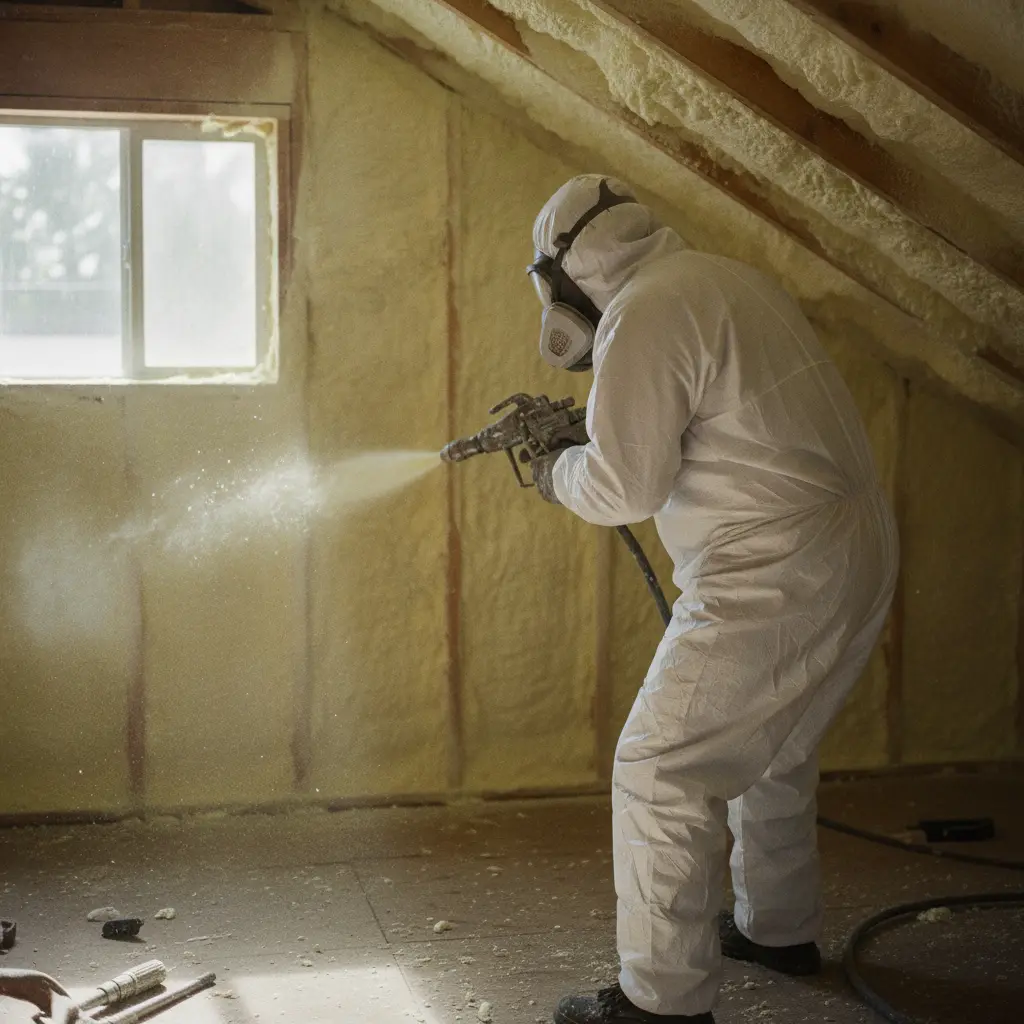
Our team in action — insulation professionals serving Orange
Spray Foam Attic Insulation Methods and Approaches
Unvented (Hot Roof) Assembly — Closed-Cell Spray Foam at Roof Deck
The most effective approach for Orange’s climate. Closed-cell spray foam is applied directly to the underside of the roof sheathing and rafters, converting the attic into conditioned space. This eliminates the attic’s extreme temperature swings, protects HVAC ducts running through the attic, and dramatically reduces cooling loads. Ideal for homes in Orange Park Acres and other areas with complex rooflines or HVAC equipment in attic spaces. Installed at R-21 to R-38 depending on rafter depth.
Vented Attic Floor Assembly — Open-Cell Spray Foam
Open-cell spray foam is applied to the attic floor joists at 5 to 6 inches, achieving R-19 to R-22 at the floor plane. This method preserves natural attic ventilation and is appropriate for homes where roof deck access is limited or budget constraints favor a vented assembly. Commonly used in Olive Hills ranch homes with standard truss attics.
Hybrid Insulation System
For older homes in the Old Towne Orange historic district, we often combine a 2-inch closed-cell spray foam layer at the roof deck for air sealing and vapor control, followed by blow-in insulation over the attic floor to achieve code-minimum R-38. This hybrid approach balances performance and cost while respecting the structural sensitivities of vintage construction.
Spray Foam Plus Insulation Removal and Replacement
For homes where existing insulation is contaminated or severely degraded, we combine complete insulation removal and replacement with spray foam air sealing at critical bypass locations before installing new insulation. This comprehensive approach delivers maximum energy improvement and is often the recommended path for Orange homes built before 1980.
Ready for Spray Foam Attic Insulation? Get Your Free Estimate Today.
Next Level Insulation of Orange serves Orange and the surrounding area — we’ll be on-site within 24 hours.
📞 Call (714) 266-2070Spray Foam Attic Insulation Cost in Orange, CA
Understanding the cost of spray foam attic insulation helps homeowners in Orange make informed decisions and budget appropriately. Costs vary based on attic size, foam type, existing conditions, and project complexity.
Typical Price Ranges
- Open-Cell Spray Foam (Attic Floor): $1.00 to $1.50 per board foot installed. For a typical 1,500 square foot Orange home attic at 5 inches depth, expect $1,800 to $3,500 total.
- Closed-Cell Spray Foam (Roof Deck/Rafter Application): $1.75 to $3.00 per board foot installed. A full unvented roof deck application for a 1,500 square foot attic typically ranges from $4,500 to $9,000.
- Hybrid Systems: $3,000 to $6,500 depending on square footage and foam depth combination.
- Insulation Removal (If Required): $1.00 to $2.00 per square foot, typically $1,500 to $3,500 for average Orange-area attics.
Factors That Affect Cost in Orange
- Attic accessibility — low-pitch rooflines common in 1960s ranch homes in Orange increase labor time
- Existing insulation removal and disposal requirements
- Presence of HVAC equipment requiring masking and protection
- Title 24 compliance documentation requirements for permitted projects
- Southern California foam material supply costs, which trend 10 to 15 percent above national averages
Available Incentives
Southern California Edison offers rebates through their Energy Efficiency Programs for qualifying insulation upgrades. Orange homeowners may also be eligible for federal tax credits under the Inflation Reduction Act — up to 30 percent of insulation installation costs, capped at $1,200 annually. Our team provides documentation to support all applicable rebate and tax credit applications. Call (714) 266-2070 for a detailed project estimate.
Neighborhoods We Serve in Orange, CA
Old Towne Orange
The historic core of Orange features craftsman bungalows, Victorian-era homes, and early twentieth century construction dating to the 1910s through 1940s. These homes often have original balloon-frame or platform-frame construction with no insulation in attic cavities whatsoever. Spray foam application requires careful assessment of knob-and-tube wiring and must comply with the Old Towne Design Standards for any exterior modifications.
Orange Park Acres
This semi-rural eastern Orange community features large custom homes on estate lots, many built between 1970 and 1995. Complex rooflines with multiple hip sections, dormers, and varied rafter depths make spray foam the preferred solution for comprehensive attic coverage. The area’s proximity to the Irvine Regional Park and Santiago Creek corridor also brings higher seasonal humidity variation.
Olive Hills
Olive Hills features predominantly 1950s and 1960s ranch-style homes with low-slope roof decks and minimal original insulation. Many homes still have original fiberglass batt insulation at R-11 — significantly below current code. The flat attic profiles make spray foam attic floor application highly efficient in this neighborhood.
Villa Park Adjacent / West Orange
Transitional neighborhoods along the western edge of Orange include 1970s and 1980s tract homes with standard truss attics and aging blown-in insulation. These homes benefit significantly from attic air sealing with spray foam before topping up with additional blow-in insulation to achieve code-compliant R-38.
Spray Foam Attic Insulation Maintenance Tips for Orange Homeowners
- Annual Attic Visual Inspection: Inspect your attic each fall before Santa Ana wind season begins. Look for displaced insulation, moisture staining, or signs of pest activity around spray foam perimeters.
- Seal HVAC Penetrations After Service Visits: HVAC technicians sometimes disturb attic insulation around duct boots. Re-inspect penetrations after any HVAC service call and reseal with appropriate caulk or foam if gaps are created.
- Monitor Attic Hatch Weatherstripping: Attic hatches are a major air infiltration point. Check weatherstripping annually and replace if compression is visible or drafts are felt around the hatch perimeter.
- Check for Recessed Light Heat Damage: Non-IC-rated recessed lights can create scorching at foam interfaces. Verify all recessed lights in contact with spray foam are rated for airtight and insulation contact use.
- Inspect After Major Weather Events: After significant Santa Ana wind events or rare heavy rain, inspect the attic for any roof leak evidence or foam delamination at ridge and eave areas.
- Maintain Proper Attic Ventilation in Vented Assemblies: If you have a vented attic system, ensure soffit and ridge vents remain clear of debris, particularly after autumn leaf drop or construction activity nearby.
- Schedule Professional Inspections Every 5 Years: Spray foam is highly durable but benefits from periodic professional evaluation to confirm R-values remain effective and no new air bypass pathways have developed.
Why Choose Next Level Insulation of Orange
When it comes to spray foam attic insulation in Orange, CA, homeowners deserve a contractor who understands not just insulation materials but the specific climate, construction history, and building code landscape of this community. Next Level Insulation of Orange focuses exclusively on insulation services — meaning every technician on our team has deep, specialized expertise in spray foam application, attic diagnostics, and California Title 24 compliance.
We serve Orange and the surrounding Orange County area with a full range of insulation solutions including spray foam insulation, attic insulation, blow-in insulation, crawl space insulation, crawl space encapsulation, and complete insulation removal and replacement.
Our work is performed with professional-grade Graco and PMC equipment to ensure consistent foam quality and uniform R-value across every square foot of your attic. We use only certified, low-GWP spray foam systems that comply with California Air Resources Board (CARB) requirements. Every project includes a detailed post-installation report and thermal imaging verification so you have documented proof of performance. Call us at (714) 266-2070 — we’re ready to help your Orange home stay comfortable year-round.
Frequently Asked Questions About Spray Foam Attic Insulation in Orange, CA
How much does spray foam attic insulation cost in Orange, CA?
Costs in Orange typically range from $1.00 to $1.50 per board foot for open-cell foam and $1.75 to $3.00 per board foot for closed-cell foam. Most residential attic projects in Orange range from $2,500 to $9,000 depending on size, foam type, and attic conditions. We provide free, itemized estimates with no obligation — call (714) 266-2070 to schedule yours.
How long does spray foam attic insulation installation take in Orange?
Most residential attic spray foam projects in Orange are completed in one to two days. A standard 1,500 square foot attic application takes approximately 4 to 8 hours for foam application, with a 24-hour cure period before the attic is fully accessible. Projects involving prior insulation removal may require an additional half to full day.
Is spray foam attic insulation required to comply with California Title 24?
Spray foam is not the only compliant option, but it is one of the most effective for meeting Title 24’s energy performance requirements in Climate Zone 8 (which includes Orange). Title 24 requires minimum R-38 in attic assemblies for most residential projects. Closed-cell spray foam at the roof deck, or open-cell spray foam at the attic floor, can both be designed to meet or exceed this threshold. We provide compliance documentation for all permitted projects.
Should I use open-cell or closed-cell spray foam for my Orange home’s attic?
For most Orange homes, closed-cell spray foam applied at the roof deck is the premium choice because it delivers higher R-values per inch, acts as a vapor retarder, and protects HVAC equipment housed in the attic from extreme heat. Open-cell foam at the attic floor is a cost-effective alternative for homes where HVAC equipment is not located in the attic space. Our assessment process includes a specific recommendation based on your home’s construction type, roof geometry, and energy goals.
Will spray foam attic insulation help during Santa Ana wind events?
Yes — significantly. Santa Ana winds create pressure differentials across building envelopes that force hot, dusty air through unsealed attic penetrations. Spray foam’s air-sealing properties virtually eliminate this infiltration pathway. Homeowners who have upgraded to spray foam frequently report that their homes maintain comfortable temperatures much longer during Santa Ana events than they did with batt or loose-fill insulation.
Do I need to remove my old insulation before spray foam is installed?
Not always. If existing insulation is structurally sound and free of contamination, spray foam can sometimes be applied over it at specific locations like the roof deck or around air bypass penetrations. However, if existing attic insulation is contaminated by rodents, shows moisture damage, or is severely compressed below effective R-value, complete removal is recommended before spray foam application. Our inspection process evaluates this on a home-by-home basis.
Does spray foam attic insulation help with wildfire smoke infiltration in Orange?
Spray foam significantly reduces the air infiltration pathways through which fine wildfire smoke particulates enter homes. While no insulation system creates a perfectly airtight building, sealed spray foam attic assemblies can reduce attic-sourced air infiltration by 80 to 90 percent, meaningfully improving indoor air quality during the smoke events that increasingly affect Orange County during fire season.
Are there rebates available for spray foam attic insulation in Orange?
Yes. Orange homeowners served by Southern California Edison may qualify for energy efficiency rebates through SCE’s programs. Additionally, the federal Residential Clean Energy Credit under the Inflation Reduction Act provides a 30 percent tax credit (up to $1,200 per year) for qualifying insulation improvements. Our team provides all necessary documentation to support your rebate and tax credit applications.
Get Your Free Spray Foam Attic Insulation Estimate in Orange, CA
Your Orange home deserves to stay cool in the summer heat, protected during Santa Ana wind events, and energy-efficient year-round. Next Level Insulation of Orange is ready to deliver a professional spray foam attic insulation solution tailored specifically to your home’s construction and the demands of Orange’s unique climate.
Don’t let another Southern California summer drive up your energy bills and strain your HVAC system. Whether you’re dealing with a 1950s ranch in Olive Hills, a large estate in Orange Park Acres, or a historic craftsman in Old Towne, our team has the expertise and equipment to get the job done right — on time and to California code.
Call us today at (714) 266-2070 to schedule your free in-home attic assessment. We serve all neighborhoods throughout Orange, CA and are ready to help you reach the next level of home comfort and efficiency.