

Duct Insulation in Burbank, CA
Energy-Saving Duct Insulation for Burbank, CA Homes — Licensed & Insured
Need duct insulation in Burbank, CA? Next Level Insulation of Burbank offers expert duct insulation services to cut energy costs & boost comfort. Call (818) 514-7541.
- Licensed & Insured
- Locally Owned & Operated
- Free Inspection & Estimate
Request Your
Free EstimateDuct insulation is the process of wrapping or lining your HVAC air distribution system with thermal and acoustic insulating materials to prevent energy loss, control condensation, and maintain consistent indoor temperatures. In Burbank, CA — where summer temperatures regularly climb above 100°F in the San Fernando Valley basin and Santa Ana wind events cause dramatic seasonal swings — poorly insulated ductwork can account for up to 30% of a home’s total energy loss.
At Next Level Insulation of Burbank, we specialize in professional duct insulation services tailored to the specific construction styles, climate conditions, and utility cost pressures that Burbank homeowners and commercial property owners face every day. Whether your ducts run through a sun-baked attic above a 1950s ranch home near Magnolia Park or through a crawl space beneath a mid-century bungalow off Glenoaks Boulevard, our team delivers expert solutions that lower your energy bills and improve your indoor comfort year-round.
Call us today at (818) 514-7541 for a free assessment.
Understanding Duct Insulation
Your home or building’s HVAC system relies on a network of ducts — typically constructed from sheet metal, flex duct, or fiberboard — to distribute conditioned air from your furnace or air conditioner to every room. Without adequate insulation surrounding those ducts, the air traveling through them absorbs or loses heat before it ever reaches your living spaces. The result is an HVAC system that works harder, runs longer, and costs more to operate.
Duct insulation has been a standard building practice since the widespread adoption of central air conditioning in the post-World War II housing boom of the late 1940s and 1950s. Burbank, which saw explosive residential development during that exact period as the aerospace and entertainment industries attracted workers to the area, is home to thousands of properties built with duct systems that are now 60 to 70 years old. Original insulation on those systems — often simple fiberglass wrap — has degraded significantly over the decades.
Modern duct insulation materials include flexible fiberglass blanket wrap, rigid foam board, reflective radiant barriers, and spray foam, each rated by an R-value that measures thermal resistance. The U.S. Department of Energy recommends a minimum R-6 insulation value for ducts located in unconditioned spaces such as attics and crawl spaces, with R-8 preferred in extreme climates — a recommendation that directly applies to Burbank’s hot, dry summers.
In Burbank specifically, the mix of building types ranges from 1920s Craftsman bungalows in the Rancho District to post-war tract homes throughout the Chandler Estates area, mid-century apartment complexes along Victory Boulevard, and modern commercial properties near the Hollywood Burbank Airport corridor. Each building type presents a unique duct layout challenge. Older homes commonly have undersized, poorly routed duct systems installed as afterthought retrofits, while newer construction may have flex duct improperly installed with excessive bends that restrict airflow and create additional insulation challenges.
Learn more about our attic insulation services in Burbank
Why Duct Insulation Is Needed in Burbank, CA
Burbank sits on the floor of the eastern San Fernando Valley, a geographic bowl bounded by the Verdugo Mountains to the northeast and the Santa Monica Mountains to the south. This topography creates a heat island effect that makes Burbank consistently 5°F to 10°F hotter than coastal Los Angeles during summer months. The National Weather Service recorded a high of 117°F at nearby Woodland Hills during the historic September 2022 heat event, and Burbank’s own temperatures reached 108°F during that same stretch — conditions that place an extraordinary thermal load on any ductwork running through unconditioned attic spaces.
Attic temperatures in Burbank during summer routinely reach 140°F to 160°F between 12:00 PM and 4:00 PM. When uninsulated or poorly insulated supply ducts pass through an attic at those temperatures, the cool 55°F air leaving your air conditioner can warm by 10°F to 15°F before it ever reaches your living room. That means your thermostat never feels satisfied, your AC runs continuously, and your Southern California Edison bill spikes — a familiar frustration for homeowners throughout the Magnolia Park, Burbank Hills, and Rancho District neighborhoods.
Santa Ana wind events, which typically occur between October and April, create a different but equally damaging set of conditions. The hot, dry winds — recorded at gusts exceeding 60 mph through the Cajon and San Fernando passes — drive extreme low-humidity air into homes, causing existing duct insulation to dry, crack, and separate from duct surfaces. The December 2017 Thomas Fire and the September 2020 Bobcat Fire, while centered in neighboring areas, produced weeks of smoke-laden air that caused Burbank residents to seal their homes and run HVAC systems continuously — accelerating wear on duct insulation already compromised by years of thermal cycling.
Seismic activity is another Burbank-specific factor. The Hollywood Fault runs just south of the city, and the 1994 Northridge Earthquake (magnitude 6.7) caused significant structural movement throughout the San Fernando Valley. Flex duct connections and rigid duct joints that were stressed or partially disconnected during seismic events often develop gaps where insulation has pulled away — gaps that may go undetected for years while silently wasting energy. Homes in Sun Valley, North Hollywood, and Burbank’s own Rancho District area built before current seismic retrofit standards are particularly susceptible.
Burbank’s water table and clay-heavy soils — classified as expansive Vertisols common throughout the eastern San Fernando Valley — also affect crawl space duct systems. Seasonal soil expansion and contraction can shift duct supports and break insulation seals around crawl space ducts, allowing cold air to escape beneath the subfloor rather than rise into conditioned living areas above.
Finally, Burbank’s commercial and mixed-use zoning along San Fernando Road, Olive Avenue, and the Media District creates demand for duct insulation in commercial HVAC systems serving office buildings, production studios, and retail spaces — environments where poor duct performance directly impacts operating costs and tenant comfort.
Signs You Need Duct Insulation in Burbank
Energy and Utility Bill Indicators
- Your Southern California Edison bills increased more than 15% year-over-year without a change in usage habits
- Your HVAC system runs nearly continuously during Burbank’s summer months without reaching your set temperature
- Certain rooms never cool or heat properly even after system tune-ups
Physical and Comfort Symptoms
- Noticeable hot or cold spots in rooms located farthest from the air handler
- Condensation forming on exposed duct surfaces in your attic or crawl space
- Musty or dusty odors coming from vents — a sign of moisture infiltration around duct insulation
- Visible tears, gaps, or disconnected sections in existing duct wrap when viewed in the attic
Structural and Age-Related Indicators
- Your home was built before 1980 and ducts have never been re-insulated
- You experienced significant shaking during a seismic event and have not had ducts inspected
- Flex duct sections appear kinked, compressed, or sagging from damaged insulation supports
Urgency Indicators
If your home is in Burbank’s Rancho District or Chandler Estates area and was built between 1945 and 1975, there is a high probability that original duct insulation has reached the end of its serviceable life. Scheduling an inspection before the next summer season is strongly recommended.
Our Duct Insulation Process in Burbank
Initial Assessment and Inspection (1–2 Hours)
Our technician performs a thorough walkthrough of your property, accessing attic spaces, crawl spaces, and mechanical rooms to photograph and document all existing ductwork. In Burbank’s older homes, we pay special attention to original sheet metal trunk lines that may have been installed without any insulation at all. We use a thermal imaging camera to identify areas of significant heat transfer and air leakage.
Duct Leakage Testing (30–60 Minutes)
We perform a blower door or duct pressurization test to quantify how much conditioned air is escaping before reaching your vents. This step is especially important in Burbank properties that experienced foundation movement, as gaps at duct joints may not be visible to the naked eye.
Air Sealing All Duct Connections (2–4 Hours)
Before any insulation is installed, every duct connection, joint, and seam is sealed with UL-181-rated mastic sealant or metal-backed tape. This step alone can reduce duct air loss by 20% to 30% and is a prerequisite to effective insulation performance. We seal boot connections at every register opening and all connections to the air handler cabinet.
Removal of Degraded Existing Insulation (1–3 Hours)
Old, deteriorated fiberglass duct wrap is carefully removed and bagged for disposal. In Burbank attics, we frequently encounter original asbestos-containing duct tape on pre-1978 systems, which is handled in accordance with California EPA protocols.
Installation of New Duct Insulation (3–8 Hours)
New insulation — selected based on your duct location, system type, and budget — is installed to achieve a minimum R-6 rating, with R-8 recommended for attic ducts in Burbank’s climate zone (California Climate Zone 9). All insulation is secured with mechanical fasteners and vapor-retardant jacketing to prevent moisture infiltration.
Post-Installation Verification (30–60 Minutes)
We conduct a final thermal scan and airflow measurement at key supply registers to confirm that conditioned air is now reaching target rooms at expected temperatures. We document before-and-after readings for your records.
Clean-Up and Client Walk-Through (30 Minutes)
All work areas are cleaned, debris is removed, and we walk you through completed work with photos, explaining what was done and what to monitor going forward.
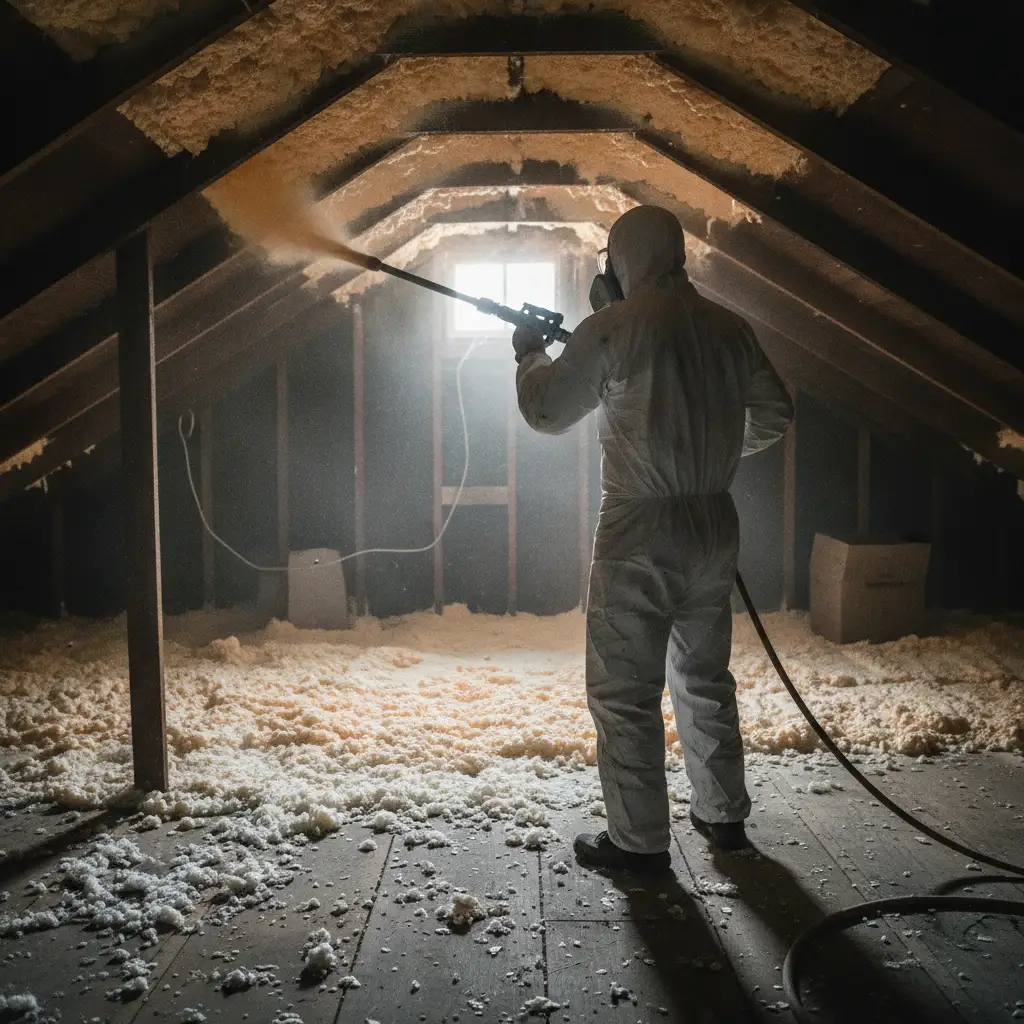
Our team in action — insulation professionals serving Burbank
Duct Insulation Methods and Approaches
Flexible Fiberglass Blanket Wrap
The most common method for wrapping existing rigid sheet metal ductwork. Available in R-6 and R-8 ratings with an outer vapor barrier jacket. Ideal for accessible attic ducts in Burbank’s ranch-style and split-level homes. Installation is relatively fast and cost-effective for straightforward duct layouts.
Spray Foam Duct Insulation
Closed-cell spray polyurethane foam can be applied directly to rigid duct exteriors, creating a seamless, air-impermeable thermal barrier. This method is particularly effective in Burbank crawl spaces where moisture from clay soil expansion creates condensation risk. Spray foam simultaneously seals air leaks and insulates, reducing the need for a separate sealing step. Learn more about spray foam insulation in Burbank
Rigid Foam Board Duct Wrapping
Pre-cut polyisocyanurate or XPS foam board panels are adhered to large rectangular duct trunk lines, offering high R-values (R-6 per inch) in a thin profile. This approach is preferred for Burbank commercial properties and media studio facilities along the Olive Avenue corridor where duct chases have limited space.
Reflective Radiant Barrier Duct Wrap
Foil-faced bubble wrap or multi-layer reflective insulation is used in Burbank attic spaces to reflect radiant heat away from duct surfaces. This is most effective when attic temperatures exceed 130°F — a condition common in Burbank from June through September — and is often used in combination with fiberglass wrap for maximum performance.
Pre-Insulated Flex Duct Replacement
When existing flex duct is severely kinked, compressed, or damaged beyond remediation, replacement with factory-insulated flex duct (R-6 or R-8 rated) is the most effective solution. This is frequently the correct choice in older Burbank homes where original flex duct was installed with excessive bends that reduce airflow by 30% or more.
Ready for Duct Insulation? Get Your Free Estimate Today.
Next Level Insulation of Burbank serves Burbank and the surrounding area — we’ll be on-site within 24 hours.
📞 Call (818) 514-7541Duct Insulation Cost in Burbank, CA
The cost of duct insulation in Burbank, CA varies based on the size of your duct system, accessibility, current condition, and the insulation method selected. Below are typical price ranges for Burbank-area projects:
- Small residential system (under 1,500 sq ft home): $800 – $1,800
- Mid-size residential system (1,500–2,500 sq ft home): $1,800 – $3,500
- Large residential system (2,500+ sq ft home): $3,500 – $6,000+
- Commercial duct insulation (per linear foot): $8 – $22
- Spray foam duct insulation (per linear foot): $12 – $25
- Duct air sealing only: $400 – $900
Factors That Affect Your Burbank Duct Insulation Cost
- Attic accessibility: Burbank homes with low-pitch rooflines common in 1950s ranch construction may require additional labor for restricted attic access
- Existing insulation removal: Removal of deteriorated original insulation adds $200–$600 depending on volume
- Asbestos abatement: Pre-1978 Burbank homes with asbestos duct tape require licensed abatement, which is priced separately
- R-value upgrade: Upgrading from R-4 to R-8 increases material cost but reduces SCE bills by an estimated 10–20% annually
- Permit requirements: City of Burbank building permits may be required for full duct replacement projects
Southern California Gas Company and Southern California Edison both offer rebates for qualifying duct sealing and insulation improvements. We can help identify incentives that may reduce your out-of-pocket cost. Contact us at (818) 514-7541 for a detailed, no-obligation estimate.
Neighborhoods We Serve in and Around Burbank
Magnolia Park, Burbank
This beloved neighborhood features a high concentration of 1930s and 1940s Craftsman and Spanish Revival homes, most of which had central HVAC systems added as retrofits in the 1960s and 1970s. Duct systems in these homes were often routed through wall cavities and floor joists — spaces where original insulation has fully degraded and air leakage is severe.
Rancho District, Burbank
Home to post-war ranch houses built largely between 1948 and 1965, the Rancho District has the highest density of original-equipment duct systems in Burbank. Attic ducts in these homes suffer from decades of thermal cycling and are a priority for R-8 fiberglass wrap upgrades.
Burbank Hills
Hillside homes in this area experience extreme radiant heat exposure on south- and west-facing roof planes. Combined with longer duct runs required to serve multi-level floor plans, attic duct temperatures here are among the highest in the city — making reflective radiant barrier duct wrap a particularly valuable addition.
North Hollywood and Sun Valley
Adjacent service areas with a high proportion of 1960s and 1970s apartment buildings featuring shared duct systems. Crawl space duct insulation is a frequent need in these communities, where clay soil movement has disrupted duct supports and compromised insulation seals. See our North Hollywood insulation services
Toluca Lake and Studio City
Affluent neighborhoods with a mix of custom estates and mid-century modern homes where comfort expectations are high and energy efficiency upgrades command premium attention. Spray foam and rigid foam board methods are commonly requested in these communities.
Duct Insulation Maintenance Tips for Burbank Homeowners
- Inspect attic ductwork every two years: Burbank’s extreme summer attic heat accelerates insulation degradation. A biennial visual check helps catch problems before they become costly.
- Check duct connections after any seismic event: Even minor earthquakes (magnitude 3.5+) can loosen flex duct connections. Inspect your attic after any notable shaking.
- Replace HVAC air filters every 60–90 days: Dirty filters increase system pressure, stressing duct connections and accelerating insulation wear at joints.
- Monitor your SCE bill for sudden spikes: A 15% or greater unexplained increase in cooling costs during summer often indicates new duct energy loss.
- Keep attic ventilation clear: Blocked soffit vents in Burbank’s stucco-and-tile homes trap additional heat in attic spaces, raising temperatures that destroy duct insulation faster.
- Address roof leaks immediately: Water infiltration through roof surfaces saturates fiberglass duct wrap, eliminating its thermal resistance and promoting mold growth on duct surfaces.
- Schedule a professional duct inspection before each summer: Have your duct system assessed in April or May, before Burbank temperatures reach peak summer levels in June through September.
Why Choose Next Level Insulation of Burbank
Next Level Insulation of Burbank is a locally based insulation contractor with deep expertise in the specific building stock, climate conditions, and code requirements of Burbank and the surrounding San Fernando Valley communities. We are not a national franchise — we are your neighbors, and we understand why a Burbank attic is a uniquely punishing environment for duct insulation materials.
Our technicians are trained in California Title 24 energy code compliance, which governs duct insulation requirements for both new construction and retrofit projects throughout the state. We work with all major insulation manufacturers and can recommend the right product for your specific home, attic configuration, and budget.
We serve all of Burbank and the surrounding communities including Studio City, Sherman Oaks, North Hollywood, Sun Valley, Toluca Lake, Universal City, Valley Village, Glendale, Pasadena, Hollywood, Beverly Hills, and beyond. View our full service area
Our full range of services includes insulation removal, blow-in insulation, crawl space encapsulation, and insulation replacement. Call us at (818) 514-7541 to schedule your free assessment.
Frequently Asked Questions About Duct Insulation in Burbank
How much does duct insulation cost in Burbank, CA?
Most residential duct insulation projects in Burbank range from $800 to $6,000 depending on the size of your home, the condition of existing ductwork, the method used, and accessibility. The average Burbank single-family home (approximately 1,800 sq ft) typically falls in the $1,800 to $3,200 range for a full attic duct insulation upgrade. Call us at (818) 514-7541 for a free, specific estimate for your property.
How long does duct insulation installation take in Burbank?
Most residential projects are completed in one day — typically 4 to 8 hours depending on the size of the home and complexity of the duct layout. Larger homes in the Burbank Hills area with multi-level duct systems may require two days. Commercial projects are scoped individually.
What R-value do I need for ducts in Burbank’s climate?
Burbank falls within California Energy Commission Climate Zone 9. Title 24 requires a minimum of R-6 for ducts in unconditioned spaces, with R-8 strongly recommended for attic ducts given the extreme summer temperatures Burbank experiences. We recommend R-8 for all attic duct work in Burbank.
Will duct insulation lower my Southern California Edison bill?
Yes. The U.S. Department of Energy estimates that properly sealed and insulated ductwork reduces HVAC energy use by 20% to 30% on average. For a Burbank household with a typical summer SCE bill of $200–$350 per month, that represents meaningful savings. SCE also offers rebates for qualifying duct improvements that can reduce your upfront cost.
Do I need a permit for duct insulation in Burbank?
Adding insulation to existing ducts generally does not require a permit in Burbank. However, replacing ductwork or installing a new duct system does typically require a City of Burbank building permit and inspection. We handle all necessary permit applications as part of our project scope when applicable.
What is the difference between duct insulation and duct sealing?
Duct sealing addresses air leakage — gaps, cracks, and disconnected joints where conditioned air escapes the duct system entirely. Duct insulation addresses thermal loss — heat transferring through the duct wall to or from the surrounding unconditioned space. Both are needed for maximum efficiency, and we perform both as part of our standard duct insulation process.
How do I know if my Burbank home’s ducts are insulated at all?
If your home was built before 1970, there is a reasonable chance that duct insulation is either absent or severely degraded. A visual attic inspection will reveal bare sheet metal (no insulation) or deteriorated fiberglass wrap that crumbles when touched. Our team offers a complimentary inspection to assess your current situation.
Can duct insulation help with air quality problems in Burbank?
Yes. Gaps in duct insulation often coincide with gaps in duct sealing, which allows attic dust, insulation fibers, and — during Burbank’s wildfire season — smoke particles to enter the air stream. Properly sealed and insulated ducts significantly reduce particulate infiltration into your indoor air supply.
Get Professional Duct Insulation in Burbank, CA Today
Don’t let another Burbank summer push your energy bills higher while your family struggles to stay comfortable. Next Level Insulation of Burbank is ready to assess your duct system, identify exactly where you are losing energy, and install the right insulation solution for your home or commercial property — all at a transparent, competitive price.
We serve Burbank and all surrounding communities including Glendale, Pasadena, North Hollywood, Studio City, Sherman Oaks, Toluca Lake, Hollywood, Beverly Hills, and beyond.
Call us now at (818) 514-7541 to schedule your free duct insulation assessment. We offer flexible scheduling including weekend appointments to accommodate Burbank homeowners and property managers.