

Spray Foam Attic Insulation in Burbank, CA
Energy-Saving Spray Foam Attic Insulation for Burbank, CA Homes — Licensed & Insured
Get expert spray foam attic insulation in Burbank, CA. Next Level Insulation serves Magnolia Park, Rancho District & beyond. Call (818) 514-7541 for a free quote.
- Licensed & Insured
- Locally Owned & Operated
- Free Inspection & Estimate
Request Your
Free EstimateSpray foam attic insulation is a high-performance insulating system that seals and insulates your attic simultaneously, creating an airtight thermal barrier that dramatically reduces energy loss. Unlike traditional insulation materials, spray polyurethane foam expands on contact to fill every crack, gap, and irregular surface in your attic structure — including around the roof rafters, eave transitions, and mechanical penetrations common in Burbank’s aging residential stock.
Burbank’s position in the eastern San Fernando Valley means attics here face relentless summer heat radiating off sun-baked rooftops, cool desert nights that drive thermal cycling, and periodic Santa Ana wind events that pressurize building envelopes. These conditions make attic insulation not a luxury but a functional necessity for home comfort and energy efficiency.
At Next Level Insulation of Burbank, our crews specialize in spray foam attic applications across Burbank’s diverse housing inventory — from the 1940s bungalows of Magnolia Park to the post-war ranch homes of Rancho District. Call us at (818) 514-7541 to schedule your attic assessment today.
Understanding Spray Foam Attic Insulation
Spray foam attic insulation refers to the application of two-component polyurethane foam — isocyanate and polyol resin — that chemically react upon mixing at the spray tip, expanding up to 100 times their liquid volume and hardening into a rigid or semi-rigid cellular matrix. There are two primary types: open-cell spray foam, which remains soft and flexible with an R-value of approximately R-3.7 per inch, and closed-cell spray foam, which cures into a dense, moisture-resistant layer delivering R-6 to R-7 per inch.
The technology traces its commercial roots to the 1970s energy crisis, when building scientists began searching for alternatives to fiberglass batts that did little to stop air infiltration. By the 1990s, two-component spray polyurethane foam had become a recognized building science solution, and California’s Title 24 energy code progressively made high-performance insulation the standard rather than the exception. Today, California’s 2022 Title 24 standards set minimum attic insulation requirements that spray foam comfortably exceeds.
In the San Fernando Valley and greater Los Angeles Basin, spray foam attic insulation is especially well-suited to the region’s roof construction conventions. The vast majority of Burbank homes built before 1980 feature conventional rafter-and-ridge framing with little to no air sealing at the eaves — exactly the configuration where spray foam outperforms all alternatives. Cathedral ceilings common in mid-century modern homes throughout the Hillside and Rancho District neighborhoods also benefit tremendously, since spray foam can insulate and air-seal in the shallow rafter cavities where blown-in products lose effectiveness.
Additionally, Burbank’s significant percentage of commercial and light-industrial buildings — particularly those housing entertainment industry infrastructure along West Olive Avenue and the production zone near Warner Bros. — often rely on spray foam for large-format metal roof decks where condensation control is as important as thermal performance.
Whether your property is a single-family Craftsman, a 1960s apartment complex, or a commercial warehouse, spray foam attic insulation provides a durable, long-lasting solution engineered for Southern California’s demanding climate profile. Learn more about our spray foam insulation services
Why Spray Foam Attic Insulation Is Needed in Burbank, CA
Burbank sits in the Verdugo Mountains’ rain shadow at an elevation ranging from roughly 550 to 700 feet above sea level across its residential neighborhoods, giving the city a semi-arid BSk climate classification. Average summer high temperatures regularly reach 95°F to 100°F, and recorded attic temperatures in poorly insulated Burbank homes during July and August routinely exceed 150°F — a thermal load that forces air conditioning systems to run continuously, inflating energy bills and accelerating HVAC equipment wear.
The Santa Ana wind events, which typically arrive between October and March and intensify every few years into damaging episodes — such as the November 2019 wind event that brought gusts exceeding 60 mph through the Verdugo Pass corridor — create extreme negative and positive pressure differentials across building envelopes. Homes with inadequate attic insulation and poor air sealing experience dramatic infiltration of dry, superheated air during these events, spiking indoor temperatures and humidity imbalances.
Burbank’s soils, predominantly the Hanford-Tujunga-Delhi sandy loam series found across the valley floor, drain rapidly and contribute to low ambient humidity for much of the year. While this reduces mold risk compared to coastal communities, it intensifies radiant heat absorption through roofing materials. Dark composition shingles prevalent on the 1950s and 1960s tract homes of the Rancho District can reach surface temperatures of 160°F to 180°F on peak summer afternoons, transferring enormous heat loads directly into under-insulated attic spaces.
Magnolia Park, one of Burbank’s most beloved and densely populated residential neighborhoods, contains a high concentration of homes built between 1930 and 1955 — many with original loose-fill rock wool insulation that has settled, compressed, and degraded to an effective R-value well below current Title 24 minimums of R-38. These homes bleed conditioned air and draw in hot attic air through the countless penetrations created by decades of plumbing, electrical, and HVAC upgrades.
The Burbank Hills area presents a different but equally compelling case. Hillside homes experience amplified wind exposure, more complex roof geometries with dormers and skylights, and increased wildfire ember risk — factors that make closed-cell spray foam’s combination of air sealing, thermal resistance, and vapor control particularly valuable. LA County’s Hazard Reduction Programs have highlighted ember intrusion through eave vents as a significant vulnerability, and closed-cell foam applied to the underside of roof sheathing directly addresses this concern by backing those vents from the interior.
Commercial and light-industrial properties near the Hollywood Burbank Airport — including the media campus zone bounded by Thornton Avenue and Empire Avenue — often operate large HVAC systems compensating for uninsulated metal roof assemblies. Energy audits of properties in this corridor frequently document heating and cooling losses of 40 to 60 percent attributable to the attic plane, making spray foam retrofit a high-return capital investment. Explore all our attic insulation solutions
Signs You Need Spray Foam Attic Insulation in Burbank
Energy and Comfort Indicators
- Monthly SoCal Edison bills above $200 during summer months for a typical single-family home, with no change in usage patterns
- Rooms on the top floor remaining 8°F to 12°F warmer than downstairs rooms despite a functioning HVAC system
- Air conditioning running continuously from midday through evening during Burbank’s July and August heat peaks
- Noticeable drafts near ceiling light fixtures, recessed cans, or attic access hatches — especially during Santa Ana wind events
Visual and Structural Warning Signs
- Existing attic insulation that appears flattened, discolored, or less than 10 inches deep (indicating R-values well below the Title 24 R-38 requirement)
- Water stains on attic sheathing or rafters indicating condensation cycles driven by poor thermal control
- Visible daylight at eave transitions, gable vents, or around plumbing stacks when viewed from inside the attic
- Dark streaks or soiling patterns on existing insulation — a sign of air washing that destroys thermal performance
Urgency Indicators
- HVAC equipment failing prematurely (under 10 years for a unit rated 15 to 20 years) due to excessive run time
- Pest activity — roof rats common in Burbank’s older neighborhoods often nest in degraded batt insulation, creating contamination that requires full removal and replacement
Learn about our insulation removal and replacement services
Our Spray Foam Attic Insulation Process
Free Attic Assessment (Day 1 — 60 to 90 Minutes)
Our technician visits your Burbank property to measure attic square footage, document existing insulation depth and condition, identify all air bypass locations — including recessed lighting, top plates, and mechanical chases — and assess roof geometry and ventilation configuration. We photograph all findings and provide a written scope.
Detailed Proposal and Material Selection (Day 1 to 3)
We present a written proposal specifying foam type (open-cell or closed-cell), target R-value, application thickness, and any prerequisite work such as insulation removal or air sealing of specific penetrations. For Burbank’s fire-hazard severity zones in the hills, we always recommend closed-cell foam for its superior vapor and ember resistance.
Prep and Protection (Installation Day — 1 to 2 Hours)
Our crew masks HVAC equipment, soffit vents, and any surfaces not receiving foam. All existing degraded insulation is bagged and removed if replacement is part of the scope. Attic access areas are protected. Burbank’s summer scheduling often means we begin at 6:00 a.m. to complete foam application before peak afternoon heat degrades working conditions.
Spray Foam Application (Installation Day — 2 to 6 Hours)
Technicians wearing full respirators and protective suits apply foam in passes, building up to the specified thickness. For open-cell applications on rafter underside (unvented attic conversion), we apply minimum 5.5 inches for code-compliant R-21. For closed-cell, we apply 3 to 4 inches achieving R-21 to R-28 in tight rafter cavities. Flat attic floor applications target R-38 to R-60 depending on budget and energy goals.
Cure and Off-Gas Period (24 Hours)
Occupants vacate the treated space for a minimum of 24 hours while the foam cures and off-gases. This is standard practice per California OSHA guidelines. Ventilation is maintained throughout.
Quality Inspection and Thermal Verification (Day 2)
Our team performs a post-installation walkthrough, inspecting foam coverage with a probe gauge and reviewing thermal uniformity. We provide a completion report documenting installed R-values and coverage area.
Clean-Up and Final Walkthrough (Day 2 — 30 Minutes)
All masking materials and debris are removed. The homeowner receives a briefing on attic maintenance and what to monitor going forward in Burbank’s climate.
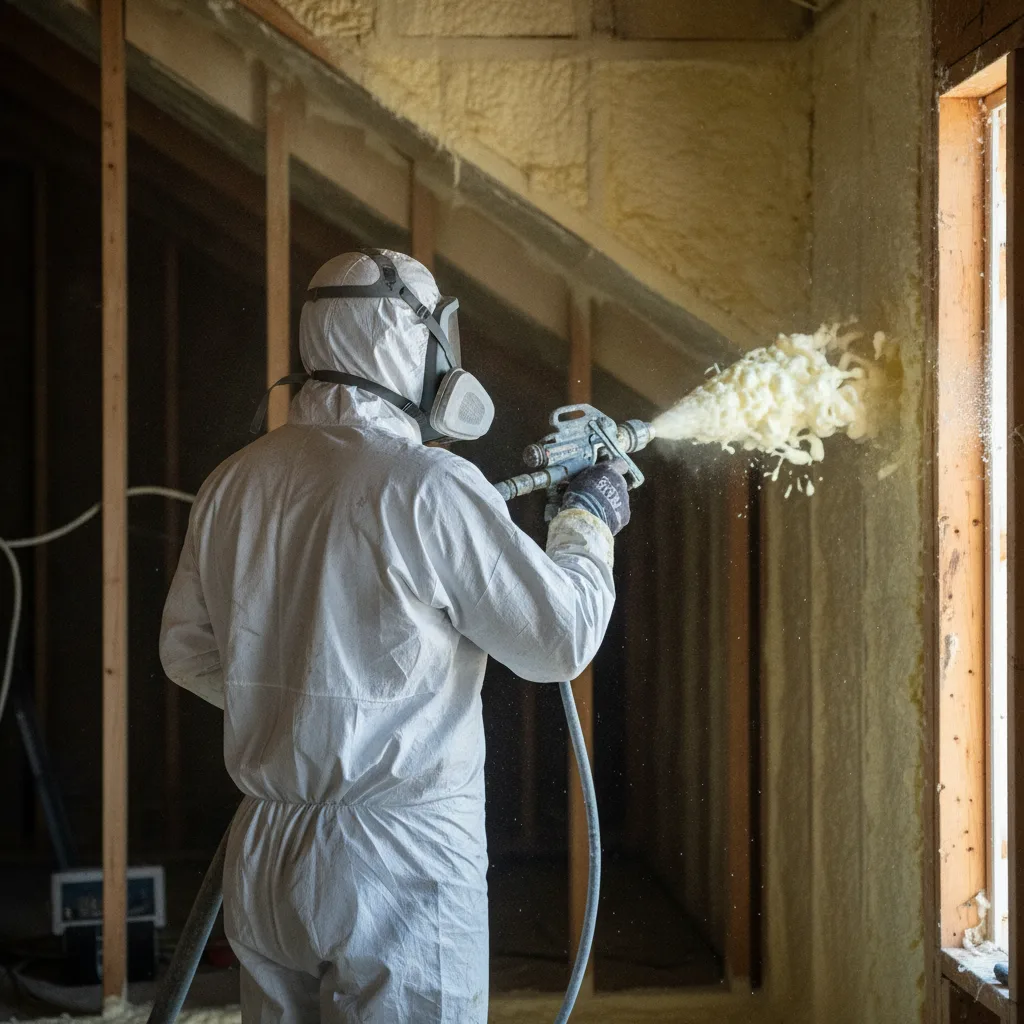
Our team in action — insulation professionals serving Burbank
Spray Foam Attic Insulation Methods and Approaches
Closed-Cell Spray Foam (2-Pound Density)
Closed-cell foam delivers R-6 to R-7 per inch and acts as both a thermal barrier and a Class II vapor retarder. It is the preferred choice for Burbank hillside properties in Wildland-Urban Interface zones where ember intrusion is a concern, for unvented attic assemblies where condensation control is critical, and for commercial metal roof decks in the Burbank Airport industrial corridor. Application thickness typically ranges from 3 to 4 inches for residential rafter applications.
Open-Cell Spray Foam (Half-Pound Density)
Open-cell foam provides R-3.5 to R-3.7 per inch at a lower material cost and is ideal for large attic floor areas where budget is the primary driver and vapor permeability is acceptable. It excels in Burbank’s older Craftsman and bungalow stock where attic floor area is large and the primary goal is air sealing plus thermal improvement without the premium of closed-cell.
Hybrid Spray Foam System
A hybrid approach applies a thin layer of closed-cell foam (1 to 1.5 inches) as a vapor-control and air-sealing foundation, followed by open-cell foam or blown-in cellulose on top for additional thermal mass. This is cost-effective for Burbank’s flat-ceiling ranch homes where rafter cavities are shallow but large attic floor areas need maximum R-value per dollar.
Unvented Attic Conversion
Converting a vented attic to an unvented conditioned attic using spray foam applied to the roof deck underside brings HVAC equipment into the conditioned envelope — a major efficiency gain for the many Burbank homes with ductwork running through the attic. This method is particularly effective for mid-century homes in the Rancho District and Magnolia Park where duct leakage through unconditioned attics is a top energy loss driver. Compare with our blow-in insulation options
Ready for Spray Foam Attic Insulation? Get Your Free Estimate Today.
Next Level Insulation of Burbank serves Burbank and the surrounding area — we’ll be on-site within 24 hours.
📞 Call (818) 514-7541Spray Foam Attic Insulation Cost in Burbank, CA
Understanding the investment involved in spray foam attic insulation helps Burbank homeowners and property managers plan accurately. Costs vary based on foam type, attic configuration, and project complexity.
Typical Cost Ranges
- Open-cell spray foam (attic floor): $1.00 to $1.50 per board foot, or approximately $1,800 to $3,500 for a typical 1,200 to 1,800 square foot Burbank ranch home attic
- Closed-cell spray foam (rafter underside, unvented conversion): $2.00 to $3.50 per board foot, with typical whole-attic projects ranging from $4,500 to $9,000 depending on attic geometry
- Hybrid system (closed-cell base plus open-cell or blown-in topper): $3,000 to $6,500 for most Burbank residential applications
- Commercial metal roof applications: $3.00 to $5.00 per board foot; large-format warehouse attics near the Burbank Airport zone typically run $15,000 to $40,000+
Burbank-Specific Cost Factors
- Existing insulation removal: Add $500 to $1,500 for full removal of contaminated or degraded insulation, common in pre-1970 Magnolia Park and Rancho District homes
- Hillside access surcharges: Steep-slope and limited-access properties in the Burbank Hills may add 10 to 20 percent to labor costs
- California Title 24 compliance documentation: Required for permitted work; typically included in our project pricing
- SoCal Edison rebates: Qualifying attic insulation upgrades may be eligible for rebates of $0.10 to $0.25 per square foot through current utility incentive programs — ask our team for current availability
Call (818) 514-7541 for a no-obligation, itemized written estimate.
Burbank Neighborhoods We Serve
Magnolia Park
One of Burbank’s most architecturally distinctive neighborhoods, Magnolia Park is home to hundreds of Craftsman bungalows and Spanish Colonial Revival homes built between 1920 and 1950. Attics in these properties typically have low-pitch gable configurations with original rock wool or early fiberglass insulation compressed to negligible performance levels. Our team regularly removes and replaces this degraded material before applying spray foam tailored to the shallow rafter depths found here.
Rancho District
This post-war suburban district features mid-century ranch homes built predominantly from 1950 to 1970, many with large, flat attic planes ideal for deep open-cell spray foam or blown-in applications. A recurring challenge is ductwork running through unconditioned attic space — a problem we solve with unvented attic conversions that dramatically cut duct-loss penalties.
Burbank Hills
Properties ascending toward the Verdugo Mountains face heightened wind exposure, complex roof geometries, and Wildland-Urban Interface fire risk designations. Closed-cell spray foam is the standard of care here, providing ember resistance, vapor control, and structural uplift resistance in a single application.
Downtown Burbank and Media District
Mixed-use and commercial properties near the entertainment production corridor along Olive Avenue and in the Warner Bros. vicinity often have large-format flat roof assemblies requiring commercial-grade spray foam. We are experienced with these project scales and California energy code documentation requirements. Ask about our crawl space insulation for older Burbank properties
Attic Insulation Maintenance Tips for Burbank Homeowners
- Inspect annually before summer: Visit your attic each April to visually confirm spray foam coverage is intact, with no physical damage from roof repairs or pest activity common in Burbank’s urban-wildland fringe areas.
- Monitor SoCal Edison bills seasonally: A sudden spike in summer cooling costs without a change in usage often signals a new air bypass or foam damage requiring prompt attention.
- Keep soffit vents clear: In vented attic configurations, blocked soffit vents reduce the effectiveness of your insulation system. Check after the leaf fall season in November and December.
- Control roof rat access: Burbank’s urban tree canopy supports a significant roof rat population. Rats can damage spray foam over time. Seal roofline penetrations and monitor for gnawing evidence during annual attic checks.
- Coordinate attic access with HVAC maintenance: Instruct HVAC technicians not to disturb foam applications around duct connections and air handlers during annual service visits.
- Replenish blown-in topper layers: If your system uses a hybrid approach with a blown-in cellulose or fiberglass topper, re-evaluate depth every 7 to 10 years as settling occurs, especially after significant Santa Ana wind events.
- Address roof leaks immediately: Water infiltration can compromise closed-cell foam adhesion and saturate open-cell foam. After Burbank’s winter rain events, inspect for new staining on attic sheathing.
Why Choose Next Level Insulation of Burbank
Next Level Insulation of Burbank is a locally focused insulation contractor with deep familiarity with the specific housing stock, climate challenges, and energy code requirements that define Burbank’s residential and commercial property landscape. Our technicians know the difference between the shallow rafter cavities of a Magnolia Park Craftsman and the cathedral ceiling challenges of a mid-century Burbank Hills contemporary — and they apply the right foam formulation and thickness for each application.
We serve not only Burbank but the wider San Fernando Valley and Los Angeles communities — including Studio City, Sherman Oaks, North Hollywood, Glendale, Pasadena, and Beverly Hills — bringing the same precision and care to every project regardless of geography.
Our full service lineup includes insulation installation, spray foam insulation, attic insulation, blow-in insulation, crawl space encapsulation, insulation removal and replacement, giving you a single trusted partner for any insulation challenge your property presents.
Call us at (818) 514-7541 to speak with a local Burbank insulation specialist today.
Frequently Asked Questions — Spray Foam Attic Insulation in Burbank, CA
How much does spray foam attic insulation cost in Burbank?
Open-cell spray foam typically costs $1.00 to $1.50 per board foot, with most Burbank residential attics running $1,800 to $3,500. Closed-cell applications for unvented attic conversions range from $4,500 to $9,000 for typical single-family homes. Hillside properties in the Burbank Hills may carry a 10 to 20 percent labor surcharge due to access complexity. Call (818) 514-7541 for a precise written quote.
How long does the installation take?
Most residential spray foam attic projects in Burbank complete in a single day. The foam application itself takes 2 to 6 hours depending on attic size and configuration, followed by a 24-hour cure and off-gas period before the space is re-occupied. Total project duration from first contact to completion is typically 5 to 10 business days, including assessment, proposal, scheduling, and installation.
Is spray foam better than blown-in insulation for Burbank attics?
Spray foam provides superior air sealing — the single biggest driver of energy loss in Burbank’s thermally stressed attics. Blown-in cellulose or fiberglass provides excellent R-value per dollar for attic floor applications but does not seal air bypasses. For homes with ductwork in the attic, complex roof geometries, or Wildland-Urban Interface fire risk, spray foam is the clear superior choice. Many Burbank projects use a hybrid approach: spray foam for air sealing and a blown-in topper for thermal mass. Compare blow-in insulation options
Will spray foam attic insulation reduce my SoCal Edison bills?
Yes, measurably. Homes in Burbank’s climate zone — California Title 24 Climate Zone 9 — typically see cooling and heating cost reductions of 20 to 40 percent following a spray foam attic upgrade, depending on pre-installation conditions. Homes in Magnolia Park and the Rancho District with original or severely degraded insulation often see the highest savings. SoCal Edison rebate programs may also partially offset your installation cost.
Do I need a permit for spray foam attic insulation in Burbank?
Insulation work in California is regulated under Title 24. Unvented attic conversions and new construction applications typically require a building permit through the City of Burbank Building and Safety Division. Re-insulation of existing attic floors generally does not require a permit but must still meet Title 24 minimum R-values. Our team handles all required documentation and can coordinate permit applications on your behalf.
Is spray foam safe for my family after installation?
Once fully cured — approximately 24 hours after application — spray foam is inert and safe for occupants. During and immediately after application, the space must remain unoccupied due to off-gassing of chemical components. Our crews follow California OSHA protocols, including full PPE and attic ventilation during application. We provide a re-occupancy clearance at project completion.
Can spray foam insulation help with wildfire protection in the Burbank Hills?
Closed-cell spray foam applied to the underside of roof sheathing can significantly reduce ember intrusion through eave spaces and roof deck gaps — one of the primary ignition pathways identified by Cal Fire in structure losses during wildland fires. While spray foam is not a standalone fire protection system, it complements ember-resistant vents and other WUI-compliant measures recommended for Burbank hillside properties.
How long does spray foam attic insulation last in Burbank’s climate?
High-quality two-component polyurethane foam has a physical service life exceeding 80 years when not disturbed by water intrusion, mechanical damage, or UV exposure. In Burbank’s enclosed attic environment, spray foam is effectively a permanent installation. Unlike fiberglass batts, it does not settle, compress, or lose R-value over time, making it one of the highest-lifetime-value insulation investments available to Burbank property owners.
Get Your Free Spray Foam Attic Insulation Estimate in Burbank Today
Stop paying for energy that’s escaping through your attic every day. Whether you own a 1940s Craftsman in Magnolia Park, a mid-century ranch in the Rancho District, or a hillside contemporary with complex rooflines, Next Level Insulation of Burbank has the expertise and equipment to transform your attic’s thermal performance.
Our team provides free, no-obligation on-site assessments with detailed written proposals — no pressure, no surprises. We serve Burbank and the greater Los Angeles area, including Studio City, North Hollywood, Glendale, Pasadena, Sherman Oaks, and beyond.
Call us now at (818) 514-7541 to schedule your attic assessment. Comfort, lower energy bills, and a properly insulated home are one call away.