

Air Sealing in Burbank, CA
Professional Air Sealing in Burbank, CA — Licensed, Insured & Locally Owned
Need air sealing in Burbank, CA? Next Level Insulation offers expert air sealing with blower door testing. Call (818) 514-7541 for a free estimate today.
- Licensed & Insured
- Locally Owned & Operated
- Free Inspection & Estimate
Request Your
Free EstimateAir sealing is the process of identifying and closing gaps, cracks, and openings in a building’s envelope that allow conditioned air to escape and unconditioned air to infiltrate. For homeowners and business owners in Burbank, CA, this service is not a luxury — it is a foundational energy-efficiency measure that directly impacts comfort, utility costs, and indoor air quality year-round.
Burbank’s unique position in the San Fernando Valley means residents deal with intense summer heat radiating off surrounding hillsides, dry Santa Ana wind events that force outside air through every unsealed gap, and cool winters that demand efficient heating. Older Craftsman bungalows near Magnolia Park and mid-century ranch homes in the Rancho neighborhood lose significant conditioned air through attic bypasses, wall penetrations, and aging window frames.
At Next Level Insulation of Burbank, our certified technicians specialize in diagnosing air leakage problems specific to Burbank’s building stock and climate zone (California Climate Zone 9). Call us today at (818) 514-7541 to schedule your assessment.
Understanding Air Sealing in Burbank, CA
Air sealing encompasses a range of techniques designed to create a continuous, airtight barrier within a building’s thermal envelope. Unlike insulation — which slows heat transfer — air sealing physically blocks the movement of air between conditioned and unconditioned spaces. The two strategies work synergistically: insulation without air sealing is like wearing a sweater with a broken zipper.
The science behind air sealing dates back to building performance research conducted in the 1970s following the oil embargo, when the U.S. Department of Energy began funding studies on residential energy losses. Researchers discovered that air infiltration accounted for anywhere from 25% to 40% of a home’s heating and cooling load — a finding that fundamentally changed how building scientists approached envelope performance. Since then, materials like two-part spray polyurethane foam, flexible caulk compounds, and weatherstripping systems have evolved dramatically.
In Burbank and the broader Los Angeles basin, the prevalence of air leakage is directly tied to the local building boom eras. The city experienced explosive residential growth between 1925 and 1955, producing thousands of wood-framed homes with balloon-frame or platform construction. These framing styles create continuous cavities that allow air to travel freely from basement to attic. A classic Craftsman home near the Magnolia Park Historic District, for example, may have been built without any intentional air barrier whatsoever — relying purely on the thermal mass of plaster walls.
The post-war building surge of the 1950s and 1960s added thousands of ranch-style homes and apartment complexes throughout Burbank’s flatlands. These structures frequently used minimal insulation and relied on single-pane windows, creating envelope systems that are highly porous by modern standards. The California Energy Commission estimates that homes built before 1978 — the year the state adopted its first mandatory energy code — typically operate at 0.5 to 1.5 air changes per hour (ACH) under natural conditions, compared to the 0.35 ACH target set by modern standards.
Commercial buildings near the Burbank Media District and Warner Bros. Studios face their own air sealing challenges, including large HVAC penetrations, loading dock gaps, and high-traffic entryways that compromise envelope integrity. Learn more about our commercial insulation services
Why Air Sealing Is Needed in Burbank, CA
The Santa Ana Wind Effect
Burbank sits in a corridor directly affected by Santa Ana wind events, which typically occur between October and March. During major events — such as the October 2019 Saddle Ridge Fire windstorm that recorded gusts exceeding 80 mph in the Verdugo Mountains just northeast of Burbank — ambient wind pressure against building envelopes increases dramatically. Even at modest Santa Ana speeds of 30 to 50 mph, pressure differentials across a building’s exterior can force outside air through gaps as small as 1/16 of an inch. Homes with unsealed attic bypasses and recessed lighting penetrations are particularly vulnerable, pulling ash, particulate matter, and allergens directly into living spaces.
California Climate Zone 9 Heat Loading
Burbank falls squarely within California Climate Zone 9, characterized by hot, dry summers with inland heat accumulation and mild, occasionally cool winters. July average highs in Burbank regularly reach 95°F to 100°F, and during heat dome events — such as the September 2020 heat wave when Burbank recorded 108°F — the thermal load on homes without proper air sealing becomes extreme. When attic temperatures climb to 140°F or higher (a common occurrence in Burbank’s low-slope residential roofs), uncontrolled air movement from attic to living space can raise indoor temperatures by 5°F to 10°F even with air conditioning running continuously.
Soil Conditions and Foundation Gaps
Burbank’s geology includes areas of expansive clay soils, particularly in the flatter portions of the city near the Los Angeles River channel and in neighborhoods like the Rancho District. As these soils shrink and swell with seasonal moisture changes, foundation movement creates micro-gaps at the sill plate — the wooden framing member that sits directly on the concrete foundation. Over a 50-year-old home’s lifetime, this cyclical movement can open sill plate gaps of 1/4 inch or more around the entire perimeter, contributing measurably to crawl space air infiltration.
The Urban Heat Island in the San Fernando Valley
The San Fernando Valley, of which Burbank is a key eastern anchor, is one of the most documented urban heat island zones in California. Studies by UCLA’s Institute of the Environment have found that valley floor temperatures average 3°F to 5°F higher than surrounding areas due to pavement density, reduced tree canopy, and concentrated building mass. This ambient heat intensification means Burbank homes work harder to maintain comfortable indoor temperatures, making every unsealed gap more costly in energy terms than it would be in a cooler coastal city like Santa Monica or Torrance.
Older Multifamily Buildings
Burbank has a significant multifamily housing inventory along corridors like Olive Avenue, Victory Boulevard, and Hollywood Way, much of it constructed in the 1960s and 1970s. These garden apartment complexes often feature open-top party walls, uninsulated laundry chases, and unblocked floor joist cavities that act as air highways between units and between conditioned and unconditioned spaces. Residents in these buildings frequently experience drafts, inconsistent temperatures between rooms, and elevated utility bills — all classic signs of envelope air leakage.
Signs You Need Air Sealing in Burbank
Energy and Comfort Indicators
- Monthly SoCal Edison bills that spike above $200 in July and August despite moderate thermostat settings
- Rooms that feel 5°F or more warmer or cooler than the thermostat reading
- HVAC system running nearly continuously during Santa Ana wind events
- Drafts felt near electrical outlets, recessed lights, or baseboards on windy days
Physical and Visual Symptoms
- Visible daylight through gaps at sill plates in crawl spaces or basements
- Discolored or dusty insulation in the attic — a sign that air is moving through it rather than around it
- Cobwebs forming consistently at the same wall or ceiling penetrations (spiders build webs where air currents bring prey)
- Frost or condensation on interior window frames during winter mornings in Burbank’s cooler months (December through February)
Indoor Air Quality Concerns
- Increased dust accumulation shortly after Santa Ana wind events
- Persistent musty odors entering from crawl spaces or unconditioned attics
- Allergy or asthma symptoms that worsen indoors during wildfire smoke events affecting the Verdugo Hills area
Urgency Indicator: If your home experienced the 2020 or 2021 Bobcat Fire smoke events and you noticed interior air quality degradation, air sealing should be treated as a priority health measure, not just an energy upgrade.
Our Air Sealing Process in Burbank
Initial Consultation and Scheduling (Day 1)
We begin with a phone or on-site consultation to discuss your energy concerns, recent utility bills, and any observable comfort issues. For Burbank residents, we specifically ask about the age of the home, proximity to the Verdugo Hills (which affects wind exposure), and whether the property has a crawl space or slab foundation.
Blower Door Diagnostic Test (2–3 Hours)
Our technicians install a calibrated blower door unit in the front door frame. This device depressurizes the home to 50 Pascals below outdoor pressure, allowing us to measure total air leakage in CFM50 (cubic feet per minute at 50 Pascals). We also use an infrared thermal camera to visualize leakage locations in real time. Burbank’s mild mornings (typically 60°F to 70°F in spring and fall) provide ideal temperature differentials for thermal imaging.
Leakage Mapping and Prioritization (1 Hour)
Results are mapped on a building diagram, prioritizing locations by leakage volume and access difficulty. In Burbank’s Craftsman homes, we typically find the highest leakage at attic bypasses around chimney chases, plumbing stacks, and interior wall top plates.
Attic Air Sealing (4–8 Hours)
Technicians access the attic and seal all identified penetrations using the appropriate material for each gap size. Attic work in Burbank homes is scheduled for morning hours to avoid dangerous attic temperatures that can reach 130°F to 140°F by early afternoon in summer months.
Crawl Space and Foundation Sealing (2–4 Hours)
Sill plates, floor joist cavities, and utility penetrations in the crawl space are sealed. We coordinate this step with any planned crawl space encapsulation work for maximum efficiency.
Living Space Penetration Sealing (2–3 Hours)
Recessed lights, electrical boxes, plumbing penetrations, and HVAC chases within conditioned spaces are addressed using fire-rated caulk and foam as required by California building code.
Post-Sealing Verification Test (1–2 Hours)
A final blower door test confirms the reduction in air leakage rate, providing a measurable before-and-after comparison. We document results and provide a written summary for your records, which is useful for utility rebate applications through SoCal Edison or SoCalGas.
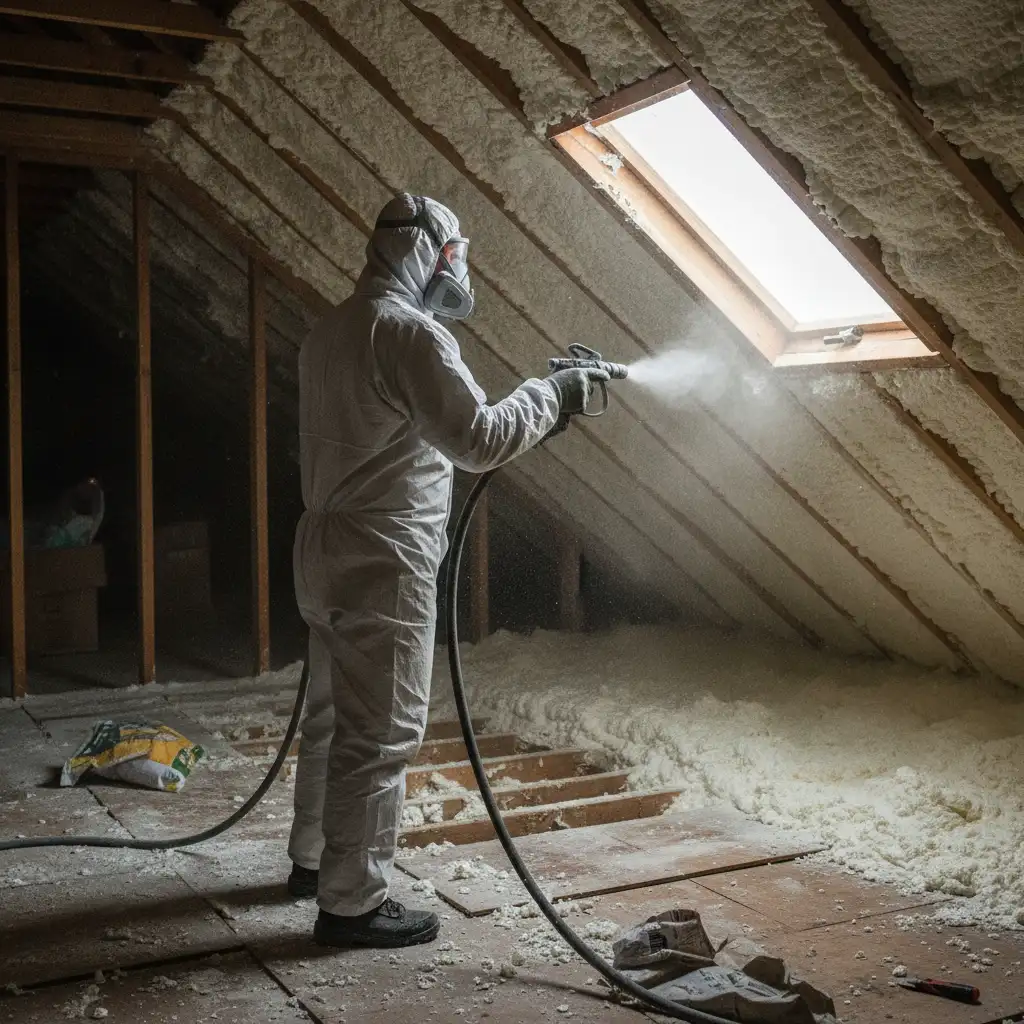
Our team in action — insulation professionals serving Burbank
Air Sealing Methods and Approaches We Use
Two-Part Spray Polyurethane Foam (SPF)
For large gaps exceeding 1/2 inch — such as those found around chimney chases in Burbank’s older Craftsman homes or at utility penetrations in attic floors — we use two-part spray foam. This expanding material fills irregular cavities completely and creates an airtight, moisture-resistant seal. In Burbank’s hot attic environments, we select high-temperature-rated closed-cell SPF formulations that maintain dimensional stability at temperatures above 120°F. Learn more about our spray foam insulation services
Low-Expansion Single-Component Foam
For medium gaps between 1/4 inch and 1/2 inch around window frames, door thresholds, and pipe penetrations, single-component low-expansion foam provides a controlled, precise seal. This is especially useful in finished living areas where over-expansion could damage trim or drywall.
Caulk and Sealant Systems
Gaps smaller than 1/4 inch at baseboards, window rough openings, and wall plate penetrations are addressed with elastomeric caulk compounds. In Burbank, we use sealants rated for temperature ranges of -20°F to 300°F to accommodate the extreme attic heat cycles common in San Fernando Valley summers.
Rigid Foam Blocking with Adhesive
For large, flat openings such as open-top partition walls at the attic floor, we cut and install rigid foam board blocking secured with foam adhesive. This approach is particularly effective in Burbank’s 1950s ranch homes, where interior wall top plates frequently open directly into the attic cavity.
Weatherstripping and Door Sweep Systems
Attic hatches, garage-to-house doors, and exterior entry points receive compression weatherstripping and automatic door sweeps, providing dynamic seals that maintain performance through seasonal wood expansion and contraction.
Ready for Air Sealing? Get Your Free Estimate Today.
Next Level Insulation of Burbank serves Burbank and the surrounding area — we’ll be on-site within 24 hours.
📞 Call (818) 514-7541Air Sealing Cost in Burbank, CA
Understanding the cost of air sealing in Burbank helps homeowners budget appropriately and evaluate the return on investment through energy savings. Pricing varies based on home size, construction type, leakage severity, and access conditions.
Typical Price Ranges
- Basic Air Sealing (attic and accessible areas only): $500 – $900 for homes under 1,500 sq ft
- Standard Whole-Home Air Sealing (attic, crawl space, living areas): $900 – $2,000 for homes between 1,500 and 2,500 sq ft
- Comprehensive Air Sealing with Blower Door Testing (before and after): $1,500 – $3,500 for larger or more complex homes above 2,500 sq ft
- Multifamily Unit Air Sealing (per unit): $400 – $800 depending on unit size and party wall access
Factors That Affect Cost in Burbank
- Attic access difficulty: Low-pitch roofs common in Burbank’s ranch homes limit mobility and increase labor time
- Age of construction: Pre-1960 balloon-frame homes typically have more leakage points and require more material
- Combination with insulation work: Bundling air sealing with attic insulation installation or blow-in insulation reduces per-service costs by 15% to 25%
- Rebate availability: SoCal Edison’s Home Energy Improvement Program offers rebates of up to $500 for qualifying air sealing projects, effectively reducing your out-of-pocket cost
Air sealing in Burbank typically delivers a payback period of 3 to 7 years through reduced utility bills, with homes in older Magnolia Park or Rancho District neighborhoods often seeing the fastest returns due to their higher baseline leakage rates. Call (818) 514-7541 for a specific estimate for your property.
Neighborhoods We Serve in and Around Burbank
Magnolia Park Historic District
This beloved Burbank neighborhood is home to some of the city’s oldest residential stock, with Craftsman bungalows and Spanish Colonial Revival homes built primarily between 1920 and 1945. These properties frequently feature plaster-over-wood-lath wall systems with no air barrier and chimney chases that bypass every floor from foundation to roof peak. Air sealing in these homes requires careful, historically sensitive approaches to avoid disturbing character-defining features.
Rancho District
Burbank’s Rancho neighborhood is dominated by post-war ranch homes built on slab foundations with low-slope roofs. The combination of expansive clay soil movement and minimal original insulation makes these homes particularly prone to sill plate gaps and attic bypass leakage. Insulation replacement paired with air sealing is a common and highly effective upgrade strategy here.
Hollywood Way Corridor
The apartment complexes lining Hollywood Way near the Bob Hope Airport area present multifamily air sealing challenges, including open-top party walls, shared HVAC chases, and high-traffic entry doors. We serve tenants and property owners alike with targeted solutions for this building type.
Additional Service Areas
We also serve Studio City, Sherman Oaks, North Hollywood, Sun Valley, Toluca Lake, Universal City, Valley Village, Hollywood, Beverly Hills, Glendale, Pasadena, Alhambra, Culver City, East Los Angeles, South Pasadena, La Cañada Flintridge, San Gabriel, and West Hollywood.
Air Sealing Maintenance Tips for Burbank Homeowners
- Inspect weatherstripping annually before Santa Ana season (September): Check all exterior doors and the attic hatch for compression loss or cracking caused by summer heat exposure.
- Check caulk at window frames every two years: Burbank’s thermal cycling between cool winter mornings and hot summer afternoons accelerates caulk deterioration. Reapply where cracking or separation is visible.
- Monitor your SoCal Edison bill seasonally: A sudden increase in July or August with no behavioral change often indicates new air leakage from UV-degraded seals or pest damage.
- Inspect crawl space vents and screens after heavy rain events: Winter rains (typically December through February) can shift soil and open gaps at foundation vents in Burbank’s clay-soil areas.
- Check attic hatch insulation and sealing annually: Attic hatches are frequently disturbed by plumber or HVAC service visits. Verify that foam gaskets remain intact after any attic access.
- Seal new penetrations immediately: Any new cable, pipe, or wire run through exterior walls or the attic floor should be sealed before the contractor leaves. Unsealed penetrations are among the most common causes of post-upgrade leakage.
- Request a follow-up blower door test every 5 years: Seals age and buildings shift. A periodic diagnostic test catches new leakage before it significantly impacts energy bills.
Why Choose Next Level Insulation of Burbank
Next Level Insulation of Burbank is a locally operated insulation and air sealing company with deep roots in the Burbank and San Fernando Valley community. Our technicians are trained specifically in the building types and climate conditions of California Climate Zone 9, giving us practical expertise that out-of-area contractors simply cannot match.
We perform diagnostic blower door testing on every comprehensive air sealing project — not as an add-on, but as a standard component of our service. This commitment to measurable results means you receive documented proof of improvement, not just a contractor’s word that the work is done.
Our team is familiar with Burbank’s specific building eras, from the Craftsman homes of Magnolia Park to the mid-century apartment complexes near Victory Boulevard, and we adapt our methods accordingly. We also stay current with SoCal Edison and SoCalGas rebate programs so we can help you maximize available incentives.
We offer comprehensive insulation services including spray foam insulation, attic insulation, blow-in insulation, crawl space insulation, insulation removal, and crawl space encapsulation. Call (818) 514-7541 to speak directly with a Burbank air sealing specialist.
Frequently Asked Questions About Air Sealing in Burbank, CA
How much does air sealing cost in Burbank, CA?
Air sealing costs in Burbank typically range from $500 for a basic attic-only service to $3,500 or more for a comprehensive whole-home project with blower door testing in a larger or older property. Homes in Burbank’s Magnolia Park and Rancho neighborhoods often fall in the $900 to $2,000 range due to their size and age. SoCal Edison rebates can offset $150 to $500 of this cost for qualifying projects.
How long does air sealing take in Burbank?
A standard whole-home air sealing project in Burbank takes one to two days. The blower door diagnostic test requires two to three hours, attic sealing typically takes four to eight hours (scheduled in the morning to avoid extreme attic heat), and crawl space work adds two to four hours. Most projects are completed in a single day for homes under 2,000 square feet.
Do I need air sealing if I already have insulation?
Yes. Insulation and air sealing serve different functions. Insulation slows heat conduction, but air sealing stops bulk air movement. A Burbank attic with 12 inches of blown-in fiberglass but no air sealing can still allow significant hot attic air to bypass the insulation layer through gaps around plumbing stacks and light fixtures. Air sealing and insulation together deliver far better results than either does alone.
Is air sealing worth it in Burbank’s climate?
Absolutely. Burbank’s combination of extreme summer heat (regularly above 95°F), Santa Ana wind pressure loading, and California Climate Zone 9 energy demands makes air sealing one of the highest-return energy upgrades available to local homeowners. Most Burbank residents see a 15% to 30% reduction in heating and cooling costs following comprehensive air sealing, with payback periods of three to seven years.
Can air sealing help with smoke and wildfire air quality in Burbank?
Yes. During wildfire events affecting the Verdugo Hills, San Gabriel Mountains, or broader Los Angeles region — such as the 2020 Bobcat Fire — a well-sealed home significantly reduces the infiltration of smoke particles and ash. While air sealing is not a substitute for air filtration, reducing uncontrolled air exchange through gaps and cracks meaningfully improves indoor air quality during smoke events.
What is a blower door test and do I need one?
A blower door test is a diagnostic procedure that pressurizes your home using a calibrated fan to measure total air leakage. We strongly recommend it for Burbank homeowners because it identifies exactly where leakage is occurring and provides a quantified baseline. After sealing, a second test confirms the improvement. This documentation is also required for certain SoCal Edison Home Energy Improvement Program rebates.
Does air sealing cause moisture problems?
When performed correctly in Burbank’s dry climate, air sealing does not cause moisture problems. California Climate Zone 9’s low humidity means moisture accumulation from reduced air exchange is rarely a concern. In fact, uncontrolled air infiltration is more likely to introduce moisture during our brief rainy season (December through March). We always evaluate ventilation requirements as part of our process to ensure code compliance.
What areas near Burbank do you serve?
In addition to Burbank, we serve Studio City, Sherman Oaks, North Hollywood, Sun Valley, Toluca Lake, Universal City, Valley Village, Monterey Park, Hollywood, Beverly Hills, Glendale, Pasadena, Alhambra, Culver City, East Los Angeles, South Pasadena, La Cañada Flintridge, San Gabriel, and West Hollywood.
Get Professional Air Sealing in Burbank Today
Stop paying for conditioned air that leaks out through unsealed gaps, and stop letting Burbank’s intense summer heat and Santa Ana winds push their way into your home. Next Level Insulation of Burbank is ready to assess your property, identify every significant leakage point, and deliver measurable results you can see on your utility bill.
Whether you live in a 1930s Craftsman in Magnolia Park, a 1960s ranch in the Rancho District, or a modern home anywhere in Burbank or the surrounding San Fernando Valley, our team has the local expertise and diagnostic tools to get the job done right.
Call us now at (818) 514-7541 to schedule your blower door assessment and air sealing consultation. Ask about current SoCal Edison rebate programs that may reduce your project cost.