

Crawl Space Insulation in Los Angeles, CA
Energy-Saving Crawl Space Insulation for Los Angeles, CA Homes — Licensed & Insured
Need crawl space insulation in Los Angeles, CA? Next Level Insulation offers expert installation, encapsulation & removal. Call (323) 765-3939 for a free estimate.
- Licensed & Insured
- Locally Owned & Operated
- Free Inspection & Estimate
Request Your
Free EstimateCrawl space insulation is the process of thermally sealing and protecting the underfloor cavity beneath your home, creating a barrier against heat transfer, moisture intrusion, pests, and poor indoor air quality. In Los Angeles, where homes range from post-war bungalows in Boyle Heights to mid-century ranchers in the San Fernando Valley, crawl spaces are exposed to a uniquely challenging combination of seasonal temperature swings, coastal humidity, and seismic activity that accelerates insulation degradation far faster than in other regions of the country.
At Next Level Insulation of Los Angeles, we specialize in comprehensive crawl space insulation solutions tailored to the specific construction styles and environmental conditions found across the greater Los Angeles area. Whether your home sits on a raised foundation in Pasadena or a hillside lot in Silver Lake, our team delivers expert-level installation using materials and methods proven to perform in Southern California’s distinct climate. Call us today at (323) 765-3939 to schedule your crawl space assessment.
Understanding Crawl Space Insulation
Crawl space insulation refers to the installation of insulating materials — such as fiberglass batts, spray foam, rigid foam board, or blown-in cellulose — within the underfloor cavity of a raised-foundation home. Depending on the approach used, insulation may be applied to the subfloor joists above (a vented crawl space strategy) or to the interior walls of the crawl space itself (an encapsulated, conditioned crawl space strategy). Each method creates a thermal envelope that reduces heat loss in winter, heat gain in summer, and limits the migration of ground moisture into your living spaces.
Historically, crawl spaces became a dominant foundation type in Los Angeles during the post-World War II housing boom of the late 1940s through the 1960s. Developers building rapidly in neighborhoods like Westchester, Monterey Park, and South Gate used raised foundations to accommodate the region’s variable hillside terrain and to allow access to plumbing and electrical systems beneath the floor. At the time, crawl space insulation standards were minimal or nonexistent — most homes were built with little to no underfloor protection, relying instead on the mild Southern California climate to compensate.
That assumption has proven costly. Studies from the California Energy Commission estimate that uninsulated or poorly insulated crawl spaces account for up to 15–20% of a home’s total heating and cooling energy loss. In Los Angeles, where the Department of Water and Power reports average residential energy costs consistently above the national median, this translates to hundreds of dollars in unnecessary utility spending each year.
Crawl spaces are present in a significant share of LA’s older housing stock — particularly single-family homes built before 1980. Craftsman bungalows in Highland Park, Spanish Colonial Revival homes in Hancock Park, and post-war tract homes in Downey and Cudahy all commonly feature raised foundations with crawl spaces that have either lost their original insulation or were never properly insulated to begin with. Understanding the age and construction type of your home is the first step toward selecting the right insulation strategy.
Why Crawl Space Insulation Is Needed in Los Angeles
Los Angeles Climate and Temperature Variance
Despite its reputation for mild weather, Los Angeles experiences meaningful temperature swings that stress uninsulated crawl spaces. The National Weather Service records average summer highs near downtown LA reaching 88°F to 95°F during heat waves, while inland communities like Pasadena and Alhambra routinely exceed 100°F during Santa Ana wind events — most notably the Woolsey-era conditions of November 2018 and the extreme heat event of September 2022 that pushed temperatures to historic highs across LA County. Meanwhile, winter nights in hillside neighborhoods like Eagle Rock and Mount Washington can dip to 38°F to 42°F. This 50–60°F seasonal range causes the wood framing of your subfloor to repeatedly expand and contract, loosening batt insulation from joist cavities and creating gaps where conditioned air escapes and unconditioned air enters.
Coastal and Inland Moisture Dynamics
Los Angeles sits within a Mediterranean climate zone characterized by dry summers and wet winters. However, the city’s proximity to the Pacific Ocean — particularly in communities like Culver City, West Hollywood, and East Los Angeles — means that marine layer humidity regularly pushes moisture levels beneath homes. The June Gloom phenomenon, which blankets coastal LA neighborhoods with marine fog from May through July, elevates underfloor relative humidity to levels between 70% and 85% on a regular basis. At these levels, wood rot, mold colonization, and pest infestation become active threats. The Maywood and Bell areas, which sit atop historically high groundwater zones, experience ground moisture vapor emissions that can penetrate unprotected crawl spaces year-round.
Seismic Activity and Structural Gaps
Los Angeles sits directly atop the Pacific-North American tectonic plate boundary. The Northridge Earthquake of January 17, 1994 — a 6.7 magnitude event — caused widespread structural shifting in thousands of raised-foundation homes across the San Fernando Valley, Glendale, and Burbank. This seismic movement created gaps between crawl space insulation and joist framing that remain a problem in homes that were never reinspected or re-insulated after the event. Even smaller earthquakes, such as the 2019 Ridgecrest sequence (5.4 and 6.4 magnitude events felt strongly in Los Angeles), continue to loosen aging fiberglass batts from subfloor cavities throughout the region.
Soil Composition and Ground Vapor
Much of the Los Angeles Basin sits on expansive clay soils — particularly the Montebello, Huntington Park, and South Gate corridors — that retain moisture and emit ground vapor throughout the cooler, wetter months. Without proper crawl space insulation combined with a vapor barrier, this ground moisture migrates upward into floor systems, causing warped hardwood floors, musty odors, and elevated indoor humidity that strains HVAC systems and degrades indoor air quality.
Signs You Need Crawl Space Insulation in Los Angeles
Comfort and Energy Indicators
- Floors that feel noticeably cold in winter or warm in summer, especially in rooms directly above the crawl space
- Unexplained spikes in your LADWP electricity or gas bill, particularly during summer heat waves or winter cold snaps
- Uneven room temperatures throughout the home, with ground-floor rooms consistently harder to heat or cool
Moisture and Air Quality Indicators
- Musty or earthy odors inside the home, especially concentrated near floor vents or baseboards
- Visible condensation on windows or interior walls during the June Gloom season
- Allergy symptoms or respiratory irritation among occupants that worsen in damp weather
- Evidence of mold or mildew on subfloor framing, visible during a crawl space inspection
Structural and Pest Indicators
- Warped, soft, or spongy flooring — a sign that moisture has penetrated the subfloor sheathing
- Visible gaps, sagging, or fallen insulation batts hanging from floor joists
- Signs of rodent or pest activity in the crawl space, including droppings, nesting material, or damaged insulation
Urgency note: If you observe both moisture damage and pest activity simultaneously, treat this as an urgent situation requiring immediate professional inspection. Pest damage to vapor barriers and insulation can escalate structural wood rot rapidly in LA’s damp winter months.
Our Crawl Space Insulation Process
At Next Level Insulation of Los Angeles, we follow a structured, multi-step process designed specifically for the construction characteristics and environmental conditions found throughout the greater Los Angeles area.
Initial Assessment and Moisture Testing (Day 1 — 1 to 2 Hours)
Our technicians perform a thorough visual inspection of your crawl space, measuring access dimensions, ceiling heights (typically 18 to 36 inches in most LA raised-foundation homes), and documenting the condition of existing insulation, vapor barriers, and structural framing. We use calibrated moisture meters to record wood moisture content and assess relative humidity levels beneath the floor.
Old Insulation Removal (Day 1–2 — 2 to 4 Hours)
Degraded, pest-damaged, or moisture-compromised insulation is carefully removed using HEPA-filtered vacuum equipment. This is especially important in pre-1980 homes in neighborhoods like South Pasadena and Alhambra where older fiberglass batts may contain compressed, mold-laden material. Removed insulation is bagged and disposed of per Los Angeles County waste management guidelines. Learn more about our insulation removal services
Crawl Space Remediation and Preparation (Day 2 — 1 to 3 Hours)
Any mold remediation, pest exclusion repairs, and structural patching are completed before new insulation is installed. Foundation vents are evaluated for proper sizing based on California Building Code Section R408 requirements.
Vapor Barrier Installation (Day 2 — 1 to 2 Hours)
A 6-mil to 20-mil polyethylene vapor barrier is installed across the crawl space floor and secured to foundation walls, reducing ground moisture vapor transmission — critical for homes in the Maywood, Bell, and Huntington Park areas with expansive clay soil conditions.
Insulation Installation (Day 2–3 — 2 to 6 Hours)
New insulation is installed to current California Title 24 Energy Code standards, which require a minimum of R-19 for underfloor applications in Climate Zone 9 (which includes most of Los Angeles). Explore our crawl space encapsulation options
Final Inspection and Documentation (Day 3 — 1 Hour)
We conduct a post-installation walkthrough, photograph completed work, and provide written documentation of materials used and R-values achieved for your records and any future permit applications.
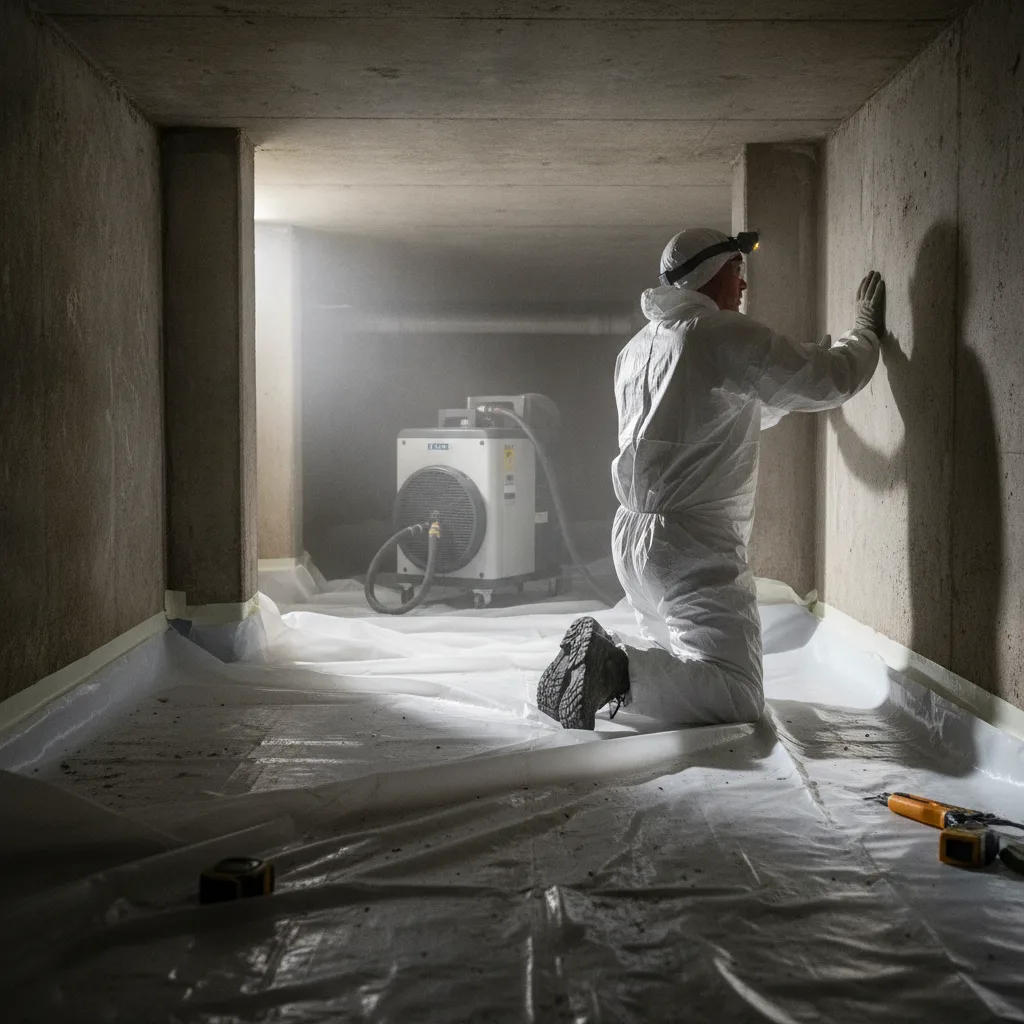
Our team in action — insulation professionals serving Los Angeles
Crawl Space Insulation Methods and Approaches
Fiberglass Batt Insulation
Fiberglass batts are the most widely used method for vented crawl spaces in Los Angeles. Batts rated R-19 to R-30 are friction-fit between floor joists and secured with insulation supports or wire hangers. This method is cost-effective and well-suited to standard 16-inch or 24-inch joist spacing common in post-war tract homes throughout Downey, Commerce, and Montebello. However, batts are susceptible to sagging in high-humidity environments, making them less ideal for homes in the marine layer zone without supplemental vapor control. Compare with our blown-in insulation solutions
Spray Foam Insulation
Closed-cell spray polyurethane foam is the premium solution for crawl spaces requiring both thermal insulation and moisture resistance in a single application. Applied to crawl space walls and rim joists in an encapsulated (unvented) crawl space design, closed-cell spray foam achieves R-6 to R-7 per inch, creating an air-impermeable barrier. This approach is highly recommended for hillside homes in Silver Lake, Echo Park, and the Elysian Heights neighborhoods where soil movement and irregular foundation geometry create complex air sealing challenges. Learn more about spray foam insulation
Blown-In Insulation
Cellulose or fiberglass blown-in insulation is ideal for crawl spaces with irregular joist cavities, obstructions, or difficult access — conditions frequently encountered in Craftsman-era homes in Highland Park and Glendale built before 1940. Blown-in material conforms to complex framing geometries and achieves consistent coverage without the gaps common with batt installation.
Rigid Foam Board
Extruded polystyrene (XPS) or polyisocyanurate rigid board is used primarily on crawl space foundation walls in encapsulation projects, providing R-10 to R-25 depending on thickness. This method is often combined with spray foam at seams for a continuous air and moisture barrier.
Ready for Crawl Space Insulation? Get Your Free Estimate Today.
Next Level Insulation of Los Angeles serves Los Angeles and the surrounding area — we’ll be on-site within 24 hours.
📞 Call (323) 765-3939Crawl Space Insulation Cost in Los Angeles, CA
Understanding the cost of crawl space insulation in Los Angeles requires accounting for factors specific to the local housing market, material costs, and regional labor rates — all of which are notably higher than national averages.
Typical Price Ranges
- Fiberglass batt insulation (vented crawl space): $1.50 to $3.00 per square foot, or $1,500 to $4,500 for a typical 1,000 to 1,500 sq ft LA home crawl space
- Spray foam insulation (encapsulated crawl space): $3.00 to $7.00 per square foot, or $3,000 to $10,500 for the same footprint
- Blown-in insulation: $2.00 to $4.00 per square foot, or $2,000 to $6,000
- Full crawl space encapsulation (vapor barrier + insulation): $5,000 to $15,000 depending on crawl space size, access difficulty, and scope of remediation required
Factors That Affect Crawl Space Insulation Cost in Los Angeles
- Crawl space access and height: Low-clearance crawl spaces (under 24 inches) common in older LA homes require additional labor time and specialized equipment
- Existing insulation removal: Adds $500 to $2,000 depending on volume and contamination level
- Mold or pest remediation: Can add $800 to $3,000 prior to insulation installation
- Current California Title 24 compliance upgrades: Homes built before 1980 often require additional materials to meet current R-value minimums
- LA County permit fees: Some encapsulation projects may require permits, adding $200 to $600
Call (323) 765-3939 for a free on-site estimate. Pricing is always provided in writing before any work begins.
Crawl Space Insulation Service Areas in Los Angeles
Pasadena
Pasadena’s housing stock includes a high concentration of pre-1940 Craftsman bungalows and Victorian-era homes, many of which still contain original knob-and-tube wiring beneath their floors. Crawl spaces here tend to be narrow and irregularly framed, requiring blown-in or spray foam approaches. Pasadena’s inland location also means summer temperatures regularly exceeding 100°F, making adequate underfloor insulation critical for energy performance. Crawl space insulation in Pasadena
Glendale
Glendale features a mix of 1950s ranch-style homes and mid-century multi-unit buildings, many with crawl spaces that experienced seismic displacement during the 1994 Northridge Earthquake. Fallen or compressed fiberglass batts are a common finding during inspections in this area. Crawl space insulation in Glendale
Culver City and West Hollywood
Homes in these coastal-adjacent communities experience elevated marine layer humidity from June through August, making moisture management the primary crawl space concern. Vapor barrier installation combined with spray foam encapsulation is the recommended approach for most properties in this zone.
Huntington Park, Maywood, and South Gate
These communities feature dense concentrations of 1940s–1960s working-class housing built on clay-heavy soils with high groundwater tables. Ground vapor intrusion is a persistent challenge, and crawl space encapsulation with robust vapor barriers is strongly recommended for homeowners in this corridor.
Crawl Space Insulation Maintenance Tips for Los Angeles Homeowners
Protecting your crawl space insulation investment requires routine attention, particularly given Los Angeles’s combination of seasonal weather patterns and seismic activity. Follow these location-specific maintenance practices:
- Inspect annually after the rainy season (April–May): Los Angeles’s wet season runs from November through March. Schedule a crawl space inspection each spring to identify moisture intrusion, vapor barrier damage, or insulation displacement caused by winter rainfall and runoff.
- Check foundation vents after earthquakes: Even minor seismic events can shift vent screens and warp foundation vent frames. Damaged vents allow pests and excess moisture to enter the crawl space — inspect them after any shaking event above 3.5 magnitude.
- Monitor for pest activity before summer: Rodent populations in LA increase in spring. Check crawl space access points and vapor barriers for signs of gnawing or nesting before warm weather drives activity underground.
- Keep soil grading sloped away from the foundation: Especially important for homes in hillside neighborhoods like Silver Lake or Eagle Rock, where drainage toward the foundation can saturate soils and increase crawl space humidity.
- Ensure downspouts discharge at least 6 feet from the foundation: Improper drainage is a leading cause of crawl space moisture problems in LA’s dense urban neighborhoods.
- Replace vapor barriers every 10–15 years: Standard 6-mil polyethylene degrades with UV exposure and soil movement. Upgrade to 20-mil reinforced barriers for longer service life.
- Schedule a professional inspection every 3–5 years: Thermal imaging and moisture testing by a qualified technician can identify insulation failure before damage escalates.
Why Choose Next Level Insulation of Los Angeles
Next Level Insulation of Los Angeles is a locally focused insulation contractor dedicated exclusively to serving homeowners across the greater Los Angeles area. Our technicians are trained and experienced in the specific construction styles, climate zones, and regulatory requirements that apply to LA County properties — from Title 24 Energy Code compliance in new construction to historic home retrofits in preservation-sensitive neighborhoods like Hancock Park and South Pasadena.
We offer the full spectrum of insulation and crawl space services under one roof, including spray foam insulation, attic insulation, blown-in insulation, insulation removal, and complete crawl space encapsulation. This means you work with one trusted team from initial assessment through final installation — no subcontracting, no handoffs.
We serve homeowners across Los Angeles, Pasadena, Glendale, Culver City, West Hollywood, Downey, Montebello, Alhambra, Huntington Park, Maywood, South Gate, Bell, Bell Gardens, Commerce, Cudahy, Monterey Park, South Pasadena, East Los Angeles, and Walnut Park. Call (323) 765-3939 today to speak with a local expert and schedule your free crawl space evaluation.
Frequently Asked Questions About Crawl Space Insulation in Los Angeles
How much does crawl space insulation cost in Los Angeles?
Crawl space insulation in Los Angeles typically costs between $1,500 and $10,500 depending on the size of the crawl space, the insulation method used, and whether old insulation removal or moisture remediation is required. Fiberglass batt installations start around $1.50 per square foot, while full spray foam encapsulation projects can reach $7.00 per square foot or more. LA’s higher labor costs and material shipping distances contribute to pricing that is generally 20–30% above national averages. Contact us at (323) 765-3939 for a free written estimate specific to your home.
How long does crawl space insulation installation take?
Most crawl space insulation projects in Los Angeles are completed within one to three days. Simple batt replacement in a standard 1,000 sq ft crawl space can often be completed in a single day. More complex projects involving old insulation removal, mold remediation, vapor barrier replacement, and spray foam encapsulation may require two to three days. We will provide a specific timeline estimate during your initial assessment.
Do I need a permit for crawl space insulation in Los Angeles?
Basic insulation replacement typically does not require a permit in the City of Los Angeles. However, crawl space encapsulation projects that alter foundation ventilation — converting from a vented to an unvented (conditioned) crawl space — may require a permit under the Los Angeles Department of Building and Safety (LADBS) regulations. Our team will advise you on permit requirements specific to your project and jurisdiction during the assessment phase.
What R-value do I need for crawl space insulation in Los Angeles?
The California Title 24 Energy Code requires a minimum of R-19 for underfloor (between-floor-joist) insulation in Climate Zone 9, which encompasses the majority of the Los Angeles Basin. Homes in hotter inland areas such as Pasadena or Alhambra may benefit from R-25 to R-30 for improved summer cooling performance. Our technicians will assess your home’s specific climate zone and recommend the appropriate R-value during your free inspection.
Can crawl space insulation help with the musty smell in my Los Angeles home?
Yes. Musty odors in Los Angeles homes are frequently caused by mold or mildew growth in crawl spaces where ground moisture vapor has not been properly controlled. A combination of old insulation removal, mold remediation, vapor barrier installation, and new crawl space insulation will address the source of the odor rather than just masking it. Homes in the Maywood, Bell, and Huntington Park areas — which sit above high-moisture clay soils — are particularly prone to this issue.
How does Los Angeles seismic activity affect my crawl space insulation?
Earthquakes cause structural shifting that can dislodge fiberglass batt insulation from between floor joists, creating gaps in the thermal envelope. The 1994 Northridge Earthquake affected tens of thousands of raised-foundation homes throughout LA County, and many were never re-inspected for insulation displacement. We recommend a professional crawl space inspection if your home is pre-1994 construction and has not had its underfloor insulation assessed since.
What is the difference between crawl space insulation and crawl space encapsulation?
Crawl space insulation refers specifically to the installation of thermal insulating material in the underfloor cavity. Crawl space encapsulation is a more comprehensive process that includes sealing all crawl space walls, floors, and vents with vapor barriers and insulation to create a fully conditioned, moisture-controlled environment. Encapsulation is recommended for homes in Los Angeles with persistent moisture problems, pest activity, or very low crawl space clearance. Learn more about crawl space encapsulation
Is spray foam or fiberglass better for crawl spaces in Los Angeles?
Both materials have appropriate applications in Los Angeles. Fiberglass batts are cost-effective for standard vented crawl spaces with moderate moisture levels. Spray foam — particularly closed-cell — is the superior choice for encapsulated crawl spaces, homes in high-humidity coastal zones, or properties with complex framing that prevents proper batt installation. Our assessment process will identify which material best matches your home’s construction and environmental conditions. Explore spray foam insulation options
Get Expert Crawl Space Insulation in Los Angeles Today
Don’t let an uninsulated or damaged crawl space drive up your energy bills, degrade your indoor air quality, or allow moisture damage to spread through your home’s structure. Next Level Insulation of Los Angeles is ready to help homeowners throughout Los Angeles, Pasadena, Glendale, Culver City, Downey, Montebello, Huntington Park, and every community in between.
Call us today at (323) 765-3939 to schedule your free, no-obligation crawl space inspection. Our local experts will assess your home’s specific conditions, explain your options in plain language, and provide a detailed written estimate — with no pressure and no surprises. Take the next step toward a more comfortable, energy-efficient, and moisture-protected home.
Next Level Insulation of Los Angeles — Call (323) 765-3939 Now