

Rockwool Insulation in Burbank, CA
Energy-Saving Rockwool Insulation for Burbank, CA Homes — Licensed & Insured
Next Level Insulation of Burbank delivers professional insulation services for Burbank, CA homes. Our licensed team improves energy efficiency and comfort with products designed for local climate conditions.
- Licensed & Insured
- Locally Owned & Operated
- Free Inspection & Estimate
Request Your
Free EstimateRockwool insulation — also known as mineral wool or stone wool insulation — is one of the most effective and durable insulating materials available for residential and commercial properties. Made from volcanic basalt rock and recycled slag, Rockwool delivers exceptional thermal performance, outstanding fire resistance, and superior soundproofing compared to traditional fiberglass options.
In Burbank, CA, where summer temperatures regularly spike above 95°F in the San Fernando Valley heat corridor and wildfire smoke events have become an annual concern, choosing the right insulation material is more than a comfort issue — it is a safety decision. Burbank’s unique mix of post-war ranch homes, mid-century commercial buildings near the Burbank Airport corridor, and newer media-industry studio facilities creates diverse insulation demands that require a material as versatile as Rockwool.
At Next Level Insulation of Burbank, we specialize in professional Rockwool insulation installation tailored to the specific structural and climate challenges of Burbank and the surrounding communities. Call us today at (818) 514-7541 to speak with a local expert.
Understanding Rockwool Insulation
Rockwool insulation is manufactured by melting natural basalt rock and industrial slag at temperatures exceeding 2,900°F, then spinning the molten material into fine, interlocking fibers. These fibers are compressed into batts, boards, or loose-fill products with an air-filled structure that traps heat and resists both thermal transfer and sound transmission simultaneously.
The history of mineral wool insulation dates back to the 1840s when engineers in Wales first noticed that volcanic eruptions produced natural glass fibers. By the early 20th century, commercial production was underway in the United States. Modern Rockwool products — particularly the ROCKWOOL SafeSound and Comfortbatt lines widely used in California residential construction — represent a dramatic evolution of that original concept, engineered specifically to meet California’s Title 24 energy efficiency building standards and fire safety codes.
In a city like Burbank, where the building stock spans nearly a century of construction styles, Rockwool’s versatility is a significant advantage. The city includes:
- 1940s–1960s tract homes in neighborhoods like Magnolia Park and Burbank Hills, where original wall cavities are often only 2×4 framing with no thermal barrier at all.
- Mid-century commercial tilt-up buildings near the Media District along Alameda Avenue that generate significant internal heat loads from production equipment.
- Modern mixed-use developments near the Burbank Town Center that require both thermal and acoustic separation between residential and retail spaces.
- Older craftsman bungalows in the Rancho Equestrian District with irregular framing cavities requiring flexible insulation solutions.
Rockwool achieves an R-value of approximately R-15 for a standard 3.5-inch wall batt and up to R-30 for a 7.25-inch product, making it compliant with California’s Title 24 requirements for Climate Zone 9, which covers Burbank. Its density — roughly 2.5 pounds per cubic foot — also means it does not sag or settle over time the way blown-in fiberglass can, ensuring long-term performance.
Beyond thermal performance, Rockwool is non-combustible up to 2,150°F, a critical feature in a city located within the wildland-urban interface zone near the Verdugo Mountains. It is also hydrophobic, meaning it repels moisture rather than absorbing it — an important quality given Burbank’s occasional winter atmospheric river events that can introduce moisture into wall assemblies.
Why Rockwool Insulation Is Needed in Burbank, CA
Extreme Thermal Swings in the San Fernando Valley
Burbank sits at the southeastern edge of the San Fernando Valley, a basin geography that creates pronounced urban heat island effects. The National Weather Service recorded a high of 114°F at Burbank Airport (BUR) during the September 2022 heat wave — one of the highest temperatures ever recorded in the city’s modern history. In summer, attic temperatures in uninsulated or under-insulated Burbank homes regularly exceed 150°F. Overnight lows can drop to the mid-50s in January, creating a diurnal temperature swing of up to 40°F within a single 24-hour period.
Rockwool’s dense fiber matrix handles this thermal cycling significantly better than fiberglass batts, which can lose up to 50% of their effective R-value when compressed or exposed to high temperatures. Rockwool maintains its R-value integrity across the full temperature range Burbank homes experience.
Wildfire Smoke and Ember Intrusion Risk
Burbank is located less than 3 miles from the Verdugo Mountains, a designated Very High Fire Hazard Severity Zone (VHFHSZ) by CalFire. The 2017 La Tuna Fire — the largest fire in Los Angeles city history at the time, burning over 7,000 acres directly above the Burbank Hills neighborhood — forced evacuations of thousands of Burbank residents and deposited heavy ash across the city. The 2019 Saddleridge Fire and the 2020 Bobcat Fire further underscored the recurring fire risk to properties in this area.
Rockwool’s non-combustible composition means it will not contribute fuel to a structure fire, and its ability to maintain structural integrity at temperatures up to 2,150°F provides a critical buffer during wildfire events. Many Burbank homeowners in the Burbank Hills and Starlight Hills communities are now retrofitting older fiberglass insulation with Rockwool specifically for this fire-resistance benefit.
Noise Pollution Near Burbank Airport and the 5 Freeway
Hollywood Burbank Airport (BUR) handles approximately 4–5 million passengers annually, with flight paths that pass directly over residential neighborhoods including Magnolia Park, Downtown Burbank, and portions of North Burbank. Properties within 1.5 miles of the airport experience sustained noise levels of 60–70 dB(A) or higher during peak departure hours. The I-5 freeway corridor running through eastern Burbank adds consistent traffic noise to neighborhoods like Rancho and Elmwood Park.
Rockwool’s Sound Transmission Class (STC) rating of 45–52 when installed in standard wall assemblies makes it significantly more effective at reducing airborne sound transmission than fiberglass batts, which typically achieve STC ratings of 39–43 in comparable assemblies. This acoustic advantage is a major reason why homeowners near the airport specifically request Rockwool at Next Level Insulation of Burbank.
Moisture Events and Atmospheric Rivers
While Burbank averages only about 14.8 inches of rain annually, atmospheric river events — like those seen in December 2021 and January 2023 that delivered over 3 inches of rain in a single 24-hour period — can overwhelm older drainage systems and introduce moisture into wall cavities, crawl spaces, and attics. Rockwool’s hydrophobic treatment ensures water drains away from the fiber matrix rather than being absorbed, preventing the mold growth and R-value degradation that commonly affects fiberglass insulation in older Burbank homes after these events.
Signs You Need Rockwool Insulation in Burbank
Thermal Comfort Issues
- Indoor temperatures exceed 80°F even with air conditioning running at capacity during Burbank summer afternoons
- Noticeable hot or cold spots near exterior walls, particularly on the south- and west-facing sides of the home
- Attic temperatures feel extreme when you open the attic hatch — a properly insulated Burbank attic should be no more than 20°F above outdoor ambient temperature
- Energy bills spiking above the Southern California Edison average for comparable Burbank homes (typically $180–$250/month in summer)
Acoustic Problems
- Clearly audible aircraft noise from Burbank Airport during morning and evening peak traffic hours
- Street noise from Magnolia Boulevard, Victory Boulevard, or the I-5 is easily heard inside with windows closed
- Sound travels freely between rooms, floors, or units in multi-family buildings
Moisture and Air Quality Concerns
- Musty odors after winter rain events — a sign existing insulation has absorbed moisture
- Visible mold on interior walls, particularly in bathroom walls or under exterior window sills
- Condensation forming on interior surfaces of exterior walls during winter months
Urgency Indicators
- Your home was built before 1978 and has never had insulation inspected or replaced
- You can see daylight through wall cavities or attic sheathing gaps
- Existing fiberglass batts are visibly yellowed, sagging, or compressed below half their original thickness
Our Rockwool Insulation Installation Process in Burbank
At Next Level Insulation of Burbank, we follow a structured, transparent installation process designed to deliver consistent results in the diverse building types found throughout Burbank and the greater San Fernando Valley area.
Initial Consultation and Site Assessment (Day 1 — 1 to 2 Hours)
We begin with a free on-site consultation at your Burbank property. Our technician performs a full walkthrough, assessing existing insulation conditions, identifying areas of air infiltration, measuring framing cavity dimensions, and evaluating any moisture intrusion points. For older homes in Magnolia Park or Burbank Hills, we also check for knob-and-tube wiring, which requires specific clearance protocols before insulation installation.
Written Estimate and Product Selection (Day 1–2)
Based on the assessment, we provide a detailed written estimate with product recommendations. We select the appropriate Rockwool product — Comfortbatt for standard wall and attic applications, Safe’n’Sound for interior partition walls near noisy corridors, or toprock boards for commercial flat-roof applications common in Burbank’s Media District — based on your specific needs and California Title 24 compliance requirements.
Preparation and Material Staging (Morning of Installation)
Our crew arrives with all materials pre-staged. We protect floors and furniture with drop cloths, seal HVAC registers to prevent fiber migration during installation, and set up ventilation as required by California OSHA regulations. For properties in Burbank’s airport noise corridor, we may also install acoustic caulk at all penetrations before fitting insulation.
Insulation Removal (If Required — 2 to 4 Hours)
If your property has existing degraded insulation, we perform a full insulation removal before installing Rockwool. All debris is bagged and disposed of in compliance with Los Angeles County waste management requirements.
Rockwool Installation (4 to 8 Hours Depending on Scope)
Our certified installers cut and friction-fit Rockwool batts into wall cavities, attic bays, and floor assemblies. Rockwool’s semi-rigid structure allows it to fill irregular cavity shapes — common in Burbank’s older craftsman and ranch-style homes — without gaps or compression. All electrical boxes receive insulation dam covers to maintain clearance while maximizing thermal coverage.
Air Sealing and Finishing (1 to 2 Hours)
Following insulation placement, we air-seal all penetrations, rim joists, and top plates with fire-rated acoustic sealant. This step is critical in Burbank’s climate, where air infiltration can undermine up to 40% of insulation’s effective performance.
Final Inspection and Cleanup (1 Hour)
We conduct a final walkthrough with the homeowner, confirm all areas meet California Title 24 R-value requirements for Climate Zone 9, and provide documentation suitable for permit sign-off or rebate applications through Southern California Edison’s energy efficiency programs.
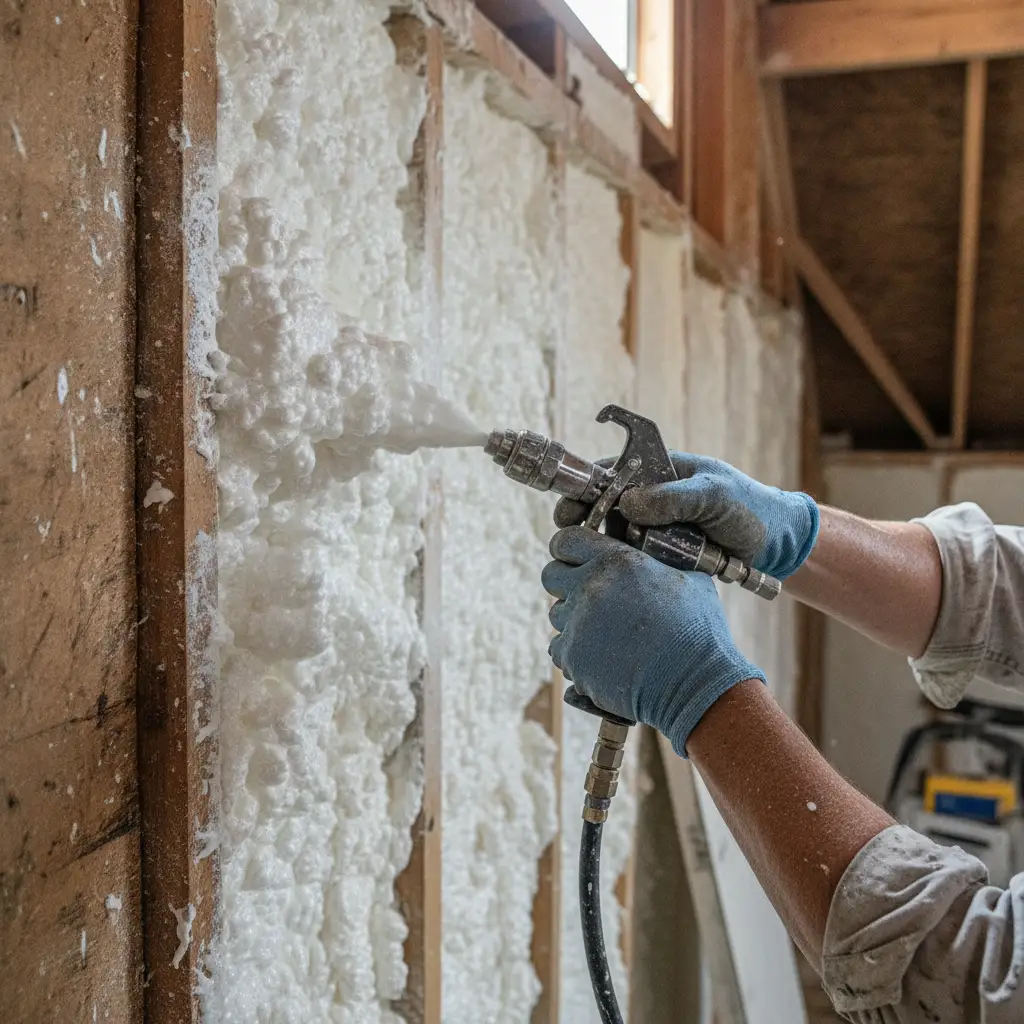
Our team in action — insulation professionals serving Burbank
Rockwool Insulation Methods and Approaches
1. Batt Installation in Open Wall Cavities
The most common method for new construction or renovation projects where wall studs are exposed. Rockwool Comfortbatt is cut to fit 16-inch or 24-inch on-center framing common in Burbank’s post-war tract homes. This method achieves R-15 in 2×4 walls and R-23 in 2×6 walls, meeting or exceeding Title 24 requirements for Climate Zone 9. Ideal for full gut-renovations and room additions throughout the Burbank Hills and Magnolia Park neighborhoods.
2. Retrofit Wall Injection (Drill-and-Fill)
For existing finished walls — common in Burbank’s 1950s ranch homes where insulation was never originally installed — we drill small access holes in the exterior sheathing or interior drywall and inject Rockwool loose-fill material. This minimally invasive method avoids full drywall replacement and is particularly popular in the Rancho Equestrian District where homeowners want to preserve original interior finishes.
3. Attic Insulation with Rockwool Batts or Blown Mineral Wool
Attic insulation is the single highest-impact application in Burbank given the extreme attic temperatures generated by the San Fernando Valley sun. Rockwool batts are installed between and over attic floor joists to achieve the recommended R-38 to R-60 for Climate Zone 9. For tight or obstructed attics — a common challenge in older Burbank bungalows — we use blow-in insulation techniques with mineral wool loose-fill.
4. Acoustic Partition Wall Installation
Rockwool Safe’n’Sound is specifically used for interior partition walls where sound isolation is the primary goal — between bedrooms and home theaters, between units in Burbank’s multi-family properties, or in recording studio facilities near the Media District. This product achieves STC ratings of 50+ when combined with resilient channel mounting systems.
5. Crawl Space and Floor Assembly Insulation
Crawl space insulation using Rockwool batts between floor joists provides both thermal separation from Burbank’s cool winter ground temperatures and moisture resistance in properties with vented crawl spaces. This is commonly combined with crawl space encapsulation for maximum performance.
Ready for Rockwool Insulation? Get Your Free Estimate Today.
Next Level Insulation of Burbank serves Burbank and the surrounding area — we’ll be on-site within 24 hours.
📞 Call (818) 514-7541Rockwool Insulation Cost in Burbank, CA
Understanding what Rockwool insulation costs in Burbank helps you budget accurately and evaluate contractor quotes. Pricing varies based on application type, scope, existing conditions, and accessibility.
Typical Price Ranges for Burbank Properties
- Wall cavity batt installation (open walls): $1.50–$2.50 per square foot of wall area, or approximately $2,500–$5,500 for a typical 1,500 sq ft Burbank ranch home
- Attic Rockwool installation: $1.80–$3.00 per square foot, or $2,700–$4,500 for a standard 1,500 sq ft attic floor
- Retrofit drill-and-fill wall injection: $2.50–$4.50 per square foot due to added labor for drilling, patching, and painting
- Crawl space floor assembly: $2.00–$3.50 per square foot
- Acoustic partition wall installation: $1.75–$2.75 per square foot
Factors That Affect Rockwool Insulation Cost in Burbank
- Existing insulation removal: Add $0.75–$1.50 per sq ft if old fiberglass or degraded insulation must be removed first
- Accessibility challenges: Older Burbank homes with low-pitch attics or crawl spaces under 18 inches incur additional labor costs of 20–35%
- R-value target: Achieving R-60 attic insulation costs more in materials than R-38
- Permit fees: Los Angeles County / City of Burbank permit fees for insulation projects typically run $150–$400 depending on project scope
Available Rebates and Incentives
Burbank homeowners may qualify for Southern California Edison’s Energy Upgrade California rebates of $0.10–$0.25 per square foot for qualifying insulation upgrades, as well as federal Inflation Reduction Act (IRA) tax credits of up to 30% of project cost (capped at $1,200 per year) under the Energy Efficient Home Improvement Credit. We provide all necessary documentation to support your rebate applications.
For a precise Rockwool insulation cost estimate tailored to your Burbank property, call us at (818) 514-7541.
Burbank Neighborhoods We Serve
Magnolia Park
One of Burbank’s most charming neighborhoods, Magnolia Park features a high concentration of 1930s–1950s craftsman bungalows and Spanish Colonial Revival homes. Most were built before California’s Title 24 standards existed, with little or no wall insulation and minimal attic coverage. Airport flight path noise from BUR is also a significant issue here, making Rockwool’s dual thermal-acoustic performance especially valuable.
Burbank Hills (Starlight Hills)
Perched on the slopes below the Verdugo Mountains, this neighborhood’s proximity to CalFire’s Very High Fire Hazard Severity Zone makes non-combustible Rockwool insulation a priority for homeowners. Many post-1980s custom homes here are being retrofitted with Rockwool to supplement existing fiberglass installations and improve wildfire resilience.
Rancho Equestrian District
Burbank’s unique equestrian community features many larger ranch-style homes from the 1960s–1980s with vented crawl spaces, irregular framing, and aging insulation. Rockwool’s moisture resistance is critical here given the proximity to the Los Angeles River flood control channel, which can elevate ground moisture levels during wet winters.
Downtown Burbank and the Media District
The commercial core along San Fernando Boulevard and Alameda Avenue includes a mix of 1950s retail blocks and modern mixed-use developments. Rockwool rigid board products are frequently specified for flat commercial roof assemblies in this area, while acoustic Rockwool partitions are in high demand for the recording studios and production facilities concentrated near Warner Bros. and Disney.
We also serve Studio City, North Hollywood, Glendale, Toluca Lake, Universal City, Sherman Oaks, Sun Valley, Pasadena, Beverly Hills, and West Hollywood.
Rockwool Insulation Maintenance Tips for Burbank Homeowners
While Rockwool is one of the most durable insulation materials available, proper maintenance ensures it continues to perform at maximum efficiency through Burbank’s challenging climate conditions.
- Annual attic inspections after fire season: Following the October–November high-fire-risk period, inspect your attic insulation for any ember intrusion or smoke-related discoloration, especially if your home is in or near the Burbank Hills neighborhood.
- Post-storm moisture checks: After significant atmospheric river events — typically December through March — check crawl spaces and attic edges for any signs of water intrusion. Rockwool resists moisture, but standing water can still create mold conditions on adjacent wood framing.
- Maintain proper attic ventilation: Burbank’s summer heat makes attic ventilation critical. Ensure soffit vents and ridge vents remain unobstructed so your Rockwool attic insulation operates within its designed temperature range.
- Seal air gaps every 5–7 years: Air sealing caulk and foam around penetrations can shrink and crack over time in Burbank’s thermal cycling climate. Periodic re-sealing maximizes the effective R-value of your Rockwool installation.
- Keep rodents out: Burbank’s proximity to the Verdugo foothills means roof rats and squirrels are a real concern. Rockwool’s density makes it harder for rodents to nest in than fiberglass, but seal all roof penetrations to prevent entry.
- Monitor HVAC ducts in insulated attics: Leaking duct connections in the attic can dump conditioned air into the insulation layer, reducing efficiency. Have ducts inspected whenever you schedule an insulation checkup.
- Document your installation: Keep your installation record, product specifications, and Southern California Edison rebate documentation for resale value and any future permit applications with the City of Burbank Building Division.
Why Choose Next Level Insulation of Burbank
When you search for Rockwool insulation near me in Burbank, you need a contractor who understands the specific demands of this city — not a regional franchise operating from a distant dispatch center.
Next Level Insulation of Burbank is a locally focused insulation company serving Burbank and the greater San Fernando Valley and Los Angeles communities. Our technicians are trained specifically on the building types, climate conditions, and code requirements that govern Burbank construction — from the post-war tract homes of Magnolia Park to the modern mixed-use developments near the Burbank Town Center.
We work with the full spectrum of insulation solutions, including spray foam insulation, attic insulation, blow-in insulation, crawl space encapsulation, insulation removal, and insulation replacement — giving us a complete picture of your building’s thermal envelope and the ability to recommend the optimal solution rather than a one-size-fits-all approach.
We are committed to compliance with California Title 24 requirements, use of high-performance materials, and clear, honest pricing. Call us at (818) 514-7541 to schedule your free Burbank property assessment.
Frequently Asked Questions About Rockwool Insulation in Burbank, CA
What is the average cost of Rockwool insulation in Burbank, CA?
Rockwool insulation in Burbank typically costs between $1.50 and $4.50 per square foot installed, depending on the application. A full attic insulation project for a typical 1,500 sq ft Burbank ranch home runs $2,700–$4,500, while wall cavity insulation for an open-wall renovation runs $2,500–$5,500. Retrofit drill-and-fill projects cost more due to additional labor. Call us at (818) 514-7541 for a free site-specific estimate.
Is Rockwool better than fiberglass insulation for Burbank homes?
For most Burbank applications, yes. Rockwool outperforms fiberglass in three key areas that matter most in Burbank: fire resistance (non-combustible vs. fiberglass which melts at around 1,100°F), acoustic performance (STC 45–52 vs. STC 39–43 for comparable fiberglass assemblies), and moisture resistance (Rockwool is hydrophobic; fiberglass absorbs water and loses R-value). In a city located near a Very High Fire Hazard Severity Zone with Burbank Airport noise impacts, these advantages are significant.
Does Rockwool insulation meet California Title 24 requirements?
Yes. Burbank is in California Climate Zone 9. Title 24 requires minimum R-38 attic insulation and R-13 to R-15 wall insulation for this zone. Rockwool Comfortbatt products achieve R-15 in standard 2×4 walls and R-23 in 2×6 walls. Rockwool attic batts can be layered to achieve R-38, R-49, or R-60 as required. We provide all necessary documentation for City of Burbank permit compliance.
How long does Rockwool insulation installation take in a Burbank home?
A typical single-family Burbank home attic insulation project takes one full day (6–8 hours). Wall insulation for a complete home renovation takes 1–2 days depending on square footage. Retrofit drill-and-fill projects may take 2–3 days due to drilling, injecting, patching, and finishing work. We provide specific timelines in our written estimates.
Can Rockwool insulation help reduce noise from Burbank Airport?
Significantly, yes. Properties within the BUR airport noise contour — particularly in Magnolia Park and Downtown Burbank within 1.5 miles of the airport — experience sustained noise levels of 60–70 dB(A). Rockwool’s STC ratings of 45–52 in wall assemblies can reduce perceived noise levels by 10–15 dB compared to uninsulated or fiberglass-insulated walls, making a noticeable difference in interior comfort.
Is Rockwool insulation safe for older Burbank homes with knob-and-tube wiring?
This requires careful attention. California code generally prohibits covering knob-and-tube wiring with insulation without prior electrical inspection and sign-off. If your older Burbank home — many built before 1950 in Magnolia Park and the Rancho area — still has knob-and-tube wiring, we will flag this during our site assessment and advise you to consult a licensed electrician before proceeding. Rockwool itself is non-combustible, which is actually an advantage in these scenarios, but code compliance must come first.
Does Next Level Insulation of Burbank serve areas outside Burbank?
Yes. We serve a wide range of communities throughout the San Fernando Valley and greater Los Angeles area, including Studio City, Sherman Oaks, North Hollywood, Sun Valley, Toluca Lake, Universal City, Valley Village, Glendale, Pasadena, Hollywood, Beverly Hills, Alhambra, Culver City, East Los Angeles, South Pasadena, La Cañada Flintridge, San Gabriel, Monterey Park, and West Hollywood.
Can Rockwool insulation be installed in an occupied Burbank home?
In most cases, yes. Rockwool batt installation in open attics or crawl spaces can be completed without requiring occupants to vacate. Wall insulation in finished spaces does require some disruption. We work to minimize impact, complete work room-by-room where possible, and fully clean up each day. For projects involving insulation removal, we recommend ventilating the home during the process. Our team will advise you on occupancy considerations during the initial assessment.