

Mineral Wool Insulation in Burbank, CA
Energy-Saving Mineral Wool Insulation for Burbank, CA Homes — Licensed & Insured
Next Level Insulation of Burbank delivers professional insulation services for Burbank, CA homes. Our licensed team improves energy efficiency and comfort with products designed for local climate conditions.
- Licensed & Insured
- Locally Owned & Operated
- Free Inspection & Estimate
Request Your
Free EstimateMineral wool insulation — also called rock wool or slag wool — is a high-density, fire-resistant insulation material made from natural volcanic rock or industrial slag spun into dense fiber batts or boards. It outperforms standard fiberglass in sound absorption, moisture resistance, and thermal performance, making it an outstanding choice for Burbank’s unique climate challenges.
Burbank sits in the eastern end of the San Fernando Valley, where summer temperatures regularly exceed 100°F, Santa Ana wind events drive extreme fire-weather conditions, and the proximity to Bob Hope Airport creates persistent noise corridors across residential neighborhoods like Magnolia Park and Rancho District. These factors make mineral wool’s triple benefit of thermal control, fire resistance, and acoustic dampening especially valuable here.
Next Level Insulation of Burbank is your local expert for mineral wool insulation installation, replacement, and upgrade projects throughout Burbank and the greater Los Angeles area. Call us today at (818) 514-7541 for a free assessment.
Understanding Mineral Wool Insulation
Mineral wool insulation has been used in construction for more than a century. Its origins trace back to the 1840s when scientists in Wales first discovered that molten slag from iron furnaces could be spun into wool-like fibers. By the mid-20th century, manufacturers refined the process using basalt and diabase rock, producing the rock wool products widely used today. The material gained significant traction in commercial construction throughout the 1970s energy crisis, and modern versions are now engineered to achieve R-values ranging from R-15 for standard 3.5-inch batts up to R-23 for 5.5-inch batts — considerably denser than comparable fiberglass products.
There are two primary forms of mineral wool used in residential and commercial buildings. Rock wool is manufactured by melting basalt rock and recycled slag at temperatures above 2,900°F, then spinning the melt into fibers. Slag wool uses post-industrial byproducts from steel mills, making it a sustainable recycled-content product. Both types are naturally hydrophobic — they repel liquid water while still allowing vapor transmission — which reduces the risk of mold growth in humid wall cavities.
In Burbank’s building stock, mineral wool is particularly well-suited to several construction types. The city’s older neighborhoods — including homes built in the 1940s and 1950s along Olive Avenue and the Rancho District — often have 2×4 stud walls with little to no existing insulation. Dense-pack mineral wool batts can be cut to fit these narrow cavities precisely. Meanwhile, mid-century commercial and studio-adjacent buildings near the Warner Bros. and Disney studio campuses frequently require upgraded acoustic insulation between shared walls — an area where mineral wool’s Sound Transmission Class (STC) rating of 45–52 far exceeds fiberglass alternatives.
California’s Title 24 Building Energy Efficiency Standards, updated most recently in 2022, require minimum R-19 wall insulation for new construction in Climate Zone 9 — the zone that includes Burbank. Mineral wool achieves this threshold while also meeting California’s stringent California Fire Code requirements, holding a Class A fire rating and resisting combustion up to approximately 2,150°F.
Learn more about our attic insulation services
Why Mineral Wool Insulation Is Needed in Burbank, CA
Extreme Summer Heat in the San Fernando Valley
Burbank is situated in the eastern San Fernando Valley basin, a geography that creates a natural heat trap. The surrounding Verdugo Mountains to the north and east and the Santa Monica Mountains to the south restrict airflow and concentrate radiant heat. During the record-setting September 2022 heat event, Burbank recorded temperatures of 109°F — significantly above the regional average. The National Weather Service has documented that Burbank averages 22 days per year above 95°F, with the Magnolia Park and Rancho District neighborhoods recording some of the highest ground-level temperatures in Los Angeles County due to their dense asphalt coverage and limited tree canopy.
Standard fiberglass batts compress and lose R-value effectiveness when subjected to repeated thermal cycling. Mineral wool maintains its density and R-value even after decades of summer temperature swings from 65°F overnight lows to 105°F daytime highs, making it a more durable long-term investment for Burbank homeowners.
Santa Ana Wind Events and Wildfire Ember Risk
The Thomas Fire of December 2017 and the Bobcat Fire of September 2020 both produced active ember transport zones that reached portions of the Verdugo Hills directly north of Burbank. During peak Santa Ana conditions, wind speeds in the La Crescenta and Sunland-Tujunga corridors adjacent to Burbank can exceed 60 mph, transporting embers up to one mile ahead of the fire front. Homes along the northern Burbank border — particularly in areas near Wildwood Canyon and the hillside streets of Sunset Canyon Drive — face measurable ember intrusion risk through attic vents and soffit gaps.
Mineral wool’s non-combustible fiber matrix provides a meaningful last line of defense. Unlike fiberglass, which melts at approximately 1,000°F, mineral wool maintains structural integrity at temperatures up to 2,150°F, helping to slow flame spread between a compromised exterior and the interior living space — critical extra minutes that can make a difference during evacuation.
Airport Noise from Hollywood Burbank Airport
Hollywood Burbank Airport (BUR) generated more than 70,000 aircraft operations in 2023, according to the Los Angeles World Airports authority. Flight paths for Runways 8 and 15 direct aircraft over densely populated neighborhoods including Magnolia Park, Downtown Burbank, and the Burbank Hills residential areas. Residents within the airport’s 65 dB Day-Night Average Sound Level (DNL) noise contour — which encompasses approximately 1.2 square miles of residential Burbank — experience chronic noise exposure that disrupts sleep and reduces property values.
Mineral wool’s dense fiber structure absorbs mid- and high-frequency noise significantly more effectively than equivalent fiberglass batts. Studies comparing STC ratings show mineral wool batts achieving STC 45–52, compared to STC 35–39 for standard fiberglass. For homes in the airport noise corridor, this difference is perceptible and significant.
Seismic Resilience and Wall Cavity Integrity
Burbank sits near the Verdugo Fault, a right-lateral oblique fault capable of producing a magnitude 6.7 earthquake based on USGS assessments. The Northridge earthquake of January 17, 1994 — centered just 15 miles northwest — caused widespread structural cracking in Burbank’s pre-1980 building stock, including wall cavity distortion that displaced or compressed existing fiberglass batts. Mineral wool’s semi-rigid batt format resists settlement and maintains its position even after minor seismic movement, unlike loose-fill fiberglass that can shift and create thermal gaps.
Moisture and Condensation Cycles
Although Burbank averages only 14.8 inches of annual rainfall, coastal eddy conditions during late spring and early summer (“June Gloom”) push marine layer moisture inland through the Cahuenga Pass corridor, raising crawl space and attic humidity levels. Mineral wool’s hydrophobic properties allow it to drain and dry without losing R-value, unlike cellulose or certain fiberglass products that absorb moisture and develop mold colonies.
Signs You Need Mineral Wool Insulation in Burbank
Thermal Performance Warning Signs
- Monthly SoCalGas or LADWP bills that are 30% or more above neighboring comparable homes during summer cooling season
- Interior wall surfaces that feel noticeably warm to the touch during afternoon heat (above 85°F surface temperature) in rooms facing south or west
- HVAC system running continuously for more than 20 minutes per cycle without reaching the thermostat setpoint during July or August
- Visible gaps or sagging sections when inspecting wall cavities after minor earthquake activity
Noise and Comfort Signs
- Clearly audible jet engine noise from Hollywood Burbank Airport inside bedrooms with windows closed
- Difficulty sleeping due to aircraft overflights — particularly between 6:00 AM and 10:00 PM when BUR flight operations peak
- Street traffic noise from Olive Avenue, San Fernando Boulevard, or Victory Boulevard penetrating interior rooms at volumes above comfortable conversation levels
Safety and Structural Warning Signs
- Existing fiberglass insulation in attic or walls that is yellowed, flattened to less than half its original thickness, or visibly water-stained
- Any discovery of knob-and-tube wiring in direct contact with existing insulation — a fire hazard requiring immediate assessment
- Musty or mildew odor emanating from wall cavities or attic space, indicating moisture-compromised existing insulation
Urgency Indicators
If your home is located within the BUR 65 dB DNL noise contour or along the northern Burbank hillside WUI (Wildland-Urban Interface) boundary, treating these signs as urgent is especially important. Contact Next Level Insulation of Burbank at (818) 514-7541 for a same-week assessment.
Our Mineral Wool Insulation Process in Burbank
Free On-Site Assessment (1–2 Hours)
Our technician visits your Burbank property and conducts a room-by-room thermal inspection using a calibrated infrared camera. We identify existing insulation types, measure current R-values, document wall cavity dimensions, and assess any fire-hazard conditions — particularly relevant for pre-1978 homes common in Magnolia Park and the Rancho District. We also note proximity to the BUR flight path to prioritize acoustic upgrade areas.
Customized Project Proposal (24–48 Hours After Visit)
We deliver a written scope of work specifying the exact mineral wool product (batt, board, or loose-fill), target R-value per California Title 24 Climate Zone 9 requirements, estimated labor hours, and total project cost with line-item transparency. We include any applicable Southern California Edison or SoCalGas rebate documentation.
Preparation and Material Staging (Half Day)
Before installation begins, our crew clears work areas and removes any degraded existing insulation — including proper HEPA-filtered disposal for older fiberglass or asbestos-containing materials in pre-1980 Burbank homes. Mineral wool batts are staged by zone to minimize disruption across multiple rooms or floors.
Precision Batt Cutting and Fitting (Per Project Scope)
Mineral wool cuts cleanly with a serrated knife or band saw — no special respirator required beyond standard N95 protection. Our installers friction-fit batts snugly against studs, eliminating thermal bridging gaps. For Burbank homes near the airport noise corridor, we use a double-layer acoustic approach in bedroom walls, achieving STC ratings above 50.
Air Sealing and Vapor Management (2–4 Hours)
We seal all electrical penetrations, top plates, and bottom plates with low-VOC caulk or spray foam before placing batts, a step required under Title 24 2022 air-sealing standards. In Burbank’s crawl spaces — where June Gloom moisture infiltration is common — we install vapor retarder membranes per California Building Code Section R408.
Quality Inspection and Thermal Verification (1–2 Hours)
A post-installation infrared scan confirms complete coverage with no thermal gaps or cold spots. We document final R-values achieved per zone and provide you with a written installation record for insurance purposes and potential resale disclosure.
Site Cleanup and Rebate Filing Assistance (1 Hour)
All packaging and removed insulation materials are hauled off site. We assist you in completing Southern California Edison’s Home Energy Improvement Program rebate forms, which can offset up to $1.50 per square foot of qualifying mineral wool installation in Burbank service territory.
Learn about our insulation removal services
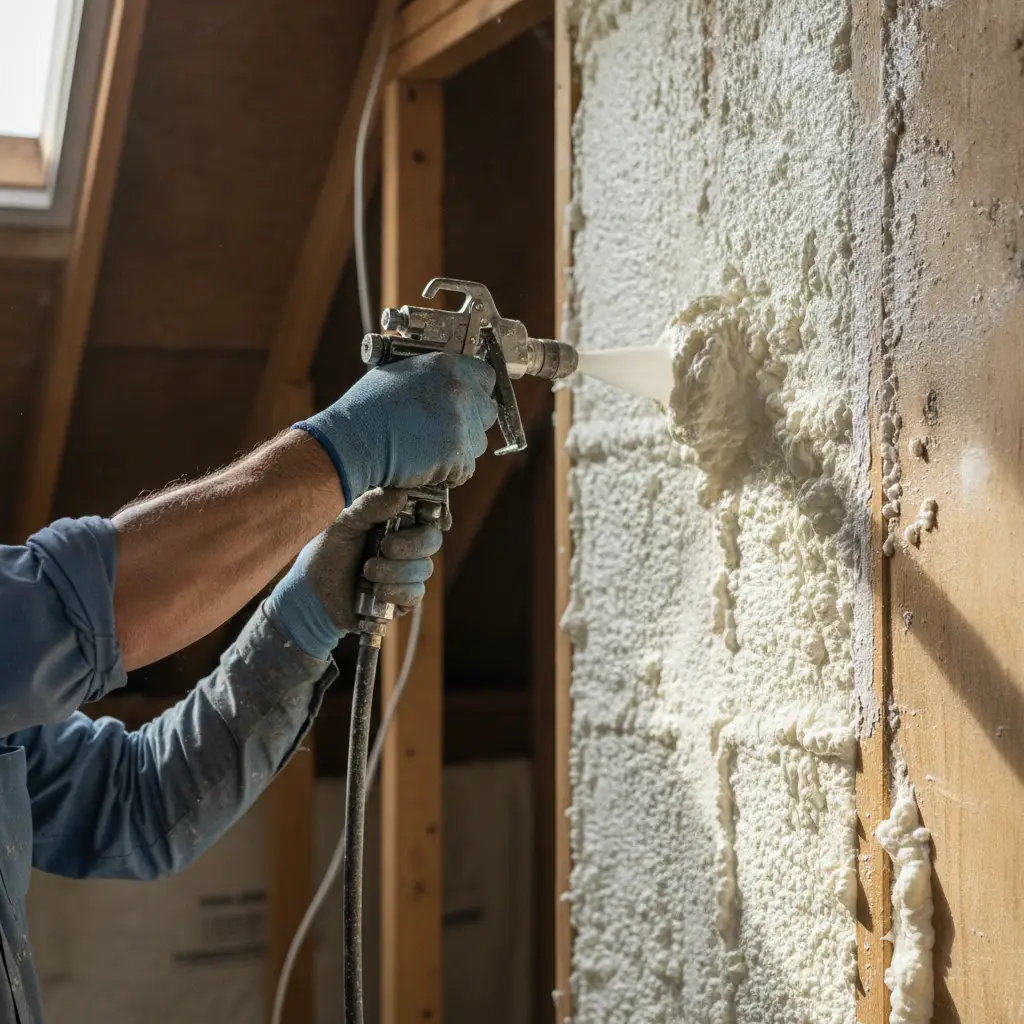
Our team in action — insulation professionals serving Burbank
Mineral Wool Insulation Methods and Approaches
1. Batt and Roll Installation
The most common method for open wall cavities and attic floor bays. Pre-cut mineral wool batts (available in 15-inch and 23-inch widths for standard 16-inch and 24-inch stud spacing) are friction-fitted between framing members. This method is ideal for new construction or gut-renovation projects in Burbank’s Rancho District bungalows and mid-century tract homes where walls are open during remodeling.
2. Mineral Wool Board (Rigid Continuous Insulation)
Semi-rigid or rigid mineral wool boards (such as Rockwool Comfortboard 80) are installed as a continuous exterior insulation layer on the outside face of wall sheathing. This method eliminates thermal bridging through studs and is particularly effective for Burbank commercial buildings and ADU (Accessory Dwelling Unit) projects where exterior re-cladding is planned — a growing trend as Burbank increases ADU permitting under California’s SB 9 legislation.
3. Dense-Pack Mineral Wool for Closed Cavities
For existing finished walls in Burbank’s older homes where opening walls is not feasible, we bore small access holes and inject dense-pack mineral wool fiber using a pneumatic blower. This approach is particularly useful for the vintage 1940s craftsman and Spanish Colonial Revival homes along Providencia Avenue and Hollywood Way that have little to no existing wall insulation.
4. Attic Blanket or Loose-Fill Mineral Wool
For attic floors with existing framing, mineral wool batts are laid perpendicular to existing joists in a double layer to achieve R-38 or R-49 — the Title 24 requirement for Climate Zone 9 attics. This is standard for Burbank’s 1950s and 1960s tract homes where original blown fiberglass has settled to less than R-11. See our blow-in insulation options
5. Crawl Space Mineral Wool with Vapor Barrier
In Burbank homes with vented crawl spaces — common in hillside properties above Glenoaks Boulevard — mineral wool batts are installed between floor joists and secured with wire hangers, combined with a 10-mil polyethylene vapor barrier on the ground surface to manage moisture from Burbank’s clay-heavy Rincon soil series. Explore our crawl space insulation services
Ready for Mineral Wool Insulation? Get Your Free Estimate Today.
Next Level Insulation of Burbank serves Burbank and the surrounding area — we’ll be on-site within 24 hours.
📞 Call (818) 514-7541Mineral Wool Insulation Cost in Burbank, CA
Understanding the investment in mineral wool insulation helps Burbank homeowners and business owners make informed decisions. Below are current typical cost ranges for our Burbank service area.
Typical Cost Ranges
- Standard batt installation (open walls or attic floor): $1.80–$2.80 per square foot, including materials and labor
- Dense-pack mineral wool for closed cavities: $2.50–$3.75 per square foot
- Rigid mineral wool board (exterior continuous insulation): $3.00–$5.50 per square foot installed
- Complete attic mineral wool installation (1,200 sq ft attic): $2,400–$4,800
- Full wall cavity upgrade, average 1,500 sq ft Burbank home: $5,500–$9,500
- Crawl space mineral wool with vapor barrier: $3.50–$6.00 per square foot
Factors That Affect Mineral Wool Insulation Cost in Burbank
- Existing insulation removal: Old fiberglass or deteriorated cellulose removal adds $0.80–$1.50 per square foot in labor and disposal fees
- Accessibility: Hillside Burbank homes with limited attic headroom or steep-pitch roofs above Sunset Canyon Drive may incur 15–25% labor premiums
- Target R-value: Higher R-value specifications (R-38 vs. R-21) require more material layers and increase costs proportionally
- Permit fees: Burbank Building and Safety Division charges approximately $125–$350 for residential insulation permits depending on project scope
- Rebates available: Southern California Edison’s Home Energy Improvement Program offers rebates of up to $1.50/sq ft for qualifying installations, potentially reducing net cost by $1,000–$2,500 on an average project
Mineral wool costs approximately 30–50% more per square foot than standard fiberglass batts, but its superior durability (50+ year effective lifespan vs. 20–25 years for fiberglass), lower replacement frequency, and energy savings typically produce a full return on the premium within 7–12 years in Burbank’s climate. Call (818) 514-7541 for a free itemized estimate.
Burbank Neighborhoods We Serve
Magnolia Park
This beloved commercial and residential district features a concentration of 1920s–1940s California Craftsman and Spanish Colonial Revival bungalows. Many were built with minimal or no wall insulation and sit within the Hollywood Burbank Airport’s primary noise corridor. Mineral wool acoustic upgrades are a top priority here, along with fire-resistant attic insulation given the older wood-framing construction.
Rancho District
Burbank’s prestigious Rancho District features larger mid-century homes from the 1950s and 1960s, many with original fiberglass batts now compressed below R-9. The area’s mature trees and larger lot sizes create unique attic microclimates where moisture from leaf debris can degrade standard insulation. We frequently perform full attic mineral wool replacements here.
Downtown Burbank / Media District
Commercial and mixed-use buildings near the Warner Bros. and Walt Disney studios require enhanced acoustic insulation to meet production studio noise standards. Mineral wool’s STC 45–52 performance in demising walls is a common specification for tenant improvement projects in this zone. Learn about spray foam for commercial applications
Burbank Hills / Sunset Canyon
Hillside homes above Glenoaks Boulevard sit within the WUI fire hazard boundary and face both extreme heat exposure and ember intrusion risk. We prioritize Class A fire-rated mineral wool for attic and wall applications in this neighborhood, combined with crawl space encapsulation for moisture management on the clay hillside soils. Explore crawl space encapsulation
Mineral Wool Insulation Maintenance Tips for Burbank Homeowners
- Annual attic inspection after Santa Ana wind events (October–March): High winds can dislodge soffit vents and allow ember or debris intrusion that compresses or displaces attic insulation. Schedule a visual check each spring.
- Check for roof leak staining after winter rains: Burbank averages most of its 14.8 annual inches between December and March. Water intrusion through aging flat roofs (common in 1960s tract homes) can wet insulation. While mineral wool dries effectively, persistent leaks should be addressed immediately.
- Inspect crawl space vapor barrier annually: Burbank’s clay-heavy Rincon soil series retains moisture; ensure the vapor barrier remains intact and that mineral wool floor batts show no signs of sagging or displacement.
- Seal new electrical or plumbing penetrations promptly: Renovations that add recessed lights or new plumbing runs can create air leakage pathways that bypass your mineral wool layer. Re-seal with fire-rated caulk or putty.
- Monitor HVAC performance each summer: A sudden increase in cooling runtime during Burbank’s July–September peak months can indicate insulation settlement or damage. Schedule an infrared scan if you notice a 20%+ increase in energy bills.
- Keep attic vents clear of debris: Leaf debris from Burbank’s mature liquidambar and jacaranda street trees can block soffit vents, reducing attic ventilation and increasing moisture buildup against insulation.
- Document your installation R-values: Keep your installation record for California’s Title 24 compliance documentation and potential homeowner insurance discounts.
Why Choose Next Level Insulation of Burbank
Next Level Insulation of Burbank is a locally focused insulation contractor with deep familiarity with the specific thermal, acoustic, and fire-safety challenges that Burbank homeowners and businesses face. We are not a regional franchise operating from a distant call center — we are here in the community, serving Magnolia Park, the Rancho District, the Media District, and Burbank Hills.
Our technicians are trained in California Title 24 2022 compliance requirements for Climate Zone 9, ensuring your installation meets or exceeds current state energy code without you needing to navigate the technical details yourself. We partner directly with Southern California Edison’s rebate program to help reduce your out-of-pocket project cost wherever eligible.
We offer comprehensive insulation services including insulation installation, spray foam insulation, attic insulation, blow-in insulation, and insulation replacement — giving you a single trusted contractor for every phase of your insulation project.
Ready to get started? Call (818) 514-7541 to schedule your free on-site assessment. We provide honest, no-pressure recommendations based on what your Burbank property actually needs.
Frequently Asked Questions About Mineral Wool Insulation in Burbank, CA
How much does mineral wool insulation cost in Burbank?
In Burbank, mineral wool insulation typically costs between $1.80 and $5.50 per square foot installed, depending on the method (batt, board, or dense-pack) and the complexity of the project. A complete attic installation for a 1,200 sq ft Burbank home generally runs $2,400–$4,800 before any Southern California Edison rebates, which can reduce net costs by $1,000–$2,500 depending on eligibility.
How long does a mineral wool insulation installation take in Burbank?
For a typical single-family Burbank home with attic and primary wall cavity treatment, our crew completes installation in 1–3 days. Larger projects involving exterior rigid board installation or full crawl space treatment may take 3–5 days. We schedule inspections within one week of your initial call.
Does mineral wool insulation help with Hollywood Burbank Airport noise?
Yes. Mineral wool is one of the most effective insulation materials for noise reduction. In bedroom walls within the BUR 65 dB DNL noise contour, properly installed mineral wool batts can improve wall STC ratings from approximately 35 (standard construction) to 45–52, resulting in a noticeable reduction in perceived aircraft noise — roughly equivalent to cutting perceived volume by 50%.
Is mineral wool insulation fire-resistant enough for Burbank’s WUI zones?
Yes. Mineral wool is non-combustible and maintains structural integrity at temperatures up to approximately 2,150°F. This makes it the preferred insulation material for homes along Burbank’s northern hillside WUI boundary near Wildwood Canyon and Sunset Canyon Drive, where ember intrusion during Santa Ana wind events is a documented risk.
Do I need a permit for mineral wool insulation installation in Burbank?
Burbank Building and Safety Division requires permits for most insulation projects involving new or replacement installation in existing wall cavities or attic spaces. Permit fees typically range from $125–$350. Our team handles permit application preparation and submits documents on your behalf, ensuring compliance with Burbank’s local building code and California Title 24 2022 requirements.
How does mineral wool compare to spray foam for Burbank homes?
Both are excellent options for different applications. Mineral wool provides superior acoustic performance and is preferred in bedroom walls near the airport corridor or in fire-risk WUI areas. Spray foam provides a superior air seal and is often preferred for attic roof decks, rim joists, and irregular geometries where a complete air barrier is the priority. Many Burbank homes benefit from a combination approach — mineral wool in walls for acoustics and fire safety, spray foam at attic peaks and penetrations for air sealing. Learn more about spray foam insulation
Can mineral wool insulation be installed in older Burbank homes with knob-and-tube wiring?
No insulation — including mineral wool — should be placed in direct contact with active knob-and-tube wiring without an electrical assessment. California’s Title 24 and local Burbank Building Code requirements prohibit burying energized knob-and-tube circuits in insulation due to fire risk. We will identify this condition during our assessment and can coordinate with licensed electricians before proceeding with installation. Many Burbank craftsman bungalows in Magnolia Park and along Olive Avenue still contain partial knob-and-tube systems.
What service areas near Burbank do you cover?
In addition to Burbank, we serve Studio City, Sherman Oaks, North Hollywood, Sun Valley, Toluca Lake, Universal City, Valley Village, Monterey Park, Hollywood, Beverly Hills, Glendale, Pasadena, Alhambra, Culver City, East Los Angeles, South Pasadena, La Cañada Flintridge, San Gabriel, and West Hollywood. All service areas are staffed by the same locally trained Burbank-based crews.