

Garage Insulation in Orange, CA
Energy-Saving Garage Insulation for Orange, CA Homes — Licensed & Insured
Expert garage insulation in Orange, CA. Spray foam, batt & blown-in options. Free estimates. Call Next Level Insulation of Orange at (714) 266-2070 today.
- Licensed & Insured
- Locally Owned & Operated
- Free Inspection & Estimate
Request Your
Free EstimateGarage insulation is the process of installing thermal and acoustic barrier materials within your garage walls, ceiling, and door to regulate temperature, reduce energy loss, and improve comfort throughout your home. In Orange, CA — where summer temperatures regularly climb above 95°F and the Santa Ana winds create dramatic seasonal temperature swings — an uninsulated garage acts as a thermal weak point that forces your HVAC system to work overtime.
At Next Level Insulation of Orange, we specialize in garage insulation solutions tailored to the specific construction styles, climate patterns, and energy demands found throughout Orange and surrounding communities. From mid-century ranch homes in Old Towne Orange to newer construction near Chapman University, our team delivers professional insulation installation designed to perform under Southern California’s demanding conditions. Call us today at (714) 266-2070 to schedule your free assessment.
Understanding Garage Insulation
Garage insulation refers to the strategic placement of insulating materials — including batts, blown-in cellulose, spray foam, or rigid boards — inside garage wall cavities, overhead ceilings, and door panels to slow the transfer of heat between the garage interior and the outside environment. While garages were historically treated as purely utilitarian, unheated spaces, modern building science recognizes them as critical thermal boundaries, especially when they share walls or ceilings with living areas.
The concept of insulating attached garages gained traction in the 1970s following the energy crises of 1973 and 1979, when homeowners and contractors alike began treating every square foot of the building envelope as an opportunity to reduce waste. California accelerated this trend with the adoption of Title 24, the state’s Building Energy Efficiency Standards, which set increasingly strict requirements for thermal performance in residential construction — standards that directly impact how garages must be treated in new builds and major renovations.
In Orange, the prevalence of attached two-car garages is high. The city’s post-World War II development boom produced thousands of ranch-style and tract homes throughout the 1950s, 1960s, and 1970s, many featuring attached garages built before modern insulation codes existed. These homes — found in neighborhoods like Serrano Heights, the Mabury Ranch area, and around Katella Avenue — often have original, un-insulated garage walls directly adjacent to kitchens, laundry rooms, and bedrooms.
Whether your garage is used as a workshop, home gym, storage space, or simply as a transition zone into your living area, proper insulation delivers measurable benefits: lower utility bills, more consistent indoor temperatures, reduced noise infiltration, and improved air quality by limiting the entry of outdoor pollutants and allergens — a genuine concern given Orange County’s periodic air quality alerts during wildfire season. Learn how attic insulation complements garage insulation for whole-home energy performance.
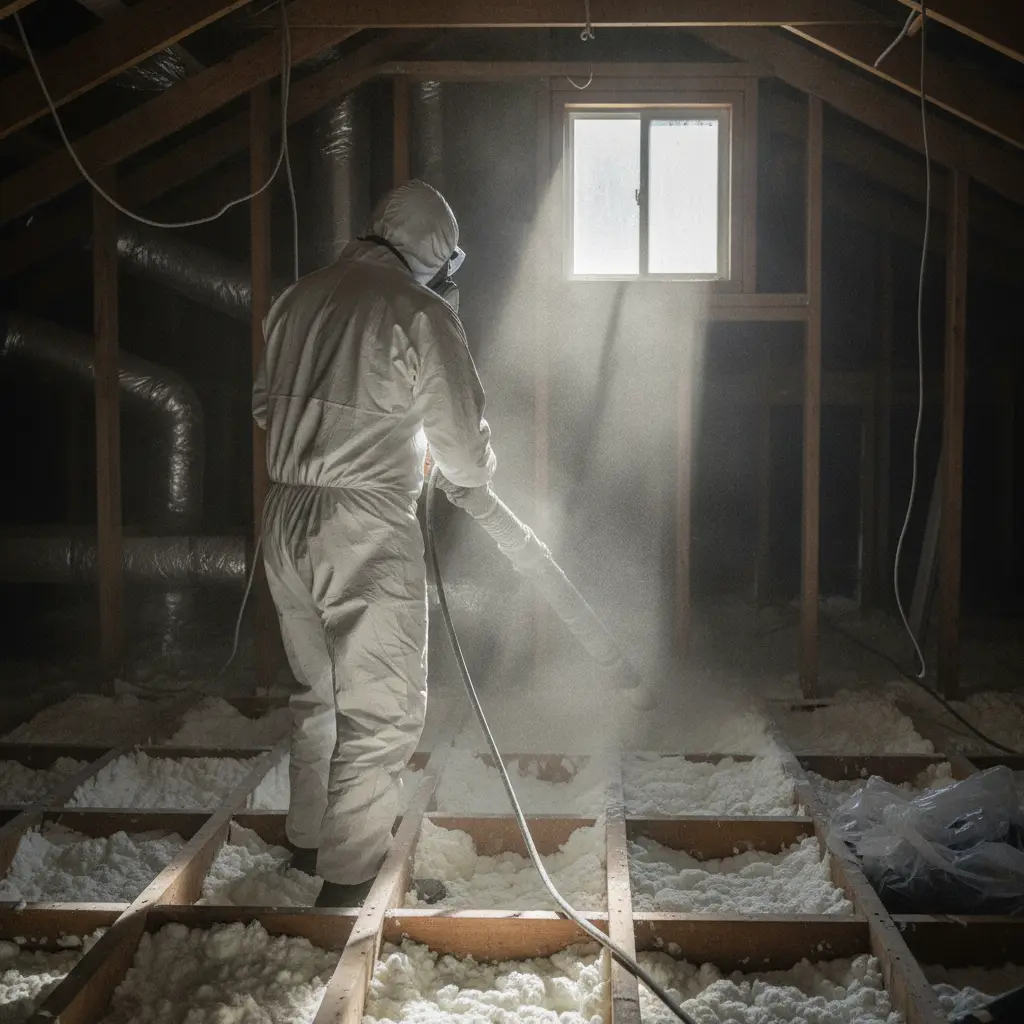
Our team in action — insulation professionals serving Orange
Why Garage Insulation Is Needed in Orange, CA
Extreme Temperature Swings Driven by Santa Ana Wind Events
Orange County experiences some of the most dramatic temperature fluctuations in Southern California. During Santa Ana wind events — which typically occur between October and April — temperatures in Orange can spike from the mid-60s to over 100°F within 24 hours. The National Weather Service recorded a historic Santa Ana event in October 2017 that pushed temperatures in inland Orange County above 108°F. An uninsulated garage during such events can reach interior temperatures exceeding 130°F, which radiates directly into adjoining living spaces and forces air conditioning systems to compensate aggressively. A properly insulated garage with R-13 wall insulation and R-38 ceiling insulation can reduce garage peak temperatures by 20–30°F under these conditions.
Southern California Edison Rates and Time-of-Use Billing
Orange homeowners served by Southern California Edison face tiered and time-of-use pricing structures that penalize high energy consumption during peak afternoon hours — precisely when an un-insulated garage is dumping radiant heat into the home. SCE’s current baseline rates hover around $0.27–$0.45 per kWh depending on usage tier and time of day. An attached garage with no wall or ceiling insulation can account for a measurable portion of a home’s cooling load, particularly in the 92868 and 92869 zip codes where older housing stock dominates.
Aging Housing Stock Constructed Before Title 24
Many of Orange’s residential neighborhoods — including the historic district surrounding Old Towne Orange, the Villa Park Road corridor, and the developments north of Chapman Avenue — consist of homes built between 1945 and 1978, before California’s Title 24 Energy Standards were introduced in 1978. Garages in these homes were constructed with minimal or zero insulation in the walls and no insulation in the ceiling assembly. As these homes age, any original fiberglass batt insulation — where it exists at all — has settled, degraded, or been compromised by moisture, reducing effective R-value well below code minimums.
High Ground-Level Air Pollution and Allergen Infiltration
Orange sits at the convergence of the 22, 5, and 57 freeways, creating elevated particulate matter levels that affect neighborhoods including El Modena, East Orange, and areas adjacent to Santiago Creek. An un-insulated, un-sealed garage is a direct conduit for vehicle exhaust, road dust, and seasonal pollen to enter the home. Foam-sealed insulation systems create an air barrier that significantly reduces this infiltration.
Moisture from Coastal Marine Layer
Although Orange is approximately 20 miles from the coast, the marine layer regularly penetrates inland during June Gloom — the May-through-July period when morning marine fog brings humidity levels to 85–95% in the early morning hours. This moisture can condense inside un-insulated garage walls, leading to mold growth, wood rot, and deterioration of stored belongings. Vapor-retarding insulation systems address this risk directly. Crawl space encapsulation pairs effectively with garage insulation to address whole-home moisture management.
Signs You Need Garage Insulation in Orange, CA
Temperature and Comfort Indicators
- Rooms adjacent to the garage — especially bedrooms or kitchens — feel noticeably warmer in summer or colder in winter than the rest of the house.
- Your garage interior exceeds 110°F on summer afternoons, even with the door closed.
- You notice a dramatic temperature difference (more than 10°F) between the garage and the attached living space.
- Your HVAC system runs continuously during afternoon hours despite a set thermostat.
Energy and Utility Bill Indicators
- Unexplained increases in your SCE monthly bill during summer months without a change in habits.
- Your home’s energy audit identifies the garage wall as a major thermal bypass.
Physical and Structural Indicators
- Visible gaps, cracks, or missing insulation in existing wall cavities (visible when an outlet plate is removed).
- Water stains, mold, or a musty odor in the garage — signs of moisture infiltration through un-sealed walls.
- Original fiberglass batts that appear yellowed, compressed, or fallen from position.
Acoustic Indicators
- Loud traffic noise from nearby streets — particularly noticeable for homes near Chapman Avenue, Katella Avenue, or the 22 Freeway — penetrating into attached living spaces through the garage wall.
Urgency note: Visible mold or persistent moisture warrants immediate inspection, as these conditions can worsen rapidly during Orange County’s June Gloom season. Learn about our insulation removal service if existing materials are damaged.
Garage Insulation Methods and Approaches
Fiberglass Batt Insulation
The most common method for standard 2×4 or 2×6 framed garage walls. Fiberglass batts (R-13 for 2×4 walls, R-19 or R-21 for 2×6 walls) are friction-fit between studs and are a cost-effective choice for garages with accessible, open wall cavities. Best suited for newer Orange homes or garages undergoing drywall renovation. Learn more about our insulation installation services.
Blown-In Insulation
Ideal for existing finished garage walls where wall cavities are enclosed by drywall. Small holes are drilled between studs, and dense-pack cellulose or fiberglass is blown in under pressure, filling the cavity completely. This is a preferred approach in Old Towne Orange historic homes where minimizing wall disruption is important. Achieves R-13 to R-15 in a standard 2×4 cavity. Learn about our blown-in insulation service.
Spray Foam Insulation
Open-cell spray foam (R-3.7 per inch) or closed-cell spray foam (R-6.5 per inch) provides both insulation and an integrated air/vapor barrier in a single application. Closed-cell is strongly recommended for Orange garages susceptible to marine layer moisture or for garage ceilings directly below conditioned living spaces. Best for garages with complex geometry, steel framing, or significant air sealing needs. Explore our spray foam insulation options.
Rigid Foam Board Insulation
Used on the interior face of concrete or masonry garage walls and on garage doors themselves. Rigid polyisocyanurate panels (R-6 per inch) are cut to fit and adhered or mechanically fastened. Common in older Orange commercial-style garages and detached workshop structures.
Garage Door Insulation Kits
Retrofit insulation kits add R-4 to R-8 to an existing uninsulated steel garage door, significantly reducing radiant heat gain through what is typically the largest single uninsulated surface in the garage.
Ready for Garage Insulation? Get Your Free Estimate Today.
Next Level Insulation of Orange serves Orange and the surrounding area — we’ll be on-site within 24 hours.
📞 Call (714) 266-2070Garage Insulation Cost in Orange, CA
The cost of garage insulation in Orange, CA varies based on garage size, insulation method, existing conditions, and material choices. Below are typical price ranges for the Orange market:
- Fiberglass Batt (standard 2-car garage walls and ceiling): $800–$1,500 installed
- Blown-In Cellulose or Fiberglass (walls only, existing drywall): $900–$1,800 installed
- Open-Cell Spray Foam (walls and ceiling): $1,500–$3,000 installed
- Closed-Cell Spray Foam (walls and ceiling): $2,500–$5,000+ installed
- Garage Door Insulation Kit (DIY-style, professionally installed): $200–$600
- Full Garage Insulation Package (walls + ceiling + door): $2,000–$6,500 depending on method
Factors That Affect Your Orange Garage Insulation Cost
- Garage size: Standard Orange two-car garages range from 400 to 600 sq ft. Larger footprints increase material and labor costs proportionally.
- Existing insulation removal: If degraded original insulation must be removed first, add $300–$800 to the project budget. See our insulation removal pricing.
- Access difficulty: Finished ceilings, narrow wall cavities, or complex framing in older Orange homes may increase labor time.
- Permit fees: City of Orange permit fees for insulation projects typically range from $75–$200 depending on project scope.
- Air sealing add-ons: Comprehensive air sealing with caulk and foam adds $200–$500 but significantly improves performance and qualifies for energy rebates.
Southern California Edison and the California Energy Commission periodically offer rebates for qualifying insulation upgrades. Contact us at (714) 266-2070 and we will advise you on any current incentive programs available to Orange residents.
Neighborhoods We Serve in Orange, CA
Old Towne Orange
The historic district surrounding the Orange Plaza circle features some of the oldest residential structures in the city, many dating to the 1910s through 1940s. Garages here are often detached or converted carriage structures with original plank walls and no insulation. We use blow-in and spray foam methods that minimize disruption to historic fabric while achieving modern thermal performance.
Serrano Heights
This master-planned community in east Orange features larger homes built predominantly in the 1990s and 2000s with three-car garages. While newer construction, many garages here lack ceiling insulation below living spaces above — a common builder omission. Batt and spray foam ceiling applications are the primary need.
El Modena
East of Hewes Street, El Modena contains a dense concentration of 1950s–1970s tract homes adjacent to the 55 Freeway corridor. Freeway noise and older construction make blown-in dense-pack cellulose a popular choice for both thermal and acoustic improvement.
Olive Hills and Panorama Heights
These hillside neighborhoods north of Santiago Canyon Road feature custom and semi-custom homes with varied garage configurations. Slope-side garages often have concrete retaining walls on one or more sides, making rigid foam board and closed-cell spray foam the preferred insulation approaches.
Garage Insulation Maintenance Tips for Orange, CA Homeowners
- Inspect annually after Santa Ana wind season (November–April): High winds and pressure differentials can dislodge batt insulation or open gaps around penetrations. Walk your garage perimeter and look for any insulation that has fallen or shifted.
- Check for moisture staining every June Gloom season: In May and June, inspect garage walls for any condensation staining or discoloration that indicates moisture is infiltrating through gaps in the insulation or vapor barrier.
- Seal garage door weatherstripping every 2–3 years: Weatherstripping degrades quickly in Southern California’s UV-intense environment. Replace worn bottom seals and side seals to maintain the thermal barrier.
- Keep garage vents clear of debris: Orange’s fall leaf season and Santa Ana-driven debris can block passive garage vents, trapping heat and moisture behind insulation.
- Avoid storing chemicals near insulated walls: Solvents and petroleum products can off-gas into foam insulation materials over time, affecting performance and indoor air quality.
- Verify no pest activity in wall cavities: Rodents attracted by Orange’s landscaping can nest in fiberglass batts. Look for droppings or chewed materials and address pest issues before they compromise insulation integrity.
- Schedule a professional re-assessment every 10 years: Insulation settles and California energy codes evolve. A professional check ensures your garage insulation still meets current Title 24 standards.
Frequently Asked Questions: Garage Insulation in Orange, CA
How much does garage insulation cost in Orange, CA?
Garage insulation in Orange typically costs between $800 and $6,500 depending on the method selected, garage size, and whether existing insulation needs to be removed first. Fiberglass batt installation in a standard two-car garage starts around $800–$1,500, while a full closed-cell spray foam application can range from $2,500 to $5,000+. Contact us at (714) 266-2070 for a free, no-obligation estimate specific to your garage.
How long does garage insulation installation take?
Most garage insulation projects in Orange are completed in a single day — typically 4 to 8 hours of active installation time. Spray foam projects require an additional 24-hour cure period before the space can be fully re-occupied. Blown-in projects on finished walls may take slightly longer depending on the number of drill holes required.
Do I need a permit to insulate my garage in Orange, CA?
Permit requirements vary based on project scope. Simple batt insulation installations in open wall cavities generally do not require a permit. However, spray foam applications, significant air sealing work, or any project involving changes to drywall may require a permit from the City of Orange Building Division. We handle permit coordination on your behalf for projects that require it.
What R-value do I need for my Orange, CA garage?
California’s Title 24 standards and Orange’s Climate Zone 8 designation generally call for a minimum of R-13 in garage walls and R-30 to R-38 in garage ceilings that are adjacent to conditioned living space above. For garages experiencing severe heat load from Santa Ana wind events, we often recommend exceeding minimums — R-15 in walls and R-38 in ceilings — for meaningful energy savings.
Can I insulate my garage door?
Yes. The garage door is often the single largest uninsulated surface in the garage. Retrofit insulation kits for steel doors provide R-4 to R-8, and we professionally install these as part of a comprehensive garage insulation package. This is a highly cost-effective upgrade for Orange homeowners dealing with afternoon heat gain.
Is spray foam insulation safe for garage use in Orange?
Yes, once fully cured. Spray polyurethane foam emits isocyanate compounds during application and the initial 24-hour cure period, which is why professional installation with proper respiratory protection is essential. After the cure period — typically 24 hours — spray foam is inert and safe. It is one of the most durable, effective, and moisture-resistant options available for Orange garages. Read more about our spray foam services.
How do I know if my existing garage insulation needs to be replaced?
Key indicators include: visible settling or compression of batt insulation (reducing effective R-value by 20–40%), water staining or mold on insulation surfaces, a persistent musty odor in the garage or adjacent rooms, or an energy audit that identifies the garage wall as a thermal bypass. Many Orange homes built before 1980 have original insulation that has long exceeded its effective service life. Learn about our insulation replacement process.
Will garage insulation really lower my SCE electric bill?
Yes — measurably so. In homes where the garage shares walls or a ceiling with conditioned living space, proper insulation reduces cooling load during peak summer afternoons (the most expensive time-of-use period under SCE’s current rate structure). Homeowners in Orange typically report a 10–20% reduction in summer cooling costs following a full garage insulation project, with payback periods of 3 to 7 years depending on the method used and current utility rates.
Get a Free Garage Insulation Estimate in Orange, CA
Ready to stop letting your garage undermine your home’s comfort and energy efficiency? Next Level Insulation of Orange provides free, no-pressure on-site assessments for homeowners throughout Orange, CA. Whether you are dealing with a sweltering garage during Santa Ana season, rising SCE bills, or decades-old insulation that has long since lost its effectiveness, we have the expertise and the right materials to solve it.
Call us today at (714) 266-2070 to schedule your free garage insulation assessment. Our team is ready to visit your Orange home, evaluate your specific situation, and provide a clear, itemized estimate with no obligation. Take the next step toward a more comfortable, energy-efficient home — contact Next Level Insulation of Orange now.