

Blown-In Insulation in Orange, CA
Energy-Saving Blown-In Insulation in Orange, CA for Orange, CA Homes — Licensed & Insured
Need blown-in insulation in Orange, CA? Next Level Insulation serves all Orange neighborhoods. Free estimates. Call 714-266-2070 for R-38+ attic upgrades today.
- Licensed & Insured
- Locally Owned & Operated
- 24/7 Emergency Service
- Financing Available
- Free Inspection & Estimate
Request Your
Free EstimateBlown-in insulation is a loose-fill insulation method in which cellulose, fiberglass, or mineral wool particles are pneumatically blown into wall cavities, attic floors, and enclosed spaces to create a dense, seamless thermal barrier. Unlike rigid batts, blown-in material conforms to irregular framing, wiring runs, and the kinds of oddly shaped attic spaces common in Orange’s older ranch-style and Craftsman-era homes.
Orange, CA sits in the heart of Orange County where summer temperatures routinely push past 95°F and dry Santa Ana wind events can drop interior humidity to punishing lows. These local climate extremes make proper insulation not a luxury but a necessity. At Next Level Insulation of Orange, our crews understand the specific building codes, microclimates, and housing stock that define this city. We deliver blown-in insulation solutions calibrated for Orange’s unique conditions — not generic one-size-fits-all installations. Call us today at 714-266-2070 to schedule a free assessment.
Understanding Blown-In Insulation
Blown-in insulation — also called loose-fill insulation — has been used in residential and commercial construction since the early twentieth century, when asbestos-based loose fill was common. By the 1970s, cellulose made from recycled newspaper became the dominant material, driven by the energy crisis and federal pressure to improve residential energy efficiency. Today, three primary materials dominate the market: cellulose (roughly 75–85% recycled content), fiberglass loose-fill, and mineral wool (rock wool). Each has distinct R-value characteristics, moisture resistance profiles, and fire-retardant properties.
The blown-in process uses a blowing machine — essentially a large hopper and hose — to propel the loose material at high velocity into the target cavity. Installers calibrate machine settings to achieve the manufacturer’s specified installed density. For attic floors, material is blown to a uniform depth and raked level. For enclosed walls or retrofit applications, small holes are drilled in the drywall or exterior sheathing, the hose is inserted, and the cavity is densely packed before the holes are patched.
In Orange, CA, the housing stock is notably diverse. The city contains a large percentage of single-family homes built between 1950 and 1980 — an era before California’s Title 24 energy standards took effect in 1978. These homes were constructed with little or no attic insulation, or with early fiberglass batts that have since settled and degraded. The Old Towne Orange Historic District adds another layer of complexity, as many Victorian and Craftsman-era structures dating to the 1890s and early 1900s require careful, minimally invasive retrofit approaches that blown-in methods handle particularly well.
Multi-family properties — duplexes, small apartment complexes, and condominium associations — are also widespread in Orange. Blown-in insulation is especially cost-effective for these building types because large attic floor areas can be covered quickly, and the material fills the gaps between complex framing members that inevitably appear when multiple dwelling units share a roof structure.
California’s Title 24 energy code currently mandates a minimum R-38 for attic assemblies in Climate Zone 8, which covers Orange. Many pre-1978 homes fall far below this standard, making blown-in upgrades both a comfort improvement and a code compliance matter.
Why Blown-In Insulation Is Needed in Orange, CA
Santa Ana Wind Events
One of the most destructive forces for Orange’s building envelopes is the Santa Ana wind pattern. These offshore wind events — which peak between October and February — push hot, extremely dry air (often below 10% relative humidity) from the inland desert toward the coast. During the October 2017 Canyon Fire 2, which burned in the hills east of Orange near Santiago Canyon Road, interior homes experienced dramatic pressure differentials as the winds exceeded 60 mph. Even for homes not threatened by the fire itself, these pressure events force unconditioned attic air through gaps in the thermal envelope, carrying heat, dust, and potential allergens directly into living spaces. Properly installed blown-in insulation at a depth of 14 to 16 inches — achieving R-49 or higher — dramatically reduces this infiltration.
Aging Housing Stock
A significant percentage of Orange’s residential properties were built in the 1950s and 1960s in neighborhoods like Serrano Heights, El Modena, and the tracts surrounding Chapman University. Homes from this era typically used 3.5-inch-deep fiberglass batts in attic floors, which yielded roughly R-11 at installation — barely a quarter of today’s Title 24 requirement of R-38. Decades of settling, rodent activity, and moisture cycling have reduced many of these existing batts to an effective R-value of R-6 or R-7. Installing 14 inches of cellulose blown-in on top of degraded existing insulation can bring these attics to code compliance in a single afternoon.
Urban Heat Island Effects
Orange’s dense urban core — particularly near The Block at Orange shopping center and along Chapman Avenue — experiences measurable urban heat island effects. Dark asphalt parking lots and roofing materials absorb solar energy and radiate heat into surrounding structures well after sunset. Infrared thermal imaging of homes in these areas routinely shows attic temperatures exceeding 150°F on summer afternoons, compared to 130°F in more vegetated residential areas. At these temperatures, an under-insulated attic acts as a giant radiator pressing heat downward into living spaces, forcing air conditioning systems to work 30–40% harder and dramatically increasing energy bills.
Soil and Foundation Considerations
Orange sits on a combination of alluvial soils and expansive clays, particularly in lower-lying areas near the Santa Ana River wash. Expansive clay soils absorb moisture in winter and shrink in summer, causing minor but repetitive foundation movement. This micro-movement creates hairline gaps in wall framing and around penetrations — gaps that allow conditioned air to escape and unconditioned air to infiltrate. Blown-in insulation in wall cavities seals these pathways more completely than rigid batts can, reducing air infiltration by an estimated 25–35% in retrofitted wall assemblies.
Signs You Need Blown-In Insulation in Orange, CA
Energy and Comfort Indicators
- Summer energy bills exceeding $250–$350 per month for a standard 1,500-square-foot Orange home
- Rooms on the top floor that are consistently 8°F to 12°F warmer than downstairs rooms
- Air conditioning running continuously without reaching the thermostat set point during July and August
- Noticeable drafts near ceiling light fixtures, recessed lights, or attic access hatches
Physical and Visual Indicators
- Attic insulation depth measuring less than 10 inches — use a ruler dropped through the attic hatch to check
- Visible fiberglass batts that appear yellowed, compressed flat, or pulled away from framing members
- Insulation contaminated by rodent droppings, urine staining, or nesting material
- Dark staining or “ghosting” on attic floor insulation — a sign of heavy air filtration through the material
Structural and Health Indicators
- Excessive dust buildup on ceiling registers, suggesting attic air is being drawn into the HVAC return
- Allergy symptoms that worsen inside the home during Santa Ana wind events
- Evidence of prior rodent infestation in the attic, which typically destroys existing insulation integrity
If two or more of these symptoms are present, a professional blown-in insulation assessment is strongly recommended before the next cooling season.
Our Blown-In Insulation Process in Orange, CA
Free On-Site Assessment (1–2 Hours)
Our technician visits your Orange property, inspects the attic or wall cavities, measures existing insulation depth with a calibrated depth gauge, identifies air sealing deficiencies, and photographs conditions. We note any rodent activity, moisture staining, or HVAC duct issues that must be addressed before insulation installation.
Detailed Scope and Proposal (Same Day or Next Business Day)
We calculate the square footage of area to be insulated, specify target R-value (typically R-38 to R-49 for Orange attics per Title 24 Climate Zone 8 requirements), identify the insulation material, and provide a written itemized proposal with no hidden fees.
Pre-Installation Air Sealing (2–4 Hours)
Before any blown-in material is installed, our crew air-seals all penetrations — recessed light cans, top plates, HVAC chases, plumbing stacks, and attic hatch perimeters — using fire-rated caulk and low-expansion spray foam. In Orange’s older homes, this step can reduce air leakage by 20–40 air changes per hour at 50 Pascals (ACH50), a significant energy-saving measure in itself.
Material Staging and Machine Setup (30–60 Minutes)
We park our blowing machine truck at your driveway or curb — fully complying with Orange’s residential parking ordinances — and run the hose to the attic hatch or designated entry point. Material is loaded and machine calibration is verified against manufacturer density charts.
Blown-In Installation (2–6 Hours Depending on Area)
Technicians work methodically from the far end of the attic toward the access hatch, achieving uniform depth and density. Depth markers (ruler sticks) are placed every 100 square feet and verified before the crew exits the attic. For wall cavity retrofits, small 2-inch holes are drilled at stud-bay intervals, material is densely packed, and holes are patched with matching material or plugs.
Post-Installation Inspection and Documentation (30 Minutes)
A supervisor conducts a final depth check at multiple measurement points and photographs completed work. We provide you with a written Certificate of Installation documenting installed R-value, material type, coverage area, and installed density — documentation you may need for utility rebates or future home sales in Orange County.
Cleanup and Site Restoration (30–45 Minutes)
All equipment, packaging, and any debris are removed. The attic hatch is resealed and insulated. Your property is left clean and ready.
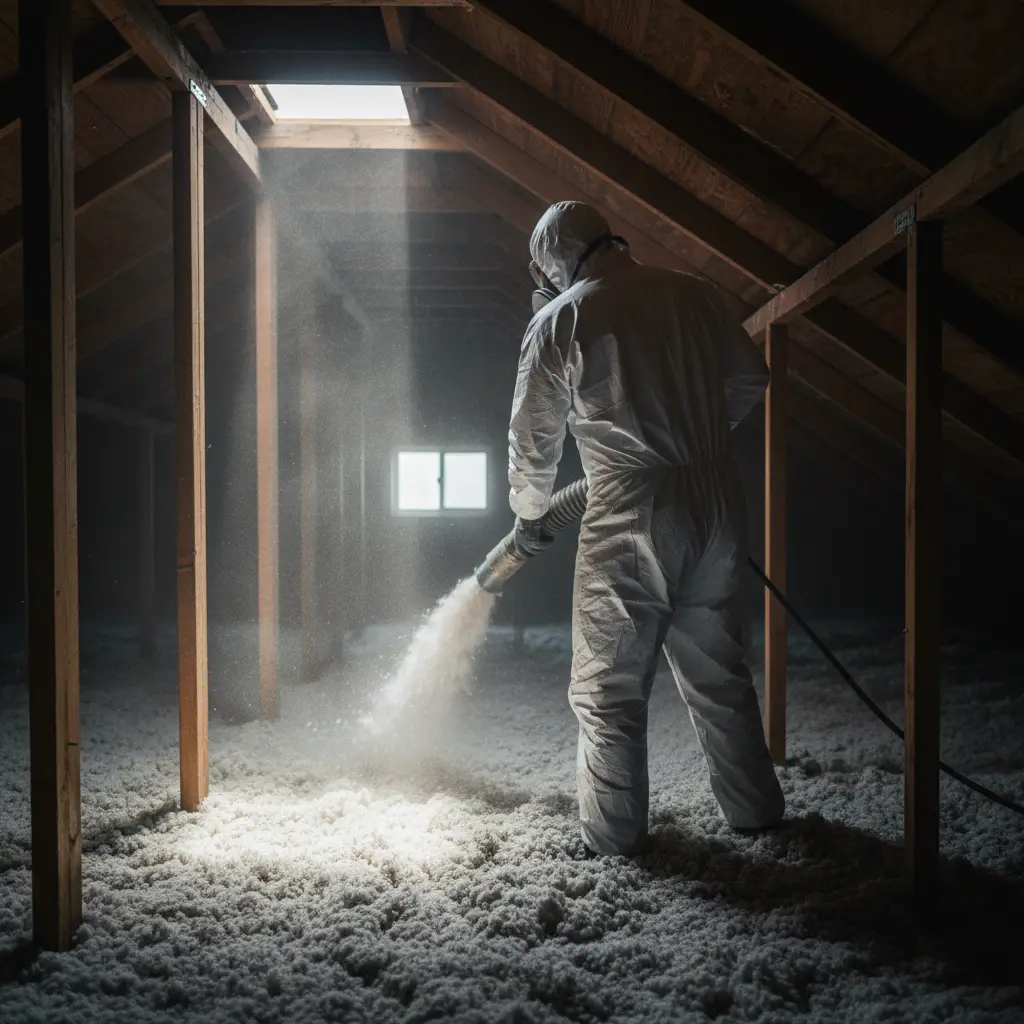
Our team in action — insulation professionals serving Orange
Blown-In Insulation Methods and Approaches
Cellulose Blown-In (Most Common in Orange)
Cellulose is the most widely used blown-in material in Orange, CA because it offers excellent R-value per inch (R-3.2 to R-3.8), superior air-sealing characteristics compared to loose fiberglass, and is made from 75–85% recycled newspaper content — aligning with California’s sustainability priorities. Cellulose is treated with borate compounds for fire resistance and insect deterrence. It is ideal for attic floors, dense-pack wall retrofits in pre-1978 Orange homes, and any application requiring excellent conformity to irregular framing.
Fiberglass Loose-Fill
Fiberglass loose-fill provides R-2.2 to R-2.7 per inch and is preferred in applications where moisture management is a priority, such as crawl spaces or attics with known minor roof leak histories. It does not absorb or hold water, making it a better choice for properties near Orange’s lower-elevation areas adjacent to the Santa Ana River floodplain. Fiberglass loose-fill is also lighter, creating less load on older ceiling assemblies found in 1920s–1940s Craftsman homes in the Old Towne area.
Dense-Pack Wall Retrofit
For Orange homes built before 1978 with empty or under-insulated wall cavities, dense-pack blown-in (typically cellulose at 3.5 lbs/cubic foot) is installed through small drilled holes. This method achieves R-13 to R-15 in a standard 2×4 wall cavity and dramatically reduces air infiltration through the wall plane — a major issue in Orange’s older bungalow and ranch-style neighborhoods.
Hybrid Systems (Spray Foam Plus Blown-In)
For maximum performance, particularly in homes near the foothill communities of Orange where wildfire smoke infiltration is a concern, we combine 2 inches of closed-cell spray foam at the attic deck for air sealing and vapor management, topped with blown-in cellulose to achieve the target R-value. Learn more about our spray foam insulation services
Ready for Blown-In Insulation? Get Your Free Estimate Today.
Next Level Insulation of Orange serves Orange and the surrounding area — we’ll be on-site within 24 hours.
📞 Call 714-266-2070Blown-In Insulation Cost in Orange, CA
Blown-in insulation costs in Orange, CA typically range from $1.50 to $3.50 per square foot for attic applications, depending on material type, target R-value, and existing conditions. For a typical 1,200-square-foot attic, homeowners can expect to invest between $1,800 and $4,200 for a complete blown-in installation including air sealing.
Cost Factors Specific to Orange, CA
- Existing insulation removal: If existing insulation is contaminated by rodents — a common issue in Orange’s older hillside neighborhoods — removal adds $1.00 to $2.00 per square foot before new insulation is installed. View our insulation removal services
- Attic access difficulty: Homes in Old Towne Orange with low-pitch rooflines (4:12 or less) require more labor time for technicians to maneuver, adding 10–20% to installation cost.
- R-value target: Achieving R-38 (minimum code) costs less than upgrading to R-49 or R-60, which some energy-conscious homeowners choose to maximize comfort and qualify for larger utility rebates.
- Wall cavity dense-pack: Wall retrofits run $3.00 to $5.00 per square foot of wall area due to drilling and patching labor.
Utility Rebates Available in Orange County
Southern California Edison and SoCalGas both offer rebates for qualifying insulation upgrades in Orange, CA. Rebates of $0.10 to $0.20 per square foot are available for attic insulation improvements that bring homes to Title 24 compliance. Our team provides all required documentation to support your rebate application at no additional charge.
Contact us at 714-266-2070 for a free, no-obligation quote specific to your Orange property.
Orange, CA Neighborhoods We Serve
Old Towne Orange
The historic district surrounding Old Towne Orange’s Plaza Square contains homes dating to the 1890s–1930s, including Victorian, Craftsman bungalow, and Colonial Revival styles. These properties present unique challenges: balloon-frame construction with open wall cavities running floor-to-ceiling, minimal original insulation, and historic preservation requirements that limit invasive exterior modifications. Our dense-pack and retrofit blown-in techniques are specifically suited to these constraints. View our attic insulation services
Serrano Heights and Belmont
These newer hillside communities in northeast Orange feature homes built predominantly between 1985 and 2005. While newer than the city’s core, many properties still fall short of current Title 24 standards as codes have tightened significantly since their construction. The higher elevation also exposes these homes to stronger wind exposure, increasing the importance of thorough air sealing beneath blown-in material.
El Modena
This historic unincorporated community — now fully within Orange city limits — contains a mix of post-WWII ranch homes built in the 1950s and 1960s. Flat or low-slope rooflines and narrow attic clearances are characteristic challenges here.
Chapman Hills
Larger single-family homes in Chapman Hills, built primarily between 1978 and 1995, often have greater attic square footage — sometimes exceeding 2,000 square feet — making blown-in insulation upgrades particularly cost-effective on a per-unit basis due to economies of machine setup and material staging.
Blown-In Insulation Maintenance Tips for Orange, CA Homeowners
- Inspect attic depth annually: Every fall before Santa Ana wind season, lower a ruler through your attic hatch to verify insulation depth has not settled below target. Cellulose can settle 10–15% in the first year after installation.
- Check for rodent entry points each spring: Orange’s urban-wildland interface areas attract roof rats and squirrels. Seal any gaps at roofline vents, fascia boards, or utility penetrations before rodents nest and damage insulation.
- Keep attic vents clear: Orange’s fall windstorms deposit debris in ridge and soffit vents. Blocked vents trap heat and moisture, accelerating insulation degradation.
- Monitor for moisture after winter rains: Inspect the attic after major storms for evidence of roof leaks, which can mat and compress blown-in material, reducing R-value.
- Do not compress insulation for storage: Never store boxes or belongings directly on blown-in attic insulation — compression dramatically reduces effective R-value.
- Seal attic hatch each use: An unsealed or poorly insulated attic hatch is one of the largest single air leakage points in an Orange home.
- Schedule a professional re-inspection every 7–10 years to assess settling, contamination, and whether updated Title 24 standards warrant a top-up installation.
Why Choose Next Level Insulation of Orange
Next Level Insulation of Orange is a locally focused insulation contractor with deep knowledge of Orange County’s housing stock, climate conditions, and building code requirements. Our team has hands-on experience with the diverse property types found across Orange — from the 1890s Craftsman bungalows in the Old Towne historic district to the hillside tract homes of Serrano Heights and Chapman Hills.
We specialize exclusively in insulation services, meaning every technician on your job is trained and focused specifically on thermal performance — not a crew moonlighting between roofing or HVAC calls. We use calibrated blowing machines, manufacturer-specified installation densities, and verified depth gauges on every project to ensure your installed R-value matches what we promised in writing.
Our full scope of services — including attic cleaning, rodent proofing, crawl space insulation, and insulation removal — means we can address the complete condition of your building envelope in one coordinated project, eliminating the delays and miscommunications that arise from hiring multiple contractors.
Call us at 714-266-2070 to speak with a local expert today.
Frequently Asked Questions About Blown-In Insulation in Orange, CA
How much does blown-in insulation cost in Orange, CA?
Most attic blown-in insulation projects in Orange range from $1,800 to $4,200 for a 1,200-square-foot attic, or approximately $1.50 to $3.50 per square foot depending on material, R-value target, and existing conditions. Wall cavity dense-pack retrofits run $3.00 to $5.00 per square foot of wall area. We provide free on-site estimates with no obligation.
How long does blown-in insulation installation take in Orange?
A standard 1,200-square-foot attic project in Orange typically takes four to eight hours from setup to cleanup, often completed in a single day. Larger projects, wall cavity retrofits, or jobs requiring significant pre-work (air sealing, insulation removal, rodent remediation) may extend to two days.
What R-value do I need for my Orange, CA home?
California Title 24 requires a minimum R-38 for attic assemblies in Climate Zone 8, which covers Orange. However, given Orange’s high summer attic temperatures — often exceeding 150°F — many homeowners opt for R-49 to R-60 to maximize comfort and energy savings. We recommend R-49 as the sweet spot for most Orange properties.
Can blown-in insulation be installed in my older Old Towne Orange home?
Yes. Blown-in insulation is particularly well-suited for older homes in the Old Towne area because the loose-fill material conforms to irregular framing, balloon-frame wall cavities, and irregular attic floor geometries without requiring the removal of historic interior finishes. Dense-pack wall retrofit can be done through small drilled holes that are patched and virtually invisible after completion.
Is blown-in insulation safe? Does it contain harmful materials?
Modern cellulose and fiberglass blown-in insulation materials are safe when properly installed. Cellulose is treated with borate — a naturally occurring mineral compound — for fire and insect resistance. Fiberglass is inert once installed. Both materials have been evaluated and accepted under California building codes. Our technicians use appropriate respiratory protection during installation to prevent inhalation of airborne fibers.
Will blown-in insulation help with noise reduction in my Orange home?
Yes, particularly cellulose dense-pack in wall cavities. Cellulose at 3.5 lbs/cubic foot density provides meaningful sound transmission reduction — typically increasing the Sound Transmission Class (STC) of a 2×4 wall assembly from approximately STC 33 (empty cavity) to STC 44–46. For homes near the 22 Freeway corridor or Chapman Avenue, this acoustic benefit is a meaningful secondary advantage of wall cavity blown-in insulation.
Does blown-in insulation settle over time?
Cellulose blown-in insulation will settle approximately 10–15% in the first 12 months after installation, which is accounted for in the installed depth calculation. After the first year, settling is minimal. Fiberglass loose-fill settles very little. Both materials are far more stable than early fiberglass batts from the 1950s–1960s, which routinely lose 30–40% of their thickness over decades.
Can I add blown-in insulation on top of my existing insulation?
In most cases, yes — provided the existing insulation is clean, dry, and free of rodent contamination. We inspect existing conditions during our free assessment. If contaminated or severely degraded insulation is found, we recommend full insulation removal before installing new blown-in material. Adding clean blown-in material on top of existing degraded batts is a cost-effective approach for many Orange homeowners bringing pre-1978 homes up to current code minimums.
Get a Free Blown-In Insulation Estimate in Orange, CA
Don’t let another brutal Orange County summer — or the next Santa Ana wind event — drain your comfort and your energy budget. Next Level Insulation of Orange is ready to assess your home, identify exactly where your thermal envelope is failing, and deliver a blown-in insulation solution built specifically for Orange’s climate, housing stock, and building codes.
Our assessments are free, our quotes are itemized and transparent, and our installations are verified to the depth and density we commit to in writing.
Call us now at 714-266-2070 to schedule your free on-site assessment. We serve all neighborhoods across Orange, CA and are ready to get your project on the calendar.
You can also explore our full range of services including attic insulation, fiberglass insulation, attic cleaning, and rodent proofing — all available to Orange homeowners from one trusted local team.