

Open Cell Spray Foam Insulation in Burbank, CA
Energy-Saving Open Cell Spray Foam Insulation for Burbank, CA Homes — Licensed & Insured
Get expert open cell spray foam insulation in Burbank, CA. Next Level Insulation serves Burbank homes & businesses. Call (818) 514-7541 for a free estimate.
- Licensed & Insured
- Locally Owned & Operated
- Free Inspection & Estimate
Request Your
Free EstimateOpen cell spray foam insulation is a cutting-edge insulation solution that expands on contact to fill gaps, cracks, and cavities with a lightweight, flexible foam that delivers excellent thermal resistance and superior sound dampening. Unlike traditional fiberglass batts or blown-in cellulose, open cell spray foam creates a continuous air barrier that dramatically reduces energy loss through walls, attics, and crawl spaces.
In Burbank, CA, where summer temperatures routinely climb above 100°F in the San Fernando Valley heat corridor and winter nights dip into the low 40s, maintaining a stable indoor climate is a year-round challenge. The city’s mix of post-war bungalows, mid-century commercial buildings, and newer mixed-use developments near the Burbank Studios district creates a wide range of insulation needs that demand a flexible, high-performance product.
At Next Level Insulation of Burbank, we specialize in open cell spray foam applications tailored to the specific construction styles, climate patterns, and energy code requirements of Burbank and the greater Los Angeles area. Call us today at (818) 514-7541 to schedule your free assessment.
Understanding Open Cell Spray Foam Insulation
Open cell spray foam insulation is a two-component polyurethane product. When the two liquid components — isocyanate and polyol resin — are mixed at the spray gun tip, a chemical reaction causes the mixture to expand rapidly, sometimes up to 100 times its original liquid volume. The resulting foam has a soft, spongy texture filled with tiny open cells that trap air, giving the material its insulating and sound-absorbing properties.
The material achieves an R-value of approximately R-3.5 to R-4 per inch, which is lower than its closed cell counterpart but still significantly more effective than standard fiberglass batts installed at the same thickness. More importantly, open cell foam’s greatest strength is air sealing. The U.S. Department of Energy estimates that air infiltration accounts for 25 to 40 percent of the energy used for heating and cooling in a typical home. Open cell foam addresses this by conforming to every contour of a wall cavity, rafter bay, or rim joist, eliminating the pathways that conditioned air uses to escape.
Open cell foam is vapor-permeable, meaning moisture can pass through it slowly. This characteristic makes it particularly well-suited for certain climates and building assemblies where some drying potential is desired. In Southern California’s predominantly dry climate, this permeability is often an asset rather than a liability, allowing attic assemblies and wall cavities to dry to the interior if any incidental moisture intrusion occurs.
Historically, spray foam technology was developed in the 1940s and 1950s primarily for industrial applications. By the 1980s and 1990s, open cell formulations became increasingly common in residential construction as energy codes tightened across California. Today, Title 24 of the California Building Standards Code — California’s energy efficiency standard — drives widespread adoption of spray foam in new construction and retrofit projects throughout Burbank and Los Angeles County.
Open cell foam is commonly used in residential attic rafters and roof decks, wall cavities during new construction or gut renovation, crawl space ceiling joists, interior partition walls for sound control, and around mechanical penetrations and rim joists in older Burbank homes built before modern air-sealing standards existed.
Learn more about our full spray foam insulation services
Why Open Cell Spray Foam Insulation Is Needed in Burbank, CA
Burbank sits at the eastern end of the San Fernando Valley, flanked by the Verdugo Mountains to the northeast and the Santa Monica Mountains to the south. This geography creates a distinct microclimate that is more extreme than coastal Los Angeles. The valley acts as a heat sink during summer months, with Burbank recording temperatures that regularly exceed 100°F — the National Weather Service recorded a high of 117°F at Burbank Bob Hope Airport during the September 2022 heat wave, one of the most severe thermal events in Southern California history.
These temperature extremes place enormous stress on building envelopes. In neighborhoods like Magnolia Park, where the housing stock is dominated by 1940s and 1950s wood-frame bungalows, original insulation — if present at all — typically consists of 2 to 3 inches of deteriorated fiberglass batts with R-values that have dropped to R-6 or less over decades of compaction and moisture cycling. California’s Title 24 energy code now requires a minimum of R-38 in attic assemblies and R-13 in walls, meaning tens of thousands of older Burbank homes are drastically under-insulated by modern standards.
The Santa Ana wind events that sweep through Burbank each fall and winter — typically occurring between October and February — create powerful pressure differentials across building envelopes. During a strong Santa Ana event, wind speeds at Burbank Airport have been recorded at 50 to 60 mph, forcing outside air through every crack, gap, and seam in a home’s structure. Standard batt insulation does nothing to stop this infiltration because it is not an air barrier. Open cell spray foam, however, seals these pathways permanently, preventing the dry, hot, or cold infiltration air from undermining HVAC performance.
Burbank’s soil profile — primarily Hanford sandy loam and Ramona loam per USDA soil survey data — has moderate to low shrink-swell capacity, but the region has experienced significant seismic activity. The 1971 Sylmar earthquake (6.6 magnitude) and the 1994 Northridge earthquake (6.7 magnitude) caused widespread foundation cracking and wall separation in older Burbank structures. These seismic events opened micro-gaps in wall assemblies and at sill plates that still allow air infiltration today. Open cell foam’s flexibility — it does not crack or delaminate under minor structural movement — makes it the ideal retrofit solution for seismically stressed buildings.
The Burbank media and entertainment corridor along Olive Avenue and around Warner Bros. Studios also creates a concentration of large commercial and mixed-use buildings with complex mechanical systems. These structures require precise thermal control and significant sound attenuation — two areas where open cell spray foam excels. The foam’s NRC (Noise Reduction Coefficient) rating of approximately 0.70 makes it highly effective at blocking the ambient sound from production lots, nearby Burbank Airport flight paths, and the I-5 freeway corridor.
Water intrusion from winter rains — Burbank averages 17 to 18 inches of rainfall annually — can compromise traditional insulation in crawl spaces and subfloor assemblies, particularly in the lower-lying areas near the Los Angeles River flood plain in Sun Valley and North Hollywood adjacent neighborhoods. Open cell foam installed in crawl space ceiling joists provides a resilient, moisture-tolerant insulation layer that outperforms fiberglass batts in these conditions.
Explore our attic insulation solutions for Burbank homes
Signs You Need Open Cell Spray Foam Insulation in Burbank
Energy Bills and Comfort Issues
- Monthly electricity bills exceeding $250 to $300 during Burbank’s June through September cooling season despite normal usage habits
- HVAC system running continuously during afternoon peak heat hours (2 PM to 7 PM) without reaching set temperature
- Noticeable temperature differences of more than 5°F between rooms on the same floor
- Drafts felt near electrical outlets, window frames, or baseboards during Santa Ana wind events
Physical Symptoms in the Building
- Visible gaps at sill plates, rim joists, or where pipes and wires penetrate wall framing
- Compressed, yellowed, or missing fiberglass batts visible in attic spaces
- Ice dam formation at eave edges during rare winter cold snaps (unusual but documented in Burbank in January 2007)
- Moisture staining or mold growth on attic sheathing, indicating warm interior air escaping and condensing on cold roof deck surfaces
- Pest evidence — rodent or insect intrusion paths often follow the same gaps that admit unconditioned air
Urgency Indicators
- Home built before 1980 with no documented insulation upgrades
- Recent home purchase revealing inadequate insulation during inspection
- Planned HVAC replacement — right-sizing a new system requires addressing the envelope first
- Participation in SoCalGas or Southern California Edison rebate programs that require upgraded insulation levels
Our Open Cell Spray Foam Insulation Process in Burbank
Comprehensive On-Site Assessment (60–90 Minutes)
Our technician performs a thorough walkthrough of your Burbank property, documenting existing insulation type and condition, identifying air leakage pathways with a flashlight and smoke pencil test, measuring attic, wall, and crawl space dimensions, and photographing all areas to be treated. We also review your most recent SoCal Edison or SoCalGas bills to establish a baseline for post-installation comparison.
Detailed Written Proposal (24–48 Hours)
We provide a written scope of work including square footage, target R-value, product specifications, projected energy savings, and itemized pricing. We also identify applicable Southern California Edison and SoCalGas rebates, which can offset installation costs by $150 to $500 depending on your project scope.
Pre-Installation Preparation (Day of Installation)
Our crew protects all surfaces adjacent to work areas with plastic sheeting and masking tape. In Burbank’s frequently occupied entertainment-adjacent properties, we coordinate with homeowners to ensure ventilation during application. All existing damaged or pest-contaminated insulation is removed prior to foam application. Learn about our insulation removal services
Open Cell Spray Foam Application (3–8 Hours Depending on Scope)
Using calibrated proportioner equipment, our certified installers apply open cell foam at the appropriate thickness for each application zone — typically 5.5 to 6 inches in rafter bays for an R-20 assembly or 3.5 inches in wall cavities for an R-13 to R-14 value. We monitor ambient temperature and humidity, as Southern California’s low-humidity environment can affect cure time and expansion ratios. Application temperatures are adjusted accordingly to ensure optimal cell structure and adhesion.
Cure and Off-Gassing Period (24 Hours)
Newly applied open cell foam releases volatile organic compounds (VOCs) as it cures. We advise all Burbank homeowners and occupants to vacate the treated areas for a minimum of 24 hours and to ventilate the space thoroughly before re-occupancy. This timeline is consistent with California Air Resources Board (CARB) guidelines.
Post-Installation Inspection and Trimming
Our crew inspects all foam for proper coverage and adhesion, trims any overfilled areas flush with framing members, and verifies that all penetrations and gaps have been fully encapsulated. A final photographic record is provided to the homeowner.
Final Walkthrough and Documentation
We review the completed work with you, provide product data sheets and application records, and walk through maintenance recommendations specific to your Burbank home’s assembly and climate exposure.
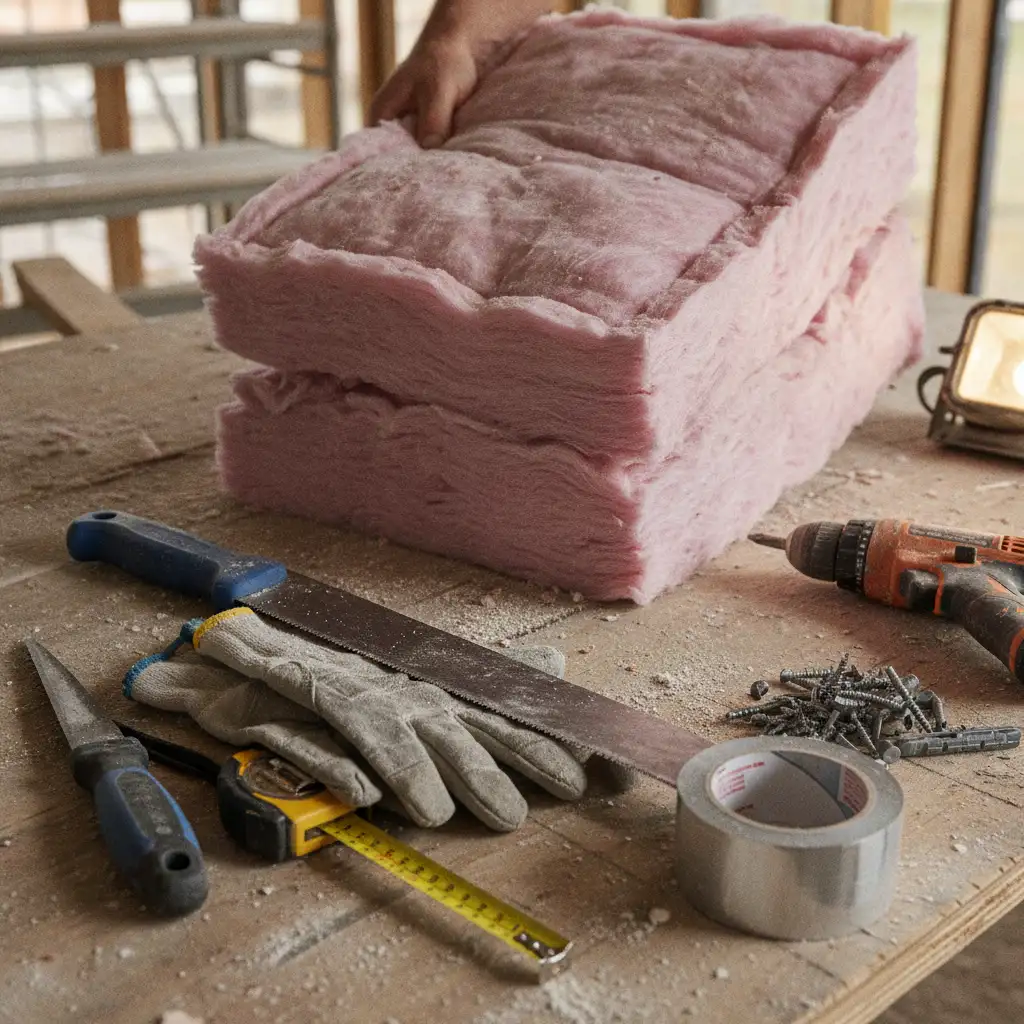
Our team in action — insulation professionals serving Burbank
Methods and Approaches for Open Cell Spray Foam in Burbank
Unvented Attic (Hot Roof) Assembly
The most common application in Burbank’s climate is spraying open cell foam directly to the underside of the roof deck, converting the attic to an unvented conditioned space. This approach is ideal for homes with HVAC equipment and ductwork located in the attic — a very common configuration in Burbank’s post-war housing stock. By bringing the attic within the thermal envelope, duct losses that typically account for 20 to 30 percent of HVAC energy consumption are dramatically reduced. Minimum application thickness is 5.5 inches per California Energy Code.
Wall Cavity New Construction or Open-Wall Retrofit
During new construction or gut renovation, open cell foam is sprayed directly into open stud bays before drywall installation. This method is widely used in Burbank’s active residential renovation market, particularly in the Rancho and Magnolia Park neighborhoods where older homes are being updated to comply with current Title 24 requirements.
Crawl Space Ceiling Joist Application
For homes with raised foundations — common in Burbank neighborhoods near the foothills — open cell foam applied to the crawl space ceiling joists provides thermal resistance and air sealing that fiberglass batts cannot achieve. This method pairs well with crawl space encapsulation for comprehensive moisture and thermal management.
Rim Joist and Band Joist Sealing
A targeted application of 2 to 3 inches of open cell foam at rim joists and band joists is one of the highest return-on-investment insulation upgrades available for older Burbank homes. These areas are notoriously leaky and are often overlooked in traditional insulation upgrades.
Interior Sound Partition Walls
In Burbank’s high-density residential corridors and entertainment-adjacent properties, open cell foam is applied within interior partition walls to reduce sound transmission between living units, home offices, and media rooms. Its NRC rating significantly outperforms fiberglass batts for sound control applications.
Ready for Open Cell Spray Foam Insulation? Get Your Free Estimate Today.
Next Level Insulation of Burbank serves Burbank and the surrounding area — we’ll be on-site within 24 hours.
📞 Call (818) 514-7541Open Cell Spray Foam Insulation Cost in Burbank, CA
The cost of open cell spray foam insulation in Burbank typically ranges from $1.00 to $1.50 per board foot (one board foot equals one square foot applied at one inch of thickness). For typical Burbank applications, this translates to the following approximate project costs:
- Attic rafter bay spray foam (unvented assembly, 1,200 sq ft attic): $3,600 to $5,400 for a 5-inch application
- Wall cavity spray foam (2,000 sq ft home, 3.5-inch application): $5,000 to $8,000 during open-wall renovation
- Crawl space ceiling joists (800 sq ft crawl space, 3-inch application): $2,000 to $3,200
- Rim joist sealing only: $800 to $1,500 for a typical single-story Burbank home
Factors That Affect Cost in Burbank
- Existing insulation removal: If old fiberglass or blown-in insulation must be removed first, add $1.00 to $2.00 per square foot for professional insulation removal
- Access difficulty: Burbank’s older homes often have low-clearance crawl spaces (under 18 inches) or attics with complex framing that increase labor time and cost by 15 to 25 percent
- Material price volatility: Polyurethane raw materials are petroleum-derived; prices fluctuate with oil markets, and Burbank installers have seen material cost increases of 10 to 20 percent in recent years
- Available rebates: Southern California Edison’s Home Energy Improvement program and SoCalGas rebates can reduce net project cost by $150 to $500
Call (818) 514-7541 for a no-obligation, itemized quote specific to your Burbank property.
Neighborhoods We Serve in and Around Burbank
Magnolia Park, Burbank
One of Burbank’s most charming residential districts, Magnolia Park is characterized by craftsman bungalows and Spanish colonial revival homes built between the 1920s and 1950s. These structures typically feature balloon-frame or platform-frame construction with minimal original insulation, wide eave overhangs, and shallow attic spaces. Open cell foam applied to the underside of the roof deck is the most effective upgrade for these homes, transforming inefficient attics into conditioned spaces that significantly reduce summer cooling loads.
Rancho District, Burbank
The Rancho neighborhood features mid-century ranch-style homes built predominantly in the 1960s and 1970s. These homes have low-sloped roofs and slab-on-grade or raised foundations. Many feature original blown-in insulation that has settled to R-10 or less. Open cell foam injection or open-attic spray applications bring these homes up to current California Energy Code minimums.
Hollywood, North Hollywood, and Studio City
The entertainment district corridor presents unique challenges including high ambient noise from production facilities, Burbank Airport flight patterns, and dense mixed-use construction. Open cell foam’s dual function as thermal insulation and acoustic dampener makes it the preferred choice for residential and commercial projects throughout this corridor.
Glendale and Toluca Lake
Bordering Burbank to the east and south, these communities share similar building vintage and climate conditions. We serve homeowners throughout these adjacent cities with the same Burbank-calibrated approach. View all our service areas
Maintenance Tips for Open Cell Spray Foam Insulation in Burbank
- Annual visual inspection: Each fall before Santa Ana season, visually inspect accessible foam surfaces in your attic or crawl space for any signs of physical damage, pest tunneling, or delamination from framing members.
- Monitor for pest activity: While open cell foam is not a food source for rodents, it can be tunneled through. Burbank’s proximity to the Verdugo Hills means roof rat activity is common; inspect foam surfaces and seal any new penetrations promptly.
- Keep attic ventilation clear: In vented attic assemblies supplemented with foam at rim joists, ensure soffit vents remain clear of blown-in material or debris after winter rains.
- Check HVAC penetrations: Verify that foam seals around duct boots and mechanical penetrations remain intact after any HVAC service work, as technicians sometimes disturb foam during equipment access.
- Humidity monitoring: Because open cell foam is vapor-permeable, install a simple attic humidity sensor if you’ve converted to an unvented attic assembly. Target relative humidity below 60 percent year-round.
- Post-seismic inspection: After any earthquake of magnitude 4.0 or greater felt in Burbank, inspect foam-insulated assemblies for cracks in adjacent drywall or framing that might indicate new air leakage pathways requiring spot repairs.
- Rebate program re-evaluation: Revisit Southern California Edison and SoCalGas rebate programs every two to three years, as new incentives for insulation upgrades are periodically added.
Why Choose Next Level Insulation of Burbank
Next Level Insulation of Burbank is a locally based insulation contractor with deep knowledge of the specific building types, climate patterns, and energy code requirements that define construction in Burbank and the San Fernando Valley. We do not operate as a franchise or national chain — every estimate, every installation, and every follow-up is handled by our Burbank-area team that lives and works in this community.
Our technicians are trained specifically in California Title 24 compliance requirements, ensuring that every open cell spray foam installation we complete meets or exceeds state energy code minimums and qualifies for available utility rebates from Southern California Edison and SoCalGas.
We offer comprehensive insulation services beyond spray foam, including attic insulation, blow-in insulation, crawl space insulation, crawl space encapsulation, and insulation removal and replacement, allowing us to serve as your single-source insulation contractor for any project scope.
We are fully insured and carry general liability coverage appropriate for residential and light commercial work in Los Angeles County. Call (818) 514-7541 to speak with a Burbank insulation specialist today.
Frequently Asked Questions About Open Cell Spray Foam Insulation in Burbank
How much does open cell spray foam insulation cost in Burbank, CA?
In Burbank, open cell spray foam typically costs between $1.00 and $1.50 per board foot. A full attic spray foam project for an average 1,200-square-foot Burbank home runs approximately $3,600 to $5,400. Factors including existing insulation removal, access difficulty in older homes, and current petroleum-based raw material pricing all affect final cost. Southern California Edison and SoCalGas rebates may reduce your net cost by $150 to $500.
How long does open cell spray foam installation take in a typical Burbank home?
Most residential projects in Burbank are completed in a single day. A standard attic application on a 1,200-square-foot home takes 4 to 6 hours of application time plus 1 to 2 hours of preparation and cleanup. Larger whole-home projects or those requiring prior insulation removal may require two days. Occupants should plan to vacate the treated area for 24 hours after application to allow for full cure and off-gassing.
Is open cell or closed cell spray foam better for Burbank’s climate?
Both have valid applications in Burbank. Open cell foam excels in attic rafter applications, interior wall cavities, and sound-control partitions where its flexibility and vapor permeability are assets. Closed cell foam is preferred in crawl spaces with higher moisture exposure, on the exterior side of wall assemblies, and where maximum R-value per inch is required in a limited-depth cavity. We assess your specific assembly and recommend the best product for each location in your Burbank home.
Will open cell spray foam in my attic void my roof warranty in Burbank?
Converting to an unvented attic assembly by spraying foam to the underside of the roof deck can affect some roofing manufacturer warranties. We recommend reviewing your roofing warranty documentation before proceeding and consulting with your roofing contractor. In Burbank, where tile and composition shingle roofs are most common, the majority of current manufacturer warranties accommodate unvented assemblies when installed per IRC or CBC code requirements, which our installations follow.
Does open cell spray foam help with noise from Burbank Airport and the freeway?
Yes. Open cell foam has a Noise Reduction Coefficient (NRC) of approximately 0.70, making it one of the most effective insulation materials for reducing airborne sound transmission. Burbank residents near Hollywood Burbank Airport flight paths or the I-5 and SR-134 corridors report noticeable reductions in ambient noise after open cell foam installation in attic and wall assemblies.
Can open cell spray foam be installed in my older Burbank home without a full renovation?
Absolutely. The most common retrofit application in Burbank’s older housing stock is an attic spray — accessible from the attic hatch without any demolition of finished interior surfaces. Rim joist sealing is another high-impact, minimally invasive retrofit. Wall cavity applications typically require open wall access, making them most cost-effective during a kitchen, bathroom, or other renovation project.
How does open cell spray foam perform during Burbank’s Santa Ana wind events?
Open cell foam is an excellent air barrier and performs exceptionally well during high-wind events like Santa Ana conditions. Because the foam physically fills and seals every gap, crack, and penetration in the building envelope, it prevents the pressurization-driven infiltration that forces unconditioned outside air into the living space. Homeowners consistently report that their homes feel dramatically tighter and more comfortable during Santa Ana events after foam installation.
Does Next Level Insulation of Burbank serve surrounding cities?
Yes. In addition to Burbank, we serve Studio City, Sherman Oaks, North Hollywood, Sun Valley, Toluca Lake, Universal City, Valley Village, Monterey Park, Hollywood, Beverly Hills, Glendale, Pasadena, Alhambra, Culver City, East Los Angeles, South Pasadena, La Cañada Flintridge, San Gabriel, and West Hollywood. View our full service area map
Get a Free Open Cell Spray Foam Estimate in Burbank Today
If your Burbank home is struggling to stay cool during triple-digit summer heat, drafty during Santa Ana wind events, or simply racking up high SoCal Edison bills, open cell spray foam insulation may be the most impactful single upgrade you can make to your property. Next Level Insulation of Burbank is ready to assess your home, explain your options, and deliver a detailed, no-obligation estimate.
Call us now at (818) 514-7541 to speak directly with a Burbank insulation specialist. We serve Burbank and surrounding communities including Glendale, Pasadena, North Hollywood, Studio City, and beyond. Don’t wait for another record-breaking San Fernando Valley summer — contact Next Level Insulation of Burbank today and start saving on energy costs year-round.