

Blown-In Attic Insulation in Burbank, CA
Energy-Saving Blown-In Attic Insulation for Burbank, CA Homes — Licensed & Insured
Need blown-in attic insulation in Burbank, CA? Next Level Insulation offers expert installation, R-38 to R-60 upgrades & BWP rebate help. Call (818) 514-7541.
- Licensed & Insured
- Locally Owned & Operated
- Free Inspection & Estimate
Request Your
Free EstimateBlown-in attic insulation is a high-performance method of filling your attic space with loose-fill insulating material — either fiberglass or cellulose — that is machine-blown into place to create a seamless, gap-free thermal barrier. Unlike batt insulation, blown-in material conforms to joists, beams, obstructions, and irregular cavities common in Burbank’s mix of mid-century and post-war construction.
Burbank’s climate presents a unique insulation challenge. Summers regularly push past 100°F in the San Fernando Valley heat corridor, while winter nights can dip below 40°F. Without adequate attic insulation, conditioned air escapes rapidly, driving up energy bills and straining HVAC systems. At Next Level Insulation of Burbank, our team brings deep familiarity with local building stock, permit requirements, and the specific thermal demands of homes and commercial properties throughout the Burbank area. Whether you’re addressing an aging ranch-style home in Magnolia Park or a newer construction near the Burbank Empire Center, we deliver precision-installed blown-in insulation that performs year-round. Call us at (818) 514-7541 for a free assessment.
Understanding Blown-In Attic Insulation
Blown-in attic insulation — also called loose-fill insulation — has been a trusted solution in American residential construction since the mid-twentieth century. The method gained widespread adoption in California during the post-war housing boom of the 1950s and 1960s, precisely the era when large swaths of Burbank’s residential neighborhoods were first developed. Early installations often used mineral wool or basic fiberglass. Today, the two dominant materials are:
- Cellulose: Made from 80–85% recycled newsprint and paper fiber treated with borate-based fire retardants. Cellulose achieves an R-value of approximately R-3.2 to R-3.8 per inch and is favored for retrofit projects in existing homes.
- Fiberglass: Spun glass fibers with an R-value of roughly R-2.2 to R-2.7 per inch. Fiberglass is non-combustible and resistant to moisture absorption, making it well-suited to attic environments with variable humidity.
The installation process involves a commercial-grade blower machine connected to a long flexible hose. A trained technician guides the hose across the attic floor, distributing material evenly while a second crew member feeds bags into the hopper below. The result is a uniform blanket of insulation that fills every corner, crevice, and cavity without the air gaps that cut-and-fit batt installation often leaves behind.
California’s Title 24 Building Energy Efficiency Standards — updated most recently for the 2022 code cycle — specify minimum R-38 attic insulation for climate zones encompassing most of Los Angeles County, including Burbank (Climate Zone 9). Many older Burbank homes currently sit at R-11 or even R-0 in their attics, representing a massive efficiency gap that blown-in insulation can close in a single day.
Blown-in attic insulation is appropriate for a wide range of building types common in Burbank: single-family ranch homes, Spanish Colonial revivals, 1960s split-levels, multi-family apartment buildings, and light commercial structures. Its versatility makes it the go-to upgrade for homeowners seeking meaningful energy savings without major renovation.
For properties that also need work beneath the home, our crawl space insulation services complement attic upgrades for comprehensive thermal performance.
Why Blown-In Attic Insulation Is Needed in Burbank, CA
The Age of Burbank’s Housing Stock
A significant driver of insulation deficiency is the age of local buildings. According to U.S. Census Bureau data, approximately 60% of Burbank’s housing units were built before 1980. Neighborhoods like Magnolia Park — characterized by 1940s and 1950s bungalows — and the Rancho District near Scott Road contain hundreds of homes with original insulation that has settled, degraded, or simply never met modern performance standards. Original fiberglass batts installed in the 1960s may have started at R-11 but lose 20–40% of their rated value through compression and moisture cycling over decades.
Santa Ana Wind Events
Burbank experiences recurring Santa Ana wind events, typically between October and March, that drive hot, dry air through the region at sustained speeds of 35–60 mph with gusts exceeding 80 mph. These events — including the notable December 2017 Thomas Fire wind event and the January 2021 Burbank wind event that downed trees across Olive Avenue — create extreme negative pressure differentials across building envelopes. Inadequately insulated attics allow this pressurized air infiltration to dramatically increase heating loads overnight.
Wildfire Smoke and Particulate Infiltration
Burbank’s proximity to fire-prone hillsides in the Verdugo Hills and the Angeles National Forest means residents regularly experience wildfire smoke infiltration. Gaps in attic insulation serve as pathways for fine particulate matter (PM2.5) to enter living spaces. Proper blown-in insulation coverage reduces these infiltration pathways significantly.
Utility Rate Pressures
Burbank Water and Power (BWP) serves the city as a municipal utility, and its tiered rate structure means high-consumption households pay substantially more per kilowatt-hour. Upgrading from R-11 to R-49 blown-in attic insulation can reduce annual cooling and heating energy use by 15–25%, translating to hundreds of dollars in annual savings for a typical 1,500–2,000 sq ft Burbank home.
Multi-Family and Commercial Properties
North Burbank’s industrial corridor along San Fernando Road and the apartment-dense neighborhoods near Buena Vista Street contain many properties with flat or low-slope roofs and minimal attic depth. These structures require specialized blown-in approaches — including dense-pack installation into shallow rafter bays — that our team executes routinely.
Signs You Need Blown-In Attic Insulation in Burbank
Energy and Comfort Indicators
- Monthly electricity bills from Burbank Water and Power exceeding $180–$220 during summer months in a home under 2,000 sq ft
- Rooms on the top floor consistently 5–10°F warmer than ground-floor rooms despite a functioning HVAC system
- Air conditioning cycling on more than 3–4 times per hour on a 95°F Burbank afternoon
- Noticeable drafts near ceiling light fixtures, recessed cans, or attic access hatches
Physical Inspection Indicators
- Visible attic floor joists protruding above existing insulation (indicating R-value below R-19)
- Patchy, uneven, or compressed batt insulation with gaps around pipes, wiring, or blocking
- Insulation discolored gray or black along edges — a sign of air filtration through the material
- Rodent tunneling or nesting damage in existing insulation, common in homes backing up to the Verdugo Hills
Urgency Indicators
- Existing insulation is vermiculite (pre-1980 homes) — may contain asbestos and requires professional testing before any work
- Moisture staining or mold growth on attic sheathing, indicating ventilation and insulation imbalance
- Home built before 1978 with no record of insulation upgrades
If you recognize two or more of these signs, contact Next Level Insulation of Burbank at (818) 514-7541 to schedule an assessment before the next Burbank heat season intensifies costs further.
Our Blown-In Attic Insulation Process in Burbank
Free On-Site Assessment (1–2 Hours)
A Next Level Insulation technician visits your Burbank property to measure the attic square footage, document existing insulation depth and R-value, assess ventilation conditions (soffit, ridge, and gable vents), and identify any pre-existing moisture or pest issues. We use a calibrated insulation depth gauge and infrared thermometer to produce accurate baseline measurements.
Pre-Installation Preparation (1–2 Hours on Install Day)
Before any material is blown, our crew seals attic air bypasses — including top plates, recessed light cans, electrical penetrations, and plumbing chases — with fire-rated spray foam or rigid blocking. This air-sealing step is critical in Burbank’s older homes, where framing gaps can account for 30–50% of total heat loss. We also install or verify baffles at each soffit vent to maintain the ventilation channel above insulation.
Insulation Removal (If Required, 2–4 Hours)
If existing insulation is damaged, contaminated, or pest-infested, we use a high-powered vacuum extraction system to remove it entirely before installing new material. Removed material is bagged and hauled off-site in compliance with Burbank’s solid waste disposal guidelines. Our insulation removal service is fully integrated into this phase.
Blown-In Installation (2–5 Hours Depending on Attic Size)
We position our truck-mounted or standalone blower machine outside the property to minimize interior disruption. A technician in the attic guides the hose systematically across the floor, working from the eaves toward the access hatch to avoid disturbing completed sections. Material depth is monitored against calibrated depth rulers stapled to joists, ensuring uniform coverage to the specified R-value — typically R-38 to R-60 for Burbank’s Climate Zone 9.
Post-Installation Verification (30–60 Minutes)
After installation, we conduct a final depth check across a grid of measurement points and document coverage with photos. We verify that ventilation baffles remain clear and that the attic hatch has been properly weatherstripped and insulated.
Cleanup and Customer Walkthrough (30 Minutes)
We clean the work area, remove all equipment and packaging, and walk you through documentation including the installed R-value, material type, and any rebate forms for Burbank Water and Power’s energy efficiency incentive program.
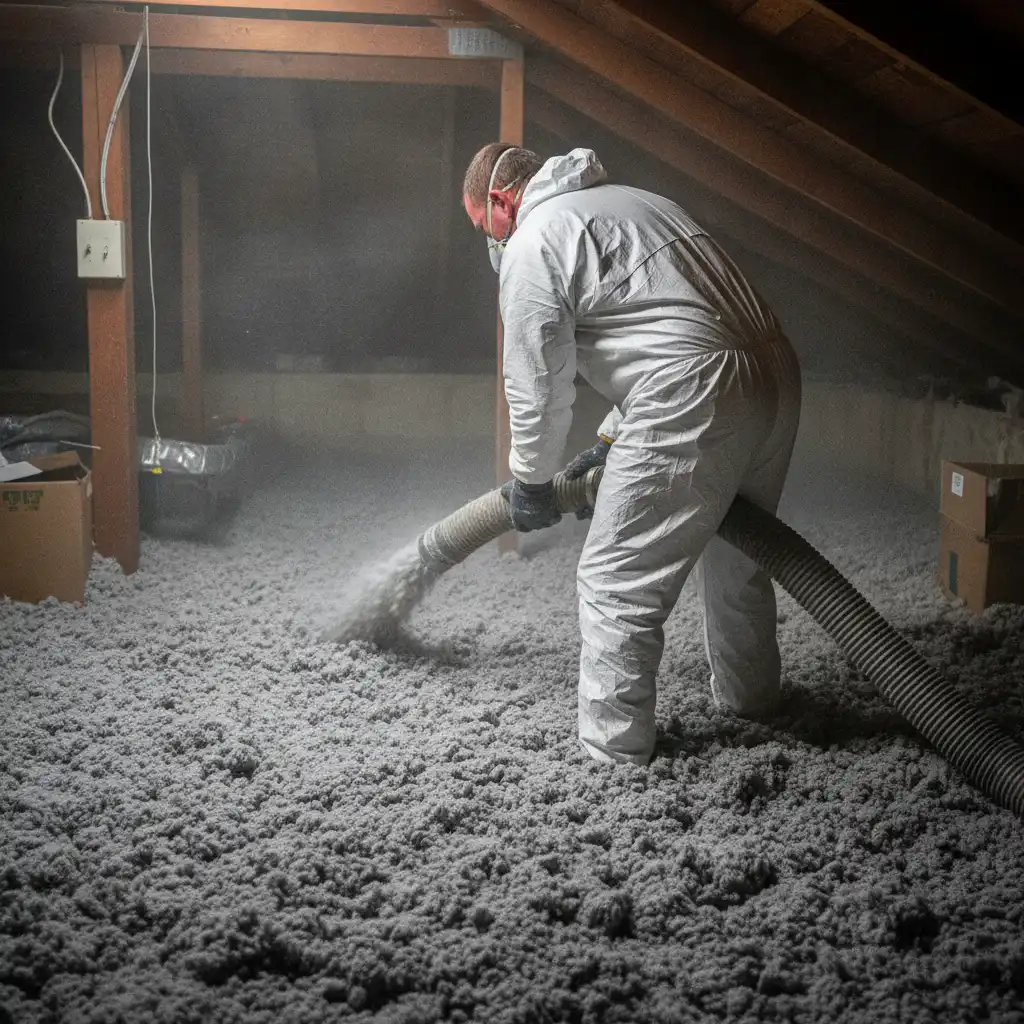
Our team in action — insulation professionals serving Burbank
Blown-In Insulation Methods and Approaches
Open-Blow Loose-Fill (Standard Attic Application)
The most common method for Burbank’s open-joist attic floors. Material is blown freely across the attic floor to a target depth. Cellulose at R-38 requires approximately 10–11 inches of installed depth; fiberglass requires 13–15 inches. This method is fast, cost-effective, and ideal for the flat attic floors typical of Burbank’s ranch and bungalow homes.
Dense-Pack Blown-In (Enclosed Cavities)
Used for enclosed rafter bays in cathedral ceilings, flat-roof structures, and knee walls. Material is blown at high density (3.5–4.0 lbs per cubic foot for cellulose) to prevent settling. This approach is common in Burbank’s 1960s split-level homes and the commercial buildings along Olive Avenue where attic access is limited.
Blow-In Batt System (Hybrid Approach)
For situations where existing batt insulation is in acceptable condition but depth is insufficient, we can supplement with a top layer of blown-in material, boosting total R-value without full removal. This is a cost-effective choice for Burbank homeowners who had insulation installed in the 1990s that simply hasn’t kept pace with current code requirements.
Wet-Spray Cellulose (Wall Cavities During Renovation)
When Burbank homeowners are renovating and walls are open, wet-spray cellulose can be applied to wall cavities before drywall installation. This method provides excellent air-sealing and is compatible with the older wood-frame construction prevalent throughout Magnolia Park and the Rancho District.
For projects requiring more than attic coverage, our spray foam insulation services provide an airtight complement to blown-in systems at the attic deck or rim joist locations.
Ready for Blown-In Attic Insulation? Get Your Free Estimate Today.
Next Level Insulation of Burbank serves Burbank and the surrounding area — we’ll be on-site within 24 hours.
📞 Call (818) 514-7541Blown-In Attic Insulation Cost in Burbank, CA
Homeowners and property managers researching blown-in attic insulation cost in Burbank, CA should expect the following ranges based on current local market conditions:
- Small attics (up to 1,000 sq ft): $800–$1,400 installed, depending on target R-value and material type
- Mid-size attics (1,000–1,800 sq ft): $1,400–$2,400 installed
- Large attics (1,800–3,000+ sq ft): $2,400–$4,200 installed
- Insulation removal and replacement: Add $1.00–$1.50 per sq ft to the above ranges
Key Cost Factors
- Target R-value: Upgrading to R-60 uses approximately 40% more material than R-38
- Attic accessibility: Low-pitch roofs and limited access hatches in some of Burbank’s older homes add 10–20% to labor costs
- Air sealing scope: Extensive air-sealing required in pre-1960 construction adds $200–$600 depending on penetration count
- Material choice: Cellulose typically runs $0.10–$0.15 per sq ft less than fiberglass at equivalent R-values
Burbank-Specific Rebates and Incentives
Burbank Water and Power offers residential energy efficiency rebates for qualifying insulation upgrades — currently up to $0.10 per sq ft for attic insulation meeting or exceeding R-38. Additionally, California’s TECH Clean California program provides supplemental incentives for whole-home energy upgrades. We assist customers with rebate documentation at no additional charge.
For a precise quote, call (818) 514-7541 or request an on-site estimate.
Burbank Neighborhoods We Serve
Magnolia Park
One of Burbank’s most walkable and architecturally distinct neighborhoods, Magnolia Park features a high concentration of 1930s–1950s bungalows and Craftsman homes. These properties commonly have shallow attic access and original insulation that has settled below R-8. Dense-pack and open-blow cellulose are our most frequent solutions here.
Rancho District
The Rancho District near Scott Road and Glenoaks Boulevard contains 1950s–1970s ranch-style single-family homes with standard open attic floors — ideal for efficient blown-in installation. Many homeowners in this area are upgrading ahead of BWP’s tiered summer rates.
Burbank Hills / Verdugo Woodlands
Hillside properties backing up to the Verdugo Hills face dual challenges: elevated wildfire risk (requiring ignition-resistant materials) and rodent intrusion through unprotected soffits. We incorporate pest-resistant cellulose and sealed soffit baffles as standard practice in this zone.
Downtown Burbank / Media District
Mixed-use and multi-family buildings near Burbank’s downtown core and the Media District (home to Warner Bros. and Disney studios) often feature flat-roof construction with minimal attic cavity. Dense-pack installation into shallow rafter assemblies is our primary approach for these property types.
We also serve Studio City, North Hollywood, Glendale, Toluca Lake, and surrounding communities throughout the greater Los Angeles area.
Maintenance Tips for Blown-In Attic Insulation in Burbank
- Annual visual inspection: Check insulation depth each fall before Burbank’s cooler months. Blown-in cellulose settles 10–15% in the first year; recheck that depth rulers remain at or above your target R-value marker.
- Pest inspection after wind events: After significant Santa Ana wind events, inspect soffit vents and fascia for gaps that could allow rodent entry into the insulation layer.
- Keep attic vents clear: Burbank’s dusty, dry summers — especially during offshore wind events — can clog soffit and ridge vents with debris. Clear blockages twice yearly to maintain proper ventilation above the insulation layer.
- Monitor for moisture after winter rains: Even in Burbank’s semi-arid climate, El Niño years bring heavy rain. Inspect attic sheathing after major rain events for staining or condensation that could indicate a ventilation imbalance.
- Don’t compress insulation with storage: Avoid placing boxes or stored items directly on blown-in insulation. Compression reduces R-value immediately; use raised attic flooring boards if storage is needed.
- Seal any new penetrations promptly: If HVAC, electrical, or plumbing contractors access the attic, ensure all new penetrations are sealed with fire-rated caulk or foam before closing the hatch.
- Schedule a professional recheck every 7–10 years: Blown-in insulation in Burbank’s thermal cycling environment should be professionally assessed each decade to confirm continued performance.
Why Choose Next Level Insulation of Burbank
Next Level Insulation of Burbank is a locally based insulation contractor with deep familiarity with the building types, climate conditions, and utility programs specific to Burbank and the surrounding San Fernando Valley communities. Unlike large national contractors who apply a one-size-fits-all approach, our team understands the difference between a Magnolia Park bungalow and a Verdugo Hills hillside home — and we adapt our methods accordingly.
Our crew is trained and equipped to handle the full scope of insulation work: from blown-in attic installation to insulation removal, crawl space encapsulation, and spray foam applications. We handle Burbank Water and Power rebate paperwork for qualifying projects, and we provide thorough post-installation documentation with every job.
We service Burbank and all neighboring communities — from Studio City and Toluca Lake to Glendale and Pasadena — with the same attention to detail on every project. When you call (818) 514-7541, you speak directly with our Burbank-based team, not a call center.
Frequently Asked Questions About Blown-In Attic Insulation in Burbank, CA
How much does blown-in attic insulation cost in Burbank, CA?
For most Burbank homes, blown-in attic insulation installation ranges from $800 to $4,200 depending on attic size, target R-value, and whether existing insulation needs to be removed first. A 1,500 sq ft attic upgraded to R-49 typically falls in the $1,800–$2,600 range. Burbank Water and Power rebates can offset a portion of this cost for qualifying upgrades.
How long does blown-in attic insulation installation take in Burbank?
Most residential blown-in insulation projects in Burbank are completed in a single day — typically 4–8 hours from crew arrival to cleanup. Larger homes, difficult attic access, or projects requiring prior insulation removal may extend to two days. We confirm estimated timelines during the free on-site assessment.
What R-value do I need for my Burbank, CA home?
California Title 24 requires a minimum of R-38 for attic insulation in Burbank’s Climate Zone 9. However, given Burbank’s documented heat extremes — including the record 114°F recorded at Bob Hope Airport in September 2017 — we recommend R-49 to R-60 for optimal performance and maximum energy savings, particularly for homes with top-floor living spaces.
Is cellulose or fiberglass better for Burbank attics?
Both materials perform well in Burbank’s climate. Cellulose offers slightly higher R-value per inch and superior air-sealing characteristics due to its denser pack, making it a strong choice for older Burbank homes with many framing gaps. Fiberglass is non-combustible and absorbs less moisture, which can be advantageous in Burbank’s hillside homes near fire-prone areas. We help homeowners choose based on their specific property conditions.
Will blown-in insulation help with noise from Burbank Airport?
Yes. Cellulose blown-in insulation provides meaningful sound attenuation in addition to thermal performance. Homes near Burbank Bob Hope Airport (Hollywood Burbank Airport) on Thornton Avenue or Airport Way frequently benefit from the sound-dampening qualities of dense-pack cellulose in attic and wall assemblies.
Do I need a permit for blown-in attic insulation in Burbank?
In most cases, attic insulation additions in existing Burbank homes do not require a building permit. However, if the project involves structural modifications to the attic access or changes to HVAC equipment, a permit may be required. We confirm permit requirements for each project and handle submissions when necessary.
Can blown-in insulation be installed over my existing insulation in Burbank?
Yes — if the existing insulation is in good condition, dry, free of pest damage, and not a hazardous material (such as vermiculite containing asbestos), we can blow new material directly over the top to achieve the target R-value. If existing insulation is damaged or contaminated, removal is recommended first. We assess this during the free on-site visit.
Do you serve areas near Burbank, CA?
Absolutely. In addition to Burbank, Next Level Insulation of Burbank serves Studio City, Sherman Oaks, North Hollywood, Sun Valley, Toluca Lake, Universal City, Valley Village, Glendale, Pasadena, Hollywood, Beverly Hills, and many other communities throughout the greater Los Angeles area. Visit our service areas page for the full list.
Get Your Free Blown-In Attic Insulation Estimate in Burbank Today
Don’t let another scorching Burbank summer — or another round of Santa Ana winds — drive up your energy bills and reduce your comfort. Next Level Insulation of Burbank is ready to assess your attic, recommend the right blown-in insulation solution for your specific home and neighborhood, and deliver a professional installation that meets California Title 24 standards and qualifies for available Burbank Water and Power rebates.
Call us today at (818) 514-7541 to speak directly with our Burbank team and schedule your free, no-obligation on-site assessment. We serve Burbank and all surrounding communities including Glendale, Toluca Lake, North Hollywood, Studio City, and beyond. Let Next Level Insulation of Burbank bring your home to the next level of comfort and efficiency.