

Basement Insulation in Burbank, CA
Energy-Saving Basement Insulation for Burbank, CA Homes — Licensed & Insured
Need basement insulation in Burbank, CA? Next Level Insulation offers expert crawl space encapsulation, spray foam & more. Call (818) 514-7541 for a free estimate.
- Licensed & Insured
- Locally Owned & Operated
- Free Inspection & Estimate
Request Your
Free EstimateBasement insulation is the process of sealing and thermally protecting the below-grade or partially below-grade spaces of a home or commercial building — including foundation walls, rim joists, and subfloor assemblies — to prevent heat loss, moisture intrusion, and energy waste. In Burbank, CA, where summer temperatures routinely climb above 100°F in the San Fernando Valley heat corridor and winter nights can dip into the mid-30s, an uninsulated or poorly insulated basement creates enormous swings in indoor comfort and utility costs.
At Next Level Insulation of Burbank, we specialize in basement insulation solutions tailored specifically to the building stock, soil conditions, and Mediterranean climate of Burbank and the greater Los Angeles area. Whether you own a mid-century ranch home near Magnolia Park, a multi-unit property off Victory Boulevard, or a commercial building in the Burbank Media District, our team delivers precision insulation that keeps your structure comfortable year-round. Call us today at (818) 514-7541 to schedule your free assessment.
Understanding Basement Insulation
Basement insulation encompasses a range of thermal and moisture-control strategies applied to the lower envelope of a building. Unlike attic insulation — which primarily targets heat rising through a ceiling — basement insulation must address multiple threat vectors simultaneously: conductive heat loss through concrete or masonry walls, air infiltration through rim joists and sill plates, moisture vapor migrating up from the ground, and cold-floor syndrome caused by uninsulated subfloors above unconditioned spaces.
Historically, basement insulation was largely ignored in Southern California construction. During Burbank’s most intensive residential building periods — the post-World War II boom of the late 1940s through the 1960s, when thousands of single-family homes were built to house workers at Lockheed Aircraft and the adjacent entertainment studios — builders prioritized speed and cost over thermal envelope performance. Energy codes at the time imposed no meaningful requirements for below-grade insulation, leaving the majority of Burbank’s mid-century housing stock with bare concrete walls and unprotected rim joists.
California’s Title 24 Building Energy Efficiency Standards, first adopted in 1978 and updated in 2022, now mandate minimum insulation values for new construction and significant remodels. However, the vast majority of Burbank’s estimated 44,000 housing units were built before these standards took effect, meaning retrofit basement insulation is not just a comfort upgrade — it is an essential energy-efficiency correction for most of the city’s existing buildings.
Basements in Burbank range from true full-depth basements (less common in the flat Valley floor areas) to shallow partial basements and daylight basements found on sloped lots in the Verdugo Mountains foothills and near Stough Canyon. Crawl spaces, which function similarly to shallow basements, are extremely common beneath single-story homes throughout the Magnolia Park, Rancho District, and McCambridge Park neighborhoods. Each configuration requires a different insulation approach, and Next Level Insulation of Burbank has the expertise to address all of them.
Proper basement insulation delivers measurable results: according to the U.S. Department of Energy, homeowners can save between 10% and 20% on annual heating and cooling costs by insulating and air-sealing their basement or crawl space — savings that are amplified in high-utility-rate markets like Southern California. Learn how attic insulation complements basement insulation for whole-home energy savings
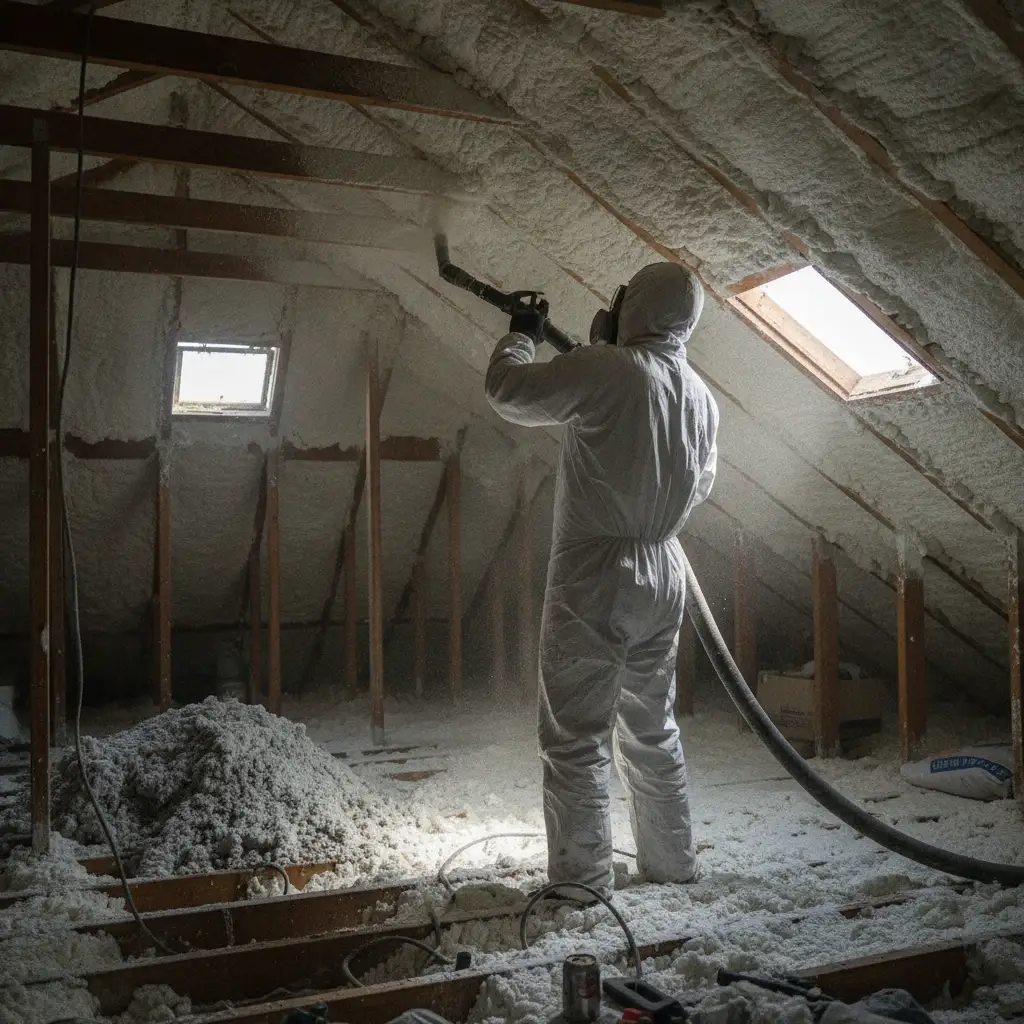
Our team in action — insulation professionals serving Burbank
Why Basement Insulation Is Needed in Burbank, CA
Burbank’s Climate Creates Unique Thermal Stress
Burbank sits in the eastern end of the San Fernando Valley, hemmed in by the Verdugo Mountains to the north and the Santa Monica Mountains to the south. This geography creates a pronounced heat island effect. The National Weather Service recorded a high of 114°F at Burbank Airport on September 6, 2020 — one of the hottest temperatures ever documented in the region — during the broader Labor Day heat event that shattered records across Southern California. During such extreme heat episodes, an uninsulated basement or crawl space allows ground-level heat to radiate upward into living areas, significantly increasing air conditioning loads and indoor humidity.
Conversely, Burbank’s winter nights can reach as low as 28°F to 32°F, particularly in hillside areas near Stough Canyon Nature Center and along the foothills of the Verdugo range. Without insulated basement walls and rim joists, cold air infiltrates the building envelope from below, creating cold floors, drafts, and elevated heating demand in the rooms immediately above the basement or crawl space.
Expansive Clay Soils and Ground Moisture
Burbank and much of the San Fernando Valley overlie alluvial fan deposits mixed with expansive Montmorillonite clay soils — the same soil type that caused widespread foundation movement during the January 1994 Northridge Earthquake (epicenter approximately 8 miles southwest of downtown Burbank). These clay soils absorb and release moisture seasonally, creating hydrostatic pressure against foundation walls during wet years and shrinkage cracks during drought years. California’s recent drought cycles — most severely from 2012 to 2017 and again from 2020 to 2022 — caused significant soil contraction beneath many Burbank foundations, creating pathways for soil gases, moisture vapor, and outside air to enter below-grade spaces.
When atmospheric rivers bring heavy rainfall — such as the January 2023 storm sequence that deposited over 8 inches of rain on Burbank in a two-week period — the same clay soils can become saturated, driving moisture vapor through porous concrete block or poured concrete foundation walls. Without a properly installed vapor barrier and insulation system on the interior of these walls, basement and crawl space moisture leads to mold growth, wood rot in floor joists, and degraded indoor air quality throughout the home.
The Santa Ana Wind Factor
Burbank experiences significant Santa Ana wind events between October and April, with gusts frequently exceeding 50 mph through the Verdugo Pass and down into the Valley floor. These dry offshore winds drive cold outside air into every unsealed gap in the building envelope — including rim joist gaps, foundation vents, and sill plate cracks. In neighborhoods like Rancho Equestrian and the older sections of Magnolia Park, where homes were built in the 1940s and 1950s with minimal air sealing, Santa Ana events can reduce interior temperatures by 5°F to 10°F in a single day without any change in thermostat settings, simply because of infiltration through the uninsulated lower envelope.
Seismic Activity and Foundation Gaps
Burbank sits within 5 miles of the Verdugo Fault and within 10 miles of the Hollywood Fault. Post-seismic settling — even from moderate Mw 3.5–4.5 events that occur several times per year in the greater Los Angeles basin — can widen micro-cracks in foundation walls and sill plate connections, increasing air and moisture infiltration pathways. Regular seismic activity makes periodic inspection and re-sealing of the lower building envelope a practical necessity in Burbank, not merely a recommended upgrade.
Signs You Need Basement Insulation in Burbank
Thermal and Comfort Indicators
- Floors above the basement or crawl space feel cold in winter or uncomfortably warm in summer, with temperature differentials exceeding 5°F compared to adjacent rooms with normal subfloor assemblies
- HVAC system runs continuously during mild weather (below 85°F) because it cannot maintain setpoint temperatures
- Noticeable drafts near floor level, especially during Santa Ana wind events
- Uneven room temperatures throughout the home, with ground-floor rooms consistently 8–12°F warmer or cooler than upper floors
Moisture and Air Quality Indicators
- Musty or earthy odors emanating from floor vents or basement access hatches — a strong indicator of mold or mildew activity in the crawl space
- Visible condensation on basement walls or floor joists after winter rains or during summer humidity spikes
- Efflorescence (white mineral deposits) on concrete or masonry walls, indicating ongoing water migration through the foundation
- Allergy or respiratory symptoms among occupants that improve when spending time outside the home
Structural Warning Signs
- Soft or springy spots in flooring above the crawl space, suggesting moisture-damaged floor joists
- Visible gaps between the sill plate and foundation wall, particularly in older Burbank homes that experienced shaking during the 1994 Northridge Earthquake
- Existing insulation that is compressed, discolored, or falling from the underside of the subfloor
Urgency Note: If you observe active mold growth on floor joists or visible standing water in a crawl space, these are emergency conditions requiring immediate professional attention. Call Next Level Insulation of Burbank at (818) 514-7541 for priority scheduling.
Basement Insulation Methods We Use in Burbank
Spray Foam Insulation (Closed-Cell)
Closed-cell spray polyurethane foam (ccSPF) is the premium solution for Burbank basement applications. Applied at 2 inches to achieve approximately R-12, or at 3 inches for R-19, ccSPF simultaneously insulates, air-seals, and acts as a Class II vapor retarder. It is ideal for rim joists, foundation walls in moisture-prone areas (particularly properties near the Tujunga Wash or low-lying areas of Sun Valley), and any application where space constraints make thicker insulation assemblies impractical. Explore our spray foam insulation services
Rigid Foam Board Insulation
Extruded polystyrene (XPS) or polyisocyanurate rigid board insulation, installed in continuous layers against foundation walls, provides excellent thermal performance with R-values of R-5 per inch. Rigid foam is well-suited for Burbank homes where owners prefer a DIY-compatible finishing system (drywall can be installed directly over foam with appropriate fire protection), or where budget constraints favor a slightly lower-cost alternative to spray foam. Minimum 2-inch thickness (R-10) is recommended per California Title 24 guidance for conditioned basements.
Blown-In Insulation for Subfloor Applications
For existing crawl spaces where the subfloor assembly will remain open (vented crawl space design), dense-pack cellulose or mineral wool blown into the floor joist cavities achieves R-19 to R-30 depending on joist depth. This approach is common in Burbank’s Magnolia Park and Rancho District neighborhoods, where 1950s-era homes have 2×10 floor joists at 16 inches on center. Learn more about blow-in insulation options
Crawl Space Encapsulation (Complete System)
For the highest performance outcome, crawl space encapsulation combines vapor barrier installation, foundation wall insulation, rim joist air sealing, and vent closure into a single conditioned-space conversion. This approach eliminates ground moisture from the equation entirely and is particularly effective for Burbank properties with persistent moisture issues related to expansive clay soil cycles. Discover our crawl space encapsulation process
Ready for Basement Insulation? Get Your Free Estimate Today.
Next Level Insulation of Burbank serves Burbank and the surrounding area — we’ll be on-site within 24 hours.
📞 Call (818) 514-7541Basement Insulation Cost in Burbank, CA
Understanding the cost of basement insulation in Burbank requires accounting for project scope, chosen method, existing conditions, and local labor rates. Below are general price ranges based on typical Burbank-area project profiles:
Typical Price Ranges
- Rim Joist Air Sealing and Spray Foam Only: $800–$2,500 for a typical 1,200–2,000 sq ft Burbank home, depending on linear footage of rim joist and degree of existing air leakage
- Crawl Space Subfloor Blown-In Insulation (R-19 to R-30): $1,500–$4,500 for an average 800–1,500 sq ft crawl space footprint
- Foundation Wall Rigid Foam or Spray Foam: $3,000–$8,000 for a full perimeter treatment of a standard Burbank basement or partial basement
- Full Crawl Space Encapsulation System: $5,000–$15,000 depending on square footage, vapor barrier thickness, and whether mechanical dehumidification is included
- Insulation Removal Plus Replacement: Add $0.75–$2.00 per square foot to any base installation cost for removal and disposal of existing degraded insulation
Burbank-Specific Cost Factors
Labor costs in Burbank and the greater Los Angeles metro area run 15%–25% higher than national averages due to California prevailing wage expectations and high cost of living. However, Southern California Edison and SoCalGas both offer rebate programs — currently up to $500 for qualifying insulation upgrades — that can partially offset project costs. Properties in hillside areas near the Verdugo Mountains may incur additional access fees of $200–$600 due to limited equipment staging areas and longer material haul distances.
Call us at (818) 514-7541 for a no-obligation, itemized estimate specific to your Burbank property. Basement insulation cost estimates are provided free of charge.
Burbank Neighborhoods We Serve
Magnolia Park
One of Burbank’s most beloved historic districts, Magnolia Park features a dense concentration of 1940s and 1950s bungalows and California ranch homes — most with original crawl spaces that have never been insulated or encapsulated. Ground moisture from seasonal clay soil swelling is a common issue in this flat, lower-elevation neighborhood.
Rancho District
The Rancho District’s larger lots and older equestrian-era homes present unique basement insulation challenges, including oversized crawl spaces with multiple access hatches and older foundation vent configurations that require careful analysis before conversion to conditioned space.
Burbank Hills / Stough Canyon Adjacent
Hillside properties near Stough Canyon Nature Center often feature daylight basements and partial below-grade spaces on sloped lots, requiring a hybrid approach combining foundation wall insulation on the below-grade side with exterior drainage management.
Media District and Downtown Burbank
Commercial and mixed-use properties in the Burbank Media District — many housing production facilities, offices, and studios — frequently require basement and sub-slab insulation upgrades to meet California’s evolving Title 24 commercial building standards. We serve all property types in this area.
We also serve Studio City, Sherman Oaks, North Hollywood, Sun Valley, Toluca Lake, Universal City, Valley Village, Glendale, Pasadena, Hollywood, Beverly Hills, and surrounding communities throughout greater Los Angeles.
Basement Insulation Maintenance Tips for Burbank Homeowners
- Inspect After Major Rain Events: Following atmospheric river events like the January 2023 storms, visually check your crawl space access hatch for signs of standing water or new moisture staining on vapor barrier seams within 48 hours of heavy rainfall.
- Monitor Indoor Humidity Levels: In Burbank’s variable climate, maintain interior humidity between 30% and 50% using a simple hygrometer. Persistent readings above 60% at floor level suggest moisture is bypassing your basement insulation or vapor barrier system.
- Check Foundation Vents Seasonally: If you have a vented crawl space, inspect vent screens each fall for blockages (rodent nesting is common in Burbank’s foothills areas) and each spring for damage from winter rains.
- Inspect for Pest Intrusion: Burbank’s warm climate supports active rodent and insect populations. Check annually for pest damage to insulation materials — rodents commonly nest in fiberglass batts, compressing R-value and creating moisture conduits.
- Re-examine After Seismic Events: After any felt earthquake (Mw 3.5 or greater), visually inspect rim joist insulation and spray foam seals at the sill plate for new cracks or separations.
- Verify Vapor Barrier Integrity: Every two to three years, have a professional inspect vapor barrier seams and wall terminations for lifting, tearing, or sealant failure — particularly if your property is in a low-lying area near the Los Angeles River corridor.
- Clear Perimeter Drainage: Keep gutters, downspouts, and perimeter drains clear to direct rainwater away from the foundation, reducing hydrostatic pressure on basement walls.
Why Choose Next Level Insulation of Burbank
Next Level Insulation of Burbank is a locally focused insulation contractor serving Burbank and the surrounding Los Angeles communities with specialized expertise in the building conditions, climate demands, and regulatory environment unique to this region. We are not a national franchise applying one-size-fits-all solutions — we are a local team that understands the difference between insulating a 1948 Magnolia Park bungalow and a 2005 hillside home near the Verdugo foothills, and we approach each project accordingly.
Our service offering covers the full spectrum of insulation and building envelope solutions: spray foam insulation, blow-in insulation, attic insulation, crawl space encapsulation, crawl space insulation, insulation removal, and insulation replacement. This comprehensive capability means we can address your entire building envelope in a single coordinated project — maximizing energy savings and minimizing disruption to your household or business operations.
We are committed to transparent, itemized pricing, clear project timelines, and communicative project management from initial assessment through final inspection. Our work is performed by trained technicians using professional-grade equipment and industry-leading materials. Reach out at (818) 514-7541 to experience the Next Level difference.
Frequently Asked Questions: Basement Insulation in Burbank, CA
How much does basement insulation cost in Burbank, CA?
Basement insulation costs in Burbank typically range from $800 for a basic rim joist spray foam application to $15,000 or more for a complete crawl space encapsulation system with vapor barrier, foundation wall insulation, and mechanical dehumidification. Most Burbank homeowners with an average-size crawl space or partial basement invest between $3,000 and $8,000 for a comprehensive solution. We provide free, no-obligation estimates — call (818) 514-7541 to schedule yours.
Does Burbank’s climate really make basement insulation necessary?
Absolutely. Burbank’s location in the eastern San Fernando Valley creates extreme thermal conditions — summer temperatures exceeding 110°F (as recorded in September 2020) and winter lows approaching freezing in hillside areas. Without insulated below-grade spaces, heat and cold transfer directly through unprotected concrete and wood assemblies, raising utility costs and reducing comfort year-round. California’s frequent drought-to-flood soil moisture cycles also make moisture management in below-grade spaces a critical issue for preserving structural integrity.
How long does a basement insulation project take to complete?
A standard Burbank residential basement or crawl space insulation project takes one to three days, depending on square footage, method selected, and whether existing insulation removal is required. Rim joist-only spray foam projects can typically be completed in a single day. Full crawl space encapsulation projects on larger Burbank properties (1,500+ sq ft crawl space) may require two to three days for proper vapor barrier installation, wall insulation, and air sealing.
What is the difference between crawl space encapsulation and standard basement insulation?
Standard basement insulation typically refers to thermal insulation added to foundation walls, rim joists, or the underside of the subfloor — focusing primarily on thermal performance. Crawl space encapsulation is a more comprehensive system that also includes sealing the crawl space from outside air (closing vents), installing a full ground-contact vapor barrier, and often adding mechanical dehumidification. Encapsulation effectively converts the crawl space from an uncontrolled exterior zone to a conditioned interior zone, offering superior moisture control — which is particularly valuable in Burbank given the expansive clay soil conditions.
Will basement insulation help with my high SoCal Edison electricity bills?
Yes, significantly. Southern California Edison rates in Burbank are among the highest in the nation, with Tier 2 rates exceeding $0.40 per kWh. By reducing the thermal load on your HVAC system — particularly critical during Burbank’s frequent heat events — properly installed basement and crawl space insulation can reduce annual cooling and heating costs by 10%–20%. Many homeowners see payback periods of four to seven years depending on current energy costs and project scope. SoCalGas and SCE also offer rebates for qualifying insulation upgrades.
Is a building permit required for basement insulation in Burbank?
In most cases, insulation retrofits in existing Burbank homes do not require a building permit. However, crawl space encapsulation projects that involve permanently closing foundation vents may require a permit from the City of Burbank Building and Safety Division, as this constitutes a change in the building’s ventilation system. We assess permit requirements during our initial site evaluation and handle all required permit applications and inspections on your behalf.
How do I know if my existing crawl space insulation has failed?
Key indicators of failed crawl space insulation in Burbank homes include: insulation batts falling from the underside of the subfloor (visible from the access hatch), musty odors rising from floor registers, cold floors in winter despite adequate HVAC operation, and visible mold or moisture staining on floor joists. Many Burbank homes with original 1950s–1960s fiberglass batt insulation have R-values that have degraded from initial R-11 or R-13 ratings to near zero due to compression, moisture absorption, and pest damage. A professional assessment will identify exactly what is present and what is needed.
Do you serve areas near Burbank, such as Glendale and North Hollywood?
Yes. In addition to all Burbank neighborhoods, Next Level Insulation serves Glendale, North Hollywood, Studio City, Sherman Oaks, Sun Valley, Toluca Lake, Universal City, Valley Village, Hollywood, Beverly Hills, Pasadena, Alhambra, Culver City, East Los Angeles, South Pasadena, La Cañada Flintridge, San Gabriel, Monterey Park, and West Hollywood. Call (818) 514-7541 to confirm service availability for your specific address.
Get Professional Basement Insulation in Burbank, CA Today
Whether you are dealing with cold floors in a Magnolia Park bungalow, moisture issues in a hillside crawl space near the Verdugos, or rising energy bills in a Burbank Media District commercial property, Next Level Insulation of Burbank has the local expertise and proven methods to solve your below-grade insulation challenges. Do not let another Burbank summer heat event or Santa Ana wind season compromise your comfort and energy efficiency.
Contact us today for a free, no-obligation basement insulation assessment:
- Phone: (818) 514-7541
- Service Area: Burbank and all surrounding Los Angeles communities
Call now and speak directly with a Burbank insulation specialist. Same-week appointments are often available. Schedule your free basement insulation estimate online