

Soundproofing Insulation in Burbank, CA
Expert Soundproofing Insulation in Burbank, CA — Storm-Tested, Warranty-Backed
Get expert soundproofing insulation in Burbank, CA. We reduce airport, studio & freeway noise. Free assessment. Call (818) 514-7541 today.
- Licensed & Insured
- Locally Owned & Operated
- Free Inspection & Estimate
Request Your
Free EstimateBurbank is one of the most acoustically demanding cities in the Los Angeles region. Home to major entertainment studios, a busy regional airport, and a dense network of surface streets and freeways, unwanted noise infiltrates homes and businesses here at rates far above typical suburban communities. Soundproofing insulation is a specialized class of building material and installation technique designed to absorb, block, and dampen airborne sound waves and structure-borne vibrations before they travel through walls, floors, ceilings, and roof assemblies.
At Next Level Insulation of Burbank, our team brings focused expertise to the unique acoustic environment of Burbank and its surrounding neighborhoods. We assess each property’s specific noise sources, structural conditions, and existing insulation before recommending a tailored solution. Whether you’re dealing with jet noise from Hollywood Burbank Airport, production sound from a nearby studio lot, or traffic rumble from the I-5 or SR-134, we deliver measurable noise reduction backed by proven methods and quality materials.
Call us today at (818) 514-7541 for a free assessment.
Understanding Soundproofing Insulation
Soundproofing insulation differs from standard thermal insulation in one critical way: it is specifically engineered to interrupt the transmission of sound energy in addition to resisting heat transfer. Sound travels in two fundamental forms inside buildings. Airborne sound — voices, music, traffic noise, and aircraft — travels as pressure waves through the air and excites building surfaces when it contacts them. Structure-borne sound, sometimes called impact noise, travels directly through solid materials such as concrete floors, wood framing, and drywall assemblies.
Effective soundproofing insulation addresses both pathways. Materials are evaluated by their Sound Transmission Class (STC) rating for airborne noise and their Impact Insulation Class (IIC) rating for impact noise. A standard interior wall with no insulation typically achieves an STC of roughly 33, meaning loud speech is clearly audible. Adding a dense soundproofing insulation product can push that rating to STC 45–55, at which point loud speech becomes unintelligible and only very loud sounds remain perceptible.
The history of acoustic construction in the Los Angeles basin stretches back to the 1920s and 1930s, when early radio broadcasting and silent-film production facilities began grappling with noise isolation in what were then open agricultural fields. Burbank became a epicenter of this challenge as Warner Bros., Disney, and NBC built large soundstage complexes beginning in the 1920s and 1940s, respectively. Residential construction in Burbank boomed in the post-World War II era, with thousands of single-family homes built between 1945 and 1965 using wood-frame techniques that offered virtually no inherent soundproofing value.
Those mid-century homes now sit beneath busy flight paths, adjacent to active studio lots, and within earshot of commercial corridors that were far quieter when the houses were first built. Modern soundproofing insulation products — including high-density mineral wool batts, open-cell and closed-cell spray foam, and resilient channel assemblies paired with acoustic drywall — give Burbank property owners the tools to retrofit these older structures and bring them up to contemporary acoustic standards without tearing down walls entirely.
Commercial and mixed-use buildings in Burbank face additional demands. Recording studios, podcast suites, post-production editing rooms, and voice-over booths require noise floor levels measured in decibels that standard construction cannot achieve without deliberate acoustic design and installation of appropriate soundproofing insulation systems.
Why Soundproofing Insulation Is Needed in Burbank, CA
Hollywood Burbank Airport Flight Operations
Hollywood Burbank Airport (BUR), operated by the Burbank-Glendale-Pasadena Airport Authority, processes roughly 3 million passengers per year and handles hundreds of daily flight operations. The airport’s runways — Runway 8/26 and Runway 15/33 — direct departure and approach paths directly over established residential neighborhoods including Magnolia Park, the R-1 residential corridor along Hollywood Way, and portions of the Chandler neighborhood. The Federal Aviation Administration designates noise exposure zones around BUR using Day-Night Average Sound Level (DNL) contours. Properties falling within the 65 DNL contour — which includes several hundred Burbank homes within roughly half a mile of the runway thresholds — regularly experience peak aircraft noise events exceeding 80 decibels (dB) inside rooms with no soundproofing treatment.
The Airport Authority has operated a residential soundproofing assistance program since the mid-1990s, demonstrating the documented, long-standing nature of the noise burden. Homes treated under that program have achieved interior noise reductions of 5 to 10 dB on average, though many homeowners seek additional private-market soundproofing upgrades beyond what the program covers.
Studio and Production Noise
Warner Bros. Studios on Olive Avenue, Walt Disney Studios on Buena Vista Street, and the NBC Universal complex on the Burbank-Universal City border generate both airborne production sound and significant truck and equipment traffic. Neighbors in the Rancho District and along Pass Avenue report persistent low-frequency rumble from HVAC systems serving large soundstages — a particularly difficult noise type because low frequencies below 250 Hz require mass-loaded and decoupled assemblies to attenuate effectively. Standard fiberglass batts alone do not meaningfully reduce sounds below 125 Hz.
Interstate and Surface Street Traffic
The I-5 (Golden State Freeway) bisects Burbank from north to south, and the SR-134 (Ventura Freeway) cuts across the southern portion of the city. California Department of Transportation (Caltrans) traffic count data shows the I-5 corridor through Burbank carrying over 200,000 vehicles per day. Homes within 500 feet of these freeway corridors — including many properties in the Elmwood Park area and along San Fernando Boulevard — experience continuous ambient noise levels of 65–75 dB exterior, translating to interior levels of 50–60 dB in untreated rooms. The World Health Organization recommends indoor nighttime noise below 30 dB for restful sleep, highlighting the significant gap that soundproofing insulation must close.
Dense Urban Building Stock
Burbank’s housing density means that multi-family properties — duplexes, triplexes, and apartment complexes common in the Downtown Burbank and Magnolia Park areas — transmit neighbor-generated noise through shared wall and floor assemblies built under older California building codes that predated modern STC requirements. The 2019 California Building Code now requires STC 50 for walls between dwelling units, but older structures built prior to 1980 often achieve only STC 30–35 with no retrofit treatment.
Southern California’s Dry Climate
Burbank’s Mediterranean climate, characterized by hot dry summers and mild wet winters, causes wood framing to expand and contract seasonally. This cyclical movement opens micro-gaps at wall plate lines, around electrical boxes, and at window and door frames — gaps that create acoustic flanking paths that bypass even well-insulated cavities. A comprehensive soundproofing approach in Burbank must account for these climate-driven penetrations.
Signs You Need Soundproofing Insulation
Noise Intrusion from Outside
- You can clearly hear aircraft engine noise during approach or departure at Hollywood Burbank Airport even with windows and doors closed.
- Traffic sound from nearby streets or the I-5 or SR-134 is audible as a continuous hum or periodic surge indoors.
- Low-frequency rumble from nearby studio HVAC systems or production trucks is felt as much as heard, causing windows or walls to faintly vibrate.
Interior Noise Transfer
- You can understand conversations in an adjacent room, apartment unit, or rental suite through shared walls.
- Footstep impact noise from an upstairs unit is clearly audible below.
- Television or music from a neighboring unit reaches your living space at nuisance levels during normal evening hours.
Sleep and Productivity Disruption
- You or family members are regularly woken between 6:00 AM and 11:00 PM by aircraft, traffic, or neighbor noise.
- Remote work or recording activities in your home are compromised by audible background noise on calls or recordings.
Urgency Indicators
- A physician has noted noise-related sleep disruption as a health concern.
- Your property is within the BUR 65 DNL noise contour zone.
- A new commercial development or studio expansion has recently increased ambient noise near your property.
Our Soundproofing Insulation Process
Acoustic Site Assessment (1–2 Hours)
Our technician visits your Burbank property and conducts a walk-through inspection using a calibrated sound level meter to measure ambient noise levels in decibels across key rooms and at multiple times corresponding to peak noise events (such as morning and evening airport flight banks or rush-hour traffic). We map the primary noise sources and entry paths specific to your property’s orientation, proximity to BUR flight corridors, freeway ramps, or studio lots.
Building Envelope Analysis (30–60 Minutes)
We evaluate existing insulation type, depth, and condition in walls, attic, and crawl space. In Burbank’s older housing stock — particularly post-war homes in Magnolia Park and the Rancho District — we commonly find original fiberglass batts that have settled, become moisture-compromised, or were never installed in interior partition walls at all. We identify flanking paths including gaps at electrical outlets, recessed lighting, HVAC penetrations, and attic access hatches.
Customized Soundproofing Plan (Delivered Within 48 Hours)
We prepare a written scope of work identifying recommended materials, assemblies, and expected STC improvements for each treated area. We provide itemized pricing so you understand exactly what each element costs.
Preparation and Protection (Half Day)
On installation day, our crew protects flooring, furniture, and adjacent surfaces. In occupied homes, we coordinate scheduling around household routines and, where applicable, remote work or recording schedules.
Material Installation (1–3 Days Depending on Scope)
Installation methods vary by assembly type and are detailed in the Methods section below. Our installers follow manufacturer specifications and California building code requirements for all work.
Acoustic Sealing and Gap Treatment (Half Day)
After insulation is installed, all penetrations, plate lines, and junction points are sealed with acoustic-grade sealant to eliminate flanking paths — a step frequently omitted by general contractors but critical for achieving rated STC performance in Burbank’s climate-stressed building envelopes.
Post-Installation Verification
We conduct a follow-up sound level measurement to verify noise reduction results and review maintenance recommendations before leaving your property.
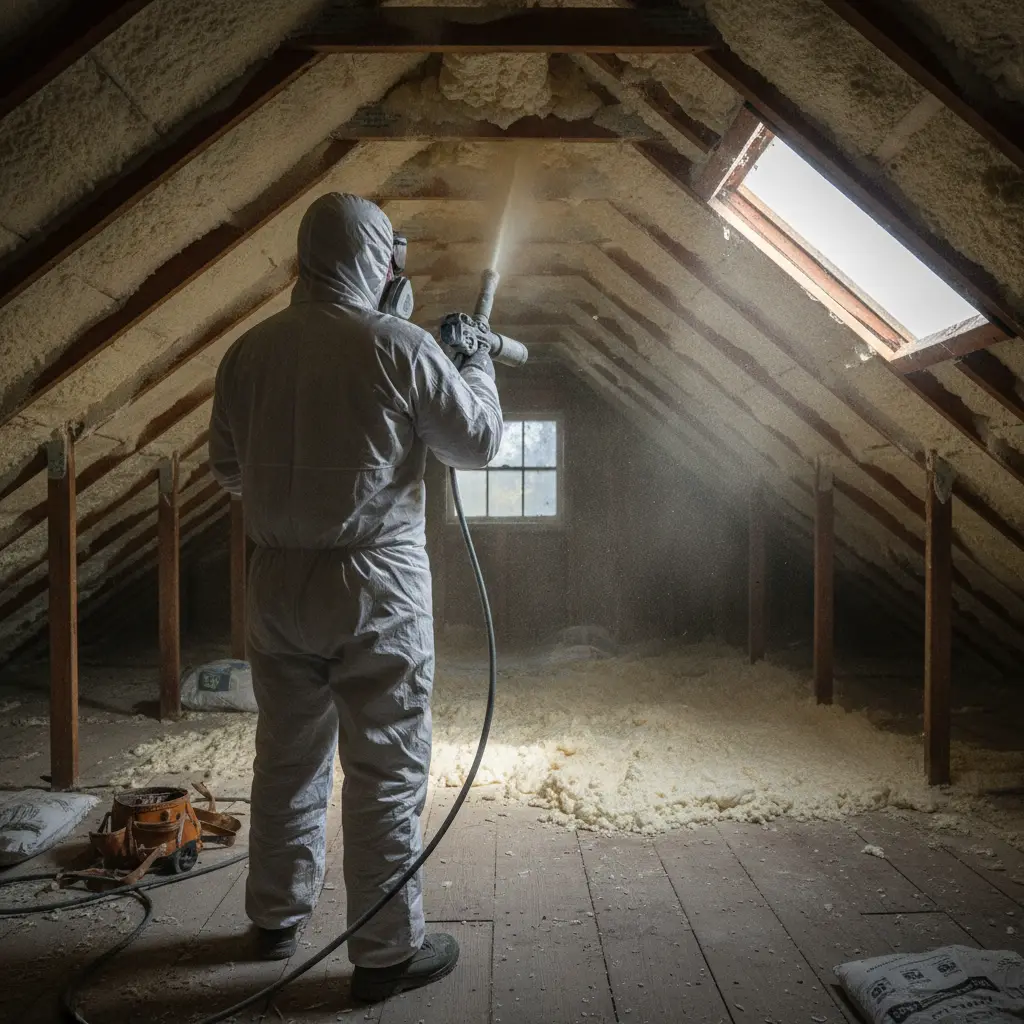
Our team in action — insulation professionals serving Burbank
Soundproofing Methods and Approaches
High-Density Mineral Wool Batt Insulation
Mineral wool (rock wool) batts with densities of 2.5–8 pounds per cubic foot provide superior sound absorption compared to standard fiberglass batts of the same thickness. Products such as Rockwool Safe ‘n’ Sound are commonly installed in interior partition walls, floor-ceiling assemblies, and around mechanical chases. This method is well-suited for new construction and open-wall retrofits in Burbank’s older bungalows and ranch homes. Expected STC contribution when combined with standard drywall: STC 40–45.
Spray Foam Insulation
Open-cell spray polyurethane foam expands to fill irregular cavities and completely seals air gaps that create acoustic flanking paths. It is particularly effective in Burbank attics where complex roof framing around dormers and skylights leaves gaps that undermine other soundproofing treatments. Learn more about our spray foam insulation services.
Mass-Loaded Vinyl (MLV) Barriers
MLV sheets, typically 1–2 pounds per square foot, are applied over existing wall surfaces or beneath flooring to add mass that blocks sound transmission — especially low-frequency noise from studio HVAC systems and freeway traffic common in Burbank.
Resilient Channel and Acoustic Drywall Assemblies
Resilient channels decouple drywall from the framing structure, interrupting the structure-borne path by which vibrations travel. When combined with acoustic drywall (such as QuietRock) and mineral wool infill, this assembly can achieve STC ratings of 55–65 in wall partitions.
Blow-In Insulation for Existing Walls
For finished walls where opening the surface is not practical, dense-pack cellulose or blown fiberglass can be injected through small holes drilled from inside or outside. Learn more about our blow-in insulation services.
Ready for Soundproofing Insulation? Get Your Free Estimate Today.
Next Level Insulation of Burbank serves Burbank and the surrounding area — we’ll be on-site within 24 hours.
📞 Call (818) 514-7541Soundproofing Insulation Cost in Burbank, CA
Understanding the cost of soundproofing insulation in Burbank helps you plan your investment accurately. Pricing varies based on the size of the area treated, materials selected, existing wall assembly conditions, and the degree of noise reduction required.
Typical Cost Ranges
- Single room (mineral wool batt in open walls, acoustic sealant): $800–$2,500 depending on room size and number of shared surfaces treated.
- Interior wall retrofit with dense-pack blow-in: $3–$7 per square foot of wall area, typically $600–$2,000 per wall.
- Full room resilient channel and acoustic drywall assembly: $15–$30 per square foot installed, making a standard 200-square-foot bedroom treatment $3,000–$6,000.
- Mass-loaded vinyl installation: $1.50–$3.00 per square foot for material plus $1–$2 per square foot for labor.
- Whole-house soundproofing program (1,500–2,000 sq ft home): $8,000–$25,000 depending on scope and existing conditions.
- Attic soundproofing with spray foam: $1,500–$5,000 for a typical Burbank single-story home attic.
Burbank-Specific Pricing Factors
Labor costs in Los Angeles County reflect regional wage rates, which run 15–25% higher than national averages for skilled insulation trades. Properties within the BUR Airport noise contour zone may qualify for partial cost offset through the Airport Authority’s soundproofing assistance program — our team can advise you on current eligibility requirements. Homes with original 1950s and 1960s plaster walls require additional prep work compared to drywall-surfaced homes, adding $500–$1,500 to project costs on average.
Call (818) 514-7541 for a specific quote. Request a free estimate online.
Neighborhoods We Serve in and Around Burbank
Magnolia Park
One of Burbank’s most desirable historic neighborhoods, Magnolia Park features a concentration of Craftsman bungalows and Spanish Colonial Revival homes built primarily between 1920 and 1945. These properties sit beneath active approach paths to BUR’s Runway 8 and commonly lack any insulation in interior partition walls. Soundproofing upgrades here focus on window treatment coordination, attic acoustic barriers, and blow-in wall insulation to preserve historic plaster surfaces.
Rancho District
Adjacent to the Warner Bros. and Disney studio campuses, the Rancho District contains a mix of post-war ranch homes from the 1950s and 1960s. Residents here frequently report low-frequency studio equipment noise and production truck traffic. Dense-pack cellulose in exterior walls combined with mass-loaded vinyl underlayment in ground-floor assemblies provides the most effective treatment profile for this neighborhood.
Downtown Burbank and Surrounding Multi-Family Stock
The area around San Fernando Boulevard and Olive Avenue includes numerous pre-1980 apartment buildings with shared wall assemblies that fall well below the current STC 50 code requirement. Retrofitting these buildings with resilient channel assemblies and mineral wool in demising walls significantly reduces tenant complaints and turnover.
We also serve Studio City, Sherman Oaks, North Hollywood, Toluca Lake, Universal City, Glendale, Hollywood, Beverly Hills, Pasadena, and many other communities throughout greater Los Angeles. View all service areas.
Soundproofing Insulation Maintenance Tips for Burbank Homeowners
- Inspect acoustic sealant annually. Burbank’s temperature swings — from summer highs above 100°F to winter lows in the mid-40s°F — cause sealant to crack at penetrations. Re-apply acoustic sealant at electrical boxes, pipe penetrations, and window frames each fall before the rainy season.
- Check attic access hatch seals. The attic hatch is one of the most common acoustic flanking paths in Burbank’s older homes. Verify the weatherstripping is intact and the panel sits flush.
- Monitor HVAC duct connections. Ducts that loosen at register boots allow both air and sound to bypass wall and ceiling assemblies. Tighten and seal duct boots annually.
- Address crawl space vents. Open foundation vents in Burbank’s mild climate allow exterior traffic and aircraft noise to enter the floor assembly from below. Crawl space encapsulation can significantly reduce this pathway.
- Re-inspect after seismic events. Minor earthquakes — frequent in the greater Los Angeles area — can shift framing and reopen gaps. After any event above magnitude 4.0, visually inspect treated wall surfaces for new cracks at joints.
- Keep vegetation trimmed away from exterior walls. Dense shrubs can trap moisture against siding, degrading any exterior-side insulation materials over time.
- Schedule a professional check every 5 years. Blown-in insulation can settle 10–15% over five years. A professional top-off maintains the design density and acoustic performance.
Why Choose Next Level Insulation of Burbank
Next Level Insulation of Burbank specializes in the acoustic and thermal challenges specific to properties in and around Burbank. Our team has direct working knowledge of the BUR Airport noise contour zones, the low-frequency noise characteristics of the studio district, and the construction details of Burbank’s diverse housing stock — from 1920s Craftsman bungalows in Magnolia Park to 1970s apartment complexes near Downtown.
We use calibrated measurement equipment at every project to establish a documented baseline and verify results after installation — not simply a before-and-after impression. Our material selections prioritize products with independently tested and published STC ratings so you know exactly what acoustic performance you are purchasing.
We approach every project with full transparency in scope and pricing, providing written estimates before any work begins. Our installers are trained in the acoustic sealing details — the gaps at outlet boxes, the duct penetrations, the attic hatch perimeters — that separate a soundproofing project that performs from one that falls short.
For expert soundproofing insulation in Burbank, CA, call us at (818) 514-7541 or submit a service request online.
Frequently Asked Questions About Soundproofing Insulation in Burbank, CA
How much does soundproofing insulation cost in Burbank?
Costs in Burbank typically range from $800–$2,500 for a single room using mineral wool batts in open walls, up to $8,000–$25,000 for a comprehensive whole-house program. Los Angeles County labor rates and the condition of older Burbank building stock are the primary local factors that influence pricing above national baseline estimates. We provide itemized written quotes at no charge before any work begins.
How long does soundproofing insulation installation take?
A single room with accessible wall cavities can typically be completed in one day. A whole-house program for a 1,500–2,000 square foot Burbank home generally takes 3–5 days depending on scope, existing conditions, and whether any drywall removal and replacement is required.
Will soundproofing insulation completely eliminate airport noise from BUR?
No soundproofing system eliminates all exterior noise, but properly installed high-performance assemblies can reduce interior noise levels from Hollywood Burbank Airport by 10–20 dB — enough to transform a clearly audible jet into a distant, low background rumble. The Airport Authority’s own residential soundproofing program has documented 5–10 dB reductions with standard window and attic treatments; upgraded wall and ceiling assemblies push that figure higher.
Can soundproofing insulation be added to finished walls without major demolition?
Yes. Dense-pack blow-in installation allows us to inject cellulose or fiberglass into existing wall cavities through small holes drilled from inside or outside, then patched. This approach is particularly useful in Burbank homes with original plaster walls where full demolition would be historically and financially undesirable. Learn more about blow-in insulation.
Does soundproofing insulation also improve energy efficiency?
In most cases, yes. Filling empty wall cavities and sealing acoustic flanking paths also reduces air infiltration, which is one of the primary drivers of heating and cooling energy waste. Burbank’s hot summers — with temperatures regularly exceeding 95°F in July and August — mean that energy efficiency gains can meaningfully offset a portion of the soundproofing investment through reduced utility bills.
Is my Burbank property eligible for the Airport Authority soundproofing program?
Eligibility for the Burbank-Glendale-Pasadena Airport Authority’s residential soundproofing assistance program is based on your property’s location within designated noise contour zones, typically the 65 DNL or greater contour. We can advise you on whether your address falls within an eligible zone and how our private-market services complement or extend the scope of the Authority’s program.
What is the best soundproofing insulation for studio and production noise in Burbank?
Low-frequency studio and production noise — the type generated by large HVAC systems and equipment on the Warner Bros. and Disney lots — requires mass and decoupling rather than absorption alone. A combination of mass-loaded vinyl, resilient channel assemblies, and dense mineral wool batts in exterior and shared wall assemblies provides the most effective attenuation for this noise profile.
Do you serve neighborhoods outside Burbank?
Yes. In addition to Burbank, we serve Studio City, Sherman Oaks, North Hollywood, Sun Valley, Toluca Lake, Universal City, Valley Village, Glendale, Hollywood, Beverly Hills, Pasadena, Alhambra, South Pasadena, La Cañada Flintridge, San Gabriel, West Hollywood, Culver City, East Los Angeles, and Monterey Park. See our full service area.
Get Your Free Soundproofing Insulation Assessment in Burbank, CA
Living or working near Hollywood Burbank Airport, the studio district, or Burbank’s busy freeway corridors does not have to mean accepting excessive noise as part of daily life. Next Level Insulation of Burbank delivers professionally designed and precisely installed soundproofing insulation solutions built around the specific acoustic conditions your property faces.
Our team is ready to conduct a calibrated noise assessment at your Burbank home or business, identify the primary sound transmission paths, and provide you with a transparent, itemized written proposal — at no cost and with no obligation.
Call us now at (818) 514-7541 to schedule your free on-site evaluation, or submit a request online and a member of our team will follow up within one business day. Take the first step toward a quieter, more comfortable property today.