

Roof Insulation in Burbank, CA
Expert Roof Insulation in Burbank, CA — Storm-Tested, Warranty-Backed
Need roof insulation in Burbank, CA? Next Level Insulation of Burbank installs spray foam, blown-in & more. Call (818) 514-7541 for a free estimate today.
- Licensed & Insured
- Locally Owned & Operated
- Free Inspection & Estimate
Request Your
Free EstimateRoof insulation is a thermal and moisture barrier installed between your living space and the outdoor elements, preventing heat transfer through your home’s ceiling and roofline. For Burbank homeowners and business owners, roof insulation is not a luxury — it is a critical line of defense against the San Fernando Valley’s intense summer heat, where rooftop surface temperatures routinely exceed 150°F on peak summer afternoons.
At Next Level Insulation of Burbank, we specialize in professionally installed roof insulation systems designed specifically for Burbank’s Mediterranean climate, its mix of post-war bungalows and modern commercial structures, and the unique thermal demands created by the valley’s bowl geography. Whether you are dealing with a hot attic that drives up your energy bills, a flat commercial roof that radiates heat into your workspace, or aging insulation that has lost its effectiveness, our team delivers solutions built for this specific community.
Call us today at (818) 514-7541 to schedule your free roof insulation assessment in Burbank, CA.
Understanding Roof Insulation in Burbank, CA
Roof insulation refers to any material or system installed at or near the roofline — whether in an attic cavity, directly against the roof deck, or between rafters — that reduces the rate of heat transfer between the exterior environment and the conditioned interior of a building. The fundamental physics at work is thermal resistance, measured in R-values. A higher R-value means greater resistance to heat flow, which translates directly into lower cooling and heating costs.
The concept of building insulation became widespread in the United States following the energy crisis of the 1970s, when the federal government began mandating minimum R-value standards through the Model Energy Code. In California, Title 24 of the California Code of Regulations now governs minimum insulation requirements for both residential and commercial structures, and these requirements have been revised upward multiple times as climate science has advanced. Many Burbank homes built before 1980 were constructed before these standards took effect, meaning they may have little to no effective roof insulation by today’s benchmarks.
Burbank’s building stock reflects its rapid post-World War II development. The city saw explosive residential growth between 1945 and 1965, producing thousands of single-story ranch homes, duplexes, and small apartment buildings across neighborhoods like Magnolia Park and the Rancho District. These structures were designed for affordability and speed of construction, not thermal efficiency. Their shallow attic cavities, minimal rafter depth, and original fiberglass batt insulation — if any remains — are wholly inadequate for the thermal loads Burbank experiences today.
Commercial properties along San Fernando Boulevard, Victory Boulevard, and near the Burbank Studios complex face different challenges: large flat or low-slope roofs that absorb enormous amounts of solar energy throughout the day. Without high-performance roof insulation, these buildings become increasingly expensive to cool and uncomfortable to occupy. Roof insulation addresses this by creating a thermal break that keeps heat from radiating downward into occupied spaces, reducing HVAC load, extending equipment life, and improving indoor air quality.
Modern roof insulation options range from blown-in cellulose and fiberglass to open-cell and closed-cell spray polyurethane foam, each carrying different R-values per inch, moisture resistance properties, and installation requirements. Learn more about our attic insulation services and explore our spray foam insulation solutions to understand which product best suits your Burbank property.
Why Roof Insulation Is Needed in Burbank, CA
The Burbank Heat Island Effect
Burbank sits in the eastern portion of the San Fernando Valley, a geographic bowl formed by the Santa Monica Mountains to the south, the Santa Susana Mountains to the northwest, and the Verdugo Mountains directly to the northeast of the city. This topography traps hot air and creates conditions that amplify urban heat island effects. According to data from the National Weather Service’s downtown Los Angeles monitoring station, Burbank and the surrounding valley regularly record temperatures 5°F to 10°F higher than coastal communities like Santa Monica during summer heat events.
The September 2020 heat wave, one of the most severe in California’s recorded history, pushed Burbank temperatures to 111°F on September 6th. During this event, uninsulated or under-insulated attic spaces in Burbank homes reached interior temperatures approaching 160°F, driving air conditioning systems to run continuously and still failing to maintain comfortable indoor temperatures. Homeowners with properly insulated roofs reported significantly lower indoor temperatures and substantially reduced energy consumption compared to neighbors without adequate insulation.
California’s Seismic and Settling Activity
Burbank sits in proximity to the Verdugo Fault, a reverse fault running along the base of the Verdugo Mountains, and the Hollywood Fault to the south. The 1994 Northridge Earthquake, centered approximately 12 miles west-northwest of Burbank, caused widespread structural movement throughout the city. This seismic activity — combined with the ongoing minor tremors that affect the region — causes older insulation batts to settle, shift, and detach from framing, creating thermal gaps that dramatically reduce effective R-value even when insulation appears visually intact from below.
Santa Ana Wind Events and Wildfire Smoke
Burbank experiences strong Santa Ana wind conditions each fall and winter, with recorded gusts exceeding 70 mph in the foothills adjacent to the Verdugo Mountains. These dry, hot, offshore winds push embers and smoke from regional wildfires — such as the 2017 La Tuna Fire, which burned over 7,200 acres in the Verdugo Hills immediately north of Burbank — directly into attic spaces through inadequate ventilation and deteriorated insulation. Smoke infiltration compromises existing insulation materials and creates air quality hazards inside the home. Our insulation removal service addresses smoke-contaminated materials safely and thoroughly.
Aging Housing Stock and Code Compliance
Burbank’s Magnolia Park Historic District, the Rancho District along Glenoaks Boulevard, and the Chandler Park neighborhood are filled with homes built between 1940 and 1960 that predate California’s Title 24 energy standards entirely. Many of these homes have original fiberglass batts compressed to a fraction of their rated R-value, or simply have bare joists with no insulation at all. California’s current Title 24 standards recommend a minimum of R-38 in attic assemblies for Climate Zone 9, which covers Burbank — a target that most pre-1980 homes in the city cannot meet without significant insulation upgrades.
Commercial Flat Roof Challenges
The Media District along Alameda Avenue and Clybourn Avenue, home to production studios, office buildings, and warehouses, features extensive flat-roof commercial construction. Flat roofs collect heat with no shading benefit from roof pitch, and without continuous insulation board or spray foam applied to the roof deck, interior temperatures and cooling costs escalate dramatically throughout Burbank’s long summer season, which typically runs from May through October.
Signs You Need Roof Insulation in Burbank
Energy and Comfort Indicators
- Monthly summer electricity bills consistently exceeding $250–$350 for a standard 1,500–2,000 square foot Burbank home
- Rooms on the top floor or directly beneath the roof feeling 8°F or more warmer than rooms on lower levels
- Air conditioning running continuously during afternoon hours without reaching the set thermostat temperature
- Noticeable temperature differences between rooms on the same floor, suggesting uneven insulation coverage
Visual and Physical Symptoms
- Visible gaps, compression, or sagging in existing batt insulation when viewed from inside the attic
- Insulation that appears discolored, damp, or matted — indicators of moisture infiltration or age-related degradation
- Daylight visible through roof vents or around eaves suggesting inadequate thermal sealing
- Ice damming during rare Burbank cold snaps (though uncommon, temperature inversions can create localized freezing near roof edges)
Urgent Warning Signs
- Musty or smoky odors coming from ceiling vents or attic access points, indicating contaminated insulation
- Evidence of rodent activity in attic insulation — a common issue near Burbank’s Chandler Bikeway green corridor
- Water stains on ceilings that coincide with insulation placement, suggesting moisture accumulation within insulation layers
If you recognize two or more of these signs, contact Next Level Insulation of Burbank at (818) 514-7541 for an immediate assessment.
Our Roof Insulation Process in Burbank, CA
Free On-Site Assessment (Day 1 — 1 to 2 Hours)
Our certified insulation specialist visits your Burbank property to conduct a comprehensive roof and attic inspection. We use thermal imaging cameras to detect heat loss patterns, measure existing R-values, identify moisture intrusion, and assess structural conditions including rafter depth, ventilation adequacy, and access points. For Burbank’s older ranch-style homes, we pay special attention to shallow attic cavities that limit insulation depth options.
Detailed Written Proposal (Within 24 Hours)
We provide a written, itemized proposal outlining recommended insulation type, target R-value meeting or exceeding California Title 24 Climate Zone 9 requirements, project scope, timeline, and total cost. We explain all available product options relevant to your specific Burbank property type.
Insulation Removal and Prep (Day of Installation — 2 to 4 Hours)
If existing insulation is damaged, contaminated by smoke from regional fire events, or degraded beyond recovery, our team safely removes and bags all material for proper disposal. Our insulation removal service uses HEPA-filtered vacuum equipment to contain particulates. We also seal any air bypasses — gaps around recessed lights, plumbing penetrations, and HVAC ducts — before new insulation goes in.
Ventilation Verification (Day of Installation — 30 to 60 Minutes)
Burbank’s climate demands a careful balance between insulation depth and attic ventilation. We verify that soffit vents and ridge vents are clear and functioning before insulation is installed, preventing moisture buildup that would degrade new materials prematurely.
Insulation Installation (Day of Installation — 3 to 6 Hours Depending on Method)
Using the approved method — blow-in fiberglass, spray foam, or batt installation — our crew installs insulation to the specified depth and R-value. Depth gauges are installed throughout the attic to verify consistent coverage. For flat commercial roofs, continuous insulation board or spray-applied polyurethane foam is applied to the roof deck exterior or interior surface.
Post-Installation Quality Inspection (Same Day — 30 Minutes)
A lead technician performs a final walkthrough with you, documenting installed R-values, taking photos of completed work, and providing a written completion report for your records — useful for California energy rebate applications and future property transactions.
Follow-Up Thermal Verification (Optional — Within 30 Days)
We offer a follow-up thermal imaging scan to confirm that the installed insulation is performing as designed, providing peace of mind and documentation of your investment.
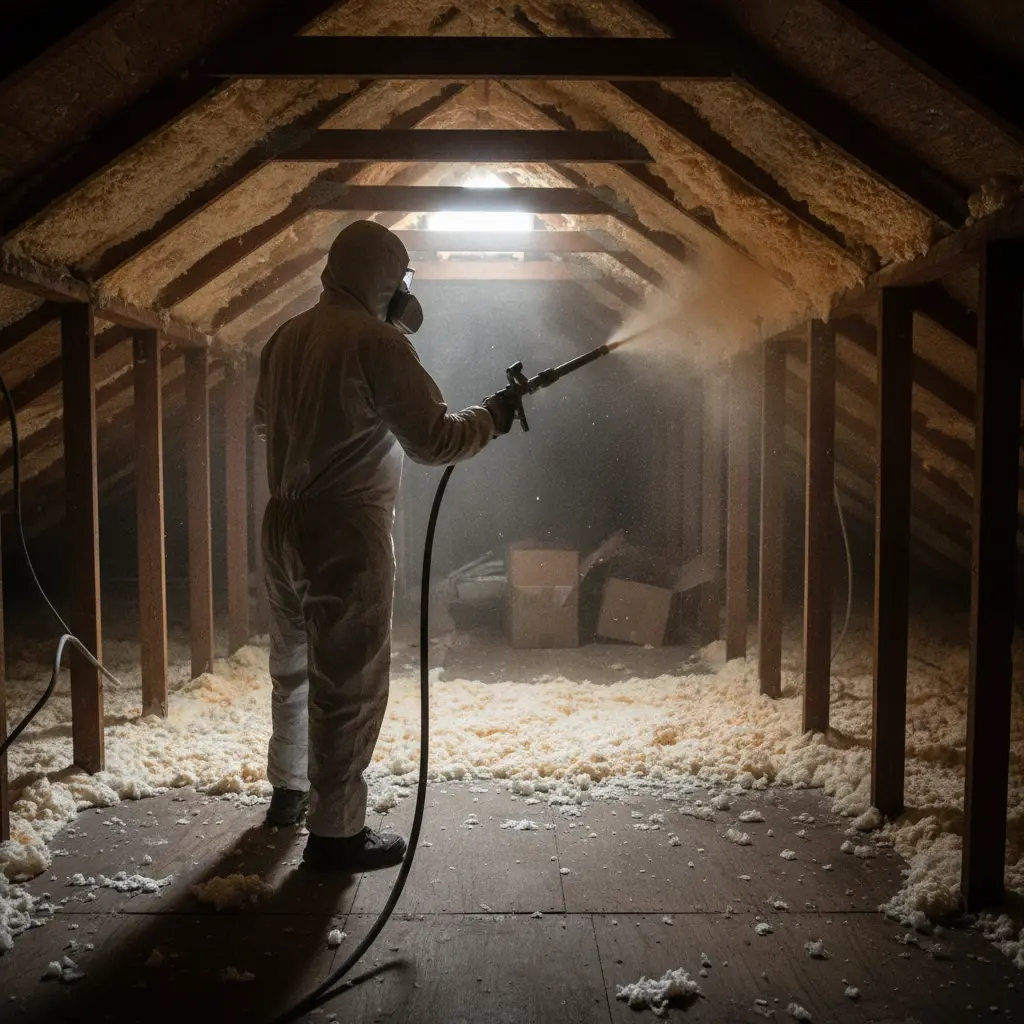
Our team in action — insulation professionals serving Burbank
Roof Insulation Methods and Approaches
Blown-In Fiberglass or Cellulose Insulation
The most common method for Burbank’s residential attic spaces, blown-in insulation achieves R-values of R-38 to R-60 depending on depth. Fiberglass blow-in is resistant to moisture and does not settle as dramatically as cellulose over time, making it particularly well-suited to Burbank’s seismically active environment where settling caused by ground movement can compress batt insulation. Cellulose, made from recycled paper treated with borate fire retardant, is an eco-friendly alternative with excellent thermal performance. Learn more about our blow-in insulation services.
Spray Foam Insulation
Closed-cell spray polyurethane foam achieves R-6 to R-7 per inch, making it ideal for Burbank’s shallow rafter bays where depth is limited. It also acts as an air and vapor barrier simultaneously, which is critical for properties near Burbank Airport’s flight path where pressure differentials can drive air infiltration through rooflines. Open-cell spray foam is better suited for interior applications where vapor permeability is desired. Explore our spray foam insulation options.
Rigid Foam Board Insulation
Used primarily on Burbank’s commercial flat roofs along the Media District, rigid polyisocyanurate (polyiso) boards achieve R-5.6 to R-8 per inch and are compatible with most commercial roofing membrane systems. They are also applied over existing roof assemblies as a continuous insulation layer to meet Title 24 commercial compliance.
Batt Insulation Replacement
For accessible attic spaces with standard 24-inch or 16-inch on-center framing, high-density fiberglass batts rated R-30 or R-38 can be layered to meet current California Title 24 minimums. This approach is cost-effective for Burbank homeowners on tighter budgets who have existing attic access. Learn about our insulation replacement process.
Ready for Roof Insulation? Get Your Free Estimate Today.
Next Level Insulation of Burbank serves Burbank and the surrounding area — we’ll be on-site within 24 hours.
📞 Call (818) 514-7541Roof Insulation Cost in Burbank, CA
Understanding the cost of roof insulation in Burbank requires looking at several interconnected factors. The following ranges reflect current 2024 market pricing in the Burbank and greater San Fernando Valley area.
Typical Price Ranges
- Blown-in attic insulation (residential): $1.50 to $3.50 per square foot, or approximately $2,000 to $5,500 for a typical 1,500 square foot Burbank ranch home attic
- Spray foam insulation (closed-cell): $3.00 to $7.00 per square foot, with full attic spray foam projects ranging from $4,000 to $12,000 depending on depth and square footage
- Rigid board commercial roof insulation: $4.00 to $9.00 per square foot installed, with large flat-roof commercial projects ranging from $15,000 to $60,000 or more
- Insulation removal (prior to replacement): $1.00 to $2.50 per square foot for residential attic removal
Factors That Affect Burbank Roof Insulation Costs
- Attic accessibility: Many Burbank post-war homes have small attic access hatches that require equipment reconfiguration, adding labor time
- Existing insulation condition: Contaminated insulation — from La Tuna Fire-era smoke in 2017 or rodent activity — requires complete removal before new material can be installed
- Rafter depth and roof pitch: Shallow-pitch ranch roofs common in Burbank’s Rancho District limit insulation depth and may require spray foam to achieve adequate R-values in confined spaces
- California utility rebates: Southern California Edison and SoCalGas both offer rebates for qualifying insulation upgrades that can reduce net project costs by $200 to $1,000 depending on scope
Call (818) 514-7541 for a free, no-obligation quote tailored to your specific Burbank property.
Neighborhoods We Serve in and Around Burbank
Magnolia Park
Burbank’s Magnolia Park neighborhood, centered along Magnolia Boulevard between Hollywood Way and Keystone Street, is characterized by Craftsman bungalows and Spanish Colonial Revival homes built between 1920 and 1945. These homes have original wood-frame construction with minimal or no insulation in their attic assemblies and are prime candidates for blown-in fiberglass upgrades to reach California Title 24’s R-38 minimum.
Rancho District
The Rancho District, stretching along Glenoaks Boulevard south of Alameda Avenue, contains dense concentrations of 1950s and 1960s ranch-style tract homes with 4-in-12 to 6-in-12 roof pitches. Shallow attic cavities in these homes are a consistent challenge, making spray foam insulation an effective solution for achieving high R-values without requiring rafter modifications.
Media District / Downtown Burbank
Commercial properties in the Media District near Warner Bros. Studios and Walt Disney Studios feature large flat-roof warehouse and office structures requiring continuous rigid board or spray-applied roof insulation to meet Title 24 commercial energy code compliance.
North Hollywood and Sun Valley
Adjacent service areas just south and east of Burbank, North Hollywood and Sun Valley share similar post-war housing stock and extreme summer heat conditions, making roof insulation upgrades equally critical for homeowners in these communities. View all service areas we cover.
Roof Insulation Maintenance Tips for Burbank Homeowners
- Inspect attic insulation annually after major seismic events. Even minor tremors on the Verdugo Fault can shift batt insulation, creating thermal gaps. A quick visual check after any earthquake above magnitude 3.5 can catch settling early.
- Clear soffit vents each spring. Burbank’s leaf litter from mature street trees — particularly the jacaranda and liquid amber trees common in Magnolia Park — can block soffit vents, trapping moisture in attic insulation and reducing its effectiveness.
- Monitor attic humidity levels during winter rainy season. Even in drought years, Burbank receives 14–16 inches of annual rainfall concentrated between November and March. High attic humidity accelerates fiberglass batt deterioration.
- Check for rodent activity each fall. Burbank’s urban-wildland interface near the Verdugo Hills drives rodent migration into attic spaces during autumn months. Rodent contamination destroys insulation R-value and creates health hazards.
- Replace insulation after any smoke events. Following regional wildfire smoke events — a recurring reality given Burbank’s proximity to the San Gabriel Mountains and Verdugo Hills — have your insulation inspected for smoke infiltration and particulate contamination.
- Verify insulation depth every 10 years. Settled insulation can lose 20–30% of its effective R-value over a decade, particularly in older fiberglass batt installations common in pre-1980 Burbank homes.
- Seal attic air bypasses proactively. Use fire-rated caulk or spray foam to seal around recessed lighting, plumbing penetrations, and HVAC ducts annually to maintain the air barrier that makes your insulation fully effective.
Why Choose Next Level Insulation of Burbank
Next Level Insulation of Burbank is a locally focused insulation contractor serving Burbank and the surrounding San Fernando Valley and greater Los Angeles communities. Our team understands the specific building types, climate conditions, and energy code requirements that define the Burbank market — from the shallow attic cavities of Rancho District ranch homes to the expansive flat roofs of the Media District’s commercial properties.
We install the full spectrum of roof insulation solutions: blown-in fiberglass and cellulose, open-cell and closed-cell spray polyurethane foam, rigid board systems, and batt replacement — allowing us to recommend the right product for each specific property rather than a one-size-fits-all approach.
Our work is guided by California Title 24 compliance requirements and the current best practices for Climate Zone 9, ensuring that every installation we complete meets or exceeds state energy code minimums. We work with homeowners to identify qualifying utility rebates through Southern California Edison and SoCalGas, reducing the net cost of your investment.
From the first call to the final thermal inspection, we prioritize clear communication, on-time project completion, and work quality that stands behind every square foot we insulate. Call (818) 514-7541 to speak with a Burbank roof insulation specialist today.
Frequently Asked Questions: Roof Insulation in Burbank, CA
How much does roof insulation cost in Burbank, CA?
Roof insulation costs in Burbank typically range from $1.50 to $3.50 per square foot for blown-in insulation and $3.00 to $7.00 per square foot for spray foam, depending on attic size, current insulation condition, and accessibility. A complete blown-in upgrade for a typical 1,500 square foot Burbank ranch home runs approximately $2,000 to $5,500 before any applicable Southern California Edison rebates.
What R-value do I need for roof insulation in Burbank?
Burbank falls within California’s Climate Zone 9. California’s Title 24 energy code requires a minimum of R-38 in attic assemblies for this zone in residential construction. For maximum energy efficiency given Burbank’s extreme summer heat peaks — which regularly exceed 105°F — we recommend targeting R-49 to R-60 where attic depth allows.
How long does roof insulation installation take in Burbank?
Most residential roof insulation installations in Burbank are completed in a single day. The timeline includes removal of old insulation if needed (2–4 hours), air sealing preparation (30–60 minutes), and installation of new material (3–6 hours). Commercial flat-roof projects may require 2–5 days depending on square footage and product selection.
Does the 1994 Northridge Earthquake affect my existing insulation?
Yes, seismic events like the 1994 Northridge Earthquake caused widespread settling and displacement of attic insulation throughout Burbank. Homes that have not had their insulation inspected since 1994 may have significant thermal gaps due to this settling, even if the insulation appears intact from below. We recommend an attic inspection if your home’s insulation has never been assessed post-Northridge.
Can I qualify for utility rebates for roof insulation in Burbank?
Yes. Southern California Edison’s residential insulation rebate program and SoCalGas offer incentives for qualifying insulation upgrades that meet minimum R-value thresholds. Rebate amounts vary by program cycle but typically range from $200 to $1,000 for residential projects. We provide all documentation needed for rebate applications as part of our standard service.
Is spray foam insulation better than blown-in for Burbank homes?
It depends on your specific property. Spray foam — particularly closed-cell foam at R-6 to R-7 per inch — is the superior choice for Burbank homes with shallow attic cavities where depth is limited, or for sealed attic assemblies where moisture control is a priority. Blown-in fiberglass or cellulose is more cost-effective for deep, accessible attic spaces where you have room to reach R-38 or higher. Our assessment process determines which method is optimal for your specific Burbank property.
How do I know if my Burbank home’s insulation was damaged by the 2017 La Tuna Fire smoke?
Signs of smoke-contaminated insulation include persistent musty or smoky odors emanating from ceiling vents or attic access points, visible discoloration or staining on insulation materials, and reduced HVAC efficiency following the fire event. If your home is in proximity to the Verdugo Hills area or experienced heavy smoke infiltration during the 2017 La Tuna Fire, we strongly recommend an attic inspection and insulation assessment. Our insulation removal service safely removes and disposes of contaminated materials.
Do you serve areas outside Burbank?
Yes. Next Level Insulation of Burbank serves the greater Los Angeles area including Studio City, Sherman Oaks, North Hollywood, Sun Valley, Toluca Lake, Universal City, Valley Village, Monterey Park, Hollywood, Beverly Hills, Glendale, Pasadena, Alhambra, Culver City, East Los Angeles, South Pasadena, La Cañada Flintridge, San Gabriel, and West Hollywood. View our complete service area map.
Get Your Free Roof Insulation Estimate in Burbank, CA Today
Your Burbank home or commercial property deserves insulation that performs through 111°F heat waves, Santa Ana wind events, and decades of California’s seismic activity. Next Level Insulation of Burbank delivers expert roof insulation installation tailored to the specific demands of Burbank’s climate, building stock, and energy code requirements.
Whether you are upgrading a 1950s Rancho District ranch home, insulating a commercial flat roof in the Media District, or replacing smoke-damaged insulation in the Magnolia Park neighborhood, our team is ready to help.
Call us now at (818) 514-7541 to schedule your free, no-obligation roof insulation assessment. Our Burbank insulation specialists are standing by to answer your questions and provide an honest, detailed estimate — with no pressure and no surprises.
Schedule your free assessment online or call (818) 514-7541 today.