

Blown-In Insulation in Los Angeles, CA
Energy-Saving Blown-In Insulation for Los Angeles, CA Homes — Licensed & Insured
Get expert blown-in insulation in Los Angeles, CA. Next Level Insulation serves LA, Pasadena, Glendale & more. Free assessments. Call (323) 765-3939 today.
- Licensed & Insured
- Locally Owned & Operated
- Free Inspection & Estimate
Request Your
Free EstimateBlown-in insulation is a modern, high-performance insulation method where loose-fill material — typically cellulose, fiberglass, or mineral wool — is mechanically blown into attic cavities, wall spaces, and other hard-to-reach areas using specialized equipment. Unlike traditional batt insulation, blown-in insulation conforms to irregular surfaces and fills gaps completely, creating a seamless thermal and acoustic barrier throughout your home or commercial property.
In Los Angeles, where temperature swings between the coast and inland valleys can exceed 30°F in a single day, and where aging housing stock from the 1920s through the 1970s remains largely under-insulated, this service addresses a critical need. From craftsman bungalows in Highland Park to mid-century ranch homes in Palms, Los Angeles properties demand insulation solutions built for a Mediterranean climate with year-round HVAC demands.
At Next Level Insulation of Los Angeles, our team brings deep local expertise to every blown-in insulation project across Los Angeles County. Call us at (323) 765-3939 to schedule your assessment today.
Understanding Blown-In Insulation
Blown-in insulation — also called loose-fill insulation — has been used in residential and commercial construction since the early 20th century, but the technology advanced dramatically in the 1970s and 1980s as energy codes tightened following the 1973 oil embargo. Today, it represents one of the most efficient, cost-effective methods for insulating existing structures without major demolition.
The process involves loading loose insulation material into a blowing machine that uses air pressure to distribute the fill through a flexible hose into the target cavity. Three primary materials are used:
- Cellulose: Made from recycled newsprint and treated with fire retardants, cellulose achieves an R-value of approximately R-3.2 to R-3.8 per inch. It is particularly popular in Los Angeles for its sustainability credentials and its ability to slow air infiltration.
- Fiberglass Loose-Fill: Composed of spun glass fibers, fiberglass loose-fill delivers R-2.2 to R-2.7 per inch and resists moisture — an important consideration in coastal Los Angeles neighborhoods like Venice and San Pedro where marine layer humidity is persistent.
- Mineral Wool (Rock Wool): Offering R-3.0 to R-3.3 per inch, mineral wool provides superior fire resistance and sound attenuation, making it ideal for multi-family buildings and urban infill projects throughout Downtown Los Angeles and Hollywood.
California’s Title 24 Building Energy Efficiency Standards require minimum insulation levels for all new construction and major renovations. For climate zone 9, which covers most of Los Angeles, attic insulation must meet a minimum R-38 rating. Many older Los Angeles homes — particularly those built before 1978 — have no attic insulation at all, or degraded materials that no longer perform adequately. Blown-in insulation offers a rapid, minimally invasive path to compliance and energy savings without tearing open finished walls or ceilings.
From single-family homes in Silver Lake to apartment complexes in Koreatown, blown-in insulation is applicable across the full spectrum of Los Angeles building types and eras. Learn more about our attic insulation services.
Why Blown-In Insulation Is Needed in Los Angeles, CA
The Los Angeles Climate Challenge
Despite its reputation as a mild-weather city, Los Angeles experiences significant thermal variability that drives year-round HVAC use. The Los Angeles basin sits within ASHRAE Climate Zone 3B, characterized by hot, dry summers and mild winters. Inland neighborhoods like Sylmar, Chatsworth, and the San Fernando Valley regularly record summer temperatures above 100°F — the National Weather Service recorded 111°F in Woodland Hills on September 6, 2020, setting an all-time Los Angeles County record. Meanwhile, coastal areas like Santa Monica and Pacific Palisades experience cooler summers but persistent marine layer humidity between June and September, a phenomenon locals call “June Gloom.”
This dual demand — cooling in summer, heating in winter — means an under-insulated Los Angeles home runs its HVAC system far longer than necessary. The U.S. Department of Energy estimates that heating and cooling account for 50–70% of energy use in the average American home, and homes with inadequate attic insulation can lose up to 25% of conditioned air through the ceiling plane alone.
Aging Housing Stock
A substantial portion of Los Angeles’s residential inventory was constructed before modern energy codes existed. According to the Los Angeles Department of Building and Safety, approximately 38% of single-family homes in the city were built before 1960. Neighborhoods like Boyle Heights, Echo Park, and Jefferson Park contain dense concentrations of craftsman bungalows and Spanish revival homes from the 1920s and 1930s that were never insulated to current standards. Many of these homes have 2×4 wall framing with no cavity insulation, and attics with bare roof decking.
Seismic Retrofitting and Insulation Gaps
Following the January 17, 1994 Northridge Earthquake — which caused $25 billion in damage and affected over 500,000 dwelling units — Los Angeles accelerated its mandatory soft-story retrofitting programs. The 2015 Mandatory Retrofit Ordinance (Ordinance No. 183893) required thousands of wood-frame soft-story buildings to undergo structural upgrades. These retrofit projects frequently disturb existing insulation in crawl spaces and walls, leaving gaps that were never addressed. Our crawl space insulation services can restore thermal performance to post-retrofit properties.
Utility Costs and California Energy Policy
Southern California Edison and the Los Angeles Department of Water and Power (LADWP) both operate tiered rate structures that penalize high energy consumers. LADWP’s residential electricity rates in 2024 range from approximately $0.14 per kWh in the lowest tier to over $0.32 per kWh in the highest tier. Homeowners in under-insulated properties are disproportionately pushed into upper tiers during summer peak months. Proper blown-in insulation, achieving the Title 24-required R-38 or greater in the attic, can reduce cooling energy consumption by 15–25% annually according to Lawrence Berkeley National Laboratory research conducted in California’s residential building stock.
Wildfire Smoke and Air Quality
The 2018 Woolsey Fire, the 2020 Bobcat Fire, and the 2025 Palisades and Eaton fires have demonstrated that air quality in Los Angeles can deteriorate rapidly and severely. Blown-in insulation, when properly installed with air sealing techniques, significantly reduces the infiltration of smoke particles and particulate matter (PM2.5) into the home — a benefit increasingly valued by Los Angeles homeowners.
Signs You Need Blown-In Insulation in Los Angeles
Energy and Comfort Indicators
- LADWP or SoCal Edison bills that spike dramatically from May through September, suggesting your HVAC is running overtime to compensate for heat gain through an uninsulated attic
- Rooms that are consistently 5°F or more warmer than the thermostat setting, particularly top-floor rooms beneath uninsulated attics
- HVAC system that runs for more than 15–20 minutes per cycle without reaching the set temperature
Physical and Visual Signs
- Visible gaps, bare spots, or compressed batt insulation when viewed from the attic access hatch
- Attic insulation depth less than 10–11 inches (the approximate depth needed to achieve R-38 with loose-fill cellulose)
- Presence of old vermiculite, pink batt insulation that has become matted and compressed over decades
- Cold floors above crawl spaces during winter months — a common issue in older homes in South Pasadena and Pasadena
Indoor Air Quality and Moisture
- Musty or dusty odors that worsen during the June marine layer season, indicating air infiltration through uninsulated cavities
- Condensation forming on interior walls during winter months, suggesting thermal bridging through uninsulated wall cavities
- Allergy symptoms that worsen indoors during Santa Ana wind events in October and November, when fine particulates infiltrate unsealed structures
Urgency Indicators
If your home was built before 1978 and has never had insulation work performed, schedule an assessment immediately — you are almost certainly out of compliance with current California Title 24 standards and are losing significant money on utility costs every month.
Our Blown-In Insulation Process in Los Angeles
Free Assessment and Thermal Inspection (Day 1 — 1 to 2 Hours)
Our technician visits your property and conducts a thorough visual inspection of the attic, crawl space, and accessible wall cavities. We use a thermal imaging camera to identify cold and hot spots that reveal insulation deficiencies invisible to the naked eye. We also measure existing insulation depth and assess for any pre-existing moisture, pest activity, or mold — conditions common in older Los Angeles bungalows that must be addressed before new insulation is installed.
Hazardous Material Check (Day 1 — Included in Assessment)
Los Angeles homes built before 1978 may contain asbestos in existing insulation materials, particularly vermiculite attic insulation. We inspect and, where necessary, recommend professional testing before proceeding. Our insulation removal team is equipped to handle hazardous material abatement in compliance with South Coast AQMD regulations.
Air Sealing (Day of Installation — 1 to 3 Hours)
Before any blown-in material is installed, our team seals all penetrations, gaps around recessed lighting, top plates, plumbing chases, and HVAC boots using fire-rated caulk and spray foam. This step is critical in Los Angeles, where older wood-frame construction has numerous unintended air pathways. Air sealing alone can reduce energy loss by 15–20% and improves the effectiveness of the blown-in insulation significantly.
Material Selection and Setup (Day of Installation — 30 Minutes)
Based on your home’s needs, budget, and Title 24 requirements, we select the appropriate loose-fill material — cellulose, fiberglass, or mineral wool. The blowing machine is set up outside the property and connected via flexible hose routed to the attic access point or wall injection ports.
Blown-In Installation (Day of Installation — 2 to 6 Hours)
Material is distributed evenly across the attic floor or injected into wall cavities. We use depth gauges placed throughout the attic to ensure uniform coverage at the specified depth — typically 11 inches for R-38 or 14 inches for R-49. In multi-zone properties across hillside areas like Mount Washington or Eagle Rock, we adjust coverage for varied roof angles and difficult-to-reach knee wall sections.
Post-Installation Verification (Day of Installation — 30 Minutes)
Our technician photographs the completed installation, confirms coverage depth at multiple points, and provides a written installation report documenting compliance with California Title 24 requirements — documentation useful for LADWP rebate applications.
Cleanup and Rebate Guidance (Day of Installation — 30 Minutes)
We remove all equipment and materials from the property and walk you through the LADWP Home Energy Improvement Program rebate process, which can provide up to $1,500 in rebates for qualifying insulation upgrades.
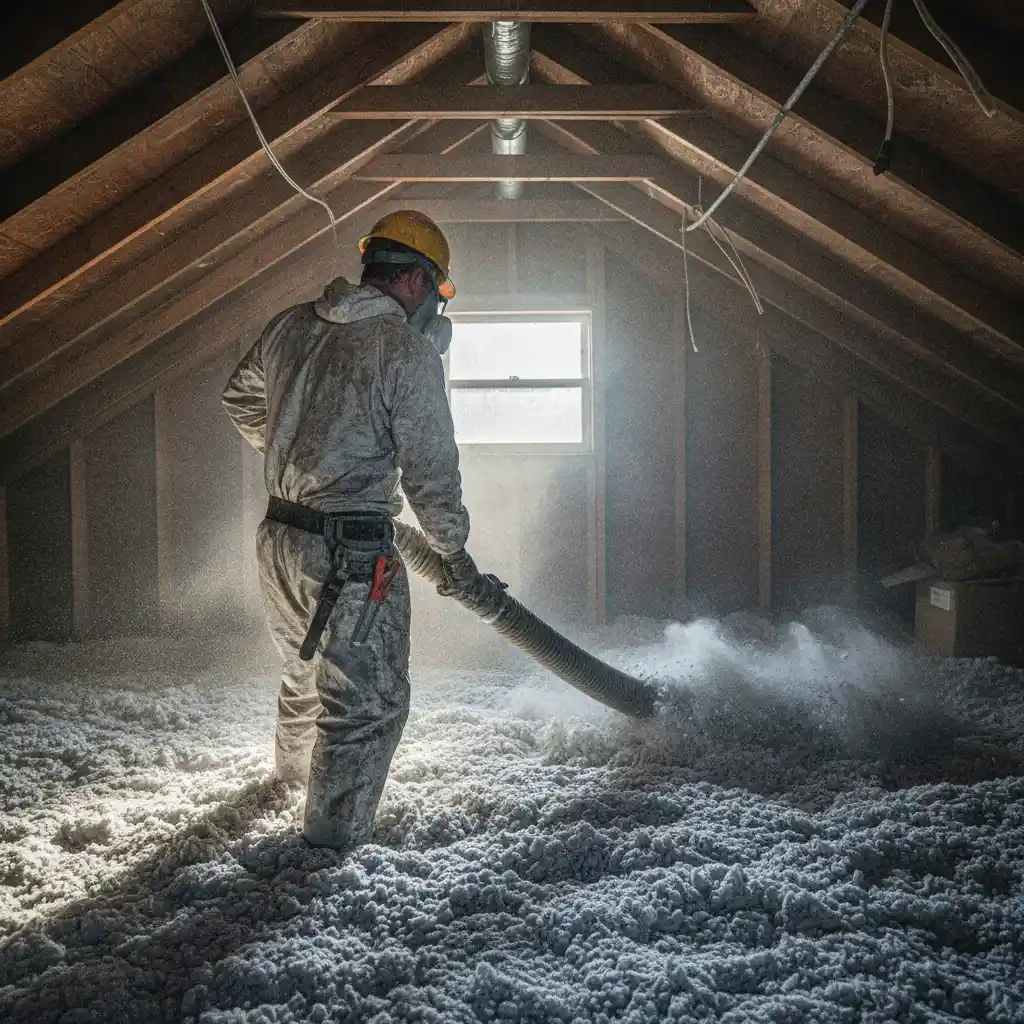
Our team in action — insulation professionals serving Los Angeles
Blown-In Insulation Methods and Approaches
Open-Blow Attic Installation
The most common method for Los Angeles homes, open-blow involves distributing loose-fill material across an open attic floor to the required depth. This approach is ideal for accessible attics with at least 30 inches of clearance — common in the 1920s–1950s craftsman and Spanish revival homes found throughout Los Feliz, West Adams, and Hancock Park. Installation is fast, typically completed in two to four hours for an average 1,500-square-foot home.
Dense-Pack Wall Injection
For uninsulated wall cavities in existing construction, technicians drill small 2-inch holes in either the interior drywall or exterior siding, insert the hose, and pack cellulose or fiberglass at a density of 3.5 lbs per cubic foot or greater. The high density prevents settling and creates a genuine air barrier. This method is widely used in Boyle Heights, Lincoln Heights, and other neighborhoods with pre-war wood-frame construction that was built without wall insulation.
Stabilized or Spray-Applied Blown-In
In attics with extreme slope or in cathedral ceiling applications — common in mid-century modern homes in the Hollywood Hills and Silver Lake — a small amount of water or adhesive is added to the blown-in material so it adheres to sloped surfaces without sliding or settling. This method is critical for maintaining uniform R-values in complex roof geometries.
Blown-In Blanket System (BIBS)
For new construction or gut renovations, a netting fabric is stapled over open stud bays and cellulose or fiberglass is blown behind it at high density. This creates a consistently thick, uniform insulation layer with no voids. It is increasingly specified in Los Angeles ADU (Accessory Dwelling Unit) construction, where Title 24 compliance is strictly enforced by city building inspectors.
Combination Air-Seal and Blown-In
Our most comprehensive approach combines spray foam insulation for sealing all penetrations and top plates, followed by blown-in loose-fill to achieve depth targets. This hybrid method delivers the best performance results and is recommended for older Los Angeles homes where air leakage is the primary energy loss driver.
Ready for Blown-In Insulation? Get Your Free Estimate Today.
Next Level Insulation of Los Angeles serves Los Angeles and the surrounding area — we’ll be on-site within 24 hours.
📞 Call (323) 765-3939Blown-In Insulation Cost in Los Angeles, CA
Understanding the cost of blown-in insulation in Los Angeles helps homeowners budget accurately and evaluate their return on investment. Pricing varies based on the scope of work, material selected, accessibility of the installation area, and existing conditions.
Typical Price Ranges
- Attic Blown-In (Open Blow): $1.50–$3.00 per square foot installed, including air sealing. For a 1,200-square-foot attic, expect a total project cost of $1,800–$3,600 to achieve R-38.
- Wall Dense-Pack Injection: $3.00–$7.00 per square foot of wall area, depending on whether exterior or interior access holes are used and whether patching is included.
- Crawl Space Blown-In: $2.00–$4.50 per square foot. Crawl space encapsulation can be bundled for additional savings.
- Combined Attic Air Seal and Blown-In Package: $2,500–$5,500 for a typical Los Angeles single-family home of 1,500–2,500 square feet.
Factors That Affect Cost in Los Angeles
- Existing insulation removal: If old, degraded, or potentially hazardous insulation must be removed first, add $1.00–$2.50 per square foot. See our insulation removal pricing.
- Attic accessibility: Low-clearance attics common in Hollywood Hills hillside homes and the flat-roofed mid-century buildings of Mar Vista may require additional labor time.
- Material choice: Mineral wool runs 20–30% more than cellulose; fiberglass loose-fill falls in between.
- Title 24 compliance upgrades: Homes requiring upgrades from zero insulation to R-38 or R-49 will cost more than top-up projects adding insulation over existing material.
Rebates and Incentives
LADWP’s Home Energy Improvement Program offers rebates of up to $1,500 for insulation upgrades in qualifying homes. Southern California Edison’s Energy Upgrade California program provides similar incentives. Call us at (323) 765-3939 and we will help you identify all applicable rebates before your project begins.
Blown-In Insulation Service Areas in Los Angeles
Pasadena and South Pasadena
These cities contain some of the oldest housing stock in the Los Angeles region, with large concentrations of craftsman bungalows and Victorian homes from the 1890s through 1920s. Many of these properties have original balloon-frame construction with no cavity insulation and uninsulated attics. The colder winter temperatures in these foothills communities — lows regularly drop to 35–40°F in January — make proper attic and wall insulation especially impactful.
Glendale and Montebello
Mid-century ranch homes from the 1950s and 1960s dominate these communities. These homes typically have shallow attics and minimal original insulation — often just 2–3 inches of fiberglass batt that has long since compressed and degraded. The summer heat load in these inland communities, where July highs average 92–95°F, drives significant HVAC costs that proper blown-in insulation can reduce substantially.
Culver City and West Hollywood
These communities feature a mix of post-war single-family homes and newer multi-family construction. Culver City’s rapid ADU development boom has created strong demand for Title 24-compliant insulation in converted garages and new detached units. West Hollywood’s dense apartment stock benefits from the sound attenuation properties of dense-pack mineral wool blown-in insulation.
We also serve Cudahy, Bell Gardens, Alhambra, Bell, Commerce, Downey, East Los Angeles, Huntington Park, Maywood, South Gate, and Walnut Park. Call (323) 765-3939 to confirm service availability in your area.
Blown-In Insulation Maintenance Tips for Los Angeles Homeowners
- Inspect attic depth annually: Check your attic each fall before the heating season. Cellulose can settle 15–20% over the first two years after installation. If depth has dropped below 10 inches, a top-up may be needed to maintain R-38 performance.
- Check for moisture intrusion after winter rains: Los Angeles’s rainy season (November through March) can expose roof leaks or failed flashing that saturates blown-in insulation. Wet cellulose loses R-value and can promote mold growth. Inspect after any significant rainfall event — storms of 1 inch or more in a 24-hour period.
- Keep attic vents clear: Soffit and ridge vents are critical for preventing moisture buildup in Los Angeles attics during the marine layer season. Ensure blown-in insulation has not been inadvertently piled against vents during installation or subsequent inspections.
- Monitor for pest activity: Rats and squirrels are common in Los Angeles urban and hillside environments. They will tunnel through loose-fill insulation, creating gaps and compressing material. Annual pest inspections protect your insulation investment.
- Re-evaluate after any roof work: Roofing contractors working in the attic can disturb insulation distribution. After any roof repair or replacement, verify that insulation depth remains uniform.
- Watch for Santa Ana wind pressure: During high-wind events (gusts above 50 mph in hillside communities), check that no blown-in material has migrated out of knee wall sections or soffit areas.
- Schedule a professional re-assessment every 10 years: Insulation performance degrades over time. A professional thermal scan every decade helps identify any emerging deficiencies before they significantly impact your energy bills.
Why Choose Next Level Insulation of Los Angeles
Local Expertise
Our technicians are thoroughly familiar with California Title 24 Energy Standards, South Coast AQMD regulations for insulation materials, and LADWP’s Home Energy Improvement Program rebate requirements. We help our clients navigate the rebate process and ensure all work is documented for utility submittal.
Comprehensive Services
We offer the full range of insulation services under one roof: insulation installation, spray foam insulation, attic insulation, blown-in insulation, crawl space encapsulation, crawl space insulation, insulation removal, and insulation replacement. This means you work with a single trusted contractor from assessment through completion.
Transparent Pricing
We provide detailed written estimates before any work begins, with no hidden fees. Call (323) 765-3939 to schedule your free assessment today.
Frequently Asked Questions About Blown-In Insulation in Los Angeles
How much does blown-in insulation cost in Los Angeles?
For a typical Los Angeles single-family home with an attic of 1,200–1,500 square feet, blown-in attic insulation including air sealing typically costs between $1,800 and $4,000. Wall dense-pack injection projects add $3.00–$7.00 per square foot of wall area. LADWP rebates of up to $1,500 are available for qualifying projects, which can significantly offset the total cost. Call us at (323) 765-3939 for a precise quote based on your property.
How long does blown-in insulation installation take?
Most residential attic blown-in insulation projects in Los Angeles are completed in a single day — typically four to eight hours including setup, air sealing, installation, and cleanup. Larger projects involving wall injection or whole-house packages may require two days. We schedule morning start times to avoid the peak afternoon heat in summer months, particularly important for work in hot attic spaces in the San Fernando Valley and Pasadena areas.
Does blown-in insulation settle over time?
Yes. Cellulose loose-fill typically settles 15–20% within the first one to two years after installation. This is a known and accounted-for behavior — installers compensate by applying slightly more depth than the final target R-value requires. Fiberglass loose-fill settles less than cellulose. Periodic inspections every few years confirm that coverage remains adequate, particularly in Los Angeles homes that experience seismic vibration from the region’s active fault system.
Can blown-in insulation be installed over existing insulation in my Los Angeles attic?
In most cases, yes. If existing insulation is dry, free of mold, and does not contain hazardous materials such as asbestos-containing vermiculite, blown-in insulation can be applied directly on top. However, homes built before 1978 in Los Angeles should be assessed for vermiculite before any attic work begins, as vermiculite imported from Libby, Montana prior to 1990 may contain asbestos fibers.
Will blown-in insulation help with wildfire smoke infiltration?
Yes — significantly. Properly installed blown-in insulation combined with thorough air sealing reduces the air exchange rate of a home, which directly reduces the infiltration of smoke particulates during events like the 2025 Palisades Fire and Eaton Fire. Homes with sealed attic penetrations and dense-pack wall insulation showed measurably better indoor air quality during wildfire events according to research published by the California Air Resources Board.
Do I need a permit for blown-in insulation in Los Angeles?
In most cases, blown-in insulation in an existing attic does not require a building permit from the City of Los Angeles or Los Angeles County. However, if the project is part of a larger renovation or new construction project subject to Title 24 plan check, the insulation work must be documented and may require an inspection. We handle all required documentation and ensure our work is compliant with applicable Los Angeles Department of Building and Safety requirements.
How do I know if my Los Angeles home qualifies for LADWP insulation rebates?
LADWP’s Home Energy Improvement Program offers rebates for insulation upgrades in single-family and multifamily residential properties served by LADWP. Eligibility is based on the type of upgrade, the pre- and post-installation insulation levels, and property location within LADWP’s service territory. Our team will verify your eligibility and assist with rebate application paperwork at no additional charge.
What is the difference between blown-in insulation and spray foam insulation?
Blown-in insulation uses dry, loose-fill material distributed pneumatically; it is ideal for attic floors, wall cavities via injection, and accessible cavities. Spray foam insulation expands on contact and creates both an air barrier and insulating layer in one step — it is preferred for rim joists, crawl space walls, and irregular cavities where an airtight seal is the primary goal. Many Los Angeles homes benefit from a combination of both. Learn more about our spray foam insulation services.
Get Your Free Blown-In Insulation Assessment in Los Angeles Today
If your Los Angeles home is uncomfortable, your utility bills are climbing, or you know your property was built before modern energy codes, now is the time to act. Next Level Insulation of Los Angeles provides expert blown-in insulation services across Los Angeles, Pasadena, Glendale, Culver City, Downey, West Hollywood, and all surrounding communities.
Our team will assess your property, provide a transparent written estimate, and guide you through available LADWP and Southern California Edison rebates to maximize your savings. Most attic projects are completed in a single day with minimal disruption to your household.
Call us now at (323) 765-3939 to schedule your free assessment. You can also reach us through our website to request an estimate online. Do not let another Los Angeles summer pass with an under-insulated home — take the next step toward year-round comfort and lower energy bills today.