

Attic Insulation in Orange, CA
Energy-Saving Attic Insulation in Orange, CA for Orange, CA Homes — Licensed & Insured
Need attic insulation in Orange, CA? Next Level Insulation serves all Orange neighborhoods. Call 714-266-2070 for a free assessment and honest pricing.
- Licensed & Insured
- Locally Owned & Operated
- 24/7 Emergency Service
- Financing Available
- Free Inspection & Estimate
Request Your
Free EstimateAttic insulation is the thermal and air barrier installed in your home’s uppermost ceiling cavity, preventing conditioned air from escaping and outdoor heat from infiltrating your living spaces. In Orange, California, where summer temperatures routinely climb above 95°F and the Santa Ana winds drive rapid temperature swings, a properly insulated attic is not a luxury — it is a fundamental part of home comfort and energy efficiency.
At Next Level Insulation of Orange, we specialize in diagnosing and installing high-performance attic insulation solutions tailored specifically to the residential and commercial building stock found throughout Orange and the surrounding communities. From older craftsman bungalows in Old Towne to modern tract homes in newer developments near Chapman University, our team understands the unique structural and climatic demands that Orange homeowners face every single day. Whether you are dealing with skyrocketing energy bills, uncomfortable hot spots in upstairs rooms, or simply upgrading an aging home, we deliver expert insulation services backed by local knowledge. Call us today at 714-266-2070 for a free assessment.
Understanding Attic Insulation
Attic insulation works by resisting the transfer of heat between your attic space and the conditioned rooms below. Heat naturally moves from warmer areas to cooler ones — in summer, that means the scorching air trapped in your attic (which can reach 150°F or higher in Southern California) constantly pushes downward into your living areas. In winter, the warmth you pay to generate inside your home rises and escapes through an under-insulated attic ceiling. Insulation material, measured by its R-value (resistance to heat flow), slows this exchange significantly.
The concept of residential insulation became standardized in the United States after the energy crisis of the 1970s, when the federal government began mandating minimum R-values for new construction. However, countless homes built in Orange before 1980 were constructed with little to no meaningful attic insulation by today’s standards. Many mid-century homes from the post-World War II housing boom that characterizes much of Orange’s older neighborhoods contain original fiberglass batts that have settled, compressed, or become contaminated over decades, rendering them largely ineffective.
The U.S. Department of Energy recommends that homes in California’s Climate Zone 8, which encompasses Orange, maintain attic insulation at a minimum R-value of R-38, with many energy efficiency programs recommending R-49 or higher for optimal performance. R-value is additive — meaning existing insulation can often be upgraded by adding a new layer on top, rather than requiring full removal in every case.
Modern attic insulation products include blown-in cellulose, spray foam, and advanced fiberglass systems, each with specific advantages depending on attic configuration, existing conditions, and homeowner goals. Orange’s housing stock spans a wide range of architectural eras and styles — from 1920s Craftsman homes near the historic plaza to 1960s ranch-style houses to contemporary builds — meaning no single approach fits every project. A professional assessment is always the starting point for any effective insulation upgrade.
Beyond thermal comfort, proper attic insulation also contributes to soundproofing, moisture management, and improved indoor air quality — all meaningful quality-of-life factors for Orange residents.
Why Attic Insulation Is Needed in Orange, CA
Extreme Attic Heat Buildup
During peak summer months — particularly July and August — ambient temperatures in Orange regularly exceed 95°F, and recorded heat events have pushed readings well above 100°F. The historic September 2020 heat wave, one of the most severe on record for Southern California, brought temperatures in the Orange area above 110°F for multiple consecutive days. During events like this, unventilated or poorly insulated attic spaces can reach internal temperatures of 140°F to 160°F. Without adequate R-value in the attic floor (typically R-38 to R-49 for this zone), that heat radiates directly into bedrooms and living spaces, overwhelming air conditioning systems and causing energy bills to spike dramatically.
Santa Ana Wind Events
Orange County experiences Santa Ana wind conditions multiple times per year, typically between October and February. These offshore winds are warm, extremely dry, and can gust above 60 mph. Beyond the wildfire risk they are famous for, Santa Ana events cause rapid temperature fluctuations that stress building envelopes. Poorly sealed attic assemblies allow this hot, dry air to infiltrate homes, dramatically increasing heating and cooling loads. Neighborhoods closer to the Anaheim Hills interface, such as areas near Santiago Creek, are especially susceptible to wind-driven air infiltration.
Aging Housing Stock and Degraded Insulation
A significant portion of Orange’s residential neighborhoods — including Old Towne Orange (the historic district around the plaza at Chapman Avenue and Glassell Street), the Eichler-influenced neighborhoods near Prospect Street, and the post-war tract developments throughout central Orange — contain homes built between 1945 and 1975. Many of these properties have never had their original insulation replaced or supplemented. Fiberglass batts from this era typically had R-values of R-11 to R-19, far below current recommendations, and decades of compression and dust accumulation have degraded even those values further.
Rodent and Pest Contamination
Orange’s warm climate and proximity to the Santa Ana River corridor and Santiago Creek open space areas means that rodent intrusion into attic spaces is a persistent problem. Rats and mice nest in and contaminate existing insulation, compressing it, saturating it with urine, and introducing pathogens. Contaminated insulation loses its thermal effectiveness and creates indoor air quality hazards. Insulation removal and replacement, combined with rodent proofing, is frequently necessary in Orange homes — particularly in neighborhoods adjacent to Irvine Regional Park and Peters Canyon.
Rising Energy Costs
Southern California Edison (SCE) rates, which affect most Orange residents, have increased significantly over the past decade. As of recent rate schedules, residential electricity costs in SCE’s territory can exceed $0.35 to $0.50 per kilowatt-hour during peak summer demand periods under Time-of-Use pricing. An inadequately insulated attic forces HVAC systems to run longer cycles, directly translating into measurable monthly cost increases of $80 to $200 or more during summer for an average Orange home.
Signs You Need Attic Insulation in Orange
Energy and Comfort Indicators
- Monthly electricity bills that are noticeably higher than neighbors’ comparable homes
- Upstairs rooms that feel significantly hotter than downstairs during summer months
- Air conditioning running continuously during Orange’s summer heat events without effectively cooling the home
- Cold drafts near ceiling fixtures during winter evenings
Physical and Visible Symptoms
- Visible existing insulation that appears thin (less than 10 inches deep for blown-in), flattened, or discolored
- Evidence of rodent nesting, droppings, or strong ammonia odor when accessing the attic hatch
- Water stains or moisture damage on insulation or attic sheathing following winter rains
- Insulation material that crumbles or disintegrates when touched
Structural and Age Indicators
- Home was built before 1980 and insulation has never been inspected or updated
- Recent HVAC replacement that still has not resolved comfort or energy issues
- Pest control company has previously treated the attic space
Urgency Note: If you notice odors, visible pest activity, or moisture damage, treat this as a priority situation. Contaminated insulation poses health risks and should be assessed immediately.
Our Attic Insulation Process
Free On-Site Assessment (60–90 Minutes)
Our technician performs a comprehensive attic inspection, measuring existing R-values with a calibrated depth gauge, checking for air leaks around penetrations, evaluating ventilation adequacy, and identifying any moisture, pest, or structural concerns specific to your Orange home. We photograph all findings and discuss results with you before any work is proposed.
Customized Project Proposal (Same Day or Within 24 Hours)
Based on the assessment, we provide a written, itemized proposal outlining recommended insulation type, target R-value, scope of any preparatory work (removal, air sealing, rodent proofing), timeline, and total cost. We review California’s Climate Zone 8 requirements and available utility rebate programs through SCE or SoCalGas with every customer.
Preparatory Work — Air Sealing and Attic Cleaning (2–4 Hours)
Before new insulation is installed, we seal all attic bypasses — gaps around recessed lighting, plumbing penetrations, HVAC chases, and top plates. This step is critical in older Orange homes where these gaps can collectively equal the size of an open window. If insulation removal or attic cleaning is required, it is completed during this phase using HEPA-equipped vacuum systems.
Rodent Proofing (If Applicable, 1–3 Hours)
For homes near Santiago Creek, Irvine Regional Park, or other open-space corridors, we install exclusion materials at all identified entry points prior to insulation installation, preventing re-infestation from compromising new materials.
Insulation Installation (2–6 Hours Depending on Scope)
New insulation is installed to the specified depth and R-value using calibrated equipment. We follow manufacturer installation standards and California Title 24 energy code requirements throughout. Depth markers are installed to allow future verification.
Final Inspection and Documentation (30 Minutes)
We photograph completed work, provide a written completion certificate noting installed R-value and product specifications, and walk you through any findings or recommendations. Documentation is provided in a format compatible with utility rebate applications.
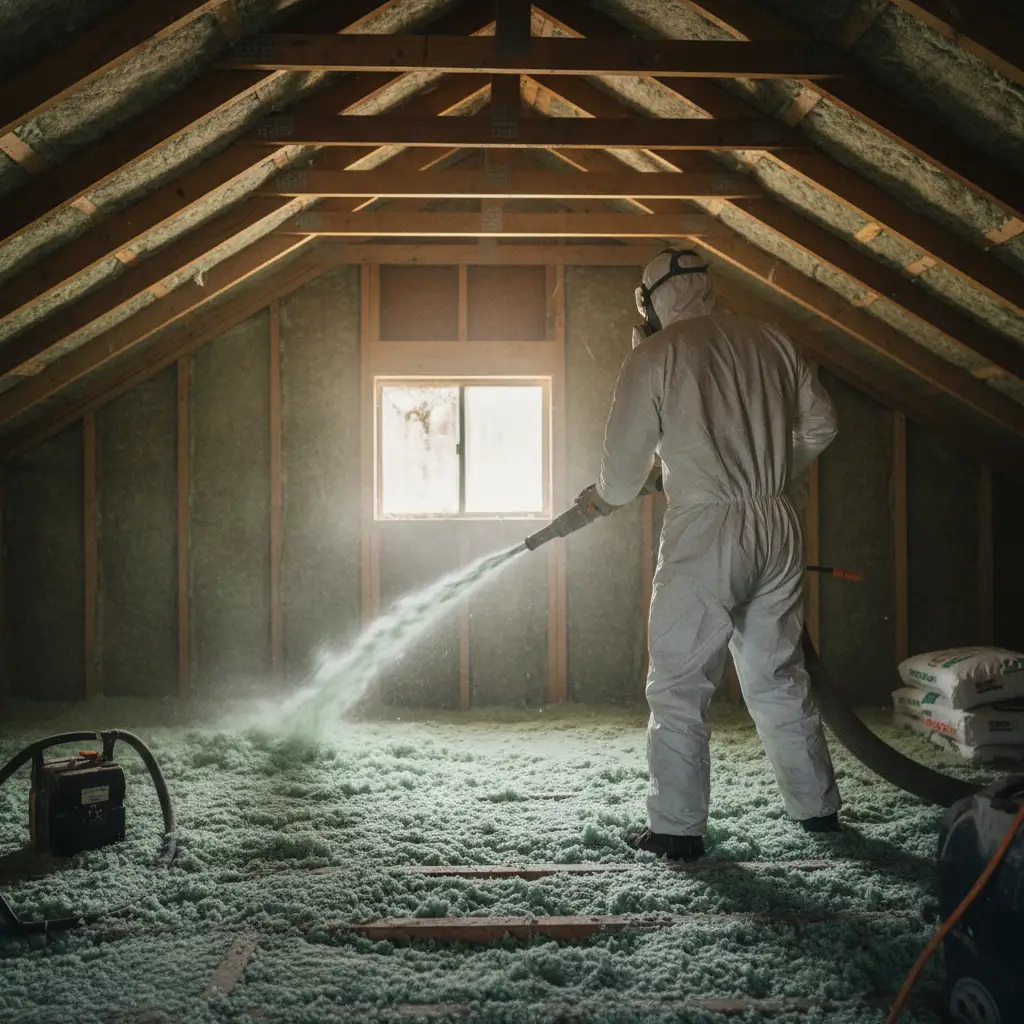
Our team in action — insulation professionals serving Orange
Attic Insulation Methods We Use in Orange
Blown-In Insulation
Blown-in cellulose or fiberglass is the most common solution for existing Orange homes. Loose-fill material is pneumatically distributed across the attic floor, conforming around existing obstacles and achieving uniform coverage. Learn more about our blown-in insulation services. This method is ideal for upgrading older homes in Old Towne or central Orange where attic access is limited and even coverage is critical. Typical installation achieves R-38 to R-60 depending on depth.
Spray Foam Insulation
Closed-cell or open-cell spray polyurethane foam provides both insulation and air sealing in a single application, making it ideal for homes with significant air leakage issues or for insulating the roof deck (creating an unvented attic assembly). Explore our spray foam insulation options. This method is frequently recommended for newer custom homes and properties near the Anaheim Hills interface where wind-driven infiltration is a concern.
Fiberglass Batt Insulation
Pre-cut fiberglass batts are appropriate for new construction, knee walls, and attic access areas where precise fit is achievable. See our fiberglass insulation services. This method is commonly used in new Orange developments and during targeted repair work.
Insulation Removal and Replacement
When existing insulation is contaminated, severely degraded, or pest-damaged — a common scenario in Orange’s older neighborhoods — full removal is the correct first step before any new product is installed. Learn about our insulation removal process.
Ready for Attic Insulation? Get Your Free Estimate Today.
Next Level Insulation of Orange serves Orange and the surrounding area — we’ll be on-site within 24 hours.
📞 Call 714-266-2070Attic Insulation Cost in Orange, CA
Understanding typical cost ranges helps Orange homeowners budget effectively and evaluate proposals. Pricing varies based on attic square footage, current insulation condition, chosen material, and project scope.
Typical Cost Ranges
- Blown-In Insulation (upgrade over existing): $1.50–$2.50 per square foot. For a typical 1,200–1,500 sq ft Orange home attic, expect $1,800–$3,750.
- Spray Foam (roof deck or targeted application): $3.00–$7.00 per square foot depending on foam type and thickness.
- Full Insulation Removal: $1.00–$2.00 per square foot ($1,200–$3,000 for an average attic) prior to new installation.
- Attic Air Sealing (standalone or combined): $500–$1,500 depending on number of penetrations and complexity.
- Rodent Proofing (combined with insulation project): $300–$800 for standard single-family homes.
Factors That Affect Pricing in Orange
Attic accessibility (low-pitch roofs common in 1950s–1970s ranch homes increase labor time), the presence of existing contaminated insulation requiring removal, HVAC ductwork routing through the attic space, and the number of recessed lights requiring air sealing all influence final project cost.
Available Rebates
Southern California Edison’s Energy Upgrade California program periodically offers rebates for qualifying insulation upgrades. We provide all documentation needed to support rebate applications, which can offset $200–$500 or more from project costs.
Contact us at 714-266-2070 for a no-obligation, itemized estimate specific to your Orange home.
Orange Neighborhoods We Serve
Old Towne Orange
The historic district surrounding the Orange Plaza — one of the largest concentrations of original Craftsman and Victorian-era homes in Southern California — presents unique insulation challenges. Homes built between 1905 and 1940 often have shallow attic cavities, balloon-frame construction, and original knob-and-tube wiring that requires careful coordination. We have extensive experience navigating these conditions while preserving historic character.
Cypress Street / Prospect Street Corridor
Mid-century modern and Eichler-adjacent homes in central Orange, many built in the 1950s and 1960s, frequently feature flat or low-slope roof assemblies and radiant heating systems. These configurations require specialized spray foam or dense-pack solutions rather than standard blown-in approaches.
Grijalva Park and East Orange
Post-war tract homes from the 1960s and 1970s are dominant in this area. These homes typically have accessible gable-style attics with original batt insulation that has long since exceeded its useful life. Blown-in upgrades to R-49 are a standard and cost-effective solution here.
Orange Hills / Santiago Canyon Adjacent
Newer custom and semi-custom homes in the hillside areas near Irvine Regional Park face Santa Ana wind exposure and potential ember intrusion concerns. Unvented attic assemblies with closed-cell spray foam are frequently the preferred solution for these properties.
Attic Insulation Maintenance Tips for Orange Homeowners
- Inspect annually before summer: Check attic insulation depth and condition each spring before Orange’s heat season begins. Look for signs of settling, moisture, or pest activity.
- Check attic ventilation: Ensure soffit and ridge vents remain unobstructed. Blocked ventilation dramatically increases attic temperature and degrades insulation performance.
- Seal attic hatch covers: Attic access panels are a major thermal bypass. Verify your hatch has weatherstripping and at least R-30 of insulation attached to its cover.
- Monitor after winter rains: Orange receives 13–15 inches of annual rainfall, much of it concentrated in winter months. Check for any moisture intrusion after significant rain events.
- Address pest activity immediately: If you hear scratching or notice droppings near the attic hatch, act quickly. Rodents can destroy insulation within weeks.
- Keep HVAC ducts sealed: Leaking ducts in the attic undermine even excellent insulation. Have ducts inspected every 3–5 years.
- Avoid attic storage compression: Placing boxes or items directly on attic insulation compresses it and reduces its R-value. Use raised attic flooring if storage is needed.
Why Choose Next Level Insulation of Orange
Next Level Insulation of Orange is a locally focused insulation contractor serving Orange and the surrounding communities of Orange County. Unlike national chains that apply one-size-fits-all solutions, our team has direct, on-the-ground familiarity with the specific housing stock, climate conditions, and pest pressures that define Orange’s residential landscape — from the historic homes of Old Towne to the hillside properties near Santiago Canyon.
We offer the full spectrum of insulation services under one roof: attic insulation, spray foam, blown-in insulation, insulation removal, attic cleaning, rodent proofing, and crawl space insulation. This comprehensive capability means we can assess your entire building envelope and recommend integrated solutions — not just sell a single product.
Every project begins with a thorough, no-pressure assessment. We provide clear, itemized written proposals and complete all work with professional-grade equipment. Our goal is a measurably better-performing home for every Orange customer we serve. Call 714-266-2070 to schedule your free assessment today.
Frequently Asked Questions — Attic Insulation in Orange, CA
How much does attic insulation cost in Orange, CA?
For a typical Orange home with an attic of 1,200–1,500 square feet, a blown-in insulation upgrade generally costs between $1,800 and $3,750, depending on existing conditions and target R-value. If old insulation must be removed first, add $1,200–$3,000 to that estimate. We provide free, itemized written quotes for every project. Contact us at 714-266-2070.
What R-value do I need for my attic in Orange, CA?
Orange falls within California’s Climate Zone 8. The U.S. Department of Energy recommends a minimum of R-38 for this zone, with R-49 to R-60 providing optimal performance. Many older Orange homes currently have R-11 to R-19 from original construction — well below current standards.
How long does attic insulation installation take?
For a standard blown-in insulation upgrade on a typical Orange single-family home, installation takes one day — usually 4 to 8 hours including air sealing and cleanup. Projects requiring full insulation removal or extensive rodent proofing may require a second day.
Do I need to remove old insulation before adding new insulation?
Not always. If existing insulation is clean, dry, and structurally intact, new blown-in material can typically be added on top to reach the target R-value. However, if insulation is contaminated by rodents — which is common in Orange homes near Santiago Creek and open space corridors — or damaged by moisture, full removal is recommended before new material is installed.
Is attic insulation effective against Orange’s Santa Ana winds?
Insulation combined with thorough air sealing is the correct response to Santa Ana wind infiltration. Insulation alone slows heat transfer; air sealing eliminates the pathways through which wind-driven hot, dry air enters the attic and living spaces. We address both as a standard part of every project in wind-exposed Orange locations.
Are there rebates available for attic insulation in Orange?
Yes. Southern California Edison’s Energy Upgrade California program offers rebates for qualifying insulation improvements for SCE customers. Rebate amounts and eligibility requirements change periodically. We provide all documentation needed to support your rebate application as part of our standard project completion process.
Can you insulate an attic in an older home in Old Towne Orange?
Yes, and we do this regularly. Historic homes in Old Towne require careful planning around older electrical systems, shallow attic depths, and preservation considerations. We assess each home individually and recommend solutions — typically blown-in cellulose or targeted spray foam — that are compatible with the structure’s original construction.
How do I know if my current attic insulation is still working?
The most reliable method is a direct physical inspection with measurement. If your attic insulation is less than 10 inches deep (for blown-in fiberglass) or less than 13 inches deep (for blown-in cellulose), you are likely below R-38. Other indicators include high summer energy bills, uneven room temperatures, and visible deterioration of insulation material. Call us at 714-266-2070 to schedule a free assessment.
Get a Free Attic Insulation Assessment in Orange, CA
If you are ready to reduce your energy bills, eliminate hot spots, and create a more comfortable home throughout Orange’s demanding summers, Next Level Insulation of Orange is ready to help. We serve all neighborhoods across Orange — from Old Towne to the Orange Hills — with expert attic insulation services tailored to the specific demands of this community.
Our free, no-pressure on-site assessments give you a clear picture of your attic’s current condition and a transparent, itemized proposal for improvement. There is no obligation, and our team will walk you through all available options including potential SCE rebates.
Call us now at 714-266-2070 to schedule your free attic insulation assessment in Orange, CA. You can also reach us online to request an appointment at your convenience. Let’s get your home to the next level of comfort and efficiency.