

Soundproofing Insulation in Orange, CA
Expert Soundproofing Insulation in Orange, CA — Storm-Tested, Warranty-Backed
Need soundproofing insulation in Orange, CA? Next Level Insulation of Orange reduces freeway & aircraft noise. Call (714) 266-2070 for a free estimate today.
- Licensed & Insured
- Locally Owned & Operated
- Free Inspection & Estimate
Request Your
Free EstimateSoundproofing insulation is a specialized application of insulating materials designed to reduce the transmission of airborne noise, impact noise, and structural vibrations through walls, ceilings, floors, and other building assemblies. Unlike standard thermal insulation, soundproofing insulation focuses on mass, absorption, and decoupling principles to create quieter interior environments.
Orange, California presents a unique acoustic challenge for homeowners and business owners alike. Situated within a densely developed urban-suburban corridor in northern Orange County, properties here contend with traffic noise from the 22 Freeway, the 55 Freeway, and Chapman Avenue, as well as noise from nearby commercial districts, schools, and the historic Old Towne Orange area. Aircraft approach paths to John Wayne Airport (SNA) in Santa Ana also affect sound levels across much of the city.
At Next Level Insulation of Orange, we specialize in diagnosing and solving noise problems specific to Orange’s building stock and local environment. Whether you live in a mid-century ranch home or a newer townhome development, our team delivers tailored soundproofing insulation solutions that create the peaceful interior spaces your property deserves. Call us today at (714) 266-2070.
Understanding Soundproofing Insulation
Soundproofing insulation works on four primary acoustic principles: absorption, mass, decoupling, and damping. Absorption involves using porous or fibrous materials — such as mineral wool, cellulose, or open-cell spray foam — to convert sound wave energy into heat as it passes through the material. Mass involves adding dense layers, such as mass-loaded vinyl or dense-pack cellulose, to walls and ceilings so that sound waves must expend more energy to vibrate those surfaces. Decoupling physically separates the structural layers of a wall or floor system so that vibrations traveling through the framing cannot easily pass from one side to the other. Damping uses viscoelastic compounds applied between layers of drywall or subfloor to dissipate vibrational energy as heat.
Modern soundproofing insulation practices have evolved significantly since the post-World War II suburban expansion that created much of Orange’s residential building stock. Early tract homes built in the 1950s and 1960s used minimal wall and ceiling insulation — often just fiberglass batts installed primarily for thermal purposes — with almost no consideration for acoustic performance. Building science research through the 1980s and 1990s developed the Sound Transmission Class (STC) rating system and Impact Insulation Class (IIC) rating system, which gave contractors and architects standardized tools for designing quieter spaces.
Today, the International Building Code and California Building Standards Code (Title 24) require minimum STC ratings for certain assemblies in multi-family residential construction. California’s Title 24, Part 2 requires interior walls separating dwelling units from common areas or adjacent units to achieve a minimum STC of 50. For Orange’s many condominium conversions, apartment complexes, and attached townhome communities — particularly those built before these codes took effect — existing assemblies often fall well short of these modern benchmarks.
Sound travels in two primary forms in buildings: airborne sound (voices, music, television) and structure-borne or impact sound (footsteps, dropped objects, mechanical vibrations). Effective soundproofing insulation addresses both categories, which is why a comprehensive assessment is essential before choosing materials and methods. Orange’s mix of older single-family homes, mid-rise condominiums near the City Drive commercial corridor, and historic structures in Old Towne means that no single solution fits every property.
Understanding the difference between sound absorption (reducing echo and reverberation within a room) and sound isolation (preventing sound from passing between rooms or buildings) is also critical. Most homeowners seeking soundproofing insulation in Orange need sound isolation — stopping freeway noise, neighbor noise, or mechanical equipment noise from entering or leaving a space.
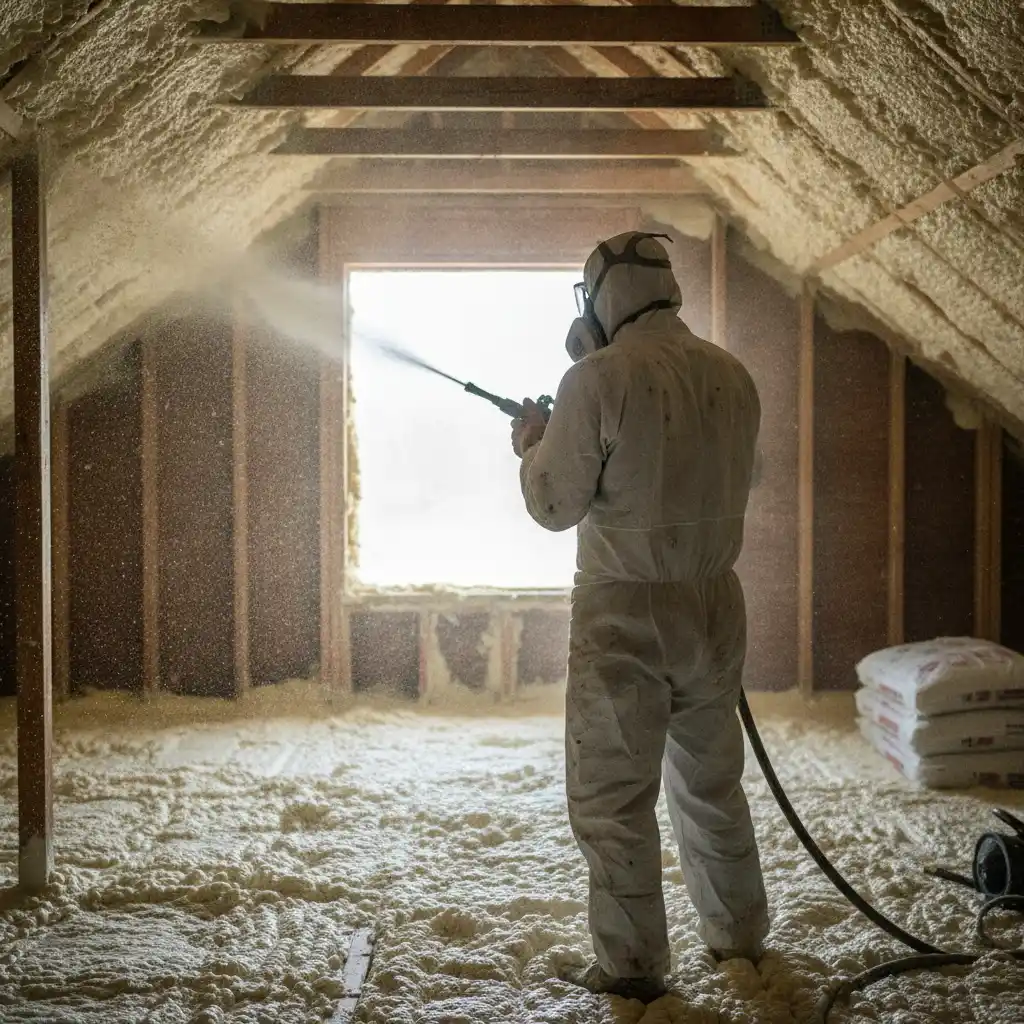
Our team in action — insulation professionals serving Orange
Why Soundproofing Insulation Is Needed in Orange, CA
Freeway and Traffic Noise
The State Route 22 (Garden Grove Freeway) cuts directly through the heart of Orange, generating sustained ambient noise levels measured at 65–75 dBA at properties within 500 feet of the roadway, according to Caltrans noise studies. The State Route 55 (Costa Mesa Freeway) forms the western boundary of much of Orange, creating a similar noise corridor. Chapman Avenue, a major east-west arterial carrying approximately 40,000 vehicle trips per day through the city, introduces additional daytime and evening traffic noise into residential neighborhoods that line this corridor. Properties in neighborhoods like Serrano Heights and the areas adjacent to Katella Avenue near Angels Stadium regularly experience traffic-related noise that can interfere with sleep and quality of life without adequate soundproofing insulation.
Aircraft Approach Noise
John Wayne Airport (SNA), located approximately 3–4 miles southwest of central Orange, serves more than 10 million passengers annually. Aircraft on approach to Runway 20L track directly over portions of Orange, including neighborhoods in the western and southwestern sections of the city near the 55 Freeway corridor. The Airport Environs Land Use Plan for Orange County designates portions of Orange within noise contours of 60–65 Community Noise Equivalent Level (CNEL). Residents in these zones report periodic aircraft noise events reaching 70–80 dBA indoors in homes with standard single-pane windows and minimal attic insulation.
Urban Density and Mixed-Use Development
Orange’s ongoing revitalization and infill development has increased residential density in areas that were previously lower-density commercial zones. The Village at Orange mall area and the City Drive corridor have attracted mixed-use developments that place residential units in close proximity to retail, restaurant, and entertainment uses. Residents in these newer developments frequently report noise transmission between units and from common areas and parking structures — a problem compounded by the lightweight framing and minimal sound isolation typically used in cost-optimized construction.
Older Building Stock
A substantial portion of Orange’s housing stock dates from the 1950s through 1970s. Many of these homes were built with 2×4 wood framing, minimal fiberglass batt insulation, and single-pane windows — assemblies that provide STC ratings of only 30–35, far below the 45–50 STC that sleep researchers recommend for bedrooms in urban environments. The historic Old Towne Orange neighborhood, centered on the famous Orange Circle (Plaza Square), contains Victorian-era and Craftsman bungalow homes from the 1880s through 1920s that have essentially no acoustic insulation in their original wall cavities.
School and Recreational Facility Noise
Orange Unified School District operates 29 schools within the city. Properties adjacent to Chapman University’s campus in Old Towne regularly experience crowd noise and event noise, particularly during evenings and weekends. The Honda Center in nearby Anaheim and Angels Stadium of Anaheim generate pedestrian, parking lot, and fireworks noise that affects Orange neighborhoods along the northern city limits on event nights.
Signs You Need Soundproofing Insulation in Orange, CA
Airborne Noise Intrusion
- You can clearly hear conversations, television, or music from adjacent rooms or neighboring units at normal listening volumes
- Freeway noise from the 22 or 55 is audible inside your home with windows closed
- Aircraft flyovers cause noticeable interior noise disruption during approach hours
- Street traffic noise from Chapman Avenue or Katella Avenue penetrates living spaces and bedrooms
Impact and Structure-Borne Noise
- Footsteps from upstairs neighbors or family members are clearly heard in rooms below
- HVAC equipment, water heater operation, or plumbing noise transmits through walls or ceilings
- You feel or hear vibrations from heavy truck traffic on nearby arterials
Sleep and Comfort Disruption
- Difficulty falling or staying asleep due to external or internal noise
- Work-from-home productivity affected by noise bleed between home office and other living spaces
- Guests comment on noise levels inside your home
Urgency Indicators
- Existing insulation is visibly deteriorated, compressed, or moisture-damaged — degraded insulation loses both thermal and acoustic performance simultaneously
- You have recently had windows upgraded but still experience significant noise intrusion, indicating wall and ceiling assemblies are the primary weak point
- Building noise ratings below STC 40 confirmed by measurement or professional assessment
Soundproofing Insulation Methods and Approaches
Dense-Pack Cellulose Insulation
Dense-pack cellulose blown into existing wall cavities at densities of 3.5–4.0 pounds per cubic foot provides excellent mass and absorption properties without requiring wall demolition. This retrofit method is particularly well-suited to Orange’s older single-family homes in neighborhoods like Olive Hills and Old Towne, where preserving original wall finishes is a priority. Dense-pack cellulose achieves STC improvements of 3–8 points in typical 2×4 wood-frame walls. Learn more about our blow-in insulation options.
Spray Foam Insulation
Open-cell spray polyurethane foam provides excellent sound absorption and air sealing in a single application. It is best applied in attic spaces, crawl spaces, and rim joist areas where sound flanking paths are common. Our spray foam insulation service is frequently used in Orange’s hillside homes in Serrano Heights, where complex roof geometries benefit from spray foam’s ability to conform to irregular surfaces while delivering both thermal and acoustic performance.
Mineral Wool Batt Insulation
Mineral wool (stone wool) batts have superior acoustic performance compared to fiberglass batts of the same thickness, offering 25–35% higher STC contribution in wall assemblies. We specify mineral wool for interior partition walls separating bedrooms from common areas, home theaters, and home offices — applications common in Orange’s growing work-from-home population.
Mass-Loaded Vinyl (MLV) Systems
Mass-loaded vinyl membranes installed as a limp mass barrier within wall and ceiling assemblies block sound transmission through mass effect. MLV is highly effective for upgrading existing assemblies in multi-family buildings without full reconstruction and is commonly used in Orange’s condominium and apartment communities.
Attic and Crawl Space Acoustic Upgrades
Our attic insulation and crawl space insulation services address the significant noise flanking paths created by uninsulated attic spaces and open crawl spaces in Orange’s prevalent single-story ranch and split-level home designs.
Ready for Soundproofing Insulation? Get Your Free Estimate Today.
Next Level Insulation of Orange serves Orange and the surrounding area — we’ll be on-site within 24 hours.
📞 Call (714) 266-2070Soundproofing Insulation Cost in Orange, CA
Understanding the cost of soundproofing insulation in Orange, CA helps you plan your project effectively. Pricing varies based on the size of the area treated, the method selected, existing conditions, and the degree of acoustic improvement targeted.
Typical Cost Ranges
- Dense-pack cellulose retrofit (per exterior wall, single room): $800–$2,000 depending on wall area and access conditions
- Interior partition soundproofing with mineral wool and acoustic drywall (per room): $1,500–$4,000
- Attic soundproofing insulation (1,200–1,800 sq ft typical Orange home attic): $2,000–$5,500
- Spray foam application in attic or crawl space: $2,500–$6,500 depending on square footage and foam thickness
- Full-room acoustic renovation including MLV, decoupling, and insulation: $4,000–$12,000 per room
- Whole-house soundproofing insulation package: $8,000–$25,000+ depending on home size, existing conditions, and performance targets
Factors Affecting Soundproofing Insulation Cost in Orange, CA
- Building age and construction type: Orange’s pre-1980 homes with plaster walls or original fiberglass batts typically require more preparation and material than newer drywall-framed construction
- Access conditions: Homes in hillside communities like Serrano Heights may have limited attic access that increases labor time
- Existing insulation removal: Insulation removal adds $1,000–$3,500 to project costs depending on volume and material type
- Permitting: City of Orange building permits for insulation work typically range from $150–$450
- Target STC rating: Higher performance targets require additional material layers and more complex assemblies
Call us at (714) 266-2070 for a no-obligation on-site estimate tailored to your specific Orange property and noise challenges.
Neighborhoods We Serve in Orange, CA
Old Towne Orange
Centered on the historic Orange Circle, Old Towne features Victorian, Craftsman, and Spanish Colonial Revival homes built primarily from the 1880s through the 1930s. These homes have original balloon-frame or platform-frame construction with no insulation in wall cavities, making them highly susceptible to noise from the busy retail and restaurant district surrounding the Circle. We specialize in retrofit dense-pack cellulose and minimally invasive methods that preserve historic character while delivering meaningful acoustic improvement.
Serrano Heights
This planned community in the eastern hills of Orange, developed largely in the 1990s and 2000s, features larger production homes with complex rooflines and attached garages. Residents contend with traffic noise from Santiago Canyon Road and Nohl Ranch Road. Our attic and spray foam services are frequently requested here.
Olive Hills / Orange Park Acres
This semirural equestrian community in eastern Orange includes a mix of custom homes and older ranch properties. Noise concerns here tend toward interior noise control and home theater applications rather than freeway noise.
West Orange / Near SR-55 Corridor
Neighborhoods immediately east of the SR-55 Freeway, including areas along Walnut Avenue and Katella Avenue, include 1960s and 1970s tract homes most affected by freeway and airport noise. Dense-pack cellulose and attic insulation upgrades are our most common services in this area.
Maintenance Tips for Soundproofing Insulation in Orange, CA
- Inspect attic insulation annually: Orange’s warm, dry summers and mild winters still allow for moisture intrusion during winter rain events — check for wet or compressed insulation each fall before the rainy season.
- Seal new penetrations promptly: Any new electrical, plumbing, or HVAC penetrations through insulated assemblies create flanking paths for sound — seal with acoustic caulk or expanding foam immediately.
- Check weatherstripping on doors and windows: Acoustic insulation performance is only as good as the weakest link — deteriorated door and window seals negate wall insulation improvements.
- Monitor crawl space moisture: In Orange’s older homes with vented crawl spaces, elevated moisture levels can degrade insulation materials and reduce both thermal and acoustic performance. Our crawl space encapsulation service addresses this proactively.
- Avoid compressing wall or ceiling insulation: Adding new electrical boxes or recessed lighting without re-sealing disturbs insulation continuity and creates acoustic weak points.
- Re-inspect after seismic events: Orange County experiences periodic seismic activity — even minor shaking can settle blown insulation and create gaps. Inspect after any felt earthquake.
- Schedule a professional re-assessment every 10–15 years: Insulation materials compress and settle over time, and noise environments change as surrounding development evolves.
Why Choose Next Level Insulation of Orange for Soundproofing Insulation
Next Level Insulation of Orange is a locally focused insulation contractor serving Orange, CA and the surrounding northern Orange County communities. Our team has hands-on experience with the specific building types, noise environments, and climatic conditions that define Orange’s residential and commercial properties — from the century-old Craftsman bungalows of Old Towne to the production homes of Serrano Heights and the condominium communities near the City Drive corridor.
We offer the full spectrum of insulation services under one roof: insulation installation, spray foam insulation, attic insulation, blow-in insulation, crawl space encapsulation, crawl space insulation, insulation removal, and insulation replacement. This means your soundproofing project is managed by one knowledgeable team from assessment through final verification — no coordination between multiple contractors, no finger-pointing if problems arise.
We use acoustically tested, code-compliant materials and follow California Title 24 standards on every project. Our detailed written estimates and post-installation acoustic measurements give you confidence that your investment delivered real, documented results. Call us at (714) 266-2070 to experience the Next Level difference.
Frequently Asked Questions About Soundproofing Insulation in Orange, CA
How much does soundproofing insulation cost in Orange, CA?
Soundproofing insulation in Orange, CA typically costs between $800 and $25,000 depending on the scope of the project. A single-room retrofit using dense-pack cellulose in an older home near the SR-22 corridor might cost $800–$2,500, while a comprehensive whole-house acoustic upgrade involving attic insulation, wall assemblies, and spray foam in a larger property runs $10,000–$25,000 or more. We provide detailed, transparent written estimates after an on-site assessment — call (714) 266-2070 to schedule yours.
Will soundproofing insulation block freeway noise from the 22 or 55 Freeway?
Soundproofing insulation significantly reduces freeway noise intrusion, though complete elimination is rarely achievable in existing construction without also addressing windows and doors. Realistic expectations are a 10–20 dBA reduction in interior noise levels with a comprehensive wall and attic insulation upgrade, which translates to noise sounding 50–75% quieter to the human ear. Properties within 500 feet of the SR-22 or SR-55 typically benefit most from combining dense-pack wall insulation with attic upgrades and window sealing.
How long does soundproofing insulation installation take?
Project timelines range from one to two days for a single-room dense-pack cellulose retrofit to ten to fourteen days for a comprehensive whole-house soundproofing insulation project. Our typical process allows most Orange homeowners to remain in their home during installation, with work contained to specific areas each day.
Do I need a permit for soundproofing insulation in Orange, CA?
Most insulation installation projects in Orange require a City of Orange building permit, particularly when work involves opening wall cavities, adding drywall layers, or modifying the building assembly. We handle all permitting on your behalf as part of our project process. Permit fees typically range from $150–$450 for residential insulation projects.
What is the difference between soundproofing insulation and regular insulation?
Standard thermal insulation — such as fiberglass batts or blown cellulose — provides some acoustic benefit but is not optimized for sound isolation. Soundproofing insulation systems combine acoustic-specific materials (high-density mineral wool, mass-loaded vinyl, acoustic damping compounds), installation techniques (decoupling, floating assemblies), and careful attention to flanking paths and penetration sealing to achieve meaningfully higher STC ratings. A standard 2×4 wall with fiberglass batts achieves roughly STC 36–38; a properly designed soundproofing assembly can achieve STC 50–60 or higher.
Is soundproofing insulation effective in older homes in Old Towne Orange?
Yes, though older homes require more careful planning. The original balloon-frame and platform-frame construction common in Old Towne’s pre-1940 housing stock has wall cavities that can be successfully treated with dense-pack cellulose without disturbing historic plaster finishes. We have experience working on historically sensitive properties and can discuss minimally invasive approaches that deliver real acoustic improvement while preserving your home’s character.
How do I know if my current insulation is providing any acoustic protection?
If you can clearly hear conversations from adjacent rooms at normal speaking volumes, or if external noise sources like traffic or aircraft are clearly audible indoors with windows closed, your current insulation is likely providing minimal acoustic protection. Our free on-site assessment includes sound level measurements that give you objective baseline data about your current acoustic environment.
Does soundproofing insulation also improve energy efficiency?
Yes — most soundproofing insulation upgrades also improve your home’s thermal performance. Dense-pack cellulose, spray foam, and mineral wool all have meaningful R-values in addition to their acoustic properties. Orange’s hot summers (July average high of 92°F) and mild winters mean that improved insulation can reduce cooling loads and lower energy bills. This dual benefit frequently improves the return on investment for Orange homeowners considering soundproofing upgrades.
Get a Free Soundproofing Insulation Estimate in Orange, CA Today
Stop letting freeway noise from the 22 or 55, aircraft approaches to John Wayne Airport, or neighborhood noise steal your peace and quiet. Next Level Insulation of Orange delivers expert soundproofing insulation solutions tailored specifically to Orange’s building types, noise environments, and California building code requirements.
Whether you need a focused single-room upgrade in your Old Towne bungalow or a comprehensive whole-house acoustic renovation in Serrano Heights, our team is ready to assess your property and design a solution that works for your budget and performance goals.
Call us today at (714) 266-2070 to schedule your free on-site acoustic assessment and estimate. You can also reach us through our website to request an appointment at your convenience. Experience the Next Level difference — quieter, more comfortable spaces built by Orange’s local soundproofing insulation experts.