

Mineral Wool Insulation in Orange, CA
Energy-Saving Mineral Wool Insulation for Orange, CA Homes — Licensed & Insured
Need mineral wool insulation in Orange, CA? Next Level Insulation of Orange provides expert installation for fire resistance, energy savings & noise reduction. Call (714) 266-2070.
- Licensed & Insured
- Locally Owned & Operated
- Free Inspection & Estimate
Request Your
Free EstimateMineral wool insulation — also known as rock wool or slag wool — is a high-density, fire-resistant insulation material manufactured by spinning molten basalt rock or industrial slag into fine fibers. Unlike fiberglass, mineral wool is naturally hydrophobic, dimensionally stable, and capable of withstanding temperatures exceeding 1,000°F without melting or releasing toxic gases.
In Orange, CA, where summer temperatures regularly climb above 95°F in inland areas, where Santa Ana wind events accelerate wildfire risk, and where aging post-war residential neighborhoods demand modern thermal upgrades, mineral wool insulation stands out as one of the most resilient and effective choices available. At Next Level Insulation of Orange, our team specializes in mineral wool installation tailored specifically to Orange’s Mediterranean climate, diverse housing stock, and California Title 24 energy code requirements. Call us today at (714) 266-2070 to schedule your free assessment.
Understanding Mineral Wool Insulation
What Is Mineral Wool Insulation?
Mineral wool insulation is produced through a high-temperature manufacturing process in which basalt rock or recycled steel-mill slag is melted at approximately 2,900°F and spun into a dense mat of interlocking fibers. The result is a rigid or semi-rigid batt material with an R-value typically ranging from R-3.0 to R-3.3 per inch — slightly higher than standard fiberglass batts — along with exceptional sound attenuation, moisture resistance, and Class A fire ratings.
A Brief Historical Context
Mineral wool was first commercialized in the early twentieth century in Europe, where dense stone construction demanded materials that could perform double duty as both thermal and acoustic barriers. In the United States, its adoption accelerated after World War II as tract housing expanded rapidly across Southern California. Many of the ranch-style homes built throughout Orange during the 1950s and 1960s were constructed with little to no wall insulation or with early fiberglass products that have since degraded. Modern mineral wool products — brands such as Rockwool Comfortbatt and Owens Corning Thermafiber — represent a significant evolution over those original materials, offering consistent density, improved R-values, and pre-cut dimensions sized for standard stud spacing.
Prevalence in Orange’s Building Stock
Orange is uniquely characterized by a mix of building eras. The historic district surrounding Old Towne Orange — listed on the National Register of Historic Places — contains Craftsman bungalows and Victorian-era structures dating back to the 1890s and early 1900s. Mid-century ranch homes dominate neighborhoods such as Serrano Heights and Panorama Heights. More recent master-planned communities near Chapman University and the Village of Orange blend 1980s stucco construction with newer townhome developments. Each era presents distinct insulation challenges: older walls with narrow cavities, mid-century homes with no vapor control strategy, and newer buildings with complex framing geometries. Mineral wool’s availability in multiple batt thicknesses — 2-inch, 3.5-inch, 5.5-inch, and 7.25-inch — makes it adaptable across all of these building types.
How It Compares to Alternatives
Compared to fiberglass batts, mineral wool is denser (approximately 1.7 lb/ft³ vs. 0.5 lb/ft³), which reduces thermal bridging through convective loops within the cavity. Compared to closed-cell spray foam, mineral wool is vapor-permeable, allowing walls to dry to the interior — a key consideration in Orange’s mixed-humid climate zone (California Climate Zone 8). It also contains up to 75% recycled content, making it a preferred choice for projects pursuing LEED certification or California Green Building Standards Code (CALGreen) compliance.
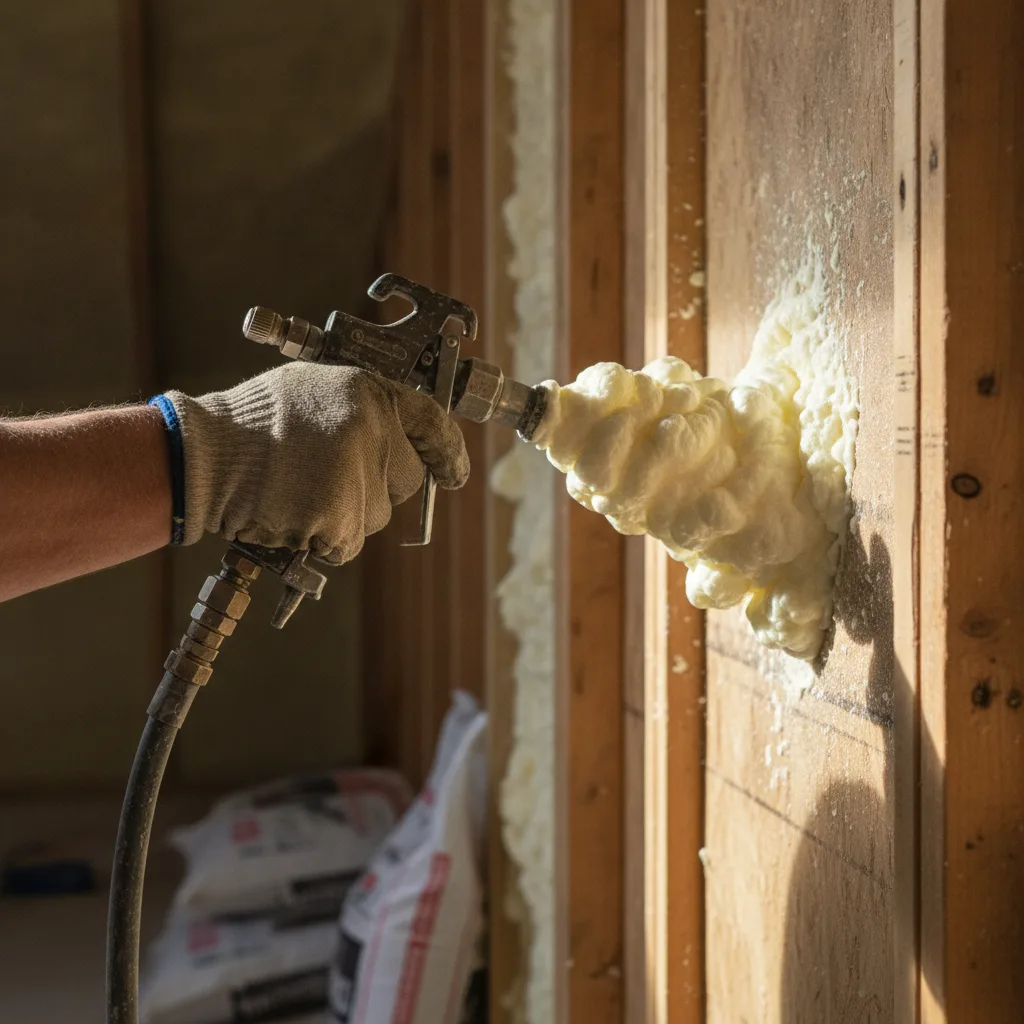
Our team in action — insulation professionals serving Orange
Why Mineral Wool Insulation Is Needed in Orange, CA
Orange’s Climate Demands High-Performance Thermal Barriers
Orange sits within California’s Climate Zone 8, characterized by long, dry summers, mild winters, and significant diurnal temperature swings. Average July high temperatures in Orange reach 93°F near inland areas like the Anaheim Hills border, while overnight lows can drop to 62°F — a daily swing of more than 30°F. Without adequate insulation, homes experience what energy auditors call “thermal roller-coaster” conditions: walls heat up during the day and radiate that stored heat indoors well into the night, forcing air conditioning systems to work overtime. The California Energy Commission reports that poorly insulated homes in Climate Zone 8 can spend 30–40% more annually on cooling alone.
Santa Ana Wind Events and Wildfire Risk
Orange County experiences multiple Santa Ana wind events each year, typically concentrated between October and February. During the October 2007 Santiago Fire, which burned more than 28,000 acres in the hills east of Orange, embers carried by winds exceeding 60 mph threatened residential areas in Irvine Park, Anaheim Hills, and the eastern edges of Orange itself. Mineral wool insulation — classified as noncombustible under ASTM E136 — provides an inherent layer of fire resistance within wall, floor, and attic assemblies that fiberglass and cellulose cannot match. For homes within Orange’s State Responsibility Area (SRA) fire hazard zones or within the Very High Fire Hazard Severity Zone (VHFHSZ) designations along Santiago Creek and Peters Canyon, mineral wool is often the code-preferred or insurance-preferred insulation choice.
Aging Housing Stock and Energy Code Compliance
A significant portion of Orange’s residential housing stock predates California’s Title 24 energy code, which was first adopted in 1978. Homes built before that year — and there are thousands in neighborhoods like Old Towne, Palmyra Avenue corridors, and the Hewes Street area — were constructed under no mandatory insulation requirements. Original wall cavities in 2×4 framing typically hold R-0 to R-7 if any insulation exists at all. Current Title 24 2022 standards require R-15 minimum for wood-framed walls in Climate Zone 8. Mineral wool at 3.5 inches in a standard 2×4 stud cavity achieves R-15 exactly, making it the most straightforward code-compliant solution for retrofit projects without requiring wall furring or framing modifications.
Acoustic Challenges in Dense Urban Areas
Orange is bisected by three major transportation corridors — State Route 22 (Garden Grove Freeway), State Route 55 (Costa Mesa Freeway), and The City Drive commercial corridor — all generating sustained road noise that penetrates older residential walls. Mineral wool’s Sound Transmission Class (STC) rating of 45–52 (depending on assembly) significantly outperforms standard fiberglass batts, which typically achieve STC 37–40 in the same wall assembly. For homeowners near SR-22 in the Olive neighborhood or along Tustin Street in South Orange, mineral wool provides measurable acoustic improvement that translates directly to quality of life.
Moisture Management Along the Santa Ana River Corridor
Properties located within half a mile of the Santa Ana River — including portions of the Riverdale and Friendly Hills neighborhoods — experience elevated ground-level humidity during winter months. Mineral wool’s hydrophobic fiber treatment causes water to bead and drain rather than absorb, preventing the mold colonization and R-value degradation that affect fiberglass batts in high- moisture environments. This characteristic is particularly valuable in crawl spaces and basement-adjacent wall assemblies common in Orange’s older housing stock.
Signs You Need Mineral Wool Insulation in Your Orange Home
Thermal Comfort Indicators
- Rooms facing east or west feel noticeably hotter by mid-afternoon despite running air conditioning
- Interior wall surfaces feel warm to the touch during summer months (surface temperature above 85°F is a concern)
- Uneven temperatures between rooms greater than 5°F with HVAC operating normally
- HVAC system runs in cycles longer than 20 minutes to reach setpoint during Orange’s summer peak hours (2–7 PM)
Energy Bill Warning Signs
- Monthly utility bills from Southern California Edison exceeding the average for your square footage — the SCE average for a 1,500 sq. ft. Orange home is approximately $180–$220 per month in summer
- Year-over-year energy cost increases that outpace SCE rate adjustments
- Failed or borderline results on a utility-sponsored home energy audit
Physical and Structural Signs
- Compressed, discolored, or visibly degraded fiberglass batts visible in attic or crawl space
- Walls that produce hollow sound when tapped, indicating empty or poorly filled cavities
- Pest damage — rodent tunneling through existing insulation, common near Orange’s Santiago Creek greenbelt
- Visible moisture staining or mold on wall sheathing during crawl space or attic inspection
Urgency Indicators
- Home built before 1978 with no record of insulation upgrades — treat as high priority before next summer cooling season
- Planning a wall, bathroom, or kitchen remodel — an open-wall opportunity significantly reduces installation cost
- Insurance carrier requesting fire-resistant improvements in VHFHSZ-designated zones of Orange
Mineral Wool Installation Methods We Use in Orange
1. Standard Batt Installation (New Construction and Open-Wall Retrofit)
The most common approach for homes undergoing renovation or new construction. Pre-cut mineral wool batts are friction-fitted into 16-inch or 24-inch on-center stud bays. This method is ideal for Orange’s active remodeling market — particularly in the Old Towne historic district, where interior gut-and-replace projects frequently expose original 2×4 framing. Installation is fast, clean, and requires no drying time.
2. Continuous Exterior Mineral Wool Rigid Board (Thermal Bridge Reduction)
For homes where adding interior furring is not practical, we install mineral wool rigid board (such as Rockwool Comfortboard 80) as a continuous exterior layer beneath new cladding. This approach eliminates thermal bridging through studs — which can account for 15–20% of total wall heat loss — and is particularly effective in Orange’s craftsman-era properties during siding replacement projects.
3. Mineral Wool in Attic Knee Walls and Cathedral Ceilings
Many of Orange’s 1950s–1960s ranch homes feature low-slope roofs or knee-wall attic configurations. High-density mineral wool batts (5.5-inch, R-23) installed in these assemblies provide both thermal performance and fire resistance critical under Orange’s VHFHSZ regulations. This method is often paired with blown-in attic insulation for flat-ceiling sections.
4. Mineral Wool for Sound Control Assemblies
In multi-family buildings, home offices, and properties adjacent to SR-22 or SR-55 corridor traffic, we install mineral wool specifically for STC enhancement. This often involves combining 3.5-inch batts with resilient channel and double-layer drywall to achieve STC ratings of 55 or higher — meeting California Building Code Section 1207 multi-family acoustical requirements.
5. Combination Systems with Spray Foam
In some applications — particularly crawl space perimeter walls or mixed-assembly walls — we combine a thin layer of closed-cell spray foam insulation at the air barrier with mineral wool fill for bulk thermal performance. This hybrid approach delivers code-compliant vapor control while maximizing R-value per inch of cavity depth.
Ready for Mineral Wool Insulation? Get Your Free Estimate Today.
Next Level Insulation of Orange serves Orange and the surrounding area — we’ll be on-site within 24 hours.
📞 Call (714) 266-2070Mineral Wool Insulation Cost in Orange, CA
Typical Price Ranges
In Orange, CA, professional mineral wool insulation installation typically costs between $1.80 and $3.50 per square foot of wall or ceiling area, including both materials and labor. For a standard 1,500 sq. ft. Orange ranch home requiring full exterior-wall insulation (approximately 900 sq. ft. of wall cavity area), expect total project costs between $1,600 and $3,150. Attic knee-wall applications typically range from $2.00 to $4.00 per square foot due to more complex access and fitting requirements.
Cost Factors Specific to Orange Projects
- Open-wall vs. closed-wall access: Open-wall retrofit (during remodel) costs 30–40% less than closed-wall injection or tearout methods.
- Insulation removal: Homes with degraded original fiberglass or blown-in insulation requiring insulation removal before mineral wool installation add $0.50–$1.20 per square foot to total cost.
- Historic district requirements: Properties in Old Towne Orange may require permits with specific review timelines, adding $200–$500 in permit costs and 2–4 weeks of lead time.
- Material grade: Standard Rockwool Comfortbatt averages $0.55–$0.75 per square foot (material only); premium acoustic-grade mineral wool averages $0.85–$1.10 per square foot.
- Access complexity: Homes with pier-and-beam foundations common in older Orange neighborhoods may require additional labor for crawl space wall applications.
Available Rebates and Incentives
Southern California Edison’s Energy Savings Assistance Program and the California Energy Commission’s TECH Clean California initiative both offer rebates for qualifying insulation upgrades in Orange. Rebate amounts range from $150 to $800 depending on square footage improved and existing R-value baseline. The federal Inflation Reduction Act (IRA) Section 25C tax credit provides an additional 30% credit (up to $1,200 per year) on qualified insulation materials. Our team can guide you through rebate applications at no additional charge.
Orange Neighborhoods We Serve
Old Towne Orange (Built 1885–1940)
Orange’s nationally registered historic district is filled with Craftsman bungalows, Spanish Colonial Revival homes, and early American Foursquares. These properties typically feature 2×4 exterior walls with original wood lath and plaster interiors, zero existing insulation, and significant air leakage at balloon-frame top plates. Mineral wool’s non-combustible properties are especially valued here given older wood construction.
Serrano Heights (Built 1980s–1990s)
This hillside community near Santiago Canyon Road features two-story stucco homes with complex vaulted ceiling geometries and homes backing against open-space preserves in VHFHSZ territory. Many homes have original R-11 fiberglass that has settled and lost effectiveness. Mineral wool upgrades combined with attic insulation are a high priority here.
Olive Neighborhood (Built 1950s–1970s)
Situated along Chapman Avenue and Tustin Street between SR-22 and Katella Avenue, Olive is a post-war tract neighborhood with single-story ranch homes averaging 1,100–1,600 sq. ft. Road noise from SR-22 is a persistent concern. Mineral wool’s dual thermal-acoustic performance makes it the preferred solution for homeowners in this area.
The Village of Orange / Orange Park Acres (Built 1960s–2000s)
Horse-property lots and rural-adjacent parcels in Orange Park Acres sit in Orange’s warmest inland microclimates, where summer highs regularly exceed 98°F. Larger floor plans in this area require more extensive insulation scopes and often benefit from combination mineral wool and blow-in insulation systems.
Mineral Wool Insulation Maintenance Tips for Orange Homeowners
- Inspect attic and crawl space annually in September — before Santa Ana wind season — to check for pest intrusion. Rodents attracted to warm spaces near Santiago Creek greenbelt corridors can compress or displace mineral wool batts.
- Check for moisture staining after winter rains. While mineral wool resists water absorption, sustained roof or flashing leaks can still damage adjacent building materials. Address leaks within 48 hours to prevent mold on wood framing.
- Do not compress batts when adding storage to attic spaces. Storing boxes on top of mineral wool reduces its effective R-value proportional to compression percentage.
- Re-caulk penetrations at 5-year intervals. Thermal movement in Orange’s daily temperature swings causes sealant to fatigue. Inspect electrical and plumbing penetrations through top and bottom plates.
- Schedule a thermal imaging check every 7–10 years to verify wall assembly integrity and identify any new thermal bypass pathways from renovations or pest activity.
- Monitor HVAC runtime trends. A 15% or greater increase in cooling runtime from one summer to the next — without a corresponding heat wave — often signals insulation degradation or new air leakage.
- Keep attic ventilation pathways clear. Mineral wool in attic kneewall applications performs best when combined with proper attic ventilation; blocked soffit vents are common in Orange’s older homes and undermine overall system performance.
Frequently Asked Questions About Mineral Wool Insulation in Orange, CA
How much does mineral wool insulation cost in Orange, CA?
Mineral wool insulation in Orange typically costs between $1.80 and $3.50 per square foot installed, depending on wall access, batt thickness, and scope of work. A complete wall insulation project for a 1,500 sq. ft. Orange home averages $1,600–$3,150. Southern California Edison rebates and federal IRA tax credits can reduce out-of-pocket costs by $350–$2,000 depending on project size and eligibility. Contact us at (714) 266-2070 for a precise, no-obligation estimate.
Is mineral wool better than fiberglass for Orange’s climate?
For most Orange homeowners, yes. Mineral wool’s higher density eliminates convective air movement within wall cavities — a significant issue in Orange’s 30°F+ daily temperature swings. Its noncombustible nature is particularly valuable in VHFHSZ-designated areas of eastern Orange near Santiago Canyon. Its superior STC ratings also address the road noise concerns common near SR-22 and SR-55 corridors.
How long does a mineral wool installation take?
Most residential mineral wool projects in Orange are completed in a single day. A full exterior-wall retrofit on a 1,500 sq. ft. single-story home typically requires 4–6 hours of installation time following a 1–2 hour air sealing phase. Larger two-story homes or projects requiring insulation removal first may extend to two days.
Do I need a permit for mineral wool insulation in Orange, CA?
Permit requirements depend on project scope. In Orange, adding insulation to existing closed walls without disturbing structural elements typically does not require a permit. Open-wall insulation work done as part of a permitted remodel is inspected as part of that broader permit. Properties in Old Towne Orange’s historic district may have additional review requirements. We handle permit inquiries and applications as part of our project management process.
Will mineral wool insulation help reduce noise from the SR-22 Freeway near my home?
Yes, measurably. Mineral wool batts in a standard 2×4 wall assembly achieve STC ratings of 45–48, compared to STC 37–40 for fiberglass in the same assembly. Combined with air sealing at all penetrations — the most critical noise pathway — homeowners near the SR-22 corridor in Orange’s Olive neighborhood typically report a noticeable reduction in freeway traffic noise after installation.
Is mineral wool safe to handle? Does it cause skin irritation?
Modern mineral wool products are manufactured with biosoluble fibers that dissolve in lung fluid — unlike older asbestos-era materials. However, like fiberglass, installation-phase fiber contact can cause temporary skin and eye irritation. Our technicians wear appropriate PPE during installation and use temporary containment to prevent fiber migration to living areas. Mineral wool is IARC Group 3 (not classifiable as carcinogenic to humans) when biosoluble fibers are used, as in all modern products we install.
Can mineral wool be installed in my Orange home’s crawl space?
Yes. Mineral wool rigid board (Comfortboard 80) is an excellent choice for crawl space perimeter walls in Orange homes with pier-and-beam foundations. Its moisture resistance makes it well-suited to the seasonal humidity fluctuations common near the Santa Ana River corridor. For vented crawl spaces, we often recommend crawl space encapsulation in combination with mineral wool for maximum moisture and thermal performance.
How soon will I see savings on my energy bills after installation?
Most Orange homeowners notice reduced HVAC runtime within the first billing cycle following installation. Measurable bill reductions are typically visible on the first full summer month’s Southern California Edison statement after installation. The California Energy Commission estimates that properly installed wall and attic insulation upgrades in Climate Zone 8 reduce annual HVAC energy consumption by 18–35%, depending on baseline conditions.
Get a Free Mineral Wool Insulation Estimate in Orange, CA
Ready to upgrade your Orange home’s comfort, energy efficiency, and fire resistance with professional mineral wool insulation? Next Level Insulation of Orange is here to help. Whether you’re dealing with high summer utility bills, noise from the SR-22 Freeway, an aging home in Old Towne Orange, or a Serrano Heights property in a fire hazard zone, we have the expertise and the right materials to solve your insulation challenges.
Call us today at (714) 266-2070 to schedule your free, no-obligation on-site assessment. Our team will inspect your home, identify insulation gaps, calculate potential savings, and provide a transparent written estimate — all at no cost to you. Don’t spend another Orange summer paying for energy that’s escaping through your walls. Contact Next Level Insulation of Orange now and take your home’s comfort and efficiency to the next level.