
Spray Foam Insulation in El Monte, CA
Energy-Saving Spray Foam Insulation for El Monte, CA Homes — Licensed & Insured
Need spray foam insulation in El Monte, CA? Next Level Insulation offers expert installation for attics, crawl spaces & walls. Call (626) 469-7656 for a free quote.
- Licensed & Insured
- Locally Owned & Operated
- Free Inspection & Estimate
Request Your
Free EstimateSpray foam insulation is a high-performance insulation solution that expands on contact to seal gaps, cracks, and cavities in walls, attics, crawl spaces, and rooflines—creating an airtight thermal and moisture barrier that traditional insulation simply cannot match. At Next Level Insulation of El Monte, we specialize in delivering professional spray foam insulation services tailored to the unique climate demands and building stock found throughout El Monte, California.
El Monte’s position in the San Gabriel Valley means residents contend with scorching summer heat frequently exceeding 100°F, dry Santa Ana wind events, and significant temperature swings between seasons. These conditions place enormous strain on under-insulated homes and commercial buildings. Our expert team understands the local building codes, the predominant housing eras, and the specific environmental pressures that make high-quality insulation not just a comfort upgrade—but a necessity. Call us today at (626) 469-7656 to schedule your consultation.
Understanding Spray Foam Insulation
Spray foam insulation is a two-component liquid chemical product—typically composed of polyol resin and isocyanate—that reacts when mixed at the tip of a spray gun, expanding rapidly to fill and seal any space it contacts. This expansion creates either an open-cell or closed-cell foam structure, both of which outperform traditional fiberglass batts and blown-in cellulose in key performance categories including R-value per inch, air sealing capability, and moisture resistance.
The technology has roots in the 1940s, when polyurethane chemistry was first developed. By the 1970s energy crisis, spray foam began gaining traction in residential and commercial construction as builders and homeowners sought ways to dramatically reduce energy consumption. Today, it is considered one of the most effective insulation solutions available and is widely specified in new construction and retrofit projects across California.
In El Monte specifically, the majority of the housing stock dates from the post-World War II building boom of the late 1940s through the 1960s. The San Gabriel Valley was one of the fastest-growing suburban corridors in Southern California during this era, and thousands of ranch-style homes, duplexes, and small commercial buildings were constructed quickly—often with minimal insulation by modern standards. Many of these structures still rely on degraded original insulation or no insulation at all in critical areas like attics and crawl spaces.
More recent construction from the 1980s through 2000s fares somewhat better, but even those buildings frequently have thermal bridging issues, poorly sealed penetrations, and aging insulation that no longer performs to its original rated values. Spray foam insulation addresses all of these issues simultaneously, acting as both insulation and air barrier in a single application.
Whether applied in a newly framed wall cavity, an existing attic, a crawl space beneath an older El Monte ranch home, or around mechanical penetrations in a commercial building along Valley Boulevard, spray foam delivers consistent, durable performance that continues to pay dividends in energy savings for decades.
Why Spray Foam Insulation Is Needed in El Monte, CA
El Monte’s location at the eastern end of the Los Angeles Basin, nestled between the San Gabriel Mountains to the north and the Rio Hondo and San Gabriel rivers, creates a microclimate that is significantly hotter and drier than coastal communities just 20 miles west. The city regularly records summer temperatures between 95°F and 108°F during heat events, and the California Department of Water Resources has documented that the San Gabriel Valley floor can be 8–12°F hotter than coastal LA during peak summer afternoons due to the urban heat island effect and geographic positioning.
The Santa Ana wind events—which typically strike between October and March but can occur any month—drive hot, dry air down from the inland desert at speeds exceeding 60 mph. During these events, recorded frequently near El Monte’s boundary with Baldwin Park and South El Monte, the humidity can drop below 10%, causing rapid moisture loss through any air leaks in a building envelope. Homes without proper air sealing and insulation lose conditioned air at staggering rates during these periods, spiking utility bills and stressing HVAC systems.
El Monte’s older neighborhoods—particularly the Mid-City residential blocks near the historic downtown along Valley Boulevard, the working-class neighborhoods east of Tyler Avenue, and the dense housing tracts south of the 10 Freeway—are heavily populated with structures built before California’s Title 24 Energy Code took effect in 1978. These pre-code homes were constructed with little or no attention to thermal performance. Attics in these properties often have less than 3 inches of original blown-in insulation, translating to an R-value of roughly R-9 to R-11—far below the current minimum requirement of R-38 to R-49 for the Los Angeles climate zone.
Ground-level moisture is also a concern in El Monte. The city sits atop the Main San Gabriel Basin, a major groundwater basin that historically has experienced both drought drawdown and replenishment cycles. During wet years—including the significant rainfall events of early 2023, when the San Gabriel Valley received more than 200% of its seasonal average precipitation—crawl spaces beneath older El Monte homes can accumulate moisture, promoting mold growth, wood rot, and pest intrusion. Closed-cell spray foam applied in crawl spaces creates a Class II vapor retarder that resists this moisture infiltration effectively.
Finally, El Monte’s proximity to the 10 and 60 freeways creates persistent noise pollution that affects residential quality of life throughout the city. Open-cell spray foam, with its sound-dampening properties, provides a meaningful reduction in traffic noise transmission through walls and ceilings—an often-overlooked benefit that is particularly relevant to homes in neighborhoods like Norwood Place and the residential streets adjacent to the Ramona Boulevard corridor.
Signs You Need Spray Foam Insulation
Energy and Comfort Indicators
- Monthly electricity bills that spike above $250–$350 during El Monte’s summer heat events despite consistent thermostat settings
- Rooms that feel noticeably hotter or colder than adjacent spaces, especially south- and west-facing rooms during afternoon heat
- HVAC system running nearly continuously during summer without reaching the set temperature
- Drafts felt near windows, outlets, or interior wall surfaces during Santa Ana wind events
Structural and Moisture Indicators
- Visible condensation on interior walls or window frames during winter mornings
- Musty odors emanating from crawl spaces, especially after winter rains
- Visible mold or efflorescence staining on crawl space joists or subfloor surfaces
- Pest or rodent intrusion entering through gaps that inadequate insulation leaves unsealed
Urgency Indicators
- Insulation that is more than 20 years old and has never been inspected
- Attic insulation visibly compressed, discolored, or wet after roof leaks
- Home built before 1978 with no record of insulation upgrades
Our Spray Foam Insulation Process in El Monte
Initial Consultation and Energy Assessment (Day 1 – 1 to 2 Hours)
Our process begins with a thorough walkthrough of your El Monte property. We evaluate current insulation levels, identify air leakage points, inspect attic and crawl space conditions, and review any utility bill history you can share. We note building-specific factors like roof type, foundation style (slab vs. raised), and proximity to freeway corridors that may influence our recommendations.
Detailed Written Estimate (Within 24–48 Hours)
Following the assessment, we prepare a written estimate that specifies foam type, coverage area, R-value targets aligned with California Title 24 requirements for the Los Angeles climate zone, and total project cost. We explain open-cell vs. closed-cell options and which is optimal for your specific application.
Pre-Installation Preparation (Day of Installation – 1 to 2 Hours)
Before foam is applied, our crew prepares the work area. This includes masking off surfaces that should not receive foam, ensuring adequate ventilation, verifying that all electrical and plumbing rough-ins are complete (for new construction), and confirming ambient temperature conditions. El Monte’s warm climate generally supports year-round foam application, though we adjust chemical ratios when temperatures exceed 95°F on-site.
Spray Foam Application (2 to 6 Hours Depending on Scope)
Our certified technicians apply spray foam using calibrated proportioner equipment, maintaining precise temperature and pressure ratios to ensure proper chemical reaction and expansion. We apply foam in lifts as required by the product manufacturer, allowing adequate cure time between passes on larger applications.
Trimming and Inspection (1 to 2 Hours)
Excess foam is trimmed flush with framing members, and our team inspects all surfaces for uniform coverage, pinhole gaps, or areas requiring additional passes. We use thermal imaging where appropriate to verify complete coverage.
Cleanup and Final Walkthrough (30 to 60 Minutes)
We remove all masking materials, clean the work area, and walk you through the completed installation, answering any questions about performance expectations and maintenance.
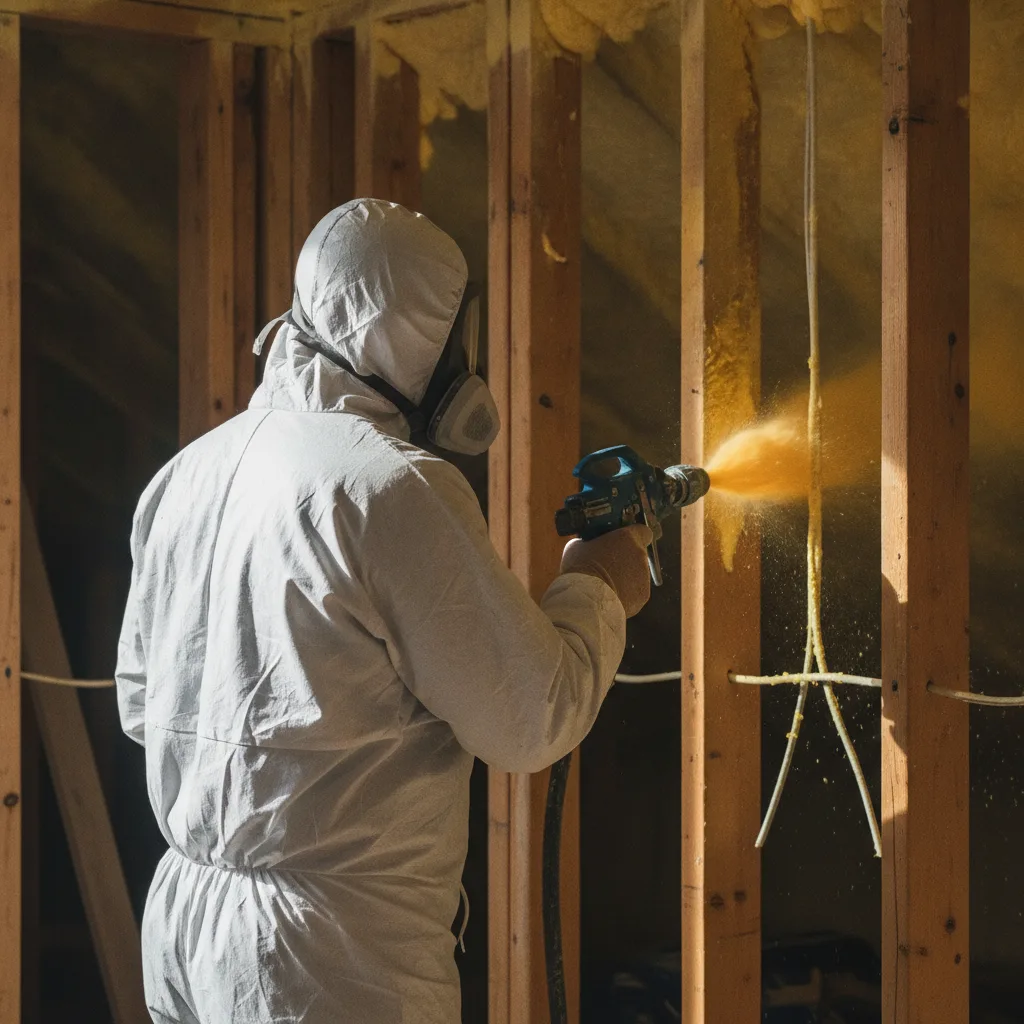
Our team in action — insulation professionals serving El Monte
Spray Foam Insulation Methods and Approaches
Open-Cell Spray Foam
Open-cell spray foam expands aggressively to approximately 100 times its liquid volume, creating a soft, spongy insulation material with an R-value of approximately R-3.5 to R-3.8 per inch. It is vapor-permeable and an excellent sound attenuator. In El Monte, open-cell foam is frequently used in interior walls of homes near the 10 and 60 freeway corridors to reduce traffic noise, and in attic applications where vapor permeability is desirable for the local climate.
Closed-Cell Spray Foam
Closed-cell spray foam is denser, more rigid, and delivers R-6 to R-7 per inch—the highest R-value per inch of any commonly available insulation material. It also acts as a Class II vapor retarder. In El Monte, closed-cell foam is the preferred solution for crawl space encapsulation beneath the raised-foundation homes common in Mid-City and older East El Monte neighborhoods, as well as for roofline applications and exterior wall assemblies where moisture intrusion risk is elevated.
Flash-and-Batt Hybrid System
This method combines a thin layer (1–2 inches) of closed-cell spray foam applied directly to the sheathing or roof deck, followed by traditional fiberglass or mineral wool batts to fill the remainder of the cavity. This hybrid approach delivers air sealing and moisture management benefits of closed-cell foam at a lower cost than full closed-cell coverage, making it a practical choice for El Monte homeowners balancing performance and budget.
Injection Foam for Existing Walls
For existing finished walls in El Monte’s older homes where spray foam cannot be applied without demolition, injection foam provides a retrofit solution. Small holes are drilled in the exterior or interior wall surface, and foam is injected under low pressure to fill the cavity before holes are patched.
Ready for Spray Foam Insulation? Get Your Free Estimate Today.
Next Level Insulation of El Monte serves El Monte and the surrounding area — we’ll be on-site within 24 hours.
📞 Call (626) 469-7656Spray Foam Insulation Cost in El Monte, CA
Understanding the cost of spray foam insulation helps El Monte homeowners and property managers plan their projects effectively. Pricing varies based on foam type, application area, and project complexity.
Typical Price Ranges
- Open-cell spray foam: $1.00–$1.50 per board foot (one square foot, one inch thick), translating to approximately $1,500–$3,500 for a typical El Monte attic of 1,000–1,500 square feet
- Closed-cell spray foam: $1.75–$3.00 per board foot, with crawl space encapsulation projects in a standard El Monte raised-foundation home ranging from $2,500–$6,000 depending on square footage and access difficulty
- Whole-home insulation package (attic + crawl space + wall insulation): $6,000–$15,000 for a typical 1,200–1,800 sq ft El Monte post-war home
Factors Affecting Cost
- Existing insulation removal required prior to installation
- Crawl space access height (homes with less than 18 inches of clearance require additional labor)
- Number of penetrations requiring sealing (plumbing, electrical, HVAC)
- Current material costs, which can fluctuate with petrochemical market conditions
El Monte-Specific Pricing Notes
Southern California labor markets and California’s stringent contractor licensing requirements mean that insulation installation in the greater Los Angeles area, including El Monte, typically runs 10–20% higher than national averages. However, SoCalGas and Southern California Edison both offer rebate programs for qualifying insulation upgrades that can offset a portion of project costs. We can provide guidance on current rebate availability when you contact us.
For a precise quote, call (626) 469-7656 or request a free on-site assessment.
El Monte Neighborhoods We Serve
Mid-City El Monte (Downtown Core and Valley Boulevard Corridor)
This area contains the city’s oldest housing stock, with many homes dating to the 1940s and 1950s. Ranch-style and bungalow-style residences here frequently have no crawl space insulation and severely degraded attic insulation. We commonly perform insulation removal and replacement projects in this neighborhood before applying fresh spray foam.
North El Monte (Peck Road and Durfee Avenue Areas)
Homes here were largely built in the 1960s and early 1970s and tend to have slab foundations, making attic insulation the primary opportunity for energy improvement. Proximity to the San Gabriel River Spreading Grounds means some properties in this area experience higher ambient moisture levels.
South El Monte Adjacent Tracts (Near the 10 Freeway)
Residential streets in this zone deal with significant freeway noise and heat retention from surrounding industrial corridors. Open-cell spray foam in walls and attics provides dual benefits of thermal performance and acoustic comfort for residents.
Norwood Place and Ramona Boulevard Corridor
This densely residential area contains a mix of single-family homes and older multi-family buildings, many of which have never had formal insulation inspections. Attic insulation upgrades are among the most requested services in this neighborhood.
Spray Foam Insulation Maintenance Tips for El Monte Homeowners
- Inspect attic venting annually: El Monte’s dry summers can cause soffit and ridge vents to accumulate debris from Santa Ana wind events. Blocked vents reduce attic ventilation, potentially causing moisture buildup even in well-insulated spaces.
- Check crawl space conditions after wet winters: Following heavy rain seasons like the exceptional 2023 rainfall, visually inspect your crawl space for standing water or moisture condensation on foam surfaces.
- Seal any new penetrations promptly: Any new plumbing, electrical, or HVAC penetrations made after initial foam installation should be sealed immediately to maintain the air barrier.
- Monitor for pest intrusion: While closed-cell foam resists pest entry, check perimeter areas seasonally for any new rodent activity that could indicate foam damage.
- Keep foam protected from UV exposure: Exposed spray foam in exterior or semi-exterior applications should be coated or painted to prevent UV degradation.
- Schedule a professional re-inspection every 5–7 years to verify foam integrity and identify any settling or shrinkage in older open-cell applications.
- Update insulation after major HVAC changes: Replacing or upgrading your HVAC system is an ideal time to reassess insulation performance and identify new gaps.
Why Choose Next Level Insulation of El Monte
Next Level Insulation of El Monte is a locally focused insulation contractor serving El Monte and the greater San Gabriel Valley. Our technicians are trained specifically on the insulation challenges presented by the region’s pre-Title 24 housing stock, its demanding climate, and the specific soil and moisture conditions of the San Gabriel Valley floor.
We offer the full spectrum of insulation services under one roof: spray foam insulation, attic insulation, blow-in insulation, crawl space encapsulation, crawl space insulation, insulation removal, and insulation replacement. This breadth of capability means we can assess your property holistically and recommend the most cost-effective combination of solutions rather than defaulting to a single product.
We are committed to transparent pricing, clear communication, and workmanship that meets or exceeds California Title 24 requirements. When you call (626) 469-7656, you speak with knowledgeable local professionals who understand El Monte—not a national call center.
Frequently Asked Questions About Spray Foam Insulation in El Monte, CA
How much does spray foam insulation cost in El Monte?
Costs range from approximately $1.00–$1.50 per board foot for open-cell foam and $1.75–$3.00 per board foot for closed-cell foam. A typical attic insulation project for an El Monte ranch home runs $1,500–$3,500, while a full crawl space encapsulation may range from $2,500–$6,000. Contact us at (626) 469-7656 for a free, specific estimate for your property.
How long does spray foam insulation last?
Properly installed spray foam insulation can last the lifetime of the building—often 80 years or more—without significant degradation of thermal or air-sealing performance. This is one of its key advantages over fiberglass batts, which can settle and compress over time, particularly in El Monte’s seismically active environment.
Is spray foam insulation worth it for older El Monte homes?
Absolutely. Homes built in the 1940s–1960s in El Monte’s Mid-City and North El Monte areas typically have such poor existing insulation that spray foam upgrades can reduce heating and cooling costs by 30–50%, according to industry benchmarks. The payback period in Southern California’s high-utility-cost environment is typically 4–8 years.
Do I need to leave my home during spray foam installation?
Occupants and pets should vacate the property during application and for a period afterward—typically 24 hours for open-cell foam and as little as 1–2 hours after closed-cell foam has fully cured, depending on the product used. We provide clear guidance on re-entry timing specific to your project.
What is the difference between open-cell and closed-cell spray foam?
Open-cell foam is softer, more affordable, vapor-permeable, and delivers R-3.5–3.8 per inch. Closed-cell foam is rigid, waterproof, delivers R-6–7 per inch, and acts as a vapor retarder. For El Monte crawl spaces and roofline applications, closed-cell is generally preferred. For interior walls and sound control near freeways, open-cell is often the better choice.
Can spray foam be applied over existing insulation?
In some cases, yes—particularly when adding a flash coat of closed-cell foam to an existing attic before adding blown-in insulation on top. However, if existing insulation is contaminated, water-damaged, or pest-infested, we recommend professional insulation removal before installing new spray foam.
Are there rebates available for spray foam insulation in El Monte?
Southern California Edison and SoCalGas both administer rebate programs for qualifying insulation improvements under their Energy Upgrade California and residential energy efficiency programs. Rebate amounts and eligibility requirements change periodically. We stay current on available incentives and can advise you during your consultation.
How long does the installation take?
Most residential spray foam projects in El Monte are completed in a single day. A full attic application typically takes 3–5 hours. Crawl space encapsulation may take 4–7 hours depending on square footage and access conditions. Whole-home projects may span 1–2 days.
Get a Free Spray Foam Insulation Estimate in El Monte Today
Don’t let another El Monte summer drive your energy bills through the roof. Next Level Insulation of El Monte is ready to assess your home or commercial property and recommend the right spray foam insulation solution for your specific needs, budget, and building type.
Whether you’re in Mid-City, North El Monte, the Norwood Place neighborhood, or anywhere else in the El Monte area, our team brings local expertise and professional-grade materials to every project.
Call us now at (626) 469-7656) to schedule your free on-site consultation. You can also reach us through our website to request a written estimate. Take the next step toward a more comfortable, energy-efficient home—contact Next Level Insulation of El Monte today.