
Insulation Removal in El Monte, CA
Energy-Saving Insulation Removal for El Monte, CA Homes — Licensed & Insured
Need insulation removal in El Monte, CA? Next Level Insulation removes attic, crawl space & contaminated insulation safely. Free quote: (626) 469-7656.
- Licensed & Insured
- Locally Owned & Operated
- Free Inspection & Estimate
Request Your
Free EstimateInsulation removal is the professional process of safely extracting old, damaged, contaminated, or ineffective insulation materials from your home or commercial building — including attics, crawl spaces, walls, and ceilings. In El Monte, CA, where summer temperatures regularly surpass 95°F and aging housing stock dominates many neighborhoods, degraded insulation is a widespread problem that directly impacts your energy bills, indoor air quality, and structural integrity.
At Next Level Insulation of El Monte, we specialize in professional insulation removal tailored to the unique demands of San Gabriel Valley homes and businesses. From mid-century ranch houses in Garvey to industrial properties near the I-10 corridor, our team arrives fully equipped to handle blown-in fiberglass, cellulose, and old batt insulation — safely, efficiently, and with minimal disruption to your daily life. Call us today at (626) 469-7656 to schedule a free inspection.
Understanding Insulation Removal
Insulation removal refers to the systematic extraction of existing insulation materials that are no longer performing their intended function of thermal and acoustic regulation. While insulation is designed to last decades, real-world conditions — moisture intrusion, pest activity, fire damage, mold growth, and simple age-related compression — can reduce its effectiveness to near zero, or worse, turn it into an active health hazard.
Historically, homes built before the 1980s in the greater Los Angeles area — including El Monte — were commonly insulated with materials we now know to be problematic. Vermiculite insulation, often contaminated with asbestos, was used in attics through the late 1970s. Urea-formaldehyde foam insulation, banned by the CPSC in 1982, found its way into walls across San Gabriel Valley tract homes. Even well-intentioned fiberglass batts installed during the post-war housing boom of the 1950s and 1960s are now severely compressed and moisture-laden in many El Monte properties.
El Monte’s housing stock is predominantly composed of single-family homes and small multi-unit buildings constructed between 1945 and 1975, during the rapid suburban expansion of the eastern San Gabriel Valley. These structures typically feature low-pitched rooflines, unconditioned attic spaces, and raised foundations with accessible crawl spaces — all of which are highly susceptible to insulation degradation over time.
Modern insulation removal is not a simple demolition task. It requires industrial-grade HEPA-filtered vacuum equipment, proper negative air pressure containment to prevent particle migration into living spaces, and adherence to California Air Resources Board (CARB) regulations for safe disposal. When the removal involves potentially hazardous materials, additional protocols under Cal/OSHA Title 8 apply. Professional removal is not just recommended — in many cases involving older El Monte homes, it is legally required before new insulation can be installed.
Removal also serves as a critical diagnostic opportunity. Once old insulation is extracted, trained technicians can fully inspect rafters, joists, vapor barriers, ductwork, and framing for hidden moisture damage, pest activity, or structural issues that would otherwise remain concealed beneath layers of degraded material.
Why Insulation Removal Is Needed in El Monte, CA
Extreme Heat Cycles
El Monte regularly records summer temperatures between 95°F and 108°F during heat events. The September 2020 heat wave, which saw El Monte reach 111°F, caused attic temperatures to soar past 150°F in poorly ventilated structures. These extreme thermal cycles accelerate the physical breakdown of fiberglass batts and cause cellulose insulation to shift and settle. Over 15–20 years, a 12-inch layer of blown cellulose can compress to as little as 7 inches, losing 40% or more of its R-value — dropping from R-38 to roughly R-22. For El Monte homeowners, this means air conditioning systems are working 25–35% harder than necessary.
Moisture and Humidity Fluctuations
Despite its inland location, El Monte experiences notable humidity swings — particularly during Southern California’s monsoonal moisture pattern from July through September, when overnight relative humidity can jump from 20% to over 80% within hours. These cycles cause repeated condensation events inside attic spaces and crawl areas, saturating fiberglass batts that then lose virtually all insulating capacity when wet. The Rio Hondo floodplain, which extends through portions of South El Monte and along the western edge of the city, contributes to elevated groundwater moisture levels beneath raised foundations, making crawl space insulation particularly vulnerable to mold and rot in neighborhoods such as Loma and Medina.
Pest Pressure
El Monte’s dense urban tree canopy — including mature sycamores, eucalyptus, and ornamental palms along Garvey Avenue and Valley Boulevard — creates an ideal habitat corridor for roof rats (Rattus rattus), which are endemic to the San Gabriel Valley. Roof rats nest almost exclusively in attic insulation, shredding fiberglass batts and contaminating blown-in cellulose with urine, feces, and nesting debris. A single season of roof rat activity can render an entire attic’s insulation biohazardous and mandate full removal under LA County Department of Public Health guidelines. Additionally, Argentine ant colonies — widespread in El Monte’s clay-heavy soils — frequently invade crawl spaces, nesting in and beneath insulation batts.
Aging Building Stock and Code Compliance
California’s Title 24 energy code requires that replacement insulation meet current R-value minimums — R-38 for attics in Climate Zone 9, which covers El Monte. Older installed insulation cannot simply be topped off if it is contaminated or structurally compromised. LA County building inspectors increasingly require documented removal and replacement when permits are pulled for HVAC replacements or re-roofing projects — both common in El Monte’s aging housing stock.
Signs You Need Insulation Removal in El Monte
Energy & Comfort Red Flags
- Energy bills have increased 20% or more without a change in usage habits
- Rooms above the attic are consistently 8–12°F warmer than the rest of the home
- Your HVAC system runs continuously during El Monte’s summer heat events
- Cold drafts or hot spots near exterior walls or ceilings during winter months
Visual & Structural Warning Signs
- Visible water stains, dark discoloration, or wet clumping in attic insulation
- Insulation depth visibly lower than the tops of your attic joists (indicates compression)
- Visible mold growth — green, black, or white fuzzy patches — on insulation or nearby wood
- Damaged vapor barriers in your crawl space with pooled moisture beneath
Pest & Health Indicators
- Scratching or scurrying sounds in the attic, especially at night (roof rat activity)
- Visible rodent droppings, nesting materials, or chewed insulation during attic inspection
- Persistent musty or ammonia-like odors inside the home
- Unexplained allergy flare-ups or respiratory irritation among household members
Urgency Indicators
If you discover vermiculite-type granular insulation in a pre-1980 El Monte home, treat it as potentially asbestos-containing material and schedule a professional inspection immediately. Do not disturb it.
Our Insulation Removal Process in El Monte
Free On-Site Assessment (Day 1 — 60 to 90 Minutes)
Our certified technician performs a complete inspection of your attic, crawl space, and accessible wall cavities. We use a thermal imaging camera and moisture meter to document compromised zones, identify pest activity, and assess potential hazardous material concerns. For El Monte homes built before 1979, we visually screen for vermiculite and collect samples if warranted, which are sent to a certified California lab.
Detailed Scope of Work & Transparent Estimate (Day 1–2)
We provide a written estimate itemizing removal volume (measured in cubic yards), disposal fees, any hazmat handling surcharges, and the timeline for completion. No hidden fees.
Containment Setup (Removal Day — 30 to 60 Minutes)
Before any insulation is disturbed, our crew installs plastic sheeting barriers at the attic hatch or crawl space entry, sets up HEPA-filtered negative air pressure machines, and seals HVAC vents to prevent particle migration into your El Monte home’s living areas. All crew members don full PPE including N100 respirators and Tyvek suits.
Insulation Extraction (2 to 6 Hours Depending on Square Footage)
Using truck-mounted or portable industrial HEPA vacuum systems, we extract all insulation material, including compressed batts, blown-in debris, nesting material, and contaminated vapor barriers. For El Monte’s common 1,200–1,800 sq ft attic spaces, full extraction typically takes 3–4 hours.
Surface Cleaning & Sanitization (1 to 2 Hours)
All framing, decking, and structural surfaces are vacuumed clean and treated with an EPA-registered antimicrobial sanitizer — essential in El Monte’s climate where rodent contamination and mold spores are common findings.
Structural Inspection & Damage Assessment (30 to 60 Minutes)
With the space cleared, we document any moisture damage, compromised rafters, failed ductwork, or air sealing deficiencies. We provide a written report and photographs.
Responsible Disposal (Same Day)
All removed material is bagged in sealed, labeled disposal bags and transported to an LA County–approved waste facility in compliance with California regulations.
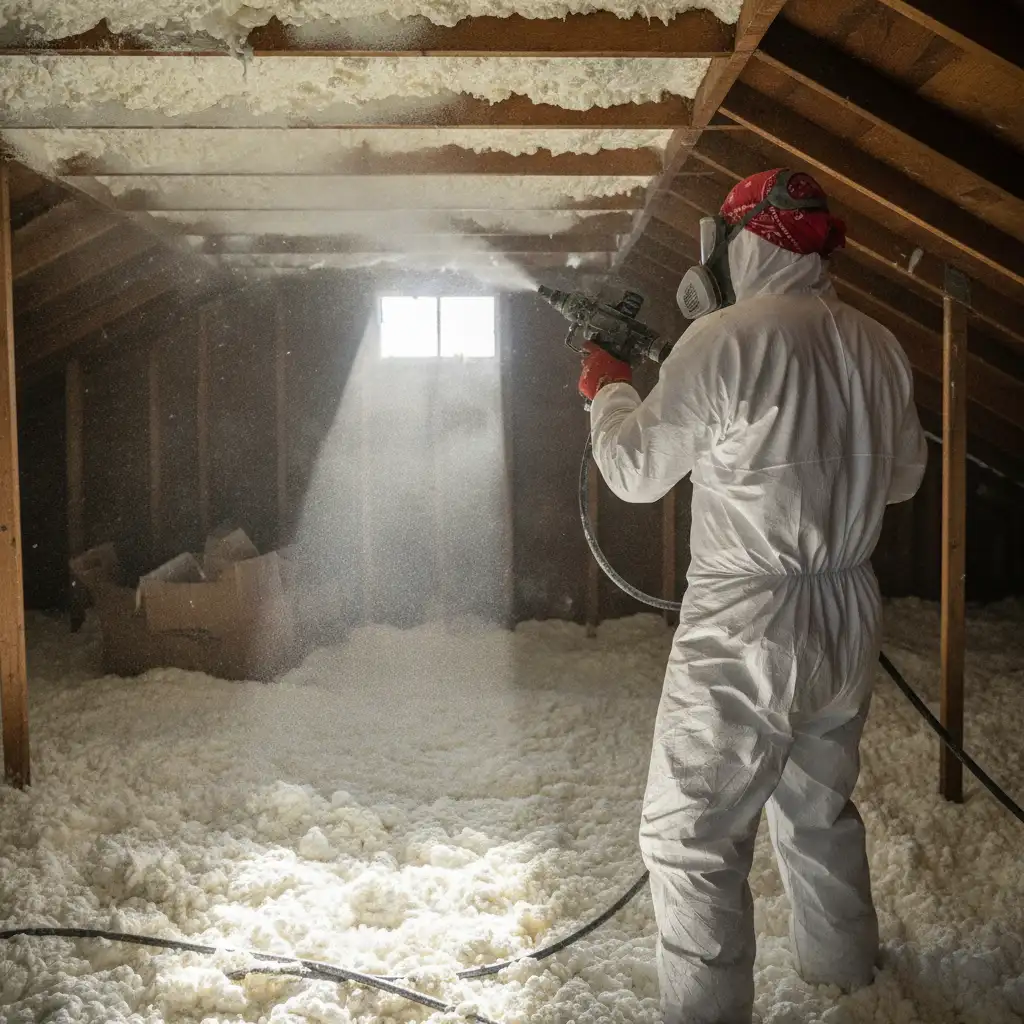
Our team in action — insulation professionals serving El Monte
Insulation Removal Methods and Approaches
Industrial Vacuum Extraction
The most common method for blown-in cellulose and loose-fill fiberglass in El Monte attics. A high-powered vacuum hose is inserted directly into the insulation layer, extracting material into sealed collection bags aboard a service truck. This method is fast, clean, and minimizes disturbance — ideal for occupied homes where residents cannot temporarily relocate.
Manual Batt Removal
Used for fiberglass or mineral wool batts installed between joists in attics, crawl spaces, and accessible wall cavities. Technicians manually extract batts and immediately bag them to prevent fiber release. This approach is standard in El Monte’s postwar ranch-style homes where batt insulation was the original installation method.
Wet Removal for Contaminated Material
When insulation is heavily saturated with rodent urine or mold-colonized, a light misting of a wetting agent is applied before extraction to suppress airborne particles. This is particularly relevant in El Monte crawl spaces adjacent to the Rio Hondo corridor where chronic moisture intrusion is documented.
Hazardous Material Abatement Protocol
If asbestos-containing material (ACM) or vermiculite is confirmed in a pre-1980 El Monte property, removal is conducted only by state-certified asbestos abatement contractors under Cal/OSHA Section 1529 protocols, with air monitoring and regulated disposal at approved Class II landfills.
Crawl Space Encapsulation Preparation Removal
For homes transitioning to a crawl space encapsulation system, all existing crawl space insulation and deteriorated vapor barriers are removed before the new sealed system is installed — a growing standard for El Monte properties with persistent moisture challenges.
Ready for Insulation Removal? Get Your Free Estimate Today.
Next Level Insulation of El Monte serves El Monte and the surrounding area — we’ll be on-site within 24 hours.
📞 Call (626) 469-7656Insulation Removal Cost in El Monte, CA
Understanding insulation removal costs helps El Monte homeowners plan accurately and avoid surprise charges. Pricing in the El Monte market reflects local labor rates, disposal costs at LA County facilities, and the specific conditions common to San Gabriel Valley properties.
Typical Price Ranges
- Attic insulation removal (standard, 1,000–1,500 sq ft): $1,200 – $2,400
- Attic insulation removal (contaminated/rodent, 1,000–1,500 sq ft): $1,800 – $3,500
- Crawl space insulation removal (standard): $800 – $2,000
- Crawl space insulation removal (with vapor barrier replacement): $1,500 – $3,200
- Wall cavity insulation removal: $1,500 – $4,000+ (dependent on access method)
- Asbestos-containing material abatement: $2,500 – $8,000+ (separate specialized quote)
Key Cost Factors
- Square footage: The primary driver; El Monte homes average 1,200–1,800 sq ft of attic space
- Insulation depth: Deeper material means more volume and longer extraction time
- Contamination level: Rodent or mold contamination adds 30–60% to base pricing
- Access difficulty: Low-clearance attics (common in El Monte’s ranch homes) increase labor time
- Disposal fees: LA County disposal rates apply; currently $0.08–$0.15 per lb of material
El Monte Pricing Context
Insulation removal costs in El Monte are generally 5–10% higher than inland Riverside County markets due to LA County disposal regulations and local labor rates, but 10–15% lower than premium West LA markets. Always request an itemized written estimate. Call (626) 469-7656 for a free, no-obligation quote.
El Monte Neighborhoods We Serve
Garvey (Central El Monte)
Characterized by dense postwar tract homes built primarily between 1948 and 1962, the Garvey neighborhood along Garvey Avenue sees high concentrations of original fiberglass batt insulation and vermiculite concerns in pre-1979 structures. Roof rat pressure is notably elevated near the tree-lined residential blocks.
South El Monte (Rio Hondo Corridor)
Properties near the Rio Hondo River experience chronic crawl space moisture issues due to high seasonal groundwater levels. Insulation in these homes frequently shows mold colonization and vapor barrier failure, requiring full removal and crawl space encapsulation replacement.
North El Monte (Peck Road Area)
A mix of 1960s–1980s single-family homes and light industrial conversion properties. Attic insulation in these structures often combines original batt insulation with poorly installed blown-in additions, creating layered removal challenges.
Medina (Eastern El Monte)
Medina’s older bungalow-style homes, many dating to the 1940s, frequently present the most significant insulation challenges — including compressed rock wool, degraded kraft-faced batts, and uninsulated kneewall areas requiring specialized removal techniques.
Insulation Maintenance Tips for El Monte Homeowners
- Inspect your attic annually — Ideally in October after summer heat cycles, check for visible compression, discoloration, or pest evidence in your El Monte home’s attic.
- Maintain attic ventilation — Ensure soffit and ridge vents are unobstructed; adequate airflow reduces the humidity buildup that degrades insulation and prevents the 150°F+ attic temperatures common during El Monte heat events.
- Seal roof penetrations promptly — Gaps around plumbing vents, electrical conduits, and HVAC penetrations are primary entry points for roof rats in El Monte neighborhoods.
- Address roof leaks within 48 hours — Even minor leaks can saturate insulation within one rainfall event; El Monte’s occasional winter atmospheric river storms can deliver 1–2 inches of rain per hour.
- Keep crawl space vents clear — Especially near South El Monte’s Rio Hondo area, proper cross-ventilation reduces groundwater moisture accumulation beneath your home.
- Install door sweeps on attic access hatches — A simple measure that dramatically reduces conditioned air loss and pest access into attic insulation.
- Schedule professional insulation assessments every 10 years — Particularly important for El Monte homes built before 1980 where original materials may be reaching end of life.
Why Choose Next Level Insulation of El Monte
Next Level Insulation of El Monte is a locally based insulation specialist serving homeowners and businesses throughout the San Gabriel Valley. We are not a national franchise dispatching unfamiliar crews — we are your neighbors, and we understand the specific building types, climate conditions, and pest pressures that make insulation removal in El Monte a different job than anywhere else in greater Los Angeles.
Our technicians are trained in California Title 24 energy code compliance and Cal/OSHA safety protocols relevant to hazardous insulation materials common in El Monte’s older housing stock. We use professional-grade HEPA vacuum systems and EPA-registered sanitizers — not residential shop vacs and bleach.
We offer complete insulation services beyond removal, including attic insulation installation, spray foam insulation, blow-in insulation, and crawl space insulation — meaning you work with one trusted local team from removal through final installation. Call (626) 469-7656 to speak with our El Monte team today.
Frequently Asked Questions — Insulation Removal in El Monte, CA
How much does insulation removal cost in El Monte, CA?
In El Monte, standard attic insulation removal typically costs between $1,200 and $2,400 for a 1,000–1,500 sq ft attic. Contaminated attics involving rodent activity or mold can run $1,800–$3,500. Crawl space removal averages $800–$2,000. Costs vary based on square footage, insulation depth, contamination level, and access difficulty. We provide free written estimates — call (626) 469-7656.
How long does insulation removal take in an El Monte home?
For a typical El Monte single-family home with a 1,200–1,600 sq ft attic, the full removal and cleanup process takes 4–8 hours in a single day. More complex projects involving heavily contaminated material, hazmat protocols, or crawl space work may extend to a second day. We schedule most El Monte jobs with same-week or next-week availability.
Is insulation removal in El Monte messy or disruptive?
Our containment system — negative air pressure machines, plastic barriers at the attic hatch, and sealed HVAC vents — is specifically designed to keep your living areas clean throughout the process. Virtually all particle migration is eliminated. Most El Monte homeowners remain in their homes comfortably during the process.
Does my El Monte home have asbestos insulation?
Homes built before 1979 in El Monte may contain asbestos in certain insulation types, particularly vermiculite attic insulation (often gray or silver granular material) or in pipe wrap and duct insulation. If your home was built before 1979, we recommend a professional screening before any insulation is disturbed. We can collect samples for laboratory testing during your free inspection.
Do I need a permit to remove insulation in El Monte?
In most cases, insulation removal alone does not require a City of El Monte building permit. However, if removal is part of a larger permitted project — such as an HVAC replacement, re-roofing, or addition — the permit for that work typically governs the scope. If asbestos-containing material is involved, notification to the South Coast AQMD is required. We handle all regulatory documentation as part of our service.
Can you remove insulation in just part of my attic?
Yes, partial removal is possible if damage is confined to a specific zone — for example, near an area of roof leak damage or a localized rodent nest. However, in El Monte homes where we find widespread compression, moisture saturation, or contamination throughout the attic space, full removal is almost always more cost-effective and results in a better outcome for new insulation performance.
What happens after insulation is removed — can you install new insulation right away?
After removal and sanitization, we inspect and document the cleared space. If no structural repairs are needed, new insulation can typically be installed the same day or the following day. We offer full insulation installation and attic insulation replacement services to bring your El Monte home up to current California Title 24 energy standards — R-38 minimum for attics in Climate Zone 9.
How do I know if my El Monte crawl space insulation needs to be removed?
Key indicators include visible sagging or fallen insulation batts beneath the floor, water staining on vapor barriers, musty odors entering your home from below, or evidence of rodent nesting. El Monte properties near the Rio Hondo corridor are particularly susceptible to crawl space moisture issues. A free crawl space inspection from our team will provide clear answers and documented findings.
Ready to Schedule Insulation Removal in El Monte? Contact Us Today.
Don’t let degraded, contaminated, or pest-damaged insulation compromise your family’s comfort, health, and energy costs. Next Level Insulation of El Monte is ready to provide a free, no-obligation on-site inspection and written estimate for your home or commercial property anywhere in El Monte, CA.
Our team is locally based in the San Gabriel Valley and available for same-week scheduling. We handle everything — from initial assessment and safe removal through full insulation replacement — so you have one point of contact and one trusted local team.
Call us now at (626) 469-7656 to speak directly with an El Monte insulation specialist. We look forward to earning your trust and bringing your home’s insulation to the next level.