
Insulation Materials & Types in El Monte, CA
Energy-Saving Insulation Materials & Types for El Monte, CA Homes — Licensed & Insured
Learn about insulation types, R-values, and costs for El Monte, CA homes. Compare spray foam, blown-in, batts, and more in this expert climate guide.
- Licensed & Insured
- Locally Owned & Operated
- Free Inspection & Estimate
Request Your
Free EstimateChoosing the right insulation material for your El Monte home is one of the most impactful decisions you can make for long-term comfort and energy efficiency. El Monte sits in California’s Inland Valley, where summer temperatures routinely climb above 95°F, attic spaces can exceed 150°F, and significant temperature swings between day and night place constant stress on building envelopes. While the area lacks coastal humidity, dry Santa Ana wind events, seasonal wildfire smoke, and the urban heat island effect all influence how insulation performs year to year.
At the center of every insulation decision is R-value — a standardized measure of thermal resistance. The higher the R-value, the better a material resists heat transfer. In El Monte’s Climate Zone 10, the California Energy Code sets minimum R-value requirements for attics, walls, and floors that are higher than national averages precisely because of the region’s intense cooling demands.
This guide covers every major insulation material available to El Monte homeowners — how each one works, where it performs best, what it costs, and how to match the right product to your specific home and budget.
Understanding Insulation Types for El Monte Homes
Insulation materials fall into several broad categories: spray-applied foams, loose-fill or blown-in products, pre-cut batts and rolls, rigid foam boards, and mineral-based options like mineral wool. Each category uses a different physical mechanism — trapped air, inert gas cells, or dense fibrous matrices — to slow heat movement through walls, ceilings, and floors.
El Monte’s housing stock skews older, with a large proportion of homes built between the 1940s and 1980s. Many of these properties were constructed before modern energy codes existed, meaning attics may have little to no insulation and walls may rely on outdated fiberglass batts that have settled or degraded over time. Retrofitting an existing home presents different challenges than insulating new construction, and the right material choice often changes depending on whether you are working with open wall cavities, finished drywall, accessible attic decking, or a sealed crawl space.
California’s Title 24 Building Energy Efficiency Standards govern new construction and major renovations in El Monte. These codes specify minimum R-values by climate zone and application area. Homes in Climate Zone 10 are required to meet stricter attic insulation thresholds than cooler coastal zones, making material selection and proper installation especially important. Understanding these code requirements — and how each insulation type meets or exceeds them — helps homeowners make informed, code-compliant decisions that also qualify for available utility and state rebate programs.
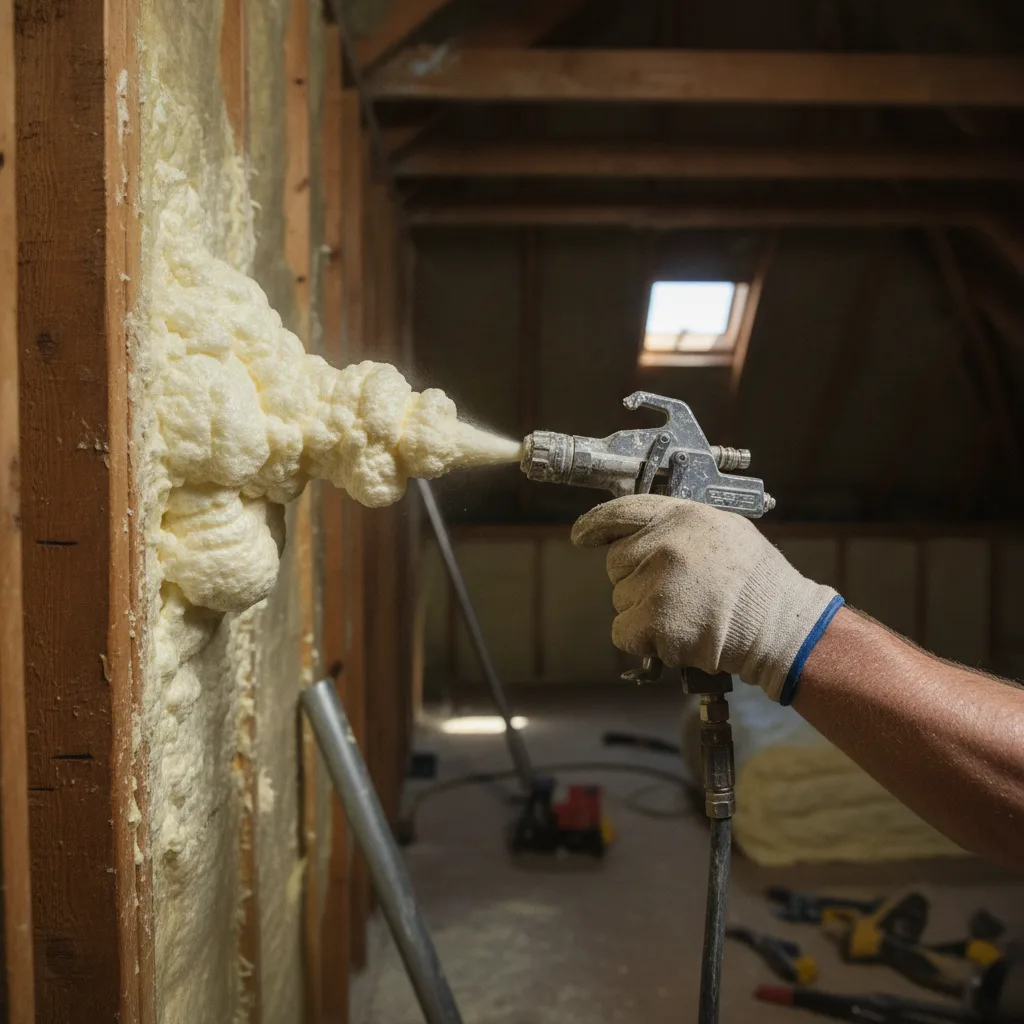
Our team in action — insulation professionals serving El Monte
How El Monte’s Climate Affects Your Insulation Material Choice
El Monte’s location in the San Gabriel Valley creates a climate profile that demands careful insulation planning. Summer afternoon temperatures frequently exceed 95°F, and attic spaces in unshaded homes can reach 140°F to 160°F — placing enormous demand on air conditioning systems and accelerating the degradation of lower-quality insulation products over time. Prioritizing high R-value and air-sealing capability in the attic delivers the greatest return on investment for most El Monte homeowners.
Unlike coastal communities, El Monte does not experience persistent marine layer humidity, but the area is not entirely dry year-round. Winter rain events and morning condensation in crawl spaces mean vapor management still matters, particularly in pier-and-beam homes where moisture from the ground can enter floor cavities.
Wildfire risk is a real consideration throughout Los Angeles County. Homeowners in or near higher-risk zones should prioritize fire-resistant materials like mineral wool or closed-cell spray foam in attics and wall assemblies where exterior embers could potentially enter.
For attic retrofits in existing homes, blown-in cellulose or fiberglass loose-fill is typically the most cost-effective path to reaching R-38 or higher without structural work. For wall retrofits in homes with finished drywall, dense-pack cellulose blown through small access holes is usually the least disruptive option. New construction projects benefit from the flexibility to choose spray foam for air sealing combined with batts or rigid board for bulk thermal resistance — a hybrid approach that meets Title 24 requirements efficiently while minimizing long-term energy costs.
Insulation Materials Available in El Monte, CA
Spray Foam Insulation
Spray polyurethane foam (SPF) is applied as a liquid that expands and cures into a rigid or semi-rigid barrier. It comes in two forms: open-cell (R-3.5 to R-3.8 per inch) and closed-cell (R-6 to R-7 per inch). Closed-cell spray foam doubles as an air and vapor barrier, making it especially effective in El Monte’s hot, dry summers where air sealing dramatically reduces cooling loads. Open-cell foam excels in attic applications where breathability is desired. Both types fill irregular gaps and cavities that batts cannot reach. Best applications include attic roof decks, rim joists, and wall cavities during renovation. Cost ranges from $1.50 to $3.50 per square foot for open-cell and $2.50 to $5.00 for closed-cell installed.
Blown-In (Loose-Fill) Insulation
Loose-fill insulation — typically fiberglass or cellulose — is pneumatically blown into attic floors or existing wall cavities through small holes. R-values range from R-2.2 to R-3.8 per inch depending on material density. For El Monte attics, blown-in products are a cost-effective way to reach the Title 24 recommended R-38 to R-60 range without tearing out existing materials. The material conforms to joists, pipes, and odd-shaped spaces. Fiberglass loose-fill resists moisture and pests, while cellulose offers superior fire resistance from borate treatment. Best suited for attic retrofits, existing wall cavities, and hard-to-reach spaces. Installed cost generally runs $1.00 to $2.50 per square foot depending on depth and material chosen.
Fiberglass Batt Insulation
Fiberglass batts are the most widely recognized insulation product — pre-cut panels of spun glass fibers designed to fit standard stud and joist spacing. R-values range from R-11 to R-38 depending on thickness. In El Monte, fiberglass batts work well in new construction with open wall cavities and attic floors, but they lose effectiveness if improperly fitted or compressed. Gaps, voids, and settling reduce real-world performance significantly. Batts do not air-seal, so they should be paired with a dedicated air barrier in El Monte’s hot climate. They are not ideal for retrofit projects without wall access. Pros include low material cost and easy availability. Installed cost ranges from $0.50 to $1.50 per square foot.
Mineral Wool / Rockwool Insulation
Mineral wool, often sold under the brand name Rockwool, is manufactured from volcanic basalt rock or recycled steel slag spun into dense fibrous batts or boards. R-values range from R-3.0 to R-4.3 per inch. Mineral wool is naturally fire-resistant up to temperatures exceeding 1,400°F — a meaningful advantage in El Monte given Southern California’s wildfire exposure risk and year-round fire season conditions. It also provides excellent soundproofing and resists moisture without losing structural integrity. Best applications include exterior walls, attics, and areas near fireplaces or mechanical equipment. Mineral wool batts are denser and more rigid than fiberglass, reducing the risk of settling. Installed cost typically runs $1.40 to $2.50 per square foot.
Cellulose Insulation
Cellulose is produced from recycled paper products treated with borate-based fire and pest retardants, giving it one of the highest recycled-content percentages of any insulation material. R-values range from R-3.2 to R-3.8 per inch. Blown dense-pack cellulose is particularly effective for retrofitting existing wall cavities in El Monte’s older housing stock without requiring full demolition. It fills voids thoroughly, reducing air infiltration better than fiberglass batts. The borate treatment also deters pests — relevant in Southern California’s warm, pest-active environment. Cellulose performs well in attics and walls but can absorb moisture in prolonged wet conditions, so vapor management is important. Installed cost ranges from $0.80 to $2.00 per square foot.
Foam Board (Rigid) Insulation
Rigid foam panels — including expanded polystyrene (EPS), extruded polystyrene (XPS), and polyisocyanurate (polyiso) — provide high R-values in thin profiles. R-values range from R-3.8 per inch (EPS) to R-6.5 per inch (polyiso). In El Monte, rigid foam board is frequently used on exterior walls as a continuous insulation layer to eliminate thermal bridging through wood studs, on garage walls, beneath slab foundations in new construction, and on the interior or exterior of existing walls during renovation. Polyiso performs well in the high-temperature conditions typical of El Monte attics. Rigid foam does not air-seal on its own — seams must be taped or foamed. Installed cost ranges from $1.00 to $3.00 per square foot depending on thickness and board type.
Ready for Insulation Materials & Types? Get Your Free Estimate Today.
Next Level Insulation of El Monte serves El Monte and the surrounding area — we’ll be on-site within 24 hours.
📞 Call (626) 469-7656Why El Monte Homeowners Trust Next Level Insulation of El Monte for Insulation
Homeowners throughout El Monte and the greater San Gabriel Valley rely on Next Level Insulation of El Monte for one straightforward reason: we know insulation, and we know this climate. Here is what sets our work apart:
Insulation Materials FAQ for El Monte Homeowners
What is the best insulation type for El Monte’s climate?
There is no single best material — the right choice depends on location in the home and project type. For attics, blown-in cellulose or fiberglass loose-fill offers excellent performance and value. For air sealing combined with insulation, closed-cell spray foam leads the category. For existing walls in older El Monte homes, dense-pack cellulose minimizes disruption. Mineral wool is a strong choice wherever fire resistance is a priority.
What R-value does my El Monte home need?
El Monte falls within California Climate Zone 10. California’s Title 24 energy code recommends a minimum of R-38 for attic insulation in existing homes and R-49 for new construction. Wall assemblies typically require R-13 to R-21 depending on framing type. Crawl spaces and floors over unconditioned spaces should target R-19 to R-25. These are minimums — going higher in the attic often delivers meaningful additional savings given El Monte’s heat levels.
How do insulation material costs compare in El Monte?
Fiberglass batts are generally the least expensive option at $0.50 to $1.50 per square foot installed. Blown-in cellulose and fiberglass loose-fill run $0.80 to $2.50 per square foot. Rigid foam board falls in the $1.00 to $3.00 range. Mineral wool batts typically cost $1.40 to $2.50. Spray foam is the most expensive option at $1.50 to $5.00 per square foot depending on open-cell versus closed-cell, but it provides the most comprehensive air sealing alongside insulation value.
Is attic insulation more important than wall insulation in El Monte?
For most El Monte homes, the attic offers the highest return on insulation investment. Heat gain through an under-insulated attic accounts for a substantial portion of summer cooling costs. However, wall insulation — especially in older homes with little or no existing material — is also important for year-round comfort. Ideally, both are addressed, but if budget requires prioritizing, start with the attic and air sealing, then address walls.
How much can better insulation save on energy bills in El Monte?
Results vary by home size, existing insulation levels, and HVAC efficiency, but upgrading attic insulation from minimal levels to R-49 in an El Monte home can reduce heating and cooling costs by 15 to 25 percent annually according to the U.S. Department of Energy. Homes with significant air leakage that is addressed at the same time as insulation may see savings at the higher end of that range or beyond.
Are there rebates or tax credits available for insulation in California?
Yes. Southern California Edison and SoCalGas both offer rebates for qualifying insulation upgrades in existing homes. The federal Inflation Reduction Act provides a tax credit of up to 30 percent of insulation material costs — up to $1,200 per year — for homeowners who make qualifying energy efficiency improvements. California’s TECH Clean California initiative may also offer additional incentives depending on project scope. Eligibility and amounts change periodically, so it is best to confirm current programs before beginning a project.
Can I add insulation to existing walls without removing drywall?
Yes. Dense-pack cellulose and blown-in fiberglass can both be installed into existing closed wall cavities by drilling small access holes from either the exterior (through siding) or the interior (through drywall), injecting material under controlled pressure, and patching the holes. This retrofit method is common in El Monte’s older housing stock and restores wall cavities to full density without requiring a complete renovation.
Does spray foam insulation work well in El Monte’s hot attics?
Closed-cell spray foam applied to the underside of roof decking creates a conditioned or semi-conditioned attic space that dramatically reduces the temperature differential experienced by HVAC equipment and ductwork located in the attic. This approach can meaningfully improve system efficiency in El Monte’s extreme summer conditions. It is a higher upfront investment but often delivers long-term energy savings that offset the cost, particularly in homes with ductwork in the attic.
Get a Free Insulation Assessment in El Monte
Not sure which insulation material is right for your home? Next Level Insulation of El Monte offers a free, no-obligation insulation assessment for El Monte homeowners. Our licensed and insured team will evaluate your attic, walls, and crawl space, identify where energy is being lost, and walk you through material options that fit your home’s construction type and your budget.
We understand El Monte’s climate, local building codes, and the utility rebate programs available to San Gabriel Valley homeowners — so you get recommendations that are practical, code-compliant, and cost-effective.
Call us today at (626) 469-7656 to schedule your free assessment. Better comfort and lower energy bills start with the right insulation choice, and we are here to help you make it.