

Attic Insulation in Chula Vista, CA
Energy-Saving Attic Insulation for Chula Vista, CA Homes — Licensed & Insured
Get expert attic insulation in Chula Vista, CA. Next Level Insulation serves all South Bay neighborhoods. Call (619) 789-4273 for a free assessment today.
- Licensed & Insured
- Locally Owned & Operated
- Free Inspection & Estimate
Request Your
Free EstimateAttic insulation is a thermal and air barrier system installed within your home’s uppermost cavity, preventing conditioned air from escaping and outdoor heat from infiltrating your living spaces. In Chula Vista, CA — where marine layer mornings give way to intense afternoon sun and temperatures regularly push past 90°F in inland neighborhoods like Eastlake Greens and Otay Ranch — a properly insulated attic is not a luxury. It is a necessity.
Next Level Insulation of Chula Vista specializes in professional attic insulation services tailored to the unique climate, building stock, and construction styles found throughout the South Bay region. From older stucco homes near National City to newer tract developments in Eastlake, our crews understand the specific thermal challenges Chula Vista homeowners face. Whether you need a complete insulation installation, a blow-in upgrade, or a full removal and replacement, we deliver energy-efficient results that lower utility bills and improve indoor comfort year-round.
Call us today at (619) 789-4273 to schedule your free attic assessment.
Understanding Attic Insulation
Attic insulation works by reducing the rate of heat transfer between your attic space and your conditioned living areas below. Heat naturally moves from warm areas to cooler ones — in summer, that means radiant heat from your roof deck pours downward into your home. In winter, your expensive heated air rises and escapes through an under-insulated attic ceiling. The insulation layer — measured in R-value, a rating of thermal resistance — slows this process dramatically.
Historically, California homes built before the 1970s were constructed with little to no formal attic insulation, as energy costs were low and building codes were minimal. Chula Vista experienced significant housing growth in two distinct eras: a post-World War II boom that filled neighborhoods like Hilltop and Castle Park with single-story ranch homes, and a major suburban expansion from the 1980s through the early 2000s that created large planned communities in the eastern portions of the city. Homes from each era have different insulation profiles and challenges.
The older western Chula Vista neighborhoods typically feature homes with shallow attic cavities, original fiberglass batt insulation that has compressed and degraded over 40 to 60 years, and older duct systems that leak conditioned air directly into unconditioned attic space. The newer eastern developments, while built to more modern standards, often have only R-19 to R-30 insulation when California’s Title 24 energy code and the Department of Energy now recommend R-38 to R-60 for Climate Zone 7, which covers most of Chula Vista.
Modern attic insulation materials include blown fiberglass, blown cellulose, spray foam, and mineral wool. Each has unique properties that make it suitable for specific attic configurations, budgets, and performance goals. In Chula Vista’s mixed-humid coastal and semi-arid inland climate, moisture management and thermal mass both play important roles in selecting the right system. Understanding the interaction between your roof type, attic ventilation, and insulation material is essential to achieving lasting results.
Learn more about our spray foam insulation services
Why Attic Insulation Is Needed in Chula Vista, CA
The Coastal and Inland Temperature Divide
Homes in western Chula Vista zip codes like 91910 near Third Avenue and J Street sit close enough to San Diego Bay to benefit from marine influence, keeping summer highs in the mid-70s to low 80s°F. However, neighborhoods in eastern zip codes like 91915 (Eastlake Greens, Vistas) and 91914 (Rolling Hills Ranch) regularly record temperatures 10 to 15°F hotter, frequently reaching 95°F to 105°F during Santa Ana wind events. Without adequate attic insulation — ideally R-49 or higher for these inland exposures — the temperature in an uninsulated attic can reach 140°F to 160°F on a hot July afternoon, radiating heat directly down through your ceiling drywall.
Santa Ana Wind Events and Extreme Heat Spikes
The October 2007 Harris Fire, which burned through parts of Otay and eastern San Diego County, and similar events like the September 2020 Valley Fire underscored how rapidly eastern Chula Vista can shift from mild temperatures to extreme heat under Santa Ana conditions. During these events, daytime temperatures can jump 20°F to 30°F in hours. Homes with inadequate attic insulation experience dramatic indoor temperature spikes during these periods, overtaxing HVAC systems and creating uncomfortable, even dangerous, indoor conditions.
Marine Layer Moisture and Insulation Degradation
Western Chula Vista’s marine layer brings another challenge: moisture. The coastal fog that blankets neighborhoods near Hilltop Drive and Bonita Road from May through July — locally known as “May Gray” and “June Gloom” — introduces humidity into attic spaces that can cause traditional fiberglass batts to absorb moisture and lose 40% or more of their R-value. Wet insulation is also a breeding ground for mold, a significant concern in older homes built in the 1950s and 1960s near the Sweetwater River corridor.
Energy Costs and Title 24 Compliance
San Diego Gas & Electric serves Chula Vista customers with some of the highest electricity rates in the nation — averaging over $0.40 per kWh under tiered pricing in 2024. A home with degraded or insufficient attic insulation can spend $150 to $350 more per month on cooling and heating than a properly insulated equivalent home. California’s Title 24 Building Energy Efficiency Standards require new construction in Climate Zone 7 to achieve a minimum of R-38 in attic assemblies, but countless existing homes fall far short of this benchmark.
Aging Housing Stock in Western Chula Vista
Neighborhoods like Hilltop, Castle Park, and the streets surrounding Chula Vista Elementary School District’s older campuses contain homes built between 1945 and 1975. Many of these properties have never had their original insulation replaced or augmented. After 50+ years, fiberglass batts settle and compress, cellulose (used in some 1970s retrofits) can shift and thin, and the result is effective R-values well below R-11 — a fraction of current recommendations.
Learn about our insulation removal and replacement services
Signs You Need Attic Insulation in Chula Vista
Temperature and Comfort Symptoms
- Rooms on the top floor of your home are significantly hotter than lower floors during summer months
- Your HVAC system runs continuously during afternoon heat without achieving the thermostat setpoint
- Indoor temperatures spike rapidly when Santa Ana winds bring hot, dry air to the eastern neighborhoods
- Cold drafts near ceiling light fixtures or recessed can lights during winter months
Energy Bill Red Flags
- SDG&E bills increasing year over year without corresponding rate changes or lifestyle shifts
- Cooling costs exceeding $250 per month during July and August in a standard three-bedroom home
- Your home fails to qualify for SDG&E energy rebates due to sub-standard insulation R-values
Physical Evidence in the Attic
- Insulation depth below 10 inches (indicating R-values under R-30)
- Visible gaps, settled areas, or compressed batts throughout the attic floor
- Dark staining or discoloration on insulation indicating moisture intrusion or air bypasses
- Pest activity — rats and mice are common in Chula Vista attics and destroy insulation while nesting
- Insulation that crumbles, flakes, or has a yellowish-gray color suggesting age-related degradation
Urgency Indicators
- Any visible mold or musty odor when accessing your attic space
- Evidence of rodent infestation requiring full insulation removal and sanitation
Our Attic Insulation Process in Chula Vista
Next Level Insulation of Chula Vista follows a structured, transparent process designed specifically for the residential building types and climate conditions found throughout the South Bay region.
Free On-Site Attic Assessment (1–2 Hours)
Our technician accesses your attic, measures existing insulation depth at multiple points, records current R-values, inspects for moisture, pest damage, mold, and air leakage pathways. We also evaluate your attic ventilation ratio, which is particularly important in Chula Vista’s sunny climate where inadequate ventilation compounds heat buildup.
Detailed Written Estimate and Material Recommendation (Same Day)
Based on your attic’s dimensions, existing conditions, and your performance goals, we provide a line-item estimate with material options. We explain the difference between blown cellulose, blown fiberglass, and spray foam, and make a specific recommendation aligned with your home’s construction type and neighborhood climate zone.
Pre-Installation Preparation (1–2 Hours on Installation Day)
Before any insulation is installed, we seal air bypasses — gaps around recessed lights, plumbing penetrations, top plates, and attic hatch perimeters — using spray foam or fire-rated caulk. This air sealing step can reduce energy loss by 15% to 30% independently of insulation and is critical in the older homes common to western Chula Vista neighborhoods.
Insulation Removal (If Required) (2–4 Hours)
When existing insulation is contaminated by rodents, mold, or excessive moisture — common in Chula Vista homes near the Sweetwater River basin — we perform complete removal using commercial HEPA-filtered vacuum equipment. The attic is then sanitized before new material is installed.
Insulation Installation (2–6 Hours Depending on Scope)
Our crews install new insulation to the specified depth and R-value, ensuring even coverage across the entire attic floor including eave areas. For blown products, we install baffles at each rafter bay to maintain ventilation channels — a step often skipped by less thorough contractors but essential for moisture management in Chula Vista’s coastal zones.
Post-Installation Verification and Documentation (30–45 Minutes)
We measure installed depth at multiple marked test locations, photograph the completed work, and provide you with documentation of the achieved R-value — useful for SDG&E rebate applications and future home sales.
Final Walkthrough and SDG&E Rebate Assistance (30 Minutes)
We walk you through the completed project, explain maintenance considerations, and assist you in identifying applicable SDG&E energy efficiency rebates, which can offset $200 to $400 or more of your project cost depending on scope.
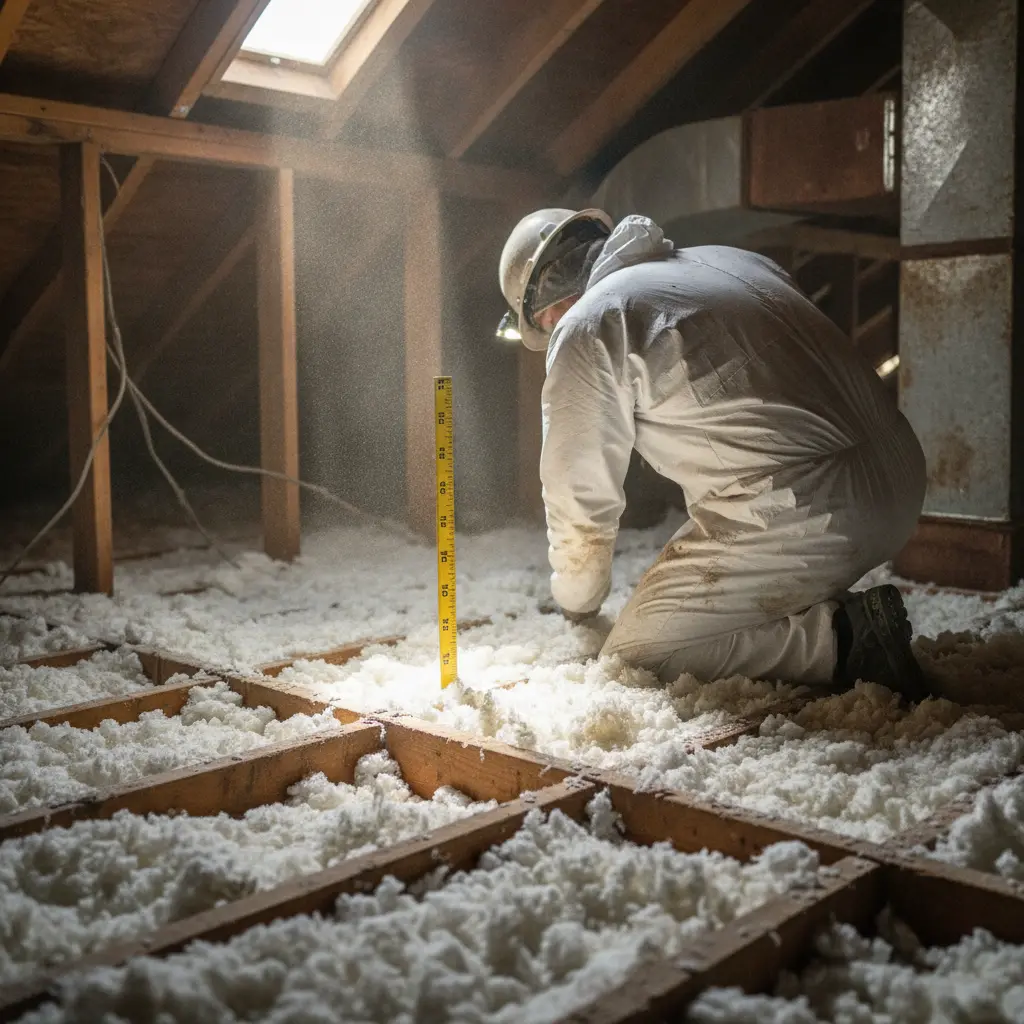
Our team in action — insulation professionals serving Chula Vista
Attic Insulation Methods We Use in Chula Vista
Blown-In Fiberglass Insulation
Blown fiberglass is our most commonly recommended solution for Chula Vista attics that are structurally sound and free of moisture issues. It achieves R-2.2 to R-2.9 per inch, installs quickly, and does not settle significantly over time. It is ideal for the large, open attic spaces common in Eastlake Greens and Rolling Hills Ranch tract homes built in the 1990s and 2000s.
Blown-In Cellulose Insulation
Cellulose offers a higher R-value per inch (R-3.2 to R-3.8) and excellent air resistance, making it well suited for tighter attic spaces in older western Chula Vista homes. Manufactured from recycled paper with borate fire retardants, it is also an environmentally preferred option. Cellulose’s density helps resist air movement — a particular advantage in homes exposed to strong Santa Ana wind pressure differentials.
Spray Foam Insulation
Closed-cell spray foam (R-6 to R-7 per inch) is used for unvented attic assemblies, roof deck applications, and areas where moisture control is the primary concern. It is particularly effective in Chula Vista homes near the bayfront and Sweetwater Marsh where elevated humidity levels threaten traditional insulation materials. Open-cell spray foam provides excellent air sealing at lower cost and is used for interior applications and attic hatch sealing.
Fiberglass Batt Insulation
Pre-cut fiberglass batts are used for attic knee walls, skylight shafts, and areas between rafters in vaulted ceiling applications — situations common in the custom homes found in the Bonita and Rancho del Rey areas of Chula Vista. Batts are also used for attic access hatch covers.
Hybrid Systems
Many Chula Vista attic projects benefit from a hybrid approach: a spray foam air sealing layer at the attic floor plane combined with a deep blown-in topping layer. This combination achieves maximum thermal performance while managing moisture risk from coastal humidity.
Learn more about our blow-in insulation services
Ready for Attic Insulation? Get Your Free Estimate Today.
Next Level Insulation of Chula Vista serves Chula Vista and the surrounding area — we’ll be on-site within 24 hours.
📞 Call (619) 789-4273Attic Insulation Cost in Chula Vista, CA
Understanding attic insulation costs helps Chula Vista homeowners make informed decisions and budget appropriately for their projects.
Typical Price Ranges
- Blown-In Fiberglass or Cellulose (Air Seal + Install): $1,500 to $3,500 for a typical 1,200 to 1,800 sq ft attic footprint
- Spray Foam Attic Application: $3,500 to $8,000+ depending on scope and foam type
- Full Insulation Removal + Reinstallation: $2,500 to $5,500 including disposal of contaminated material
- Rodent Remediation + Full Replacement: $3,000 to $7,000 depending on infestation severity and attic size
Key Cost Factors in Chula Vista
Attic Accessibility: Older western Chula Vista ranch homes often have low-pitch roofs with limited attic clearance, increasing labor time. Existing Conditions: Contaminated insulation requiring removal and sanitation significantly adds to project cost. Target R-Value: Upgrading from R-11 to R-49 requires more material than a smaller top-up. Attic Square Footage: Larger eastern Chula Vista homes with 2,000+ sq ft attic footprints cost more than smaller older homes near the 91910 zip code corridor.
SDG&E Rebates and Incentives
SDG&E’s Energy Upgrade California program and the federal Inflation Reduction Act 25C tax credit (up to 30% of project cost, capped at $1,200 for insulation) can meaningfully reduce your net cost. Chula Vista homeowners may also qualify for TECH Clean California incentives. We provide documentation to support all applicable rebate applications.
Return on Investment
Most Chula Vista homeowners recover their attic insulation investment through energy savings within 3 to 7 years, with homes in hotter inland zip codes like 91914 and 91915 seeing the fastest payback periods.
Attic Insulation Services Across Chula Vista Neighborhoods
Eastlake Greens and Eastlake Vistas (91915)
Built primarily between 1990 and 2005, Eastlake’s two-story stucco homes often have R-19 to R-30 original insulation that falls short of current recommendations. Eastern exposure and distance from the coast mean attic temperatures here reach some of the highest in Chula Vista. Upgrades to R-49 blown fiberglass are our standard recommendation for this area.
Hilltop and Castle Park (91911)
This older western Chula Vista neighborhood features post-war ranch homes built between 1945 and 1965. Many have original compressed fiberglass batts at or below R-11, inadequate attic ventilation, and aluminum single-pane window adjacencies that compound thermal transfer. Full removal and replacement with blown cellulose is frequently the right solution here.
Bonita and Rancho del Rey (91902 / 91910)
These established communities contain a mix of custom homes from the 1970s through 1990s. Bonita properties often feature complex rooflines, vaulted ceilings, and larger attic square footages. Hybrid spray foam and blown insulation systems work well for these varied attic geometries.
Rolling Hills Ranch (91914)
One of Chula Vista’s newest planned communities, Rolling Hills Ranch homes were built in the early 2000s with code-minimum insulation that now benefits from upgrades. Hot eastern exposure and proximity to the Otay Lakes corridor make thermal performance a priority here.
View all neighborhoods and cities we serve in the South Bay
Attic Insulation Maintenance Tips for Chula Vista Homeowners
- Inspect Annually After Wildfire Season: Smoke infiltration during events like October Santa Ana wind episodes can introduce particulates into attic spaces. Check for unusual odors or discoloration each fall.
- Monitor for Rodent Activity: Roof rats are common throughout Chula Vista and can destroy insulation in months. Check your attic for droppings, nesting material, or gnaw marks at least twice per year.
- Check Attic Ventilation Quarterly: Ensure soffit vents remain unobstructed. Compressed or shifted insulation blocking soffit baffles leads to moisture buildup in Chula Vista’s coastal marine layer months (May through July).
- Seal Your Attic Hatch Annually: Inspect the weatherstripping and insulation cover on your attic access hatch — a common source of conditioned air loss.
- Review SDG&E Bills Seasonally: A sudden unexplained increase in summer cooling costs often signals insulation degradation or a new air leak pathway.
- Keep Gutters and Roof in Good Repair: Roof leaks introduce moisture that rapidly degrades attic insulation. After winter storm events, inspect your attic for water staining on sheathing.
- Do Not Store Items Directly on Insulation: Compressing blown insulation with stored boxes reduces its R-value. Use attic flooring panels if storage is needed.
Why Choose Next Level Insulation of Chula Vista
Next Level Insulation of Chula Vista is a locally based insulation contractor serving the entire South Bay region, with deep knowledge of the specific building types, climate conditions, and energy programs that affect Chula Vista homeowners. We do not operate as a regional franchise with rotating crews — we are a dedicated local team that understands the difference between insulating a 1950s Castle Park ranch home and a 2003 Eastlake Greens two-story.
Our technicians are trained in current California Title 24 standards and familiar with SDG&E’s rebate documentation requirements, ensuring you capture every dollar of available incentive. We serve all of Chula Vista’s neighborhoods — from the bayfront corridor near J Street Marina to the far eastern reaches of Rolling Hills Ranch — as well as surrounding communities including National City, Bonita, Spring Valley, La Mesa, Lemon Grove, Imperial Beach, and San Diego proper.
We provide free, no-obligation attic assessments with a written report of your existing conditions and a clear, itemized estimate. Our work is performed with HEPA-filtered equipment, appropriate personal protective equipment, and strict attention to California disposal regulations for contaminated insulation materials.
Contact us at (619) 789-4273 to schedule your free assessment.
Ask about our crawl space insulation and encapsulation services
Frequently Asked Questions — Attic Insulation in Chula Vista, CA
How much does attic insulation cost in Chula Vista, CA?
Most Chula Vista attic insulation projects range from $1,500 to $5,500 depending on attic square footage, the type of insulation selected, whether removal of existing material is required, and your target R-value. Larger homes in eastern Chula Vista neighborhoods like Eastlake or Rolling Hills Ranch with 1,800 to 2,500 sq ft attic footprints typically fall in the $2,500 to $4,500 range for a complete blown-in upgrade with air sealing. Contact us at (619) 789-4273 for a free, no-obligation quote.
What R-value do I need for my Chula Vista attic?
Chula Vista falls primarily within California Climate Zone 7. The Department of Energy recommends R-49 to R-60 for attics in this zone, and California’s Title 24 code requires a minimum of R-38 for new construction. Most existing Chula Vista homes have R-11 to R-30, making upgrades both necessary and cost-effective given SDG&E’s electricity rates.
How long does attic insulation installation take in Chula Vista?
A standard blown-in insulation installation for a 1,200 to 1,800 sq ft attic in Chula Vista takes approximately 4 to 8 hours on a single day, including air sealing and post-installation verification. Projects requiring full removal and reinstallation may span two days. We work to minimize disruption to your household and complete most residential projects in a single visit.
Is attic insulation installation messy or disruptive to my home?
When performed by trained professionals, attic insulation work is minimally disruptive. Our crews use protective drop cloths at attic access points, HEPA-filtered blowing equipment that minimizes dust, and we thoroughly clean any work areas before completing each job. Homeowners do not need to vacate the property for standard installations.
Does Chula Vista get cold enough in winter to need attic insulation for heating?
Yes. While Chula Vista winters are mild compared to inland California, evening temperatures in January and February regularly drop into the low 40s°F, and eastern neighborhoods like Rolling Hills Ranch can see temperatures in the upper 30s°F on clear nights. Without adequate attic insulation, heated air escapes rapidly through the ceiling plane, increasing heating costs and reducing comfort. Proper insulation pays dividends in both summer cooling and winter heating efficiency.
Do I qualify for SDG&E rebates for attic insulation in Chula Vista?
Chula Vista homeowners served by SDG&E may qualify for Energy Upgrade California rebates when upgrading to qualifying R-values. Additionally, the federal Inflation Reduction Act 25C tax credit provides 30% back on insulation project costs, up to $1,200 per year. We provide all documentation needed to support your rebate claims at no additional charge.
How do I know if my existing attic insulation in Chula Vista is still effective?
We recommend a free professional assessment. Warning signs include an attic insulation depth below 10 inches, visible settling or gaps, any evidence of moisture, rodent activity, or mold, and unexplained increases in your SDG&E bills. Many Chula Vista homes — especially those built before 1985 in the western zip codes of 91910 and 91911 — have insulation that is well past its effective service life.
Can you install attic insulation in a home with very low roof pitch, like the ranch homes in western Chula Vista?
Yes. Our crews are experienced with the low-pitch, limited-clearance attics common in the post-war ranch homes of Hilltop, Castle Park, and similar western Chula Vista neighborhoods. We use appropriately sized equipment and trained personnel to safely work in confined attic spaces and ensure complete, even coverage even where ceiling heights are limited to 18 to 24 inches.
Get Your Free Attic Insulation Assessment in Chula Vista Today
Whether you live in a 1950s ranch home in Castle Park, a 1990s two-story in Eastlake Greens, or a newer property in Rolling Hills Ranch, Next Level Insulation of Chula Vista is ready to help you achieve a more comfortable, energy-efficient home. Stop overpaying on SDG&E bills and stop suffering through hot summer afternoons with an inadequately insulated attic.
Call us now at (619) 789-4273 to schedule your free, no-obligation attic assessment. Our Chula Vista team will evaluate your existing insulation, explain your options in plain language, and provide a transparent written estimate — all at no cost to you.
We serve all of Chula Vista and the surrounding South Bay communities including Bonita, National City, Imperial Beach, Spring Valley, La Mesa, Lemon Grove, La Presa, and San Diego. Same-week appointments are typically available.
Schedule your free attic insulation consultation online