

Garage Insulation in Santa Clarita, CA
Energy-Saving Garage Insulation for Santa Clarita, CA Homes — Licensed & Insured
Need garage insulation in Santa Clarita, CA? Next Level Insulation offers expert installation, spray foam & blown-in options. Call (661) 582-0187 for a free assessment.
- Licensed & Insured
- Locally Owned & Operated
- Free Inspection & Estimate
Request Your
Free EstimateGarage insulation is the process of installing thermal and air barrier materials throughout your garage’s walls, ceiling, and door systems to control temperature, reduce energy loss, and improve overall comfort. In Santa Clarita, CA, where summer temperatures routinely exceed 100°F in neighborhoods like Canyon Country and Newhall, and where the Santa Ana wind events can drive dramatic temperature swings overnight, an uninsulated garage becomes one of the biggest sources of energy waste in your home.
At Next Level Insulation of Santa Clarita, we specialize in garage insulation solutions tailored to the specific construction styles, climate conditions, and building codes found throughout the Santa Clarita Valley. Whether your garage is attached to a 1980s tract home in Stevenson Ranch or a newer custom build in Porter Ranch, our team assesses your space, recommends the right insulation type, and installs it efficiently so you see real results on your utility bills. Call us today at (661) 582-0187 to get started.
Understanding Garage Insulation in Santa Clarita, CA
Garage insulation encompasses several building science concepts that work together: thermal resistance (measured in R-value), air sealing, vapor management, and radiant heat control. When all of these factors are addressed, your garage becomes a conditioned or semi-conditioned buffer zone that stops extreme outdoor temperatures from migrating into your home’s living spaces.
Historically, garages in the Santa Clarita area were built as purely utilitarian spaces. During the major housing expansions of the 1970s through the early 2000s — when master-planned communities like Valencia and Stevenson Ranch were developed — builders focused on bedroom and living area insulation while garages were left as unconditioned shells. This was an accepted practice at the time because energy costs were lower and building codes did not yet require garage thermal envelopes. California’s Title 24 energy code has evolved significantly, but millions of existing garages throughout Santa Clarita and the broader Los Angeles County region still lack adequate insulation.
A properly insulated garage addresses three primary heat transfer mechanisms. Conduction moves heat through solid materials like drywall and framing; insulation batts and blown-in products interrupt this pathway. Convection carries heat through air movement; spray foam and air sealing products close the gaps that allow this. Radiation from the sun heats surfaces like metal garage doors and concrete slabs; radiant barriers and reflective insulation address this third pathway.
Santa Clarita’s building stock is diverse. You’ll find single-story ranch homes built in the 1960s in Newhall with two-car garages that have never been touched by an insulation contractor. You’ll also find three-car garages attached to large two-story homes built in Canyon Country during the 2000s boom. Multi-family units in the Saugus area often feature shared garages with unique air-sealing challenges. Each building type requires a customized insulation strategy, which is why a professional assessment is always the right first step before any materials are ordered or installed.
Understanding R-value is essential for Santa Clarita homeowners. The California Energy Commission recommends a minimum of R-13 in garage walls and R-30 or higher in garage ceilings that are adjacent to living space. Given our local climate zone — California Climate Zone 9, which covers most of the Santa Clarita Valley — exceeding minimum R-values typically delivers a strong return on investment through reduced HVAC load. Learn more about our attic insulation services to see how a whole-home approach maximizes your energy savings.
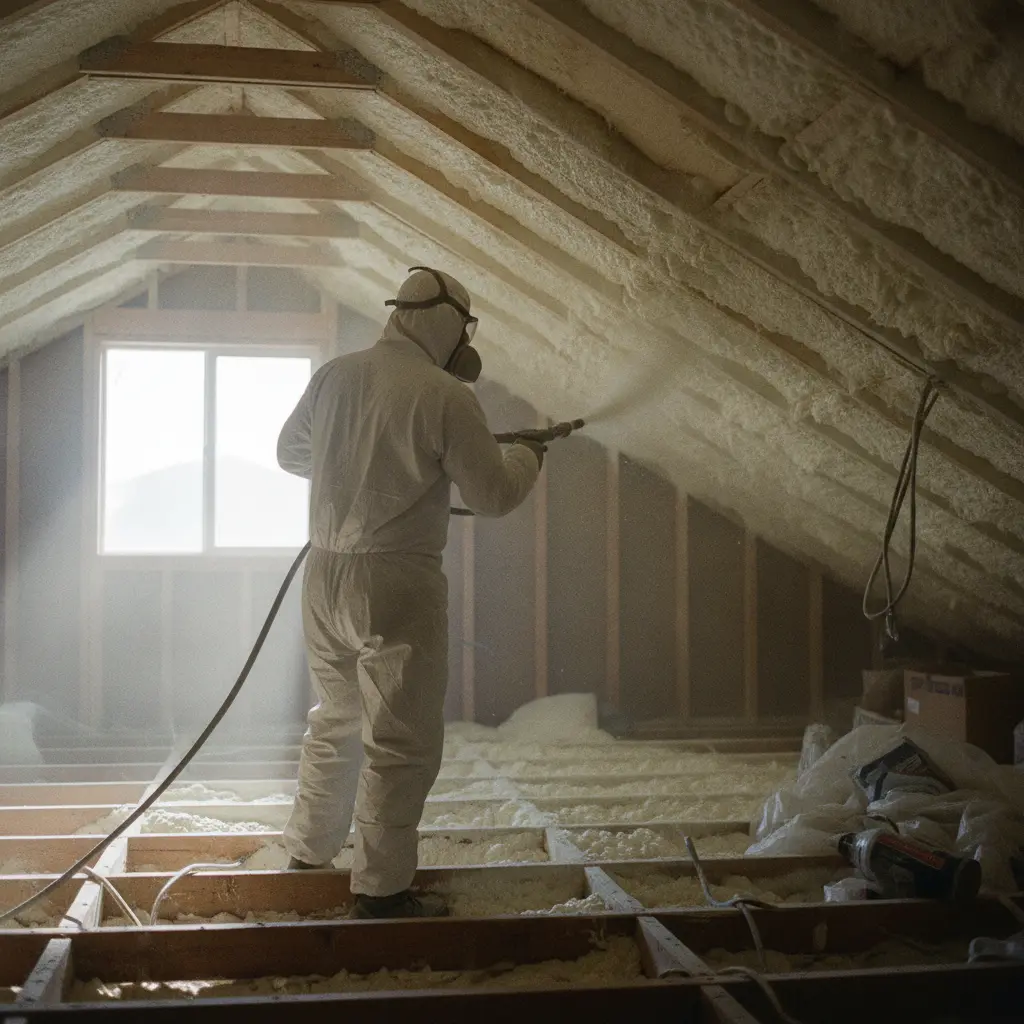
Our team in action — insulation professionals serving Santa Clarita
Why Garage Insulation Is Needed in Santa Clarita, CA
Extreme Heat Cycles
Santa Clarita regularly records summer temperatures between 95°F and 108°F from June through September. During the record-breaking heat event of September 2022, the National Weather Service recorded temperatures of 109°F in Santa Clarita — one of the highest readings in the city’s recorded history. An uninsulated garage exposed to full afternoon sun on a day like that can reach interior temperatures exceeding 140°F. When this garage shares a wall with a kitchen, bedroom, or living room, that radiant heat load adds enormous strain to your air conditioning system and can raise interior home temperatures by 8°F to 12°F in the adjacent rooms.
Santa Ana Wind Events
The Santa Ana winds that funnel through the Newhall Pass and sweep across the Santa Clarita Valley are a defining climate feature. These offshore wind events — which occur most frequently from October through March and can sustain speeds of 35 to 65 mph in canyon communities like Sand Canyon Road and Soledad Canyon — drive rapid temperature fluctuations. In November 2019, the Tick Fire burned through Canyon Country, an event that highlighted how wind-driven weather extremes affect the entire community. During Santa Ana events, gaps in garage construction allow large volumes of hot, dry air to infiltrate the home, spiking energy use and reducing indoor air quality. Proper air sealing and insulation in your garage directly combats this infiltration.
Cold Winter Nights
While Santa Clarita’s summers dominate energy cost conversations, winter nights are colder than most residents expect. The city sits at elevations ranging from approximately 1,000 feet near Newhall to over 1,600 feet in parts of Canyon Country, and nighttime temperatures from December through February regularly drop into the mid-30s°F. Castaic, located at the northern end of the Santa Clarita Valley, has recorded freezing temperatures that damage unprotected plumbing located in garage walls. Insulating your garage walls and ceiling protects pipes, keeps stored items from freezing, and reduces heating costs in attached living spaces.
Utility Costs and SCE Rate Increases
Southern California Edison, which serves most of Santa Clarita’s residential customers, has implemented rate increases that make energy efficiency improvements more financially attractive than ever. SCE’s tiered pricing structure means that high-consumption summer months — precisely when an uninsulated garage is most damaging — are billed at the highest per-kilowatt-hour rates. Homeowners in Canyon Country and Stevenson Ranch who complete garage insulation projects routinely report a 15% to 25% reduction in their summer cooling bills.
Wildfire Smoke and Air Quality
Santa Clarita’s proximity to fire-prone hillsides means that wildfire smoke events are a recurring reality. During the 2019 Tick Fire, the 2017 Creek Fire, and the 2016 Sand Fire — which burned approximately 41,432 acres in the Sand Canyon and Sierra Pelona areas — residents with poorly sealed garages found that smoke infiltrated their homes rapidly through the garage-to-house connection. Insulating and air sealing the garage creates a meaningful barrier against smoke intrusion, a benefit unique to fire-adjacent communities like ours. Learn how spray foam insulation provides superior air sealing against wildfire smoke infiltration.
Signs You Need Garage Insulation in Santa Clarita
Temperature and Comfort Indicators
- Rooms adjacent to the garage — especially bedrooms above or kitchens sharing a wall — feel noticeably hotter than the rest of the home during Santa Clarita summers
- Your garage interior reaches temperatures that feel dangerous to enter after 2:00 PM in July or August
- Items stored in the garage (electronics, paint, wine, medications) show heat-related damage
- The wall between your garage and living area feels warm to the touch during afternoon hours
Energy and Utility Red Flags
- Unexplained spikes in SCE bills during peak summer months without changes in usage habits
- Your HVAC system runs continuously during the afternoon and cannot maintain set temperatures
- Drafts are noticeable near the garage door threshold or the door connecting the garage to the house
Structural and Age-Related Signals
- Your home was built before 1990, when insulation standards in Santa Clarita were significantly lower
- Visible gaps around pipes, conduit, or wiring that penetrate the garage wall into the house
- Existing batt insulation that is compressed, water-stained, or falling from the framing cavity
- No vapor barrier visible in the garage ceiling if you have a room above it
Urgency Indicators
If you have a water heater, gas furnace, or HVAC air handler located in the garage, inadequate insulation poses both comfort and safety concerns. Combustion equipment working in extreme heat conditions may cycle improperly, increasing fuel consumption and equipment wear. Address these situations promptly.
Garage Insulation Methods and Approaches
Fiberglass Batt Insulation
Fiberglass batts are the most widely recognized insulation product and remain a cost-effective choice for standard 2×4 and 2×6 framed garage walls. In Santa Clarita garages built between 1975 and 2000 — the dominant construction era in Valencia and Saugus — wall cavities are typically 3.5 inches deep, accepting R-13 faced batts. Ceiling assemblies may accommodate R-19 or R-21 batts between joists. Batts are best suited to garages where the wall framing is open and accessible, and where air sealing is completed separately beforehand. Learn more about our full insulation installation services.
Blown-In Insulation
Blown-in cellulose or fiberglass is the preferred method for garage ceilings beneath a living space, particularly when access to the ceiling cavity is limited or when an existing finish ceiling is present. In Porter Ranch and Stevenson Ranch homes where the garage ceiling leads directly to a bedroom floor above, blown-in insulation achieves uniform coverage around joists, wiring, and mechanical runs that batts cannot replicate. We target R-30 to R-38 in these ceiling assemblies. Explore our blow-in insulation options in detail.
Spray Foam Insulation
Open-cell and closed-cell spray polyurethane foam deliver both insulation value and air sealing in a single application. Closed-cell spray foam — which achieves R-6 to R-7 per inch — is particularly valuable in Santa Clarita garages where wall cavity depth is limited or where a vapor retarder is needed. For garages in fire-risk zones near Agua Dulce and Sand Canyon, spray foam’s seamless air barrier also provides meaningful resistance to smoke infiltration during wildfire events. Discover all the benefits of spray foam insulation for your garage.
Garage Door Insulation
The garage door itself is often the largest single thermal weak point. Uninsulated steel garage doors have an effective R-value of less than R-2. We install polystyrene or polyisocyanurate garage door insulation panels that raise this to R-8 through R-18, complementing the wall and ceiling work. This is especially impactful for west- and south-facing garages in Canyon Country that receive direct afternoon sun exposure.
Ready for Garage Insulation? Get Your Free Estimate Today.
Next Level Insulation of Santa Clarita serves Santa Clarita and the surrounding area — we’ll be on-site within 24 hours.
📞 Call (661) 582-0187Garage Insulation Cost in Santa Clarita, CA
Understanding the cost of garage insulation in Santa Clarita helps homeowners budget accurately and evaluate quotes. Pricing varies based on garage size, insulation type, existing conditions, and the scope of air sealing work included.
Typical Cost Ranges
- Basic Batt Insulation (walls only, two-car garage): $600 to $1,200
- Batt Insulation (walls and ceiling, two-car garage): $1,000 to $2,200
- Blown-In Ceiling Insulation (two-car garage ceiling only): $800 to $1,500
- Spray Foam (partial application, air sealing focus): $1,200 to $2,800
- Full Spray Foam (walls and ceiling, two-car garage): $2,500 to $5,500
- Garage Door Insulation Panels: $200 to $600 per door
- Complete Garage Insulation Package (all surfaces, air sealing, garage door): $2,000 to $6,500 depending on size and method
Factors That Affect Garage Insulation Cost in Santa Clarita
- Garage size: Three-car garages common in Stevenson Ranch and Porter Ranch cost proportionally more than standard two-car configurations
- Existing insulation removal: If degraded or contaminated insulation must be removed before new material is installed, add $300 to $800 to the project cost. See our insulation removal service for details.
- Access difficulty: Garages with finished ceilings require drilling and blowing-in product rather than open installation, increasing labor time
- Material costs: Spray foam products have higher material costs than batts but deliver superior performance in Santa Clarita’s extreme climate
Southern California Edison periodically offers rebates for residential insulation improvements. We recommend checking the current SCE Energy Upgrade California program to determine whether your garage insulation project qualifies for a rebate at the time of installation, which can offset 10% to 20% of total project costs.
Neighborhoods We Serve in and Around Santa Clarita
Canyon Country
Canyon Country contains a large volume of tract homes built from the late 1970s through the 1990s, many of which have never received garage insulation upgrades. West-facing garages in this area absorb intense afternoon heat from June through October. We frequently find original R-11 batts that have compressed to less than half their rated value over the decades. Canyon Country is also in one of the highest wildfire interface zones in the Santa Clarita area, making air sealing a critical component of every garage insulation project here.
Stevenson Ranch and Valencia
These planned communities feature homes built primarily from the 1990s through the 2010s. While construction quality is generally higher, three-car garages are common, and garage ceilings frequently lie directly beneath master bedroom suites. Homeowners in Stevenson Ranch and Valencia consistently report that bedroom temperatures drop noticeably after garage ceiling insulation is upgraded to R-38.
Newhall
Newhall is one of the oldest communities in the Santa Clarita Valley, with homes dating back to the early 1900s in some blocks. Older garages here may have no wall framing at all — just a structural masonry shell — which requires spray foam or rigid foam board approaches rather than standard batt installation. We are experienced with these non-standard assemblies.
Castaic and Northridge
Castaic sits at the northern gateway to the Santa Clarita Valley at higher elevation, where winter temperatures are consistently colder than the valley floor. Garages in Castaic benefit significantly from both wall and ceiling insulation upgrades to protect plumbing and reduce heating costs. We also serve Northridge, bringing the same Santa Clarita-calibrated expertise to neighboring communities. View our full service area coverage.
Garage Insulation Maintenance Tips for Santa Clarita Homeowners
- Inspect annually for moisture damage: Santa Clarita’s rare but intense winter rain events — particularly during La Niña and El Niño cycles — can introduce moisture into garage wall cavities. Check batt insulation for discoloration or sagging each spring.
- Recheck garage door seals after Santa Ana wind events: The bottom weatherstrip on your garage door is frequently damaged by debris carried in high-wind events. A damaged seal undermines your garage insulation investment significantly.
- Keep soffit vents clear: If your garage ceiling has attic ventilation above it, ensure soffit vents remain unobstructed so that thermal management works as designed.
- Seal new penetrations promptly: Any time an electrician, plumber, or HVAC technician makes a new penetration through the garage wall, reseal around it with fire-rated caulk or foam.
- Avoid compressing insulation with storage: Boxes and shelving pressed directly against batt-insulated walls compress the material and reduce its R-value. Maintain a small gap between storage and insulated walls.
- Inspect spray foam for cracks or delamination every three to five years: While spray foam is durable, UV exposure on any exposed areas and seismic events common to the greater Los Angeles area can create micro-cracks over time.
- Schedule a professional thermal scan every ten years: An infrared camera inspection reveals hidden voids, moisture pockets, and air leakage paths that visual inspection misses.
Why Choose Next Level Insulation of Santa Clarita
Next Level Insulation of Santa Clarita is a locally focused insulation contractor serving the Santa Clarita Valley and surrounding communities. We are not a national franchise dispatching crews unfamiliar with local conditions — we are a team that understands the specific demands of California Climate Zone 9, the construction history of Canyon Country tract homes, the wildfire smoke infiltration concerns unique to our region, and the performance expectations of Santa Clarita homeowners who deal with 100°F summer days every single year.
Every garage insulation project begins with a thorough on-site assessment rather than a phone quote, because no two Santa Clarita garages are identical. We specify R-values that meet or exceed California Title 24 requirements and that are appropriate for your specific garage orientation, wall assembly, and use case.
We carry full liability insurance and comply with all applicable California contractor regulations. Our installation teams are trained in current best practices for air sealing, vapor management, and fire-code-compliant foam application.
For questions about your garage insulation project, reach out to our team directly at (661) 582-0187. We are proud to serve Santa Clarita and the entire surrounding valley. Contact us online to request your free garage insulation assessment.
Frequently Asked Questions: Garage Insulation in Santa Clarita, CA
How much does garage insulation cost in Santa Clarita?
Garage insulation in Santa Clarita typically ranges from $600 to $6,500 depending on garage size, insulation type, and the scope of air sealing included. A standard two-car garage with batt insulation on walls and a blown-in ceiling typically falls between $1,200 and $2,500. Spray foam projects cost more but deliver superior performance in our extreme summer climate. We provide written, itemized quotes for every project so there are no surprises.
How long does garage insulation installation take?
Most garage insulation projects in Santa Clarita are completed in a single day. A standard two-car garage with open wall framing and an accessible ceiling can be fully insulated in four to six hours. Larger three-car garages common in Stevenson Ranch, or projects requiring insulation removal before new installation, may take up to two days.
Do I need a permit to insulate my garage in Santa Clarita?
In most cases, straightforward garage insulation projects in Santa Clarita do not require a building permit. However, if your project includes changes to wall assemblies, spray foam application over a certain depth, or work connected to conditioned HVAC systems, a permit may be required by the City of Santa Clarita Building and Safety Division. We advise clients on permit requirements during the assessment phase and can assist with documentation when needed.
What R-value do I need for my Santa Clarita garage?
Santa Clarita falls within California Climate Zone 9. For garage walls adjacent to conditioned living space, we recommend a minimum of R-13 for 2×4 framing and R-21 for 2×6 framing. For garage ceilings below living space, we recommend R-30 to R-38. Garage doors — frequently overlooked — should be upgraded to at least R-8, with R-12 or higher being ideal for west- and south-facing garages in Canyon Country and Valencia that receive direct afternoon sun.
Will insulating my garage really reduce my electricity bill in Santa Clarita?
Yes, particularly for homes where the garage shares a wall or ceiling with living space. Santa Clarita homeowners with attached garages typically see a 15% to 25% reduction in summer cooling costs after completing a comprehensive garage insulation project. Given Southern California Edison’s tiered rate structure, savings are most pronounced during the peak summer billing cycles of July, August, and September — exactly when Santa Clarita temperatures are highest.
Can garage insulation help with wildfire smoke during events like the Tick Fire or Sand Fire?
Yes. Air sealing the garage — particularly using spray foam around all penetrations and ensuring weatherstripping is intact on garage doors — significantly reduces the infiltration of wildfire smoke from outside. During smoke events that affect Santa Clarita, a properly air-sealed garage creates a meaningful buffer between outdoor air and your home’s interior. This is one of the most locally relevant benefits of garage insulation that is specific to our fire-adjacent community.
Should I insulate my garage door or just the walls and ceiling?
We strongly recommend including the garage door in your insulation project. An uninsulated steel garage door has an effective R-value of less than R-2, which means it is essentially a large thermal hole in your garage envelope. Insulated garage door panels are relatively inexpensive — typically $200 to $600 per door — and can raise the door’s R-value to R-8 or higher, completing the thermal envelope you’ve invested in with your wall and ceiling insulation.
Do you offer insulation removal if my existing garage insulation is damaged?
Yes. We offer professional insulation removal for garages where existing material is compressed, water-damaged, pest-contaminated, or simply too outdated to be worth improving. This is common in Newhall and older Canyon Country homes where original 1970s-era fiberglass batts have been in place for forty or more years. Learn more about our insulation removal and replacement services.
Get Your Garage Insulation Project Started Today
If you live in Santa Clarita, Canyon Country, Stevenson Ranch, Newhall, Castaic, or any of the surrounding communities and you’re tired of a garage that turns into an oven every summer — or a freezing draft zone every winter — Next Level Insulation of Santa Clarita is ready to help.
Our team will visit your property, assess your garage’s current insulation condition, and provide you with a clear, honest, itemized proposal. No pressure. No guesswork. Just real expertise from a contractor who knows the Santa Clarita Valley.
Call us now at (661) 582-0187 to schedule your on-site garage insulation assessment. You can also reach us through our online contact form and we will follow up within one business day. Take the next step toward a more comfortable, energy-efficient home.