

Spray Foam Attic Insulation in Santa Clarita, CA
Energy-Saving Spray Foam Attic Insulation for Santa Clarita, CA Homes — Licensed & Insured
Get expert spray foam attic insulation in Santa Clarita, CA. Next Level Insulation serves Canyon Country, Valencia & nearby areas. Call (661) 582-0187 for a free estimate.
- Licensed & Insured
- Locally Owned & Operated
- Free Inspection & Estimate
Request Your
Free EstimateSpray foam attic insulation is a high-performance insulation solution that seals air gaps, reduces heat transfer, and creates a continuous thermal envelope in your attic space. Unlike traditional batt or blown-in insulation, spray polyurethane foam expands on contact to fill every crack, joint, and penetration — delivering both insulation and air sealing in a single application.
In Santa Clarita, CA, where summer temperatures routinely exceed 100°F in communities like Canyon Country and Newhall, and where the Santa Ana winds create dramatic pressure differentials across rooflines, a poorly insulated attic can mean skyrocketing energy bills and uncomfortable living conditions year-round. The unique semi-arid climate of the Santa Clarita Valley demands insulation that performs under extreme thermal swings — not just moderate coastal conditions.
At Next Level Insulation of Santa Clarita, we specialize in spray foam attic insulation installations tailored specifically to the building stock, climate conditions, and energy codes of the Santa Clarita area. Call us today at (661) 582-0187 to schedule your free assessment.
Understanding Spray Foam Attic Insulation
Spray foam attic insulation is a two-component insulation material — typically composed of isocyanate and polyol resin — that reacts chemically when mixed at the spray tip, expanding rapidly to fill cavities and create an airtight, moisture-resistant barrier. There are two primary types: open-cell spray foam, which remains soft and spongy after curing, and closed-cell spray foam, which cures into a rigid, dense layer with a higher R-value per inch.
Historically, spray polyurethane foam was developed in the 1940s as a derivative of World War II military research into synthetic materials. By the 1980s and 1990s, residential and commercial construction began adopting it widely as energy codes tightened across the United States. California, with its Title 24 Building Energy Efficiency Standards — first adopted in 1978 and regularly updated — has been at the forefront of mandating higher insulation performance, making spray foam increasingly common in new construction and retrofits throughout the state.
In the Santa Clarita Valley, the building stock spans a wide range of eras and construction styles. Developments like the master-planned community of Valencia — built predominantly from the 1970s through the 2000s — feature tract homes with vaulted ceilings, open attic spaces, and wood-frame construction that respond exceptionally well to spray foam retrofits. Older neighborhoods in Newhall and Canyon Country contain homes built in the 1950s and 1960s, many with insufficient original insulation that degrades further in the region’s harsh thermal environment.
The California Energy Commission’s 2022 Title 24 update requires attic insulation in climate zone 9 — which covers most of the Santa Clarita area — to achieve a minimum R-38 in ceilings. Closed-cell spray foam, with an R-value of approximately R-6 to R-7 per inch, can achieve this standard with as little as 5.5 to 6 inches of applied foam, making it a space-efficient solution for attics with limited clearance or complex geometry.
Beyond thermal performance, spray foam attic insulation delivers secondary benefits highly relevant to Santa Clarita properties: it resists moisture intrusion common during the region’s winter rain events, deters nesting pests like roof rats and squirrels that are prevalent in foothill communities, and strengthens roof decking by bonding directly to sheathing when applied as a closed-cell application.
Why Spray Foam Attic Insulation Is Needed in Santa Clarita, CA
Extreme Thermal Cycling
Weather data from the Santa Clarita monitoring station at William S. Hart Park consistently records summer highs above 100°F, with recorded peaks reaching 113°F during the September 2022 heat wave that gripped the entire region. Nighttime temperatures can drop into the mid-50s°F, meaning attic spaces in Canyon Country or Stevenson Ranch may swing through a daily temperature differential of 40°F to 50°F. This constant thermal cycling degrades traditional fiberglass batts over time, causing them to compress, shift, and lose effective R-value. Spray foam, by contrast, adheres permanently to surfaces and does not settle or shift with temperature changes.
Santa Ana Wind Events and Air Infiltration
The Santa Ana winds — which funnel through the Santa Clarita Valley multiple times per year, typically between October and March — can generate sustained winds of 35 to 50 mph with gusts exceeding 70 mph. During these events, pressure differentials across rooflines and attic cavities drive unconditioned outdoor air deep into the building envelope through gaps around recessed lights, plumbing penetrations, and attic hatch perimeters. In a typical 2,000-square-foot home in Newhall or Valencia, these infiltration points can account for the equivalent of leaving a window open year-round. Spray foam eliminates these pathways at their source.
Wildfire Smoke and Air Quality
The Tick Fire of October 2019, which burned over 4,600 acres in the Canyon Country area and forced the evacuation of more than 40,000 residents, highlighted a lesser-discussed problem with leaky attics: smoke infiltration. Homes with porous attic assemblies experienced interior smoke contamination even when not directly threatened by flames. Closed-cell spray foam’s airtight seal significantly reduces smoke infiltration pathways, improving both air quality and safety during fire events — a recurring threat given Santa Clarita’s position in one of California’s most fire-prone regions.
Pest Pressure in Foothill Communities
Communities like Porter Ranch, Chatsworth, and Granada Hills border open space and wildland interface areas where wildlife pressure on residential structures is high. Roof rats, squirrels, and even larger animals exploit gaps in traditional insulation to nest in attic spaces, contaminating fiberglass batts with urine and feces and creating fire hazards from gnawed wiring. Spray foam’s rigid, closed structure provides no nesting material and physically seals the entry points these animals exploit.
Title 24 Compliance in an Active Real Estate Market
Santa Clarita’s real estate market, with median home prices regularly exceeding $750,000 as of 2024, means homeowners face increasing scrutiny of energy efficiency during property transactions. Upgrading attic insulation to meet or exceed the Title 24 climate zone 9 R-38 minimum is not only a code requirement for permitted work but also a documented factor in home appraisals and buyer negotiations throughout the Santa Clarita Valley.
Signs You Need Spray Foam Attic Insulation in Santa Clarita
Energy and Comfort Indicators
- Monthly electricity bills exceeding $250 to $350 during summer months despite a functioning HVAC system
- Rooms on the top floor of your home that are consistently 5°F or more warmer than ground-floor spaces
- HVAC system running continuously during afternoon peak heat hours in July and August
- Noticeable drafts near ceiling light fixtures, recessed can lights, or attic access hatches
Physical and Visual Indicators
- Existing fiberglass batt insulation that is compressed, stained, or displaced from its original position
- Blown-in insulation depth below 10 inches (indicating R-value well below the Title 24 R-38 requirement)
- Visible daylight or exterior light penetrating through roof sheathing gaps when viewed from inside the attic
- Evidence of moisture staining on attic joists or roof decking, particularly following winter rain events
- Signs of rodent or pest activity — droppings, nesting material, or gnaw marks — within the attic insulation
Urgency Indicators
- Active insulation removal recently completed, leaving attic space entirely unprotected heading into summer
- Recent roof replacement that disturbed or removed existing insulation
- Planning a home sale or refinancing within 12 months and seeking documented energy improvements
Our Spray Foam Attic Insulation Process in Santa Clarita
Free Attic Assessment (Day 1 — 60 to 90 Minutes)
Our technician performs a thorough inspection of your attic space, measuring existing insulation depth, identifying air leakage points, checking for moisture damage or pest contamination, and photographing conditions. We document current estimated R-value and compare it against Title 24 requirements for climate zone 9. This assessment is provided at no charge to Santa Clarita homeowners.
Detailed Written Estimate (Within 24 to 48 Hours)
We provide a line-item written estimate specifying foam type (open-cell or closed-cell), applied depth in inches, projected R-value, and total square footage. We note any preparatory work required, such as insulation removal or pest remediation.
Pre-Installation Preparation (Day of Installation — 30 to 60 Minutes)
Before any foam is applied, our crew masks HVAC equipment, covers attic ventilation baffles as appropriate, and installs protective sheeting to prevent overspray contamination. In older Newhall and Canyon Country homes, we pay particular attention to covering original wood roof members and verifying ventilation channel integrity.
Spray Foam Application (2 to 6 Hours Depending on Square Footage)
Our certified applicators spray foam in controlled lifts, building thickness in passes to avoid exothermic heat buildup. For closed-cell foam applications on standard Santa Clarita attic decks, we typically apply in two to three passes at approximately 2 inches per lift. Open-cell applications on cathedral ceiling assemblies are applied in a single-pass wet coat.
Cure and Quality Verification (30 to 60 Minutes Post-Application)
After foam cures — typically within 15 to 30 minutes depending on ambient temperature (a factor particularly relevant during Santa Clarita summers when attic temperatures can reach 140°F) — our technician performs a visual inspection and depth verification using calibrated measurement probes across multiple sampling points.
Site Cleanup and Documentation (30 Minutes)
We remove all protective materials, clean the work area, and provide you with a written completion report including installed depth, R-value achieved, and photographs of the completed installation — documentation useful for Title 24 compliance records or future home sales.
Follow-Up and Satisfaction Check (Within 7 Days)
We follow up to confirm your satisfaction and answer any questions about performance expectations as your home adjusts to the new thermal envelope. Most Santa Clarita homeowners report noticeable comfort improvements within the first full week of occupancy post-installation.
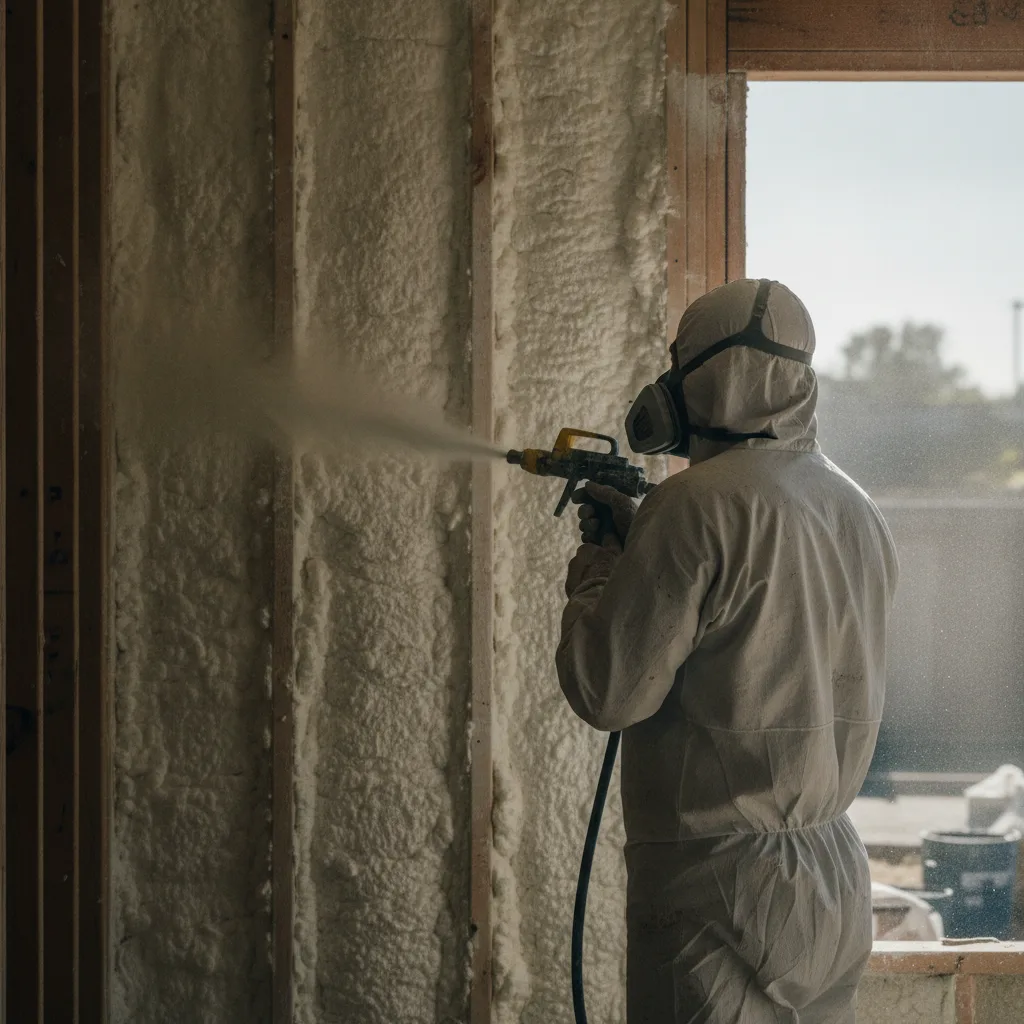
Our team in action — insulation professionals serving Santa Clarita
Spray Foam Attic Insulation Methods and Approaches
Closed-Cell Spray Foam (2-Pound Density)
Closed-cell spray foam is the highest-performing option available, delivering R-6 to R-7 per inch. Its rigid, moisture-impermeable structure makes it ideal for Santa Clarita attics that face both extreme heat loads and seasonal rain intrusion risk. It is the preferred choice for encapsulated attic applications, cathedral ceiling rafter bays, and situations where structural reinforcement of roof sheathing is desired. Particularly recommended for homes in Porter Ranch and Stevenson Ranch where wildfire-related smoke infiltration is a documented concern.
Open-Cell Spray Foam (0.5-Pound Density)
Open-cell spray foam expands dramatically — up to 100 times its liquid volume — making it cost-effective for filling large, irregular attic cavities. At R-3.5 to R-3.8 per inch, it requires greater depth to achieve Title 24 R-38 targets but provides excellent sound attenuation. Best suited for interior attic floor applications and open-rafter cathedral assemblies in Valencia-era homes with complex rooflines.
Flash-and-Batt Hybrid System
A flash coat of 1 to 2 inches of closed-cell foam is applied directly to roof decking or wall cavities, followed by conventional fiberglass or mineral wool batt insulation. This hybrid approach delivers the air sealing and vapor control of spray foam at reduced cost, while achieving total system R-values meeting or exceeding Title 24 requirements. Commonly specified for budget-conscious retrofits in Canyon Country neighborhoods built during the 1970s and 1980s.
Attic Floor Spray Foam Application
Rather than spraying the roof deck, open-cell foam is applied directly across the attic floor joists, insulating the ceiling plane while leaving the attic space vented. This approach aligns with traditional ventilated attic assemblies and is appropriate when existing roof ventilation infrastructure is in good condition and the primary goal is meeting minimum code R-value requirements economically.
Ready for Spray Foam Attic Insulation? Get Your Free Estimate Today.
Next Level Insulation of Santa Clarita serves Santa Clarita and the surrounding area — we’ll be on-site within 24 hours.
📞 Call (661) 582-0187Spray Foam Attic Insulation Cost in Santa Clarita, CA
Understanding the cost of spray foam attic insulation in Santa Clarita requires considering several variables specific to the local market, your home’s construction, and the type of foam selected.
Typical Cost Ranges
- Open-Cell Spray Foam: $1.00 to $1.50 per board foot (approximately $1,200 to $2,500 for a 1,200-square-foot attic at 3.5-inch depth)
- Closed-Cell Spray Foam: $1.75 to $3.00 per board foot (approximately $2,500 to $5,000 for a 1,200-square-foot attic at 2-inch depth)
- Full Encapsulated Attic System (Closed-Cell to R-38): $4,500 to $9,000 for an average Santa Clarita home of 1,800 to 2,400 square feet
- Flash-and-Batt Hybrid System: $1,800 to $3,500 for a typical Santa Clarita ranch-style home
Local Cost Factors
Several Santa Clarita-specific factors influence final pricing. Homes in Canyon Country and Newhall with attic access limited to a single 22-inch x 30-inch hatch may require additional labor for equipment positioning. Older homes with existing contaminated insulation requiring removal — a service we also provide; learn about our insulation removal service — add $0.50 to $1.25 per square foot to project costs. Material costs in the Santa Clarita market are also influenced by Los Angeles County construction demand, which tends to run 8% to 12% above national averages.
Return on Investment
Based on Southern California Gas and SCE rate structures, properly insulated Santa Clarita homes typically see annual HVAC energy savings of $400 to $900, yielding a simple payback period of 5 to 10 years — before accounting for utility rebate programs offered through SCE and SoCalGas for qualifying insulation upgrades.
Learn more about all of our spray foam insulation services
Spray Foam Attic Insulation Service Areas Near Santa Clarita
Newhall and Canyon Country
Among the oldest developed communities in the Santa Clarita Valley, Newhall and Canyon Country contain significant housing stock from the 1950s through 1970s. These homes frequently feature minimal original insulation — often R-11 or less — and deteriorated vapor barriers that require complete removal before spray foam installation. Explore our full attic insulation services
Valencia and Stevenson Ranch
Planned communities developed primarily between the 1970s and 2000s, Valencia and Stevenson Ranch feature larger footprints, complex rooflines with multiple attic zones, and cathedral ceiling sections that respond particularly well to closed-cell spray foam applications. Many homeowners in these areas are upgrading ahead of home sales in the active Santa Clarita real estate market.
Porter Ranch, Granada Hills, and Northridge
These communities sit at the wildland-urban interface and face heightened wildfire smoke infiltration risk. Closed-cell spray foam’s airtight performance is especially valued by homeowners in these neighborhoods following the Saddleridge Fire (October 2019) and other recent fire events. Ask us about crawl space encapsulation for complete home envelope performance
We also serve Canoga Park, Chatsworth, Mission Hills, Sylmar, North Hills, Castaic, Simi Valley, and San Fernando.
Attic Insulation Maintenance Tips for Santa Clarita Homeowners
- Inspect annually before summer: Schedule an attic check each April or May — before Santa Clarita’s extreme heat season begins — to identify any foam delamination, pest intrusion, or new penetrations created by HVAC service technicians.
- Seal attic access hatches: Even after spray foam installation, attic hatches are a common weak point. Ensure hatches are weatherstripped and insulated to R-38 to maintain the thermal envelope.
- Monitor for roof leaks after winter rain events: Santa Clarita’s seasonal rain events, typically December through March, can introduce moisture through roof penetrations. Inspect closed-cell foam surfaces for staining after significant storms.
- Keep attic ventilation clear: In vented attic assemblies, ensure soffit vents are not obstructed by foam overspray or added storage materials.
- Address pest activity immediately: If you observe roof rat or squirrel activity — common in foothill-adjacent areas like Chatsworth and Porter Ranch — address entry points promptly before animals create new penetrations through foam.
- Document your installation: Retain your completion report showing installed R-value for Title 24 compliance documentation and future home sale disclosures.
- Avoid storing materials against foam surfaces: Cardboard boxes stored against spray foam in attic spaces can trap moisture and create pest harborage. Use plastic bins and maintain clearance from foam surfaces.
Why Choose Next Level Insulation of Santa Clarita
Next Level Insulation of Santa Clarita is a locally operated insulation contractor dedicated exclusively to serving homeowners and businesses throughout the Santa Clarita Valley and surrounding communities. Our focus is narrow by design: we specialize in insulation installation, removal, and replacement — meaning every project we take on benefits from deep, specific expertise rather than the generalized approach of a general contractor.
We understand the Santa Clarita market in ways that out-of-area contractors simply cannot replicate. We know the construction peculiarities of 1970s-era Newhall tract homes, the complex roofline geometry common to Valencia master-planned communities, and the wildfire smoke infiltration concerns that drive Porter Ranch homeowners to prioritize airtight assemblies. Our familiarity with local building department requirements, Title 24 climate zone 9 standards, and Santa Clarita-specific utility rebate programs means you get code-compliant work and maximum financial benefit from every project.
Our full range of services — including blow-in insulation, crawl space insulation, insulation removal, and crawl space encapsulation — means we can address your entire home’s thermal envelope in a single relationship with a contractor you trust.
Call us at (661) 582-0187 to speak directly with our team.
Frequently Asked Questions: Spray Foam Attic Insulation in Santa Clarita, CA
How much does spray foam attic insulation cost in Santa Clarita?
Costs vary by foam type and attic size. Open-cell foam typically runs $1,200 to $2,500 for a 1,200-square-foot attic. Closed-cell foam for the same space ranges from $2,500 to $5,000. Full encapsulated attic systems for average Santa Clarita homes of 1,800 to 2,400 square feet generally fall between $4,500 and $9,000. Contact us at (661) 582-0187 for a free site-specific estimate.
How long does spray foam attic insulation installation take in Santa Clarita?
Most residential attic spray foam projects in Santa Clarita are completed in a single day. Preparation and masking takes 30 to 60 minutes, foam application 2 to 6 hours depending on square footage and complexity, and cleanup an additional 30 minutes. Attic spaces can typically be re-entered 24 hours after application for storage purposes, though the foam itself cures within 30 minutes of application.
Is spray foam attic insulation worth it compared to blown-in insulation in Santa Clarita’s climate?
For Santa Clarita’s extreme thermal environment — with summer attic temperatures reaching 140°F and Santa Ana wind events creating significant air infiltration pressure — spray foam’s combined insulation and air sealing performance typically outperforms blown-in cellulose or fiberglass over the life of the installation. Blown-in insulation which we also install is less expensive upfront but does not seal air leakage pathways, which account for 25% to 40% of HVAC energy loss in typical Santa Clarita homes.
Will I need a building permit for spray foam attic insulation in Santa Clarita?
In most cases, residential insulation replacement or upgrade work in Santa Clarita does not require a building permit. However, projects involving structural modifications, changes to ventilation systems, or insulation as part of a larger remodel may require permit coordination with the City of Santa Clarita Building and Safety Division. We advise clients on permit requirements as part of our assessment process.
How does Santa Clarita’s wildfire risk affect which type of spray foam I should choose?
Closed-cell spray foam is the preferred option for homeowners in fire-adjacent communities like Porter Ranch, Chatsworth, and Canyon Country. Its airtight structure significantly reduces smoke infiltration during nearby fire events — a documented issue during the Tick Fire of October 2019 and the Saddleridge Fire of the same month. Closed-cell foam also provides a secondary benefit of strengthening roof decking, which can help resist ember intrusion under extreme fire conditions.
Can spray foam attic insulation be installed over existing fiberglass batts?
In most cases, no. Existing insulation — particularly contaminated, compressed, or moisture-damaged batts common in older Newhall and Canyon Country homes — should be removed before spray foam application to ensure proper adhesion and to eliminate pest contamination, mold risk, and odor issues. We provide complete insulation removal services as part of a full retrofit process.
Does spray foam attic insulation qualify for any rebates or incentives in California?
Yes. Southern California Edison (SCE) and SoCalGas both offer rebate programs for qualifying insulation upgrades under their Energy Efficiency Programs. Federal energy efficiency tax credits under the Inflation Reduction Act (IRA) also apply to qualifying attic insulation improvements, providing up to 30% of project costs as a federal tax credit (subject to annual caps). We can provide documentation to support rebate and tax credit applications.
How do I know if my Santa Clarita home’s existing insulation needs to be replaced versus supplemented?
During our free attic assessment, we measure existing insulation depth, assess R-value, check for moisture damage, and inspect for pest contamination. In general, insulation that is compressed to less than 50% of its original depth, visibly stained or contaminated, or containing pest activity should be fully removed and replaced rather than supplemented. Insulation in good condition but below R-38 depth may be candidates for supplemental application.
Get Your Free Spray Foam Attic Insulation Estimate in Santa Clarita Today
Don’t let another scorching Santa Clarita summer drain your energy budget through an under-insulated attic. Whether you’re in Canyon Country, Valencia, Newhall, Stevenson Ranch, or any surrounding community, Next Level Insulation of Santa Clarita is ready to assess your attic and deliver a no-obligation written estimate — typically within 24 to 48 hours of your call.
Our team understands the unique demands of Santa Clarita’s climate, construction styles, and Title 24 energy code requirements. We’re here to help you achieve maximum comfort and energy efficiency with spray foam attic insulation installed by local experts who know your neighborhood.
Call us now at (661) 582-0187 to schedule your free attic assessment. We serve Santa Clarita and all surrounding communities including Newhall, Canyon Country, Valencia, Stevenson Ranch, Porter Ranch, Granada Hills, Northridge, Simi Valley, and more.